









- Which customer acquisition channels will be affected by cross-border marketing trends in 2026?Sep 06, 2026View details
- Which homogenization risks should be considered in an analysis of the AI-powered website building industry?Aug 30, 2026View details
- How Will AI Marketing Trends 2026 Change Advertising Budget AllocationAug 28, 2026View details
- Is the EV SSL certificate market shrinking or upgrading? How should companies assess certificate procurement?Aug 11, 2026View details
- Why the old AMP SEO 2020 practices no longer work and what has changed in current optimization prioritiesAug 02, 2026View details
- How to Choose Topics for an Industry News Section to Attract More Organic Search TrafficJul 29, 2026View details
Arabic Website Development: Key Considerations from Right-to-Left Design to Localized Content
Arabic Website Development: Key Considerations from Right-to-Left Design to Localized Content
When building an arabische site for the Middle East market, the real difficulty is usually not simply “translating Chinese or English into Arabic.” After many projects go live, the language may appear fine and the pages may open properly, yet inquiries remain scarce, visit durations are short, and advertising landing pages have high bounce rates. The reason is often that the website still follows left-to-right market logic: the visual flow is reversed, form conventions are unsuitable, the content tone is stiff, and even images and ways of presenting commitments can make local visitors feel disconnected.
For projects involving engineering equipment, manufacturing exports, and cross-border services, an Arabic website often also serves to qualify leads, establish supplier credibility, and receive search and advertising traffic. Project managers should not view it merely as a multilingual page, but incorporate it into the overall overseas customer acquisition process: from domain names and page structure to content review, form handling, advertising materials, and subsequent sales follow-up, every link may affect the outcome.
Get Right-to-Left Design Right First, Rather Than Simply Mirroring Pages
Arabic uses a right-to-left reading direction, commonly referred to in the industry as an RTL layout. It is not as simple as flipping an existing page as a whole. Navigation hierarchy, breadcrumbs, carousel switching direction, button icons, form labels, and error messages must all be verified individually on the live page. Pages with more interactions, especially product filter pages, quotation forms, and technical document download sections, are most likely to have inconsistencies between visual direction and operational logic.
For example, the primary call-to-action button should generally be placed where users can easily reach it after naturally scanning the page; arrows with directional meanings, such as “Back” and “Next,” need to be adjusted according to RTL rules. However, brand logos, product models, email addresses, URLs, phone numbers, international units, and some English abbreviations do not necessarily need to be displayed in reverse. If dimensions, power ratings, and model parameters commonly found in engineering projects are incorrectly rearranged, this can appear unprofessional at best and cause communication misunderstandings at worst.
Therefore, project acceptance should not rely solely on design mockups. Testing should be conducted separately on mobile phones, tablets, and desktops: whether menus are easy to use after expanding, whether mixed numbers and Arabic text break incorrectly, whether downloaded filenames are readable, and whether confirmation messages remain where users expect after submitting forms. Mobile should especially not simply copy desktop layouts, because mobile browsing is usually an entry point that must be prioritized in Middle East access scenarios.
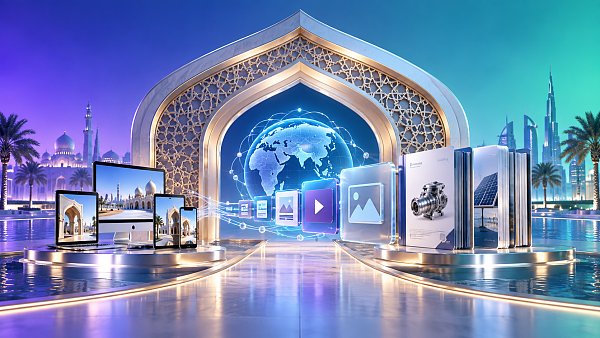
Translation Is Only the Starting Point; Content Must Address Local Buyers’ Questions
Many companies directly machine-translate their completed English websites into Arabic. This can quickly fill the language-version gap in the short term, but it is difficult to build trust in the long run. The challenge of Arabic content lies in the fact that acceptance of wording, polite expressions, and product names varies across countries and industries. Content priorities for industrial procurement users in the Gulf region may differ significantly from those for distributor networks in North Africa.
Localized content that can be used for customer acquisition should answer at least several practical questions: What operating conditions is the product suitable for? How are key specifications confirmed? Who is responsible for delivery, packaging, and after-sales support? Can documentation, samples, or remote technical communication be provided? For B2B equipment websites, vague claims such as “high quality” and “globally leading” are less effective than clearly stating materials, operating environments, available configurations, and the information required for inquiries. When certifications, compliance, temperature and pressure resistance, or applicable standards are involved, do not overstate claims without verifiable documentation; retaining “subject to the actual specification sheet and project requirements” is more prudent.
Localization also includes appropriate visual presentation and expression. People, settings, and festive content should avoid relying on stereotypes; if images of local construction, warehousing, or business settings are used, it is necessary to confirm that clothing, environments, and contexts of use do not present obvious conflicts. English labels in product images, number formats in drawings, video subtitles, and voice-overs should also be included in the review scope. Even if a homepage is beautifully designed, the conversion path will still break later if users download a document package that is entirely in English and lacks explanation.
Multilingual Architecture Determines How Easily Promotion Can Be Managed Later
Before the Arabic version goes live, the technical team needs to determine a strategy for language directories, subdomains, or separate domains. There is no absolutely correct solution; the key lies in the company’s existing website scale, market investment, content maintenance capabilities, and brand management requirements. Regardless of the approach adopted, Arabic pages should have stable, accessible standalone URLs. It is not recommended to rely solely on browser scripts to temporarily replace text, as search engines and external shared links will both struggle to identify the content accurately.
The relationships between language versions within the site must also be handled correctly to prevent confusing redirects among Chinese, English, and Arabic pages. Product detail pages, solution pages, news pages, and form success pages do not need to correspond one-to-one mechanically, but core landing pages must at least provide a complete path: after users enter from search results or advertisements, they can understand the content, find contact information, submit their needs, and receive clear subsequent feedback.
If the team operates Google organic search, advertising, and social media simultaneously, it is best to standardize naming conventions, UTM parameters, form fields, and lead-source labels at the project initiation stage. Otherwise, the advertising team may say it generated traffic while the sales team cannot determine which Arabic page the customer came from, leaving subsequent optimization to guesswork. When companies advance the coordination of artificial intelligence tools and internal data processes, they may also refer to the relevant discussion in An Analysis of the Integrated Development Path of Enterprise Artificial Intelligence and Accounting Informatization: automation does not mean abandoning data standards and manual review, especially when quotations, customer information, and budget attribution are involved.
Include Website Development, Promotion, and Lead Handling in One Project Plan
The most common rework in an arabische site project does not occur during development, but after website delivery, when it is discovered that advertising requires dedicated landing pages, SEO requires supplementary topic content, and sales requires additional fields for project types and procurement cycles. A more practical approach is to involve marketing, sales, and product documentation managers during the page prototyping stage, clarifying which pages are used to build brand trust, which pages are used to capture specific product keywords and inquiries, and which content is suitable only as supporting documentation.
Form fields should not be excessive. Complex engineering projects do require an understanding of application scenarios, required quantities, destinations, and technical requirements, but asking for too much information at the first contact often increases abandonment rates. “Request a Quote,” “Get a Catalog,” and “Schedule a Technical Consultation” can be separated into different entry points, allowing visitors with different levels of interest to leave information at their own pace. The post-submission page, automated emails, and sales response language should also remain consistent with the Arabic website; users should not be returned to stiff English system notifications immediately after submitting a form.
Beijing Yiyingbao Information Technology Co., Ltd. has long served foreign trade companies, manufacturing factories, cross-border e-commerce sellers, and brand globalization projects. Its AI-driven website development, SEO, advertising, and social media capabilities are suitable for coordinating multilingual corporate websites, advertising landing pages, and overseas customer acquisition data. For project managers, what deserves greater attention is not how long the feature list is, but whether the system can support continuous updates to Arabic pages, rapid iteration of landing pages across different channels, and the return of leads to a clear follow-up process.
Set Aside a Round of Checks from a Local User’s Perspective Before Launch
Before formal campaign deployment, it is recommended to conduct a walkthrough using a real user journey: enter a product page from search results, switch languages, view specifications, download materials, and then submit an inquiry. During the review, pay particular attention to whether Arabic fonts are clear, mixed-language content is misaligned, required-field prompts are easy to understand, and telephone and instant communication entry points function properly. If the site needs to cover multiple Arabic-speaking countries, it is also necessary to confirm that currencies, delivery descriptions, contact details, and privacy notices align with the actual scope of business.
An Arabic website is not a translation project that ends once it goes live. The truly useful approach is to continuously supplement content that users repeatedly ask about based on search terms, advertising inquiries, sales feedback, and page behavior. Establishing the direction, language, and trust details firmly before expanding the promotion budget is usually more reliable than rushing to increase the number of pages.
Related Articles

Related Products
 Yiyingbao SaaS Intelligent Website Building and Marketing SystemYiyingbao SaaS Intelligent Website Building and Marketing System, AI-powered no-code website building, rapid creation of multilingual B2B international websites in 10 minutes, global server acceleration, AI-powered SEO optimization, helping businesses connect efficiently with global markets. The perfect integration of technology and operation makes building an international trade website remarkably simple
 AI+SEM Intelligent Advertising Marketing SystemAI+SEM drives intelligent ad creation, empowering full-funnel precision advertising marketing. The system automatically generates weekly/monthly reports, AI recommends keywords and target countries, monitors core metrics in real-time with intelligent alerts, and enables one-click high-conversion ad solutions to help quickly acquire customers and improve ROI.
 AI+SEO Dual-Engine System Optimization ServicesYiyingbao’s AI+SEO dual-engine optimization system helps foreign trade enterprises acquire high-quality organic traffic through AI-powered keyword research, content generation, and comprehensive technical optimization, significantly improving search rankings and conversion rates.
 AI+SNS Social Media Marketing SystemYingbao AI+SNS Social Media Marketing System - Precision social capture for the social media era. Supports one-click content synchronization across major platforms like Facebook and LinkedIn. AI intelligently rewrites posts for enhanced relevance. 24/7 AI customer service and user profiling analysis empower businesses to efficiently expand into global markets.
 AI+SEO营销解决方案易营宝AI+SEO营销解决方案,通过AI批量写作、智能生成TDK、精准关键词扩词等功能,全面优化网站SEO效果,提升流量与转化率。助力企业构建高效智能网站新生态。
 AI+SEM Advertising Marketing SolutionsAI+SEM Advertising Marketing Solution leverages AI technology to deeply empower SEM ad campaigns. It automatically generates weekly/monthly reports using AI, presenting account data across multiple dimensions for comprehensive insights into campaign performance and trends. The system precisely recommends keywords and target countries, intelligently generates high-conversion ad copy, and enables one-click activation of efficient campaign plans to help businesses rapidly acquire customers. Simultaneously, it monitors core metrics in real time, intelligently identifies abnormal fluctuations, and issues timely alerts to ensure stable, high-return advertising results.
 Domain Name ServicesEasyWin provides professional domain name services, including intelligent queries, one-stop registration, brand protection, and full lifecycle management, helping businesses build a digital brand image.
 EasyOperate B2C Cross-Border E-Commerce Platform & Independent WebsiteEasyStore B2C Cross-border E-commerce Independent Store is an intelligent website building and cross-border e-commerce integrated solution independently developed by EasyStore Information Technology (Beijing) Co., Ltd. The system is specially designed for small and medium-sized as well as large export enterprises, integrating 'website building, operation, marketing, advertising, and conversion' into one, helping enterprises quickly establish cross-border e-commerce independent stores to achieve brand globalization and global sales growth.
The platform supports multiple languages, multiple currencies, and multi-channel marketing, with built-in AI intelligent translation and SEO optimization systems, suitable for mainstream markets such as Southeast Asia, Europe and America, Latin America, and the Middle East, assisting Chinese manufacturing enterprises in efficiently deploying international e-commerce strategies. SSL证书易营宝提供专业SSL安全证书服务,包括单域名和泛域名证书,确保网站数据传输加密、身份验证和完整性保护,助力企业建立安全可信的在线业务环境。









