









- Fujian Announces the First Batch of Provincial-Level Cross-Border E-Commerce Industrial Parks and Key Brands for CultivationNov 14, 2026View details
- Amazon Global Store Announces the Launch of the 2026 Black Friday Global Shopping SeasonNov 14, 2026View details
- CCTV.com Examines APEC’s Role in China’s Foreign TradeNov 12, 2026View details
- China’s Tariff Commission of the State Council Adjusts Additional Tariffs on U.S. Goods: 24% Tariff Suspended for Two MonthsNov 10, 2026View details
- APEC Shenzhen Spotlight: Cross-Border E-Commerce Orders Promote Asia-Pacific Trade and Economic CooperationNov 08, 2026View details
- China-Europe Railway Express and CIIE Hold Business Matchmaking Event, Focusing on Cross-Border E-commerce B2B ExportsNov 07, 2026View details
Why Might a Page Not Be Indexed Even When hreflang Is Configured Correctly?
After a multilingual website goes live, the hreflang tags may be in place, yet pages in different languages still fail to appear in Google search results. This is a common issue for website operators. Before repeatedly changing the tags, keep in mind that hreflang indicates the language and regional relationship between pages; it does not guarantee that pages will be crawled or indexed. To improve hreflang indexing, expand your investigation to crawling, canonicalization, page content, and internal links.
First, confirm: Is the page really not indexed, or is it simply not showing up?
If a page in the target language does not appear when you search for a particular keyword, that does not necessarily mean it is not indexed. It may simply rank lower, or the search engine may consider another version more suitable for the current user. Rather than repeatedly searching for keywords, use the URL Inspection tool in Google Search Console and enter the full URL that is not showing. Check its indexing status, last crawl time, and the canonical URL selected by Google.
If the tool reports that the URL is on Google, but the search results are unsatisfactory, investigate keyword relevance, the user’s location, and page quality. If it reports that the page is not indexed, address the specific reason provided. Note that a live test can check whether the page is currently accessible, but passing the test does not mean the page has been indexed.

Where might the process be getting stuck—from crawling to indexing?
1. The page cannot be accessed properly
Even perfectly implemented hreflang tags will not help if search engines cannot retrieve the page content. Opening the target URL in a browser is only the first step. Also check that the server returns the expected 200 status code and that there are no login requirements, CAPTCHAs, regional restrictions, or frequent server errors. If the site relies on JavaScript to load content, use the URL Inspection tool to view the rendered page and confirm that its main text and links can be read.
Also check robots.txt, the page’s noindex directive, and the HTTP response headers. In particular, note that blocking crawling in robots.txt is not a reliable way to prevent indexing. If a page has a noindex directive, blocking its crawl may prevent search engines from seeing that directive. To have a page indexed, remove any relevant restrictions and ensure it can be crawled.
2. The canonical URL points signals to another version
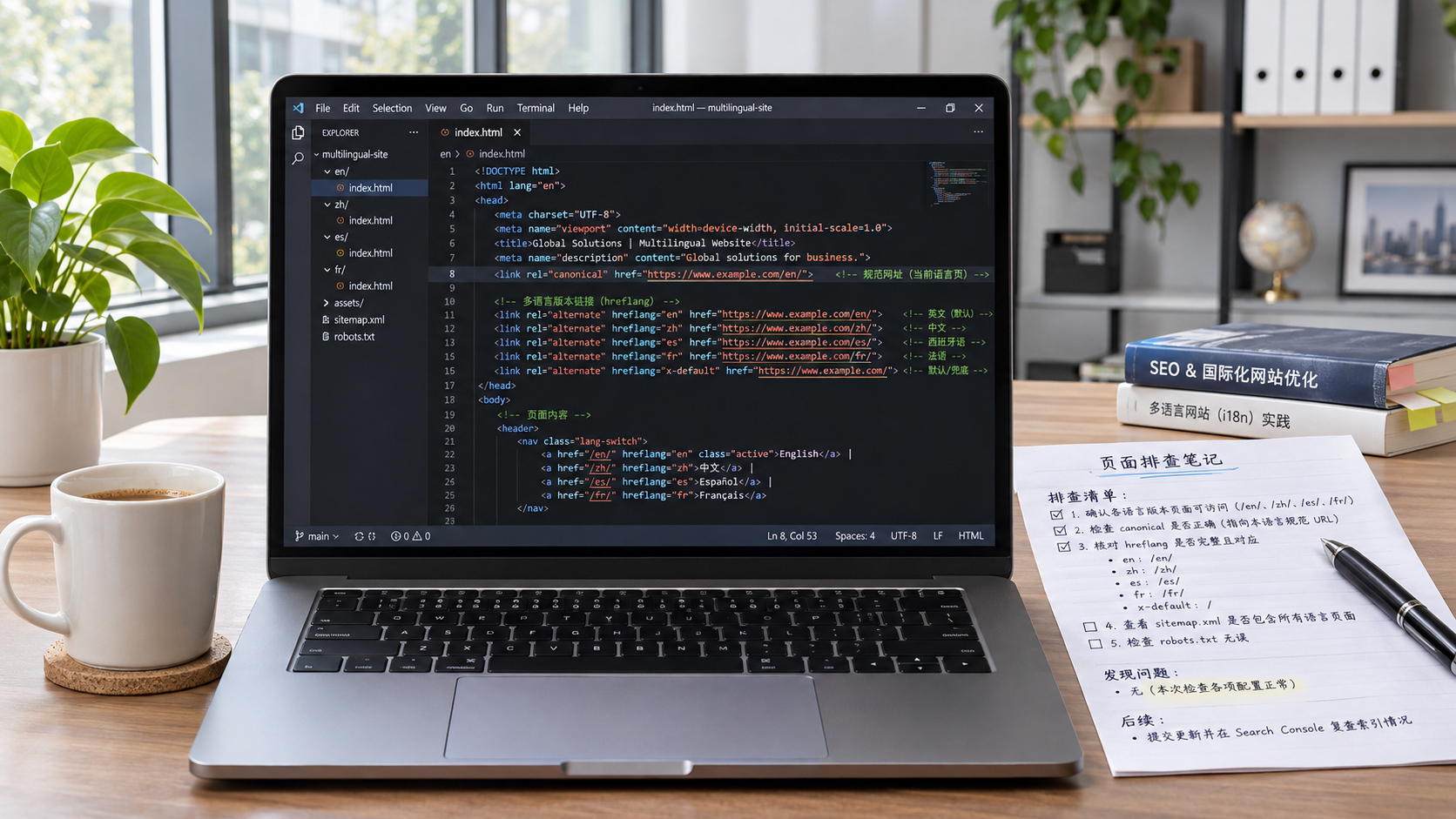
Suppose the canonical URL on a French page points to the English homepage. Search engines may treat the French page as a duplicate rather than as a distinct language version. When checking this, review both the canonical URL declared on the page and the “Google-selected canonical” in Search Console. If they do not match, revisit content similarity, internal links, redirects, and the sitemap to find conflicting signals.
Pages in different languages should generally each declare a canonical URL corresponding to themselves. If there are highly similar versions in the same language for different regions, consider the actual content and target markets when deciding how to handle them. Do not blindly remove all canonical tags just to get a particular page indexed.
3. Correct tag syntax does not mean the version relationships are complete
Even if an individual page’s hreflang syntax passes validation, check that all pages in the group reference one another, including a reference to themselves; that the language and region codes are valid; and that the target URLs are accessible and do not redirect to unrelated pages. For example, use en-GB for British English rather than abbreviating the country name arbitrarily. x-default can designate a default page for users who do not match a specific language or region, but it is not an indexing switch.
hreflang information can be provided through HTML tags, HTTP response headers, or an XML sitemap. Whichever method you use, the key is to keep the references consistent. If you use multiple methods at once, take extra care to ensure that they do not point the same language version to different URLs.
4. The page has been discovered but lacks content worth indexing
“Discovered – currently not indexed” and “Crawled – currently not indexed” do not necessarily indicate technical problems. For the former, investigate crawl resources, server responses, and site structure. For the latter, also review whether the content is duplicated, thin, or lacking practical value. Do not assume the cause based on the status label alone.
A common scenario is that only the navigation has been translated, while product descriptions, specifications, and purchase information are still missing; regional pages differ only in the currency symbol; or machine translation makes technical specifications and industry terminology difficult to understand. For international businesses, adding information that local users care about—such as use cases, units of measurement, delivery options, and inquiry details—is usually more meaningful than simply copying pages. Content should be accurate and relevant to the market it serves; there is no need to invent information just to make pages look different.
A troubleshooting sequence for website operators
When dealing with a large number of unindexed pages, start with one representative URL and work through the following questions rather than changing the entire site at once:
- Can it be crawled? Check the status code, robots.txt, noindex directives, redirects, and rendered page.
- Which version is canonical? Compare the declared canonical URL with the canonical URL selected by Google, and look for conflicting signals.
- Are the language versions correctly linked? Check each hreflang URL and code, as well as the reciprocal references, and make sure the target pages are accessible.
- Is the page easy to discover? Add crawlable internal links from the navigation, category pages, or relevant content pages in the corresponding language, and submit the canonical URL in the sitemap.
- Does the content meet local needs? Review translation quality, the completeness of key information, and whether the page truly corresponds to the target language and region.
After making fixes, you can request indexing for important pages in Search Console and record the dates of changes and the results of your checks. A request only prompts search engines to process the page again; it does not guarantee immediate crawling or indexing. For large groups of pages, it is better to fix shared issues, improve internal links and sitemaps, and monitor the results over time.
After launching a multilingual website, do not focus your checks on tags alone
For teams using a website builder to manage multiple language versions, canonical tags, hreflang tags, navigation links, and sitemaps are often generated in bulk by templates. Before making changes, confirm where the rules are controlled, then test them on a small number of pages to reduce the risk of one change affecting multiple markets. Recheck these signals when adding a language, migrating a domain, or changing URLs.
If your team is responsible for both multilingual website development and international customer acquisition, technical checks can be built into your day-to-day operating process. Yiyingbao offers multilingual website development and SEO optimization services. When choosing how to implement them, pay particular attention to whether page content, indexing directives, and language-version relationships are easy to check and maintain. The key to hreflang indexing optimization is not making tags look more complex, but ensuring that search engines can access, understand, and distinguish every page that offers real value.
Related Articles
 Why Might a Page Not Be Indexed Even When hreflang Is Configured Correctly?
 How Should a B2C Multilingual Website Set Currencies for Different Regions?
 Can a Korean-language website reach Japanese customers when expanding into the Japanese and South Korean markets?

Related Products
 Yiyingbao SaaS Intelligent Website Building and Marketing SystemYiyingbao SaaS Intelligent Website Building and Marketing System, AI-powered no-code website building, rapid creation of multilingual B2B international websites in 10 minutes, global server acceleration, AI-powered SEO optimization, helping businesses connect efficiently with global markets. The perfect integration of technology and operation makes building an international trade website remarkably simple
 AI+SEM Intelligent Advertising Marketing SystemAI+SEM drives intelligent ad creation, empowering full-funnel precision advertising marketing. The system automatically generates weekly/monthly reports, AI recommends keywords and target countries, monitors core metrics in real-time with intelligent alerts, and enables one-click high-conversion ad solutions to help quickly acquire customers and improve ROI.
 AI+SEO Dual-Engine System Optimization ServicesYiyingbao’s AI+SEO dual-engine optimization system helps foreign trade enterprises acquire high-quality organic traffic through AI-powered keyword research, content generation, and comprehensive technical optimization, significantly improving search rankings and conversion rates.
 AI+SNS Social Media Marketing SystemYingbao AI+SNS Social Media Marketing System - Precision social capture for the social media era. Supports one-click content synchronization across major platforms like Facebook and LinkedIn. AI intelligently rewrites posts for enhanced relevance. 24/7 AI customer service and user profiling analysis empower businesses to efficiently expand into global markets.
 AI+SEO营销解决方案易营宝AI+SEO营销解决方案,通过AI批量写作、智能生成TDK、精准关键词扩词等功能,全面优化网站SEO效果,提升流量与转化率。助力企业构建高效智能网站新生态。
 AI+SEM Advertising Marketing SolutionsAI+SEM Advertising Marketing Solution leverages AI technology to deeply empower SEM ad campaigns. It automatically generates weekly/monthly reports using AI, presenting account data across multiple dimensions for comprehensive insights into campaign performance and trends. The system precisely recommends keywords and target countries, intelligently generates high-conversion ad copy, and enables one-click activation of efficient campaign plans to help businesses rapidly acquire customers. Simultaneously, it monitors core metrics in real time, intelligently identifies abnormal fluctuations, and issues timely alerts to ensure stable, high-return advertising results.
 Domain Name ServicesEasyWin provides professional domain name services, including intelligent queries, one-stop registration, brand protection, and full lifecycle management, helping businesses build a digital brand image.
 EasyOperate B2C Cross-Border E-Commerce Platform & Independent WebsiteEasyStore B2C Cross-border E-commerce Independent Store is an intelligent website building and cross-border e-commerce integrated solution independently developed by EasyStore Information Technology (Beijing) Co., Ltd. The system is specially designed for small and medium-sized as well as large export enterprises, integrating 'website building, operation, marketing, advertising, and conversion' into one, helping enterprises quickly establish cross-border e-commerce independent stores to achieve brand globalization and global sales growth.
The platform supports multiple languages, multiple currencies, and multi-channel marketing, with built-in AI intelligent translation and SEO optimization systems, suitable for mainstream markets such as Southeast Asia, Europe and America, Latin America, and the Middle East, assisting Chinese manufacturing enterprises in efficiently deploying international e-commerce strategies. SSL证书易营宝提供专业SSL安全证书服务,包括单域名和泛域名证书,确保网站数据传输加密、身份验证和完整性保护,助力企业建立安全可信的在线业务环境。









