









- Can the average annual growth rate reflect real opportunities in overseas markets?Oct 07, 2026View details
- Which customer acquisition channels will be affected by cross-border marketing trends in 2026?Sep 06, 2026View details
- Which homogenization risks should be considered in an analysis of the AI-powered website building industry?Aug 30, 2026View details
- How Will AI Marketing Trends 2026 Change Advertising Budget AllocationAug 28, 2026View details
- Is the EV SSL certificate market shrinking or upgrading? How should companies assess certificate procurement?Aug 11, 2026View details
- Why the old AMP SEO 2020 practices no longer work and what has changed in current optimization prioritiesAug 02, 2026View details
How can a Beijing Arabic website design company evaluate its localization capabilities?
When assessing the localization capabilities of an Arabic website design company in Beijing, acceptance should not be based solely on whether “the pages have been translated into Arabic.” What truly affects post-launch performance is whether the content aligns with reading habits in the target region, whether right-to-left interfaces display consistently across all devices, and whether inquiries, forms, search, and advertising landing pages form a consistent conversion path. If a provider can only present visual mockups but cannot explain how these elements will be implemented, subsequent rework is often concentrated during launch testing and marketing campaign execution.
First, assess whether the language fits the business context
Arabic localization cannot be completed simply by replacing one writing system with another. Localized content needs to distinguish between Modern Standard Arabic and expressions commonly used in specific markets: brand websites serving multiple Arab countries generally require relatively neutral, formal written language; if a page serves a single country, promotional campaign, or social media traffic acquisition, the tone, forms of address, and calls to action may need to better align with local habits.
During evaluation, you may ask the provider to supply short, authentic sample translations for the homepage hero section, product specifications, inquiry form, and after-sales instructions. The focus is not on checking the Chinese source sentence by sentence, but on verifying whether the Arabic preserves the original business meaning and whether formats for units, dates, addresses, currencies, and telephone numbers are adapted to the target market. This is particularly important for industrial product and B2B pages: models, materials, dimensional ranges, and delivery terms must not be translated into generic promotional language. Omitting qualifying terms such as “optional,” “customized according to drawings,” or “reference value” can easily lead to misunderstandings during inquiry communications.
You should also ask who reviews the translations and how revisions are fed back into the website content repository. Relying solely on machine-generated first drafts is not necessarily unacceptable, but a terminology glossary, human review, and version confirmation mechanism must be in place. Otherwise, the same product may use different translations across category pages, detail pages, and downloadable materials, which weakens the professional impression and makes it more difficult for on-site search and search engines to understand the page topic.
Right-to-left design requires verification of “systematic reversal”
Arabic websites use a right-to-left reading direction. Problems often arise not on static pages, but in component interactions. Qualified design should not simply move the navigation bar to the right; it must also address layout logic, icon direction, form order, pop-up positions, carousel controls, and mobile accordion menus.
- Content hierarchy: Headings, body text, numbered lists, and product selling points should be organized according to the right-to-left reading rhythm, while URLs, email addresses, model numbers, English brand terms, and technical parameters often need to remain displayed left to right. When these two text types are mixed, punctuation displacement, reversed brackets, or split model numbers must be prevented.
- Functional components: For fields such as name, country, telephone number, and requirement description in inquiry forms, the alignment of labels and the placement of required-field and error messages need to be checked. Third-party components such as CAPTCHA, file upload, and date pickers are especially likely to retain left-to-right logic.
- Visual assets: Images containing people, gestures, arrows, flowcharts, and product operating steps do not necessarily all need to be mirrored. If mirroring changes device buttons, traffic direction, text labels, or operating sequences, it may instead cause confusion and should be assessed image by image.
- Responsive pages: Correct desktop display does not mean the mobile version is usable. Arabic word forms can be long, making mobile buttons, filter options, and product specification tables more likely to wrap or overflow. Acceptance should not rely only on screenshots from common screen sizes.
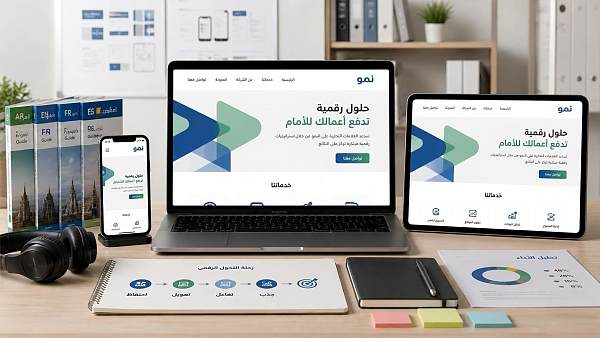
During demonstrations, the provider should be asked to switch directly to a real testing environment rather than merely show polished design mockups. At a minimum, review the homepage, category page, product detail page, search page, and submission confirmation page, and complete one form submission on a mobile device. This can reveal whether the language direction applies only to the hero section and whether cache, navigation state, and link paths behave abnormally after switching languages.
Multilingual architecture determines future maintenance costs
Arabic, English, and Chinese pages on the same website need to have clear content correspondences. When evaluating a solution, confirm whether language versions are deployed as separate pages, separate directories, or region-specific sites, and check whether switching languages takes users to the corresponding version of the same content rather than returning them to the homepage or mixing in pages in another language.
Page URLs, titles, descriptions, structured data, and on-site breadcrumbs should also be handled in sync with each language version. If Arabic pages retain Chinese URLs, English titles, or incorrect language tags, search engines may struggle to determine the language and region targeted by the pages. Rather than simply asking whether “SEO is supported,” review a set of configured pages: the language attributes in the page source code, bidirectional language associations, canonical links, and whether pagination and filtered pages generate a large number of duplicate URLs.
Content management should likewise be assessed in detail. During bulk product updates, can editors identify which Arabic pages have not yet been translated? After source-language specifications are changed, do translations receive a pending-update status? Can editors preview right-to-left layouts without discovering formatting issues only after publication? These capabilities directly affect long-term maintenance, especially for websites with numerous product models and frequently updated materials.
Marketing pages should provide a coherent local visitor journey
Localization capability is also reflected in whether the actions visitors take after reaching a page feel natural. When search ads and social media ads use Arabic materials, the landing page promise, product name, and call-to-action buttons should match the ad copy. If an ad offers a catalog but the landing page only provides a generic “Contact Us,” it increases the effort required to understand the offer; if an ad targets a particular region but the form requires irrelevant province and city fields, it also reduces willingness to submit.
For inquiry-driven websites, telephone fields should support international dialing codes and common local writing formats, while automatic replies after submission, email subject lines, and sales lead notifications should also include Arabic content. If users need to be redirected to an instant messaging tool, first confirm how the link opens in browsers and mobile network environments commonly used locally, rather than validating it only once on an office network.
Finally, the acceptance scope should be defined at the page and functional level rather than broadly stated as “completion of the Arabic version.” Specify which pages require translation review, which text and images need to be rearranged, which plugins must support right-to-left display, and how new content will be handled after launch. Such an agreement distinguishes Beijing Arabic website design companies with localization delivery capabilities from service providers that can only perform language replacement.
Related Articles
Related Products
 Yiyingbao SaaS Intelligent Website Building and Marketing SystemYiyingbao SaaS Intelligent Website Building and Marketing System, AI-powered no-code website building, rapid creation of multilingual B2B international websites in 10 minutes, global server acceleration, AI-powered SEO optimization, helping businesses connect efficiently with global markets. The perfect integration of technology and operation makes building an international trade website remarkably simple
 AI+SEM Intelligent Advertising Marketing SystemAI+SEM drives intelligent ad creation, empowering full-funnel precision advertising marketing. The system automatically generates weekly/monthly reports, AI recommends keywords and target countries, monitors core metrics in real-time with intelligent alerts, and enables one-click high-conversion ad solutions to help quickly acquire customers and improve ROI.
 AI+SEO Dual-Engine System Optimization ServicesYiyingbao’s AI+SEO dual-engine optimization system helps foreign trade enterprises acquire high-quality organic traffic through AI-powered keyword research, content generation, and comprehensive technical optimization, significantly improving search rankings and conversion rates.
 AI+SNS Social Media Marketing SystemYingbao AI+SNS Social Media Marketing System - Precision social capture for the social media era. Supports one-click content synchronization across major platforms like Facebook and LinkedIn. AI intelligently rewrites posts for enhanced relevance. 24/7 AI customer service and user profiling analysis empower businesses to efficiently expand into global markets.
 AI+SEO营销解决方案易营宝AI+SEO营销解决方案,通过AI批量写作、智能生成TDK、精准关键词扩词等功能,全面优化网站SEO效果,提升流量与转化率。助力企业构建高效智能网站新生态。
 AI+SEM Advertising Marketing SolutionsAI+SEM Advertising Marketing Solution leverages AI technology to deeply empower SEM ad campaigns. It automatically generates weekly/monthly reports using AI, presenting account data across multiple dimensions for comprehensive insights into campaign performance and trends. The system precisely recommends keywords and target countries, intelligently generates high-conversion ad copy, and enables one-click activation of efficient campaign plans to help businesses rapidly acquire customers. Simultaneously, it monitors core metrics in real time, intelligently identifies abnormal fluctuations, and issues timely alerts to ensure stable, high-return advertising results.
 Domain Name ServicesEasyWin provides professional domain name services, including intelligent queries, one-stop registration, brand protection, and full lifecycle management, helping businesses build a digital brand image.
 EasyOperate B2C Cross-Border E-Commerce Platform & Independent WebsiteEasyStore B2C Cross-border E-commerce Independent Store is an intelligent website building and cross-border e-commerce integrated solution independently developed by EasyStore Information Technology (Beijing) Co., Ltd. The system is specially designed for small and medium-sized as well as large export enterprises, integrating 'website building, operation, marketing, advertising, and conversion' into one, helping enterprises quickly establish cross-border e-commerce independent stores to achieve brand globalization and global sales growth.
The platform supports multiple languages, multiple currencies, and multi-channel marketing, with built-in AI intelligent translation and SEO optimization systems, suitable for mainstream markets such as Southeast Asia, Europe and America, Latin America, and the Middle East, assisting Chinese manufacturing enterprises in efficiently deploying international e-commerce strategies. SSL证书易营宝提供专业SSL安全证书服务,包括单域名和泛域名证书,确保网站数据传输加密、身份验证和完整性保护,助力企业建立安全可信的在线业务环境。









