









- Can the average annual growth rate reflect real opportunities in overseas markets?Oct 07, 2026View details
- Which customer acquisition channels will be affected by cross-border marketing trends in 2026?Sep 06, 2026View details
- Which homogenization risks should be considered in an analysis of the AI-powered website building industry?Aug 30, 2026View details
- How Will AI Marketing Trends 2026 Change Advertising Budget AllocationAug 28, 2026View details
- Is the EV SSL certificate market shrinking or upgrading? How should companies assess certificate procurement?Aug 11, 2026View details
- Why the old AMP SEO 2020 practices no longer work and what has changed in current optimization prioritiesAug 02, 2026View details
How to Develop an Overseas Market Customer Acquisition Strategy: The Complete Path from Target Customer Positioning to Lead Conversion
How to Develop an Overseas Market Customer Acquisition Plan: A Complete Path from Target Customer Positioning to Lead Conversion
Developing an overseas market customer acquisition plan cannot rely solely on increasing advertising budgets. Companies should establish a closed loop from target customer positioning and channel deployment to lead conversion, continuously acquiring high-quality overseas business opportunities.
First, Understand That Businesses Need Not Traffic, but Overseas Customers Who Are Ready to Buy
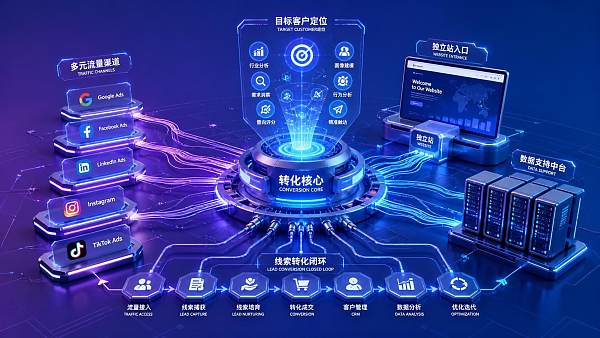
Business decision-makers searching for overseas market customer acquisition solutions are usually not looking to learn about a single promotional tool. Instead, they want to address three core questions: where overseas customers come from, whether investment can be controlled, and whether leads can be converted into sales.
A truly effective solution should start with business growth objectives, rather than website development, SEO, advertising, or social media accounts. Channels are merely means; customer quality, sales efficiency, and long-term customer acquisition costs are the outcomes that matter.
If a company lacks clarity on priority markets, target customer roles, product competitive advantages, and sales follow-up capabilities, even a large volume of short-term traffic can easily result in invalid inquiries, loss of contact after quotations, and continuously rising advertising costs.
Therefore, an overseas market customer acquisition plan should be regarded as an operating system: the front end attracts target buyers, the middle stage qualifies and nurtures leads, and the back end drives sales conversion while continuously feeding transaction results back into marketing decisions.
Step One: Reduce Ineffective Investment Through Market and Customer Positioning
More overseas markets are not necessarily better. For manufacturing companies or brands expanding overseas with limited resources, it is advisable to first select one or two priority regions and validate demand strength, the competitive landscape, delivery capabilities, and payment collection risks.
Market selection can begin with four indicators: local search demand for the product, import volume in the target country, the websites and advertising activities of major competitors, and the company’s own fit in terms of language, logistics, certifications, and after-sales service.
Customer positioning should not remain at broad labels such as “distributors” or “purchasers.” Companies need to further define the customer’s industry, company size, purchasing frequency, decision-making chain, pain points, and commonly used search terms.
For example, B2B industrial product companies may deal with purchasing managers, technical leaders, and business owners. These three groups focus on different information, so website pages, ad copy, and sales materials should each address issues related to cost, specifications, production capacity, and risk.
When setting customer segment criteria, companies can create an ideal customer profile to define the country, application scenario, order size, certification requirements, and decision cycle of high-value customers, while filtering out unqualified inquiries in advance.
Step Two: Build a Website Presence That Can Be Found, Understood, and Trusted
An independent website is infrastructure for overseas customer acquisition, not simply a corporate brochure. It needs to serve multiple functions, including search indexing, ad landing, product explanation, trust building, inquiry acquisition, and data tracking.
For B2B companies, website content should be organized around product categories, application scenarios, industry solutions, and target markets, rather than simply copying a Chinese corporate website. Once buyers enter the page, they should quickly understand what problems the company can solve.
Key pages should fully present product specifications, application cases, quality control, certifications, delivery capabilities, frequently asked questions, and clear inquiry entry points. The more closely the information aligns with procurement decision-making needs, the higher the quality of leads is typically.
Multilingual development should not rely solely on direct machine translation. Different regions have varying concerns regarding units of measurement, technical terminology, payment methods, and trust-related information, and localized expression directly affects time on page and willingness to submit inquiries.
When evaluating website development investment, managers should focus on whether pages can be continuously expanded, whether they support SEO and advertising landing pages, and whether they can integrate forms and customer management systems, rather than only comparing visual design or one-time production quotations.
Step Three: Combine SEO, Advertising, and Social Media Channels by Procurement Stage
A complete overseas market customer acquisition plan should not place the entire budget on a single channel. Different channels cover different procurement stages, and only a well-balanced combination can deliver both short-term leads and long-term organic growth.
Google SEO is suitable for capturing search traffic with clear demand, particularly for product keywords, solution keywords, and industry question keywords. Its value lies in continuously accumulating visibility and reducing future reliance on paid traffic.
Google Ads is suitable for new product testing, priority market validation, and securing keywords with high commercial intent. Before launching campaigns, companies should define the cost per qualified lead, target conversion rate, and acceptable customer acquisition cost to avoid focusing only on click volume.
Facebook, LinkedIn, YouTube, and short-video platforms are better suited for building awareness, reaching specific industry audiences, and conducting remarketing. For products with longer decision cycles, social media content can continuously strengthen professionalism and brand trust.
As AI search entry points grow, companies should also consider whether their content has a clear structure, reliable evidence, and sufficient coverage of professional topics. The focus of GEO generative engine optimization is to increase the likelihood that brands and solutions will be understood, cited, and recommended by AI.
Step Four: Incorporate Inquiry Management into the Conversion Process Rather Than Leaving It to Sales Improvisation
For many companies, the problem is not at the customer acquisition stage, but rather the lack of unified standards after leads enter the pipeline. Marketing departments pursue inquiry volume, while sales departments consider customer quality low, ultimately making it impossible to determine which channels truly generate orders.
It is recommended to classify leads into three categories: high-intent, nurture-ready, and low-fit. High-intent customers should receive a response within a specified time frame; nurture-ready customers should enter email, content, or remarketing workflows; and low-fit customers should receive reduced manual input.
Form design should help companies collect information in advance, including country, required products, purchase quantity, application scenarios, and contact details. For highly customized products, this information provides more value for assessment than an email address alone.
Sales follow-up needs to work in coordination with marketing content. The first response should not contain only a quotation; it should also provide case studies, specification comparisons, certification documents, or delivery explanations based on the customer’s scenario, reducing uncertainty in overseas buyers’ decisions.
Cross-departmental management can draw on approaches to risk identification and process documentation, such as the division of responsibilities and process controls emphasized in Research on Internal Audit and Risk Management Countermeasures for Real Estate Development Enterprises, to avoid omissions, delays, and data distortion during lead handover.
Step Five: Use Data to Determine Whether the Plan Is Profitable, Rather Than Looking Only at Impressions and Inquiries
Decision-makers should establish funnel metrics from visits to transactions, including organic traffic, ad clicks, form conversion rate, qualified lead rate, sales follow-up rate, quotation rate, closing rate, and customer acquisition cost per customer.
Among these, the most important metrics are qualified lead rate and contribution to closed deals. A channel that generates one hundred inquiries is not necessarily better than one that generates ten highly matched customers; marketing evaluation must be connected to actual business outcomes.
It is recommended to review the performance of countries, products, keywords, ad campaigns, and content pages on a monthly basis to identify high-cost, low-conversion stages. Budget adjustments should be data-driven, rather than frequently changing channels or strategies due to short-term fluctuations.
For companies entering overseas markets for the first time, demand can first be validated through small-budget advertising and core landing pages, followed by the gradual expansion of SEO content, social media operations, and multilingual websites, reducing the cost of trial and error before large-scale investment.
Conclusion: Turn Overseas Customer Acquisition into a Replicable Growth Mechanism
At its core, a high-quality overseas market customer acquisition plan is a complete closed loop with clear positioning, a conversion-ready website, clearly defined channel roles, sales follow-up capability, and data that can be reviewed. It is not simply the addition of several marketing services.
Companies should first answer who their target customers are, why customers should choose them, which paths will reach them, and who will drive transactions forward, before selecting suitable website development, SEO, advertising, and social media tools. Only then can the resulting customer acquisition system continuously build overseas growth capabilities.
Related Articles


Related Products
 Yiyingbao SaaS Intelligent Website Building and Marketing SystemYiyingbao SaaS Intelligent Website Building and Marketing System, AI-powered no-code website building, rapid creation of multilingual B2B international websites in 10 minutes, global server acceleration, AI-powered SEO optimization, helping businesses connect efficiently with global markets. The perfect integration of technology and operation makes building an international trade website remarkably simple
 AI+SEM Intelligent Advertising Marketing SystemAI+SEM drives intelligent ad creation, empowering full-funnel precision advertising marketing. The system automatically generates weekly/monthly reports, AI recommends keywords and target countries, monitors core metrics in real-time with intelligent alerts, and enables one-click high-conversion ad solutions to help quickly acquire customers and improve ROI.
 AI+SEO Dual-Engine System Optimization ServicesYiyingbao’s AI+SEO dual-engine optimization system helps foreign trade enterprises acquire high-quality organic traffic through AI-powered keyword research, content generation, and comprehensive technical optimization, significantly improving search rankings and conversion rates.
 AI+SNS Social Media Marketing SystemYingbao AI+SNS Social Media Marketing System - Precision social capture for the social media era. Supports one-click content synchronization across major platforms like Facebook and LinkedIn. AI intelligently rewrites posts for enhanced relevance. 24/7 AI customer service and user profiling analysis empower businesses to efficiently expand into global markets.
 AI+SEO营销解决方案易营宝AI+SEO营销解决方案,通过AI批量写作、智能生成TDK、精准关键词扩词等功能,全面优化网站SEO效果,提升流量与转化率。助力企业构建高效智能网站新生态。
 AI+SEM Advertising Marketing SolutionsAI+SEM Advertising Marketing Solution leverages AI technology to deeply empower SEM ad campaigns. It automatically generates weekly/monthly reports using AI, presenting account data across multiple dimensions for comprehensive insights into campaign performance and trends. The system precisely recommends keywords and target countries, intelligently generates high-conversion ad copy, and enables one-click activation of efficient campaign plans to help businesses rapidly acquire customers. Simultaneously, it monitors core metrics in real time, intelligently identifies abnormal fluctuations, and issues timely alerts to ensure stable, high-return advertising results.
 Domain Name ServicesEasyWin provides professional domain name services, including intelligent queries, one-stop registration, brand protection, and full lifecycle management, helping businesses build a digital brand image.
 EasyOperate B2C Cross-Border E-Commerce Platform & Independent WebsiteEasyStore B2C Cross-border E-commerce Independent Store is an intelligent website building and cross-border e-commerce integrated solution independently developed by EasyStore Information Technology (Beijing) Co., Ltd. The system is specially designed for small and medium-sized as well as large export enterprises, integrating 'website building, operation, marketing, advertising, and conversion' into one, helping enterprises quickly establish cross-border e-commerce independent stores to achieve brand globalization and global sales growth.
The platform supports multiple languages, multiple currencies, and multi-channel marketing, with built-in AI intelligent translation and SEO optimization systems, suitable for mainstream markets such as Southeast Asia, Europe and America, Latin America, and the Middle East, assisting Chinese manufacturing enterprises in efficiently deploying international e-commerce strategies. SSL证书易营宝提供专业SSL安全证书服务,包括单域名和泛域名证书,确保网站数据传输加密、身份验证和完整性保护,助力企业建立安全可信的在线业务环境。









