









- The U.S. has ended the $800 de minimis exemption for non-postal shipments; express courier packages must be formally declared.Nov 16, 2026View details
- ASEAN Signs Digital Economy Framework Agreement, Moving Toward Harmonized Cross-Border E-Commerce RulesNov 15, 2026View details
- Shenzhen Becomes the First City in Mainland China to Exceed RMB 5 Trillion in Foreign TradeNov 15, 2026View details
- Fujian Announces the First Batch of Provincial-Level Cross-Border E-Commerce Industrial Parks and Key Brands for CultivationNov 14, 2026View details
- Amazon Global Store Announces the Launch of the 2026 Black Friday Global Shopping SeasonNov 14, 2026View details
- CCTV.com Examines APEC’s Role in China’s Foreign TradeNov 12, 2026View details
Which Professional Terms Should Be Standardized in B2B Website Translation?
The most common issues in B2B website translation are not whether sentences read smoothly, but whether the same technical concept is translated differently across product pages, specification sheets, certificate download pages, and inquiry forms. For companies involved in quality, safety, and compliance, such inconsistencies can directly affect overseas buyers’ understanding of product capabilities, scope of application, and certification status.
When handling multilingual websites, a “terminology priority” should first be established: terms that may alter product definitions, performance commitments, safety responsibilities, or certification implications must be standardized and confirmed by the relevant business departments; general marketing descriptions may be localized as long as their original meaning remains unchanged. B2B website translation is not about converting Chinese into another language sentence by sentence, but about consistently communicating technical information that has already been confirmed internally to customers in different markets.
First, standardize terminology that affects compliance assessment
Product names, categories, and intended uses usually come first. A Chinese product name may be commonly abbreviated within a company, but overseas customers need to determine from the name whether it is equipment, a component, a consumable, or a system. If a product page uses “industrial equipment” while a document page uses “machine,” this may not be entirely incorrect, but it can prevent customers from quickly determining the scope of supply.
For products with clearly defined usage boundaries, the following information should be standardized in particular:
- Product categories and models: Product series, models, versions, and component names should correspond to drawings, labels, and manuals. Hyphens, capitalization, and unit formats in model numbers should not vary from page to page.
- Intended uses and application scenarios: In Chinese, the distinctions among “used for,” “suitable for,” and “can be used for” may not be obvious, but after translation they can imply commitments of different strength. Pages should clearly indicate whether something is an intended use, a recommended application, or a use permitted under specific conditions.
- Limitations: Such as operating environment, media, temperature, installation method, and maintenance conditions. Limitations must not be generalized into marketing phrases such as “suitable for harsh environments,” but should retain their original, assessable meaning.
- Safety notices: Alert levels such as warning, caution, prohibition, risk, and danger should use consistent translations and formatting throughout the website. Operational restrictions must not be weakened into ordinary recommendations.
The principle is straightforward: whether customers can determine from the page content, “Is this the product I need, and can it be used in my application?” depends on terminology accuracy, not on how fluent the copy appears.
Certifications, standards, and testing statements cannot rely on “free translation”
Content related to standards and certifications is a relatively high-risk part of B2B website translation. Certification names, standard names, test items, declarations of conformity, and certificate status should be translated based on official documents held by the company. Website editors should not add certification scope based on common wording, nor should they expand the compliance status of a component, a specific model, or a particular market into a conclusion for the entire product line.
For example, “certified,” “compliant,” and “tested” cannot be used interchangeably on English pages. The first generally indicates that a certification has been obtained, while the latter two respectively emphasize compliance with requirements or having undergone testing. If website copy mixes these terms, buyers, factory auditors, or distributors may raise follow-up questions on that basis, increasing subsequent communication costs.
Likewise, avoid translating “designed to comply with a certain standard” as having already completed third-party certification. Design basis, internal verification, third-party testing, and certification ownership represent different levels of information. Only by clarifying the level referred to in the original text before translation can the appropriate wording be determined for the page.
Parameter units, material names, and performance indicators require a consistent format
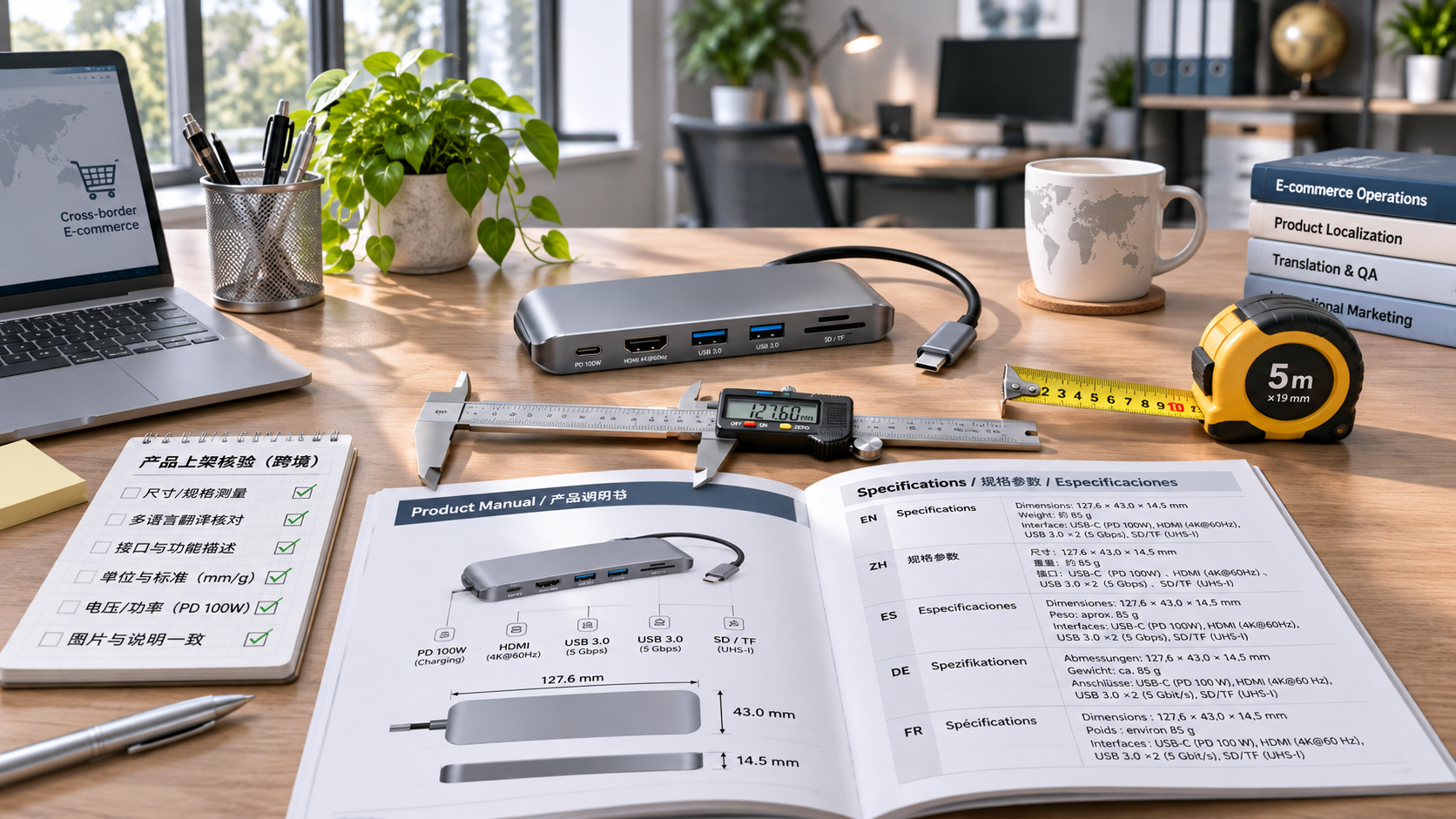
Parameter translation may appear mechanical, but it actually demands the greatest attention to detail. For data such as length, weight, pressure, voltage, concentration, accuracy, and rating, in addition to the numerical values themselves, units, test conditions, allowable tolerances, and comparison benchmarks must also be retained. Translating “maximum value” as “rated value,” or treating a “typical value” as a guaranteed value, will alter customer understanding.
It is advisable to manage specification tables separately from ordinary webpage copy. Numbers should not be manually entered by translators; unit conversions, field order, and decimal-place rules should be controlled by the data source. If another unit needs to be added due to target-market conventions, the original unit should be retained at the same time, and the conversion relationship should be clearly stated. This can reduce discrepancies in specifications among product detail pages, PDF catalogs, and advertising landing pages.
Material names should not merely pursue literal equivalence. Some Chinese material names are industry colloquialisms, abbreviated grade designations, or internal factory terms, and direct translation may not be recognizable to overseas buyers. A more reliable approach is to list the generic material name, grade, key composition, or processing condition separately, with technical documentation determining the English name. For descriptions such as “food-grade,” “medical-grade,” and “flame-retardant,” which have clear applicability prerequisites, the conditions under which they apply must also be retained and must not be used alone as generic labels.
Quality and safety terminology must distinguish between “capability” and “commitment”
Corporate websites often use terms such as “quality control,” “quality assurance,” “inspection,” and “testing.” All are related to quality, but they do not refer to the same thing: quality control focuses on control activities during production; quality assurance is closer to system-based and preventive arrangements; inspection is the examination of products or processes; while testing emphasizes obtaining results according to a method. If these terms are conflated, a website can easily present internal processes as external performance commitments.
Safety content presents similar issues. “Safe” should not be used as a generalized adjective on product pages. More accurate wording usually explains which safety characteristics a product has under what design, installation, operating, or maintenance conditions. For terms such as “explosion-proof,” “waterproof,” “dustproof,” “protective,” and “corrosion-resistant,” it should be clear whether they refer to the capability of the overall product, the capability of a particular component, or a rating or performance achieved under specified conditions.
Any absolute statements on a page containing terms such as “guaranteed,” “complete,” or “zero risk” should be reassessed against the original technical documentation. B2B procurement focuses on traceable information and will not reduce verification requirements because of strong modifiers.
A terminology database cannot be left to the translation team alone
An actionable terminology database should at least include Chinese terms, approved translations, prohibited translations, definitions or usage notes, information sources, applicable product scope, and responsible reviewers. External names, model-number rules, certification terminology, hazard warnings, and material and parameter fields should be set as controlled entries; page editors may only use approved versions and must not revise them on their own for stylistic reasons.
A practical workflow is to first extract high-risk terms from product manuals, drawings, test reports, certificates, and labels; then have technical, quality, and marketing teams confirm them jointly; and subsequently map the terminology to the website’s product pages, download center, FAQ, forms, advertising materials, and social media content. After the website goes live, each model update, change in certification scope, or parameter adjustment must be synchronously checked across the corresponding language versions.
When using a platform that supports multilingual content management, it is best to link the terminology database, product data, and page content. Yingyingbao provides multilingual website development and overseas marketing-related services. This type of systematic management helps product materials, SEO pages, and promotional landing pages use the same set of controlled wording, reducing version discrepancies caused by content duplication.
Check three easily overlooked areas before publishing
The first is text in images. English on equipment nameplates, specification graphics, flowcharts, and packaging labels often does not enter the standard translation workflow, yet customers read it directly. The second is forms and automated replies. If formal terminology is used on product pages while internal abbreviations are used in inquiry dropdown options, the efficiency of information categorization and subsequent communication will be reduced. The third is search snippets and advertising copy. Removing limitations in order to reduce word count may cause search results to convey commitments that exceed the actual scope.
Translation acceptance should not consist only of linguistic proofreading. Select a product model and verify it along the path of “search result—product page—specification table—certificate download—inquiry form—automated email.” This often makes it possible to quickly identify whether terminology, model numbers, units, and certification status are consistent. If a term cannot be supported by formal documentation, it should not appear first on an external-facing website.
When establishing a cross-departmental content governance process, administrative and research-related content may refer to the ideas concerning implementation mechanisms in Research on Measures to Improve Fiscal Budget Execution Rates in Public Institutions; however, product safety, quality, and certification pages should still use the company’s own controlled technical documents as their core source.
The objective of standardized terminology is not to make every page read exactly the same, but to ensure that the same fact retains the same verifiable meaning across different languages, pages, and promotional channels. By first controlling product definitions, certification status, parameter conditions, and safety notices, and then addressing marketing expression, a B2B website can both facilitate understanding by overseas customers and withstand questions from procurement and technical stakeholders.
Related Articles
 How Can You Avoid Localization Mistakes When Building a Japanese-Language Brand Website?
 How Does a Website Localization System Manage Multilingual Content Updates?
 How Can Cross-Border E-Commerce Multilingual Product Pages Avoid Errors in Translating Product Specifications?
Related Products
 Yiyingbao SaaS Intelligent Website Building and Marketing SystemYiyingbao SaaS Intelligent Website Building and Marketing System, AI-powered no-code website building, rapid creation of multilingual B2B international websites in 10 minutes, global server acceleration, AI-powered SEO optimization, helping businesses connect efficiently with global markets. The perfect integration of technology and operation makes building an international trade website remarkably simple
 AI+SEM Intelligent Advertising Marketing SystemAI+SEM drives intelligent ad creation, empowering full-funnel precision advertising marketing. The system automatically generates weekly/monthly reports, AI recommends keywords and target countries, monitors core metrics in real-time with intelligent alerts, and enables one-click high-conversion ad solutions to help quickly acquire customers and improve ROI.
 AI+SEO Dual-Engine System Optimization ServicesYiyingbao’s AI+SEO dual-engine optimization system helps foreign trade enterprises acquire high-quality organic traffic through AI-powered keyword research, content generation, and comprehensive technical optimization, significantly improving search rankings and conversion rates.
 AI+SNS Social Media Marketing SystemYingbao AI+SNS Social Media Marketing System - Precision social capture for the social media era. Supports one-click content synchronization across major platforms like Facebook and LinkedIn. AI intelligently rewrites posts for enhanced relevance. 24/7 AI customer service and user profiling analysis empower businesses to efficiently expand into global markets.
 AI+SEO营销解决方案易营宝AI+SEO营销解决方案,通过AI批量写作、智能生成TDK、精准关键词扩词等功能,全面优化网站SEO效果,提升流量与转化率。助力企业构建高效智能网站新生态。
 AI+SEM Advertising Marketing SolutionsAI+SEM Advertising Marketing Solution leverages AI technology to deeply empower SEM ad campaigns. It automatically generates weekly/monthly reports using AI, presenting account data across multiple dimensions for comprehensive insights into campaign performance and trends. The system precisely recommends keywords and target countries, intelligently generates high-conversion ad copy, and enables one-click activation of efficient campaign plans to help businesses rapidly acquire customers. Simultaneously, it monitors core metrics in real time, intelligently identifies abnormal fluctuations, and issues timely alerts to ensure stable, high-return advertising results.
 Domain Name ServicesEasyWin provides professional domain name services, including intelligent queries, one-stop registration, brand protection, and full lifecycle management, helping businesses build a digital brand image.
 EasyOperate B2C Cross-Border E-Commerce Platform & Independent WebsiteEasyStore B2C Cross-border E-commerce Independent Store is an intelligent website building and cross-border e-commerce integrated solution independently developed by EasyStore Information Technology (Beijing) Co., Ltd. The system is specially designed for small and medium-sized as well as large export enterprises, integrating 'website building, operation, marketing, advertising, and conversion' into one, helping enterprises quickly establish cross-border e-commerce independent stores to achieve brand globalization and global sales growth.
The platform supports multiple languages, multiple currencies, and multi-channel marketing, with built-in AI intelligent translation and SEO optimization systems, suitable for mainstream markets such as Southeast Asia, Europe and America, Latin America, and the Middle East, assisting Chinese manufacturing enterprises in efficiently deploying international e-commerce strategies. SSL证书易营宝提供专业SSL安全证书服务,包括单域名和泛域名证书,确保网站数据传输加密、身份验证和完整性保护,助力企业建立安全可信的在线业务环境。









