









- Which customer acquisition channels will be affected by cross-border marketing trends in 2026?Sep 06, 2026View details
- Which homogenization risks should be considered in an analysis of the AI-powered website building industry?Aug 30, 2026View details
- How Will AI Marketing Trends 2026 Change Advertising Budget AllocationAug 28, 2026View details
- Is the EV SSL certificate market shrinking or upgrading? How should companies assess certificate procurement?Aug 11, 2026View details
- Why the old AMP SEO 2020 practices no longer work and what has changed in current optimization prioritiesAug 02, 2026View details
- How to Choose Topics for an Industry News Section to Attract More Organic Search TrafficJul 29, 2026View details
How to Avoid Semantic Distortion When Using AI to Write Multilingual Content
For people creating multilingual content, the biggest challenge is often not being unable to write it, but writing something that looks correct while actually distorting the meaning. This is especially true for websites, advertising landing pages, and product pages, where multilingual AI-generated content can directly affect conversions. Once semantic distortion occurs, the result may be merely awkward wording at best, or may completely misrepresent the selling points, scope of commitments, and applicable users at worst. Without a systematic checking method at the operational level, revisions will become increasingly time-consuming.
The checklist below is suitable for personnel responsible for multilingual website content, overseas marketing pages, product introductions, and advertising copy. It can be used directly for troubleshooting. It does not focus on theory, but on what to check at each step, how to make a judgment, and where errors may occur.
First check whether the source copy itself is “translatable”
Many cases of semantic distortion do not start in the target language. Instead, the source copy may already be too vague, convoluted, or packed with several meanings into a single sentence. AI is most likely to “get clever” in such situations, producing a version that appears fluent but is actually inaccurate.
- Does one sentence contain functions, advantages, and results at the same time? If there are too many layers, key points can easily be lost during translation.
- Is the subject clear? Sentences such as “can be widely applied” and “supports rapid deployment” often do not make clear who supports what or what is being supported.
- Are there words that are common in Chinese but unstable across languages, such as “flexible,” “efficient,” “one-stop,” and “empower”? Without specifying the object, these words will most likely become vague when translated.
The solution is straightforward: first break the source copy into shorter sentences, with each sentence retaining only one action or judgment. For example, on a product page, write the functions, applicable scenarios, and resulting benefits separately. This can significantly reduce the error rate of AI-generated content. Although this step appears to be preliminary, it actually saves the most rework later.
Do not start by asking AI to “translate directly into the target language”
If your content has a marketing purpose, direct translation is usually not enough. A more reliable approach is to clearly define the task boundaries for AI first: Is this product documentation, inquiry-page copy, an advertising headline, or blog content? Different purposes have completely different requirements for tone, information density, and tolerance for variation.
During operation, at least three types of information should be provided: who the target audience is, what the purpose of the page is, and which terms must remain consistent. Without these constraints, AI will default to pursuing fluent readability, which can smooth out the industry-specific precision of the original text. This is particularly evident on B2B manufacturing websites. Once many terms are replaced with generalized expressions, the professional quality immediately declines.
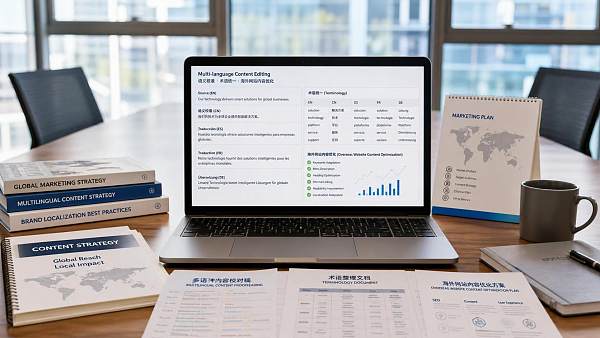
Without defining a terminology glossary first, revisions will only become more chaotic
When AI creates multilingual content, the most common problem is not that an entire paragraph is wrong, but that the same term is expressed differently on different pages. The homepage may use one term, the product page another, and the advertising landing page yet another. Users may then feel that you are referring to different things.
It is recommended to create a basic terminology glossary first. It does not need to be complicated; it only needs to be practical. At a minimum, it should include the following categories:
The value of this table is not how attractive it looks, but that all subsequent pages, advertising materials, and social media copy can use the same terminology and messaging standards.
The key is not comparing sentences one by one, but checking whether the “intent has shifted”
When reviewing multilingual content, many people are accustomed to comparing the source and translation line by line. This can identify omissions, but it may not reveal distortion. What you really need to check is: What did the original text intend users to understand, believe, and do, and how much of that remains in the target language?
There is a practical method: after reading the target-language version, answer the following three questions without looking back at the source.
- What is this content selling, or what is it explaining?
- Who is it suitable for, and in what scenarios does it apply?
- What does it want the user to do next?
If these three questions cannot be answered clearly, the content has not passed review, even if the grammar is correct. Marketing copy is particularly vulnerable to this kind of problem: it may appear smooth on the surface while actually losing its focus.
Localization is not about adding a few colloquial words; it is about using expressions that local users would actually use
Semantic distortion can also occur in a more subtle form: the wording is not literally wrong, but it is not familiar to users in the local market. This is particularly important for overseas websites, as business communication habits differ considerably across North America, Europe, Southeast Asia, Japan and South Korea, the Middle East, and other markets. If AI only generates content based on general-language data, it often produces wording that users can understand but that does not sound like something a local company would write.
Do not focus only on vocabulary. Pay attention to three levels:
- Does the order of information match local reading habits? Some markets look at the conclusion first, while others care more about conditions and boundaries.
- Is the tone of the commitments excessive? Strong expressions that are common in Chinese may appear imprecise in certain markets.
- Are calls to action natural? Buttons, form prompts, and inquiry guidance are the places most likely to reveal a “translation feel.”
In simple terms, translation solves the problem of “being understandable,” while localization solves the problem of “being trusted.”
When functions, specifications, or service scope are involved, do not let AI fill in the gaps on its own
Whenever content includes clear boundaries, such as support scope, deliverables, applicable users, or service processes, special care is required. To make a sentence complete, AI may automatically add causal relationships that do not exist, or turn an “optional item” into something “provided by default.” Such errors are particularly dangerous on product and service pages because users will interpret the wording literally.
During review, focus directly on the following areas:
- Has the object following “support,” “provide,” “include,” or “apply to” been expanded?
- Have time, quantity, or scope changed from a vague description into a definite statement?
- Does the source merely describe a capability while the translation turns it into a commitment regarding results?
For this type of content, it is better for the sentence to be plain than to let AI improvise freely. Operationally, the safest approach is to lock fields that must not be rewritten separately, and then let AI process only the connecting and polishing parts.
Integrate SEO keywords naturally; do not turn them into obstacles
Another common problem with multilingual websites is that keywords are forcibly inserted into every paragraph to accommodate search requirements, making the meaning awkward. When AI-generated multilingual content also carries an SEO task, operators need to distinguish between two things: search terms need to be covered, but the page must first read like content written by a real person.
The checking method is not complicated. Remove the keyword and see whether the sentence still works; then put the keyword back and see whether it reads like a genuine business expression. If the sentence becomes stiff after the keyword is added, it usually means that the keyword is in the wrong position or should not be integrated in that way in the first place. Keywords can be appropriately covered in titles, opening paragraphs, key subheadings, and near image descriptions. The body text should focus more naturally on the relevant problem scenarios.
Have AI back-translate once to identify high-risk deviations
If you work with many languages and cannot rely on thorough manual review for every version, back-translation is a practical second line of defense. The purpose is not to pursue literal consistency, but to identify the areas with the greatest deviations.
It is recommended to sample only high-risk content: page titles, core selling points, form guidance, pricing information, service scope, and button copy. Translate the target-language version back into Chinese and check whether any of the following situations occur:
- The conditions or limitations in the source have disappeared;
- A neutral description in the source has been back-translated into an exaggerated statement;
- The object of the action has changed—for example, the source targets businesses, but the back-translation appears to target individuals;
- Actions such as making an inquiry, registering, and purchasing have been confused.
Once one type of deviation is identified, do not revise only that sentence. Similar problems will usually exist in other content from the same batch.
In the final round, review by page journey rather than by document
Many teams review content by document paragraphs, but users do not read this way. Users click through from search results and then evaluate the title, above-the-fold content, buttons, forms, and supplementary information as they move down the page. Semantic accuracy should ideally be checked along this same path.
In practice, go through the following sequence:
- First review the title and description to confirm that the topic has not shifted.
- Then review the above-the-fold selling points to confirm that users can immediately understand what you provide.
- Check the functions and scenario sections to confirm that terminology is consistent and relationships are clear.
- Finally, review the buttons, forms, and contact guidance to confirm that action words are accurate and will not mislead conversion.
If you are responsible for a multilingual corporate website, independent site, or advertising landing page, this sequence is closer to the actual user experience than simply proofreading grammar.
To truly reduce semantic distortion, the solution is not simply to use a stronger model, but to control the process: first organize translatable source copy, then standardize terminology and page objectives, focus on intent, boundaries, and localized expressions after generation, and finally review everything along the user's browsing path. With this approach, AI-generated multilingual content is not merely “fast”; it can genuinely be used for launch, advertising, and conversion.
Related Articles

Related Products
 Yiyingbao SaaS Intelligent Website Building and Marketing SystemYiyingbao SaaS Intelligent Website Building and Marketing System, AI-powered no-code website building, rapid creation of multilingual B2B international websites in 10 minutes, global server acceleration, AI-powered SEO optimization, helping businesses connect efficiently with global markets. The perfect integration of technology and operation makes building an international trade website remarkably simple
 AI+SEM Intelligent Advertising Marketing SystemAI+SEM drives intelligent ad creation, empowering full-funnel precision advertising marketing. The system automatically generates weekly/monthly reports, AI recommends keywords and target countries, monitors core metrics in real-time with intelligent alerts, and enables one-click high-conversion ad solutions to help quickly acquire customers and improve ROI.
 AI+SEO Dual-Engine System Optimization ServicesYiyingbao’s AI+SEO dual-engine optimization system helps foreign trade enterprises acquire high-quality organic traffic through AI-powered keyword research, content generation, and comprehensive technical optimization, significantly improving search rankings and conversion rates.
 AI+SNS Social Media Marketing SystemYingbao AI+SNS Social Media Marketing System - Precision social capture for the social media era. Supports one-click content synchronization across major platforms like Facebook and LinkedIn. AI intelligently rewrites posts for enhanced relevance. 24/7 AI customer service and user profiling analysis empower businesses to efficiently expand into global markets.
 AI+SEO营销解决方案易营宝AI+SEO营销解决方案,通过AI批量写作、智能生成TDK、精准关键词扩词等功能,全面优化网站SEO效果,提升流量与转化率。助力企业构建高效智能网站新生态。
 AI+SEM Advertising Marketing SolutionsAI+SEM Advertising Marketing Solution leverages AI technology to deeply empower SEM ad campaigns. It automatically generates weekly/monthly reports using AI, presenting account data across multiple dimensions for comprehensive insights into campaign performance and trends. The system precisely recommends keywords and target countries, intelligently generates high-conversion ad copy, and enables one-click activation of efficient campaign plans to help businesses rapidly acquire customers. Simultaneously, it monitors core metrics in real time, intelligently identifies abnormal fluctuations, and issues timely alerts to ensure stable, high-return advertising results.
 Domain Name ServicesEasyWin provides professional domain name services, including intelligent queries, one-stop registration, brand protection, and full lifecycle management, helping businesses build a digital brand image.
 EasyOperate B2C Cross-Border E-Commerce Platform & Independent WebsiteEasyStore B2C Cross-border E-commerce Independent Store is an intelligent website building and cross-border e-commerce integrated solution independently developed by EasyStore Information Technology (Beijing) Co., Ltd. The system is specially designed for small and medium-sized as well as large export enterprises, integrating 'website building, operation, marketing, advertising, and conversion' into one, helping enterprises quickly establish cross-border e-commerce independent stores to achieve brand globalization and global sales growth.
The platform supports multiple languages, multiple currencies, and multi-channel marketing, with built-in AI intelligent translation and SEO optimization systems, suitable for mainstream markets such as Southeast Asia, Europe and America, Latin America, and the Middle East, assisting Chinese manufacturing enterprises in efficiently deploying international e-commerce strategies. SSL证书易营宝提供专业SSL安全证书服务,包括单域名和泛域名证书,确保网站数据传输加密、身份验证和完整性保护,助力企业建立安全可信的在线业务环境。









