









- Can the average annual growth rate reflect real opportunities in overseas markets?Oct 07, 2026View details
- Which customer acquisition channels will be affected by cross-border marketing trends in 2026?Sep 06, 2026View details
- Which homogenization risks should be considered in an analysis of the AI-powered website building industry?Aug 30, 2026View details
- How Will AI Marketing Trends 2026 Change Advertising Budget AllocationAug 28, 2026View details
- Is the EV SSL certificate market shrinking or upgrading? How should companies assess certificate procurement?Aug 11, 2026View details
- Why the old AMP SEO 2020 practices no longer work and what has changed in current optimization prioritiesAug 02, 2026View details
What are the most common issues when using AI website building to create multilingual websites?
Many operators using AI website builders to create multilingual websites for the first time experience the feeling that they have clearly saved time on website development, yet everything becomes increasingly chaotic afterward. The pages go online quickly, and language versions are launched one after another, but before long they discover that some pages are translated unnaturally, some language versions are not indexed, some users leave immediately after entering the site, and some inquiries fail to convert despite generating traffic. The so-called “AI website building multilingual problems” are never simply about replacing Chinese with English, Japanese, or Spanish. The entire website structure, content logic, search engine recognition, and user experience must work together.
For those responsible for website operations, international trade promotion, or overseas marketing execution, what they really need to know is not whether a “multilingual feature” exists, but whether the resulting website can be seen, understood, and converted. The following issues are among the most common in actual operations and are also the easiest to overlook.
The translation looks correct but is not suitable for local users
This is the most common type of problem. AI translation is fast and suitable for generating initial page drafts in batches, but many websites mistakenly equate “readable translation” with “ready for launch.” As a result, the sentences may have no grammatical errors, yet fail to match local industry expressions, and the product benefits may be inaccurately conveyed.
For example, phrases commonly used on B2B manufacturing websites, such as “direct supply from the manufacturer,” “customization available,” and “stable lead times,” may not inspire trust among overseas buyers if they are mechanically translated. In some language versions, product specifications, material names, and application scenarios may even be translated inconsistently, leaving users increasingly confused as they read.
The practical recommendation is not to treat AI as the final translator, but as a tool for improving efficiency during the first round. Core pages—including the homepage, product category pages, solution pages, and inquiry pages—must undergo human proofreading. At a minimum, confirm that terminology is consistent, product benefits are expressed in the appropriate industry context, and contact information and call-to-action buttons are clear and easy to understand. The details that truly affect conversion are often not lengthy content, but elements such as headings, buttons, form prompts, and delivery commitments.
The multilingual website structure is confusing, making it difficult for search engines to identify relationships between versions
Many people assume that adding several directories means multilingual deployment is complete. In reality, structure is the foundation of indexing and ranking. If an AI website-building system simply copies pages and replaces the language content separately, without defining clear language paths, canonical URLs, and relationships between versions, search engines will have difficulty understanding which page is intended for users in which country or language.
Common problems include mixed English and French URLs, multiple duplicate paths for the same page, being redirected to the homepage after switching languages, and different languages sharing the same page address parameters. These issues may not cause the website to display an immediate error, but they can continuously affect crawling efficiency and index quality.
A more reliable approach is to determine the multilingual architecture during the website-building stage: whether to use subdirectories, subdomains, or independent domains; which markets can share one language and which require separate content; and whether language switching can maintain the corresponding page rather than always returning to the homepage. For operators, the earlier this is clarified, the less rework will be required later.
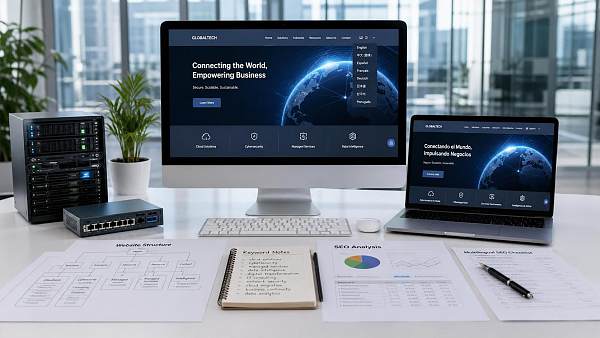
hreflang is configured incorrectly—or not configured at all
Many AI website-building users focus on page generation speed but overlook technical details such as hreflang. Its purpose is straightforward: to tell search engines which language or regional versions a page has and which version should be displayed to which type of user.
When it is missing or configured incorrectly, several consequences may occur: an English page may be shown to German-speaking users, pages in different languages may compete with one another, and search engines may treat multilingual versions as duplicate content. Particularly when a company targets multiple markets such as North America, Europe, and Southeast Asia, this can cause the content it has worked hard to create to lose ranking weight across versions.
If you use an AI website-building system with multilingual capabilities, check carefully whether it can automatically generate and correctly maintain hreflang. Even if it does, do not assume that “the system supports it” means it is necessarily configured correctly. Key pages still need to be checked on a sample basis. For teams engaged in overseas promotion, technical configuration may seem like a minor detail, but it directly affects indexing efficiency.
The pages have been translated, but the keywords have not been localized
This is one of the easiest pitfalls to encounter in SEO. The multilingual content on many websites is translated directly from the Chinese original. The logic may be sound, but users in the target market may not search for it that way.
For example, companies in China are accustomed to creating pages around terms such as “manufacturer,” “supplier,” “wholesale,” and “customization,” but users in different countries do not necessarily use corresponding search terms. Some markets pay more attention to certifications, materials, and uses; others care more about application scenarios and industry solutions; and some regions tend to use more conversational terms when searching.
Therefore, “AI website building multilingual problems” are not merely technical or translation issues, but also keyword strategy issues. The correct approach is not to translate one set of keywords into multiple languages, but to reorganize search expressions based on the target market. Page titles, descriptions, category names, and product copy should all be aligned with local search habits. Otherwise, even if the website is fully launched, it may still fail to attract meaningful traffic.
Loading speeds become slower, especially when accessed from overseas
Many companies feel that their websites perform well when viewed in the backend, but when overseas customers actually visit them, problems such as slow image loading, slow script responses, and slow page transitions become apparent. Multilingual websites often contain more pages and assets. When automatic translation plugins, external fonts, video backgrounds, and complex animations are added, speed can easily become uncontrollable.
For operators, the most troublesome aspect of this type of problem is that it may not be obvious, yet it continuously erodes conversions. Users are not willing to wait, and search engines are also reluctant to prioritize pages that provide a poor experience.
Therefore, when building an AI website, do not focus only on the visual effect of the template. Also consider whether it supports lightweight code, image compression, static resource optimization, and stable global access. For teams working on international corporate websites, cross-border stores, and advertising landing pages, speed is not an optional extra but a basic requirement.
Every language looks exactly the same, so none of them is truly user-friendly
Some multilingual websites look very neat: the structure, layout, and content blocks of every language version are exactly the same. The problem is that users in different markets do not have identical reading habits or decision-making paths.
For example, B2B purchasing users typically care more about qualifications, factory capabilities, delivery processes, and case studies, while B2C consumers are more concerned with prices, reviews, logistics, and return information. If the same Chinese page is simply translated into multiple languages in batches, the website can easily become “localized in form but not in experience.”
A more practical approach is to first distinguish which pages are suitable for centralized management and which require market-specific adaptation. Brand introductions and basic product specifications can share a common framework, while advertising landing pages, core category pages, and homepages for key markets should reorganize the content order and conversion path according to local audiences.
Forms, buttons, and contact information are not adjusted along with the multilingual content
Many inquiry conversion problems are not caused by poor traffic, but by a breakdown at the final step. The page content has been translated into multiple languages, but the form prompts are still in Chinese, the submission success message is unclear, the telephone country-code format is incompatible, or the button copy remains a literal translation of wording such as “Contact Us Now.”
Once users hesitate before taking an important action, conversion rates decline noticeably. In overseas markets especially, users have different preferences regarding form-field length, privacy notices, and communication methods. Some prefer communication by email, while others are more willing to use WhatsApp, Messenger, or a form to schedule a consultation.
Therefore, when creating a multilingual website, do not focus only on the page content itself. Review the entire conversion journey as well: whether the buttons sound natural, whether the forms are easy to complete, whether there is clear feedback after submission, and whether sales follow-up is matched to the corresponding language.
Batch generation in the backend does not mean sustainable maintenance afterward
One major advantage of AI website building is its efficiency, but as a multilingual website grows, its maintenance burden also increases. When a new product is added, must it be added to every language at the same time? When the original content changes, are the translations updated automatically? After an old page is deleted, will dead links remain in other language versions? These are typical issues in later-stage operations.
If the website-building system only solves “generation” but not “management,” operators will become increasingly passive. Today they add an English page, tomorrow they fix a Spanish link, and over time the website content becomes increasingly fragmented. For companies that continuously work on Google SEO, advertising, and overseas content operations, backend version management, page association, and update mechanisms are more important than temporary generation speed.
The value of integrated platforms such as 易营宝, which cover AI-powered website building, multilingual website development, SEO optimization, and overseas marketing, lies in the fact that they do not merely create a website. They also place greater emphasis on making it promotable, indexable, and maintainable afterward. For teams handling execution tasks, this systematic capability is often more practically valuable than the number of templates available.
How to determine whether a multilingual AI website-building solution is reliable
If you are selecting a solution or optimizing an existing one, you can use several simple criteria to evaluate it:
- Do the language versions have clear, independent, and standardized URL structures?
- Do the core pages support human refinement, rather than allowing only full machine translation?
- Can the system handle basic SEO configurations such as hreflang, indexing rules, and sitemaps?
- Is page speed stable when accessed from overseas?
- Can forms, buttons, and conversion components be genuinely localized along with each language version?
- Is it easy to maintain content when adding, modifying, or synchronizing it later?
If two or three of these points are already problematic, the issues will usually continue to increase. A multilingual website is not a one-time deliverable, but a long-term growth asset.
Final thoughts
Returning to the original question, what are the most common problems when using AI website building to create a multilingual website? The answer is clear: translation is not localization, building a website does not mean it will be indexed, and generating traffic does not mean it will convert. What truly troubles operators is often not one isolated error, but the failure of translation, structure, SEO, speed, and conversion to form a complete loop.
If you are preparing to take your website overseas, planning to upgrade an existing site, or have already launched a website that has yet to deliver results, do not focus only on whether the page “has multilingual content.” Instead, return to the issue that matters to both users and search engines: is this website genuinely suitable for being found, understood, and trusted in the target market? Once these fundamentals are firmly established, AI can truly become a productivity tool rather than a source of rework later.
Related Articles

Related Products
 Yiyingbao SaaS Intelligent Website Building and Marketing SystemYiyingbao SaaS Intelligent Website Building and Marketing System, AI-powered no-code website building, rapid creation of multilingual B2B international websites in 10 minutes, global server acceleration, AI-powered SEO optimization, helping businesses connect efficiently with global markets. The perfect integration of technology and operation makes building an international trade website remarkably simple
 AI+SEM Intelligent Advertising Marketing SystemAI+SEM drives intelligent ad creation, empowering full-funnel precision advertising marketing. The system automatically generates weekly/monthly reports, AI recommends keywords and target countries, monitors core metrics in real-time with intelligent alerts, and enables one-click high-conversion ad solutions to help quickly acquire customers and improve ROI.
 AI+SEO Dual-Engine System Optimization ServicesYiyingbao’s AI+SEO dual-engine optimization system helps foreign trade enterprises acquire high-quality organic traffic through AI-powered keyword research, content generation, and comprehensive technical optimization, significantly improving search rankings and conversion rates.
 AI+SNS Social Media Marketing SystemYingbao AI+SNS Social Media Marketing System - Precision social capture for the social media era. Supports one-click content synchronization across major platforms like Facebook and LinkedIn. AI intelligently rewrites posts for enhanced relevance. 24/7 AI customer service and user profiling analysis empower businesses to efficiently expand into global markets.
 AI+SEO营销解决方案易营宝AI+SEO营销解决方案,通过AI批量写作、智能生成TDK、精准关键词扩词等功能,全面优化网站SEO效果,提升流量与转化率。助力企业构建高效智能网站新生态。
 AI+SEM Advertising Marketing SolutionsAI+SEM Advertising Marketing Solution leverages AI technology to deeply empower SEM ad campaigns. It automatically generates weekly/monthly reports using AI, presenting account data across multiple dimensions for comprehensive insights into campaign performance and trends. The system precisely recommends keywords and target countries, intelligently generates high-conversion ad copy, and enables one-click activation of efficient campaign plans to help businesses rapidly acquire customers. Simultaneously, it monitors core metrics in real time, intelligently identifies abnormal fluctuations, and issues timely alerts to ensure stable, high-return advertising results.
 Domain Name ServicesEasyWin provides professional domain name services, including intelligent queries, one-stop registration, brand protection, and full lifecycle management, helping businesses build a digital brand image.
 EasyOperate B2C Cross-Border E-Commerce Platform & Independent WebsiteEasyStore B2C Cross-border E-commerce Independent Store is an intelligent website building and cross-border e-commerce integrated solution independently developed by EasyStore Information Technology (Beijing) Co., Ltd. The system is specially designed for small and medium-sized as well as large export enterprises, integrating 'website building, operation, marketing, advertising, and conversion' into one, helping enterprises quickly establish cross-border e-commerce independent stores to achieve brand globalization and global sales growth.
The platform supports multiple languages, multiple currencies, and multi-channel marketing, with built-in AI intelligent translation and SEO optimization systems, suitable for mainstream markets such as Southeast Asia, Europe and America, Latin America, and the Middle East, assisting Chinese manufacturing enterprises in efficiently deploying international e-commerce strategies. SSL证书易营宝提供专业SSL安全证书服务,包括单域名和泛域名证书,确保网站数据传输加密、身份验证和完整性保护,助力企业建立安全可信的在线业务环境。









