









- Can the average annual growth rate reflect real opportunities in overseas markets?Oct 07, 2026View details
- Which customer acquisition channels will be affected by cross-border marketing trends in 2026?Sep 06, 2026View details
- Which homogenization risks should be considered in an analysis of the AI-powered website building industry?Aug 30, 2026View details
- How Will AI Marketing Trends 2026 Change Advertising Budget AllocationAug 28, 2026View details
- Is the EV SSL certificate market shrinking or upgrading? How should companies assess certificate procurement?Aug 11, 2026View details
- Why the old AMP SEO 2020 practices no longer work and what has changed in current optimization prioritiesAug 02, 2026View details
Is Digitalization for Global Expansion Suitable for Companies with Annual Revenue Below 50 Million?
Is digital transformation for overseas expansion really unsuitable for companies with annual revenue below RMB 50 million? When many business decision-makers search for this question, what they are truly struggling with is not whether to expand overseas, but a more practical consideration: the company is still relatively small, so is implementing digital systems, building an overseas website, investing in search and advertising, and preparing content and social media a proactive move—or simply burning money prematurely?
Let’s start with the conclusion: digital transformation for overseas expansion is not only feasible for companies with annual revenue below RMB 50 million; in many cases, they should start earlier. The prerequisite, however, is not to “scale down the actions of a large company,” but to determine whether your business has reached the stage where digitalization is necessary to improve customer acquisition efficiency, shorten the sales cycle, and reduce the cost of trial and error. If it is understood merely as “building an English website” or “opening several advertising accounts,” the results are often unsatisfactory.
Don’t ask whether your company is large enough yet; first ask whether you are already stuck with several key problems
Many small and medium-sized enterprises use revenue size as the dividing line for determining whether they are suitable for digital transformation for overseas expansion. This approach is not particularly accurate. What matters more is whether the company is currently facing the following types of problems:
- Overseas customer acquisition relies too heavily on platforms, trade shows, and referrals from acquaintances, making the channels limited and unstable;
- The number of inquiries is not small, but their quality fluctuates significantly, resulting in high sales screening costs;
- The company has strong products and supply chain capabilities, but its external presentation is weak, with incomplete websites, content, case studies, and trust-building elements;
- It wants to expand into multiple markets, but its language capabilities, localization, advertising, and content coordination cannot keep up;
- It invests in overseas promotion every year but finds it difficult to accumulate long-term assets, leaving it dependent on repeatedly purchasing traffic.
If these problems have already emerged, the answer to the question “Is a digital transformation solution for overseas expansion suitable for companies with annual revenue below RMB 50 million?” is often yes. This is because what such companies typically lack is not a complex system, but the ability to quickly establish a sustainable, trackable, and optimizable overseas customer acquisition mechanism.
Conversely, if the company has not yet clearly selected its target markets, refined its product advantages, or stabilized basic conditions such as delivery, after-sales service, settlement, and compliance, starting digital investment too early may simply amplify originally unclear problems more quickly.
For small and medium-sized companies pursuing digital transformation for overseas expansion, the focus is not “comprehensiveness,” but an “effective closed loop”
When many companies hear the phrase “digital transformation solution,” their first reaction is that it is complex, expensive, and time-consuming—something only large companies can afford. Today, this impression is no longer entirely accurate. For companies with annual revenue below RMB 50 million, a more practical approach is not to deploy every channel and system at once, but to focus on the shortest conversion path and first connect several key links.
For B2B companies, this path typically includes a website capable of receiving overseas traffic, a multilingual and content framework, search visibility, basic advertising, inquiry collection and distribution, and data feedback and optimization. For B2C or cross-border brands, greater emphasis is placed on independent website conversion, advertising landing page efficiency, social media content coordination, remarketing, and conversion analysis.
The issue is not whether to pursue “integration,” but whether this integration helps reduce points of disconnection. What companies fear most is not doing one less task, but having one supplier build the website, another team handle SEO, and a third party manage advertising. In the end, the data becomes fragmented, responsibility for problems cannot be identified, and the budget is quickly consumed.
This is also why “website + marketing services integration” has attracted increasing attention from small and medium-sized companies expanding overseas in recent years. Its appeal lies not only in convenience, but also in making it easier to view website development, content, SEO, advertising, and social media—originally separate activities—within the same growth logic.
Why do many companies with annual revenue below RMB 50 million actually need digital capabilities even more?
Large enterprises can use brand momentum, channel resources, offline networks, and team size to address many problems. Small and medium-sized companies do not have this buffer. Limited budgets, short trial-and-error windows, and the need for owners to see returns quickly mean that they need to improve the certainty of every investment even more.
From this perspective, digital transformation for overseas expansion is not merely “the icing on the cake”; it is a way to use limited resources more precisely. Its value is particularly evident in the following scenarios:
- The product has a relatively high average order value and a long decision-making cycle, requiring websites, case studies, and content to build trust;
- Sales depend on inquiries, but the quality of existing traffic is unstable, creating an urgent need to screen and improve lead quality;
- The company is preparing to expand into multiple countries or language markets and needs more efficient content management and page expansion capabilities;
- The company has long relied on platform traffic and hopes to gradually accumulate its own website assets and customer data;
- The team is small and cannot establish separate positions for website development, SEO, advertising, content, and technology.
If these companies continue to rely entirely on a single platform or individual advertising channel, they may be able to maintain operations in the short term. However, once traffic costs rise, platform rules change, or a channel fluctuates, their ability to withstand risk will be relatively weak. In many cases, this is the significance of digitalization: not to make a company grow immediately, but to make it less vulnerable to external changes.
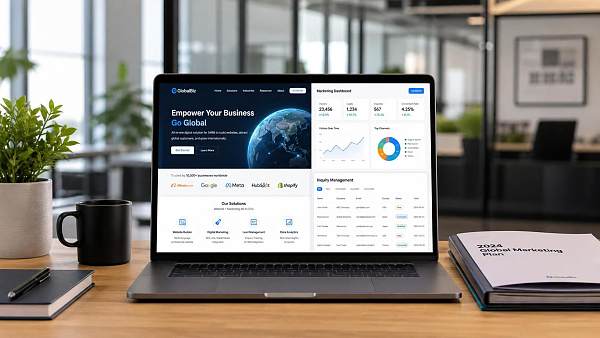
What is truly unsuitable for immediate digital transformation is often not being “small,” but lacking the necessary foundation
A common misconception should be avoided: interpreting “digital transformation” as “implement it first and figure it out later.” For companies with annual revenue below RMB 50 million, money and energy are even more valuable, so decisions should be made more cautiously. In the following situations, it is generally not advisable to rush into a complete solution:
- The product is not competitive, and there are no clear advantages in price or delivery time;
- The target customer profile is vague, and the company does not know exactly whom it is selling to, who makes the decisions, or who uses the product;
- The selection of overseas markets is too scattered: the company wants to target Europe and the United States today and try Southeast Asia tomorrow, without clear priorities;
- There is no basic internal follow-up mechanism, so inquiries cannot be properly received, followed up, or converted;
- Digitalization is treated as a short-term results tool, with the expectation of generating stable orders within one or two months.
To put it bluntly, digitalization can amplify strengths, but it can also amplify weaknesses. If your sales messaging, quotation logic, case materials, and delivery capabilities are not ready, even the best website and traffic system will have difficulty closing deals for you.
When selecting a solution, the most important consideration is not the feature list, but whether it suits your growth stage
When evaluating solutions, many companies are easily led by feature lists: how many languages are supported, whether AI can be integrated, whether there is an advertising system, whether an SEO module is available, and whether the solution covers all channels. Truly experienced decision-makers should instead ask whether the solution is useful at the company’s current stage, whether it can be implemented, and whether the return on investment is controllable.
If a company is in the initial stage of expanding overseas, its priority is usually not “all features,” but three things:
- Whether it can quickly build a website foundation suitable for overseas promotion, capable of being indexed and generating conversions;
- Whether it can conduct initial validation of content, search, and advertising around its target market;
- Whether it can obtain clear data feedback within a limited budget, rather than making long-term investments without a basis for judgment.
If the company already has a certain foundation in overseas business, its focus will be upgraded to:
- Whether multiple languages, websites, and markets can be managed centrally;
- Whether SEO, advertising, social media, and content can work together instead of operating separately;
- Whether the data can support decisions about which pages, keywords, and channels truly generate qualified customers;
- Whether it is convenient to expand into new markets, product lines, and traffic sources, including capabilities related to visibility in AI search.
At this level, platform-based solutions with capabilities in intelligent website building, SEO, advertising, and content coordination are indeed more suitable for companies with limited resources to evaluate. The reason is simple: small and medium-sized enterprises do not have much budget to coordinate interface issues among multiple service providers. In this context, integrated “website development + overseas marketing” solutions such as 易营宝 can be understood as an option for reducing organizational complexity. However, whether they are suitable still depends on their delivery methods, service depth, industry adaptability, and actual execution capabilities—not on the brand introduction itself.
A lower budget is not always better; the key is getting the structure right
Business decision-makers have another common misconception about this issue: they always want to reduce the budget to the lowest possible level before deciding whether to proceed. The result is often a very inexpensive website without a content strategy, advertising with poor landing page support, or SEO built on inadequate technical foundations. Although each individual item appears to save money, overall efficiency is ultimately lower.
For companies with annual revenue below RMB 50 million, a more reasonable approach is not to “spend less,” but to “spend on the areas that can form a closed loop.” For example, first connect the website foundation, core page content, basic SEO architecture, inquiry path, and advertising validation, and then decide whether to increase advertising, add languages, or expand channels. The advantage of this approach is that every investment is supported by a basis for judgment.
If the budget structure is unbalanced—for example, investing heavily in traffic but lightly in development, focusing on page quantity while neglecting conversion logic, or emphasizing superficial multilingualism while neglecting true localization—it is easy to create a situation in which a great deal appears to have been done, but no effective growth assets are actually formed.
Do not understand “digitalization” merely as purchasing tools; it is essentially an adjustment to the way the business operates
This is also why some companies still feel that results are mediocre even after purchasing systems, building an official website, and opening advertising accounts. The problem may not lie in the tools themselves, but in the company’s failure to adjust its internal business operations accordingly.
For example, can the marketing department continuously provide content materials? Can sales staff classify and follow up on inquiries? Does the owner accept a process of validating first and scaling later? Can products and case studies be reframed around the issues that overseas customers care about? All of these factors determine whether a digital solution can truly operate effectively.
Based on industry observations, the small and medium-sized companies most likely to succeed with digital transformation for overseas expansion are not necessarily those with the largest budgets, but those with the clearest organizational coordination: they know which market to prioritize, which type of customer to validate first, and which customer acquisition method to establish initially, before gradually adding capabilities such as SEO, advertising, social media, short-video marketing, and even AI search optimization.
The final question is not “Can we do it?” but “Where should we start?”
So, are digital transformation solutions for overseas expansion suitable for companies with annual revenue below RMB 50 million? If a company already has clear products, target markets, and basic delivery capabilities, and genuinely needs a more stable way to acquire overseas customers, the answer is most likely yes. Moreover, the earlier it establishes its own digital presence, the less likely it is to become passive later.
However, suitability does not mean doing everything at once. For most companies, a more feasible path is to begin with small-scale validation: determine the core market, build a website and pages capable of supporting conversions, configure basic search and advertising, observe inquiry quality, and then decide whether to increase investment. Treating digitalization as a growth system rather than a one-time procurement project leads to more accurate decisions and more controllable risks.
What truly deserves attention has never been that “the company is not yet large enough,” but that as overseas competition becomes increasingly transparent and traffic becomes increasingly fragmented, the company still places its overseas growth bets on a single channel and subjective experience.
Related Articles

Related Products
 Yiyingbao SaaS Intelligent Website Building and Marketing SystemYiyingbao SaaS Intelligent Website Building and Marketing System, AI-powered no-code website building, rapid creation of multilingual B2B international websites in 10 minutes, global server acceleration, AI-powered SEO optimization, helping businesses connect efficiently with global markets. The perfect integration of technology and operation makes building an international trade website remarkably simple
 AI+SEM Intelligent Advertising Marketing SystemAI+SEM drives intelligent ad creation, empowering full-funnel precision advertising marketing. The system automatically generates weekly/monthly reports, AI recommends keywords and target countries, monitors core metrics in real-time with intelligent alerts, and enables one-click high-conversion ad solutions to help quickly acquire customers and improve ROI.
 AI+SEO Dual-Engine System Optimization ServicesYiyingbao’s AI+SEO dual-engine optimization system helps foreign trade enterprises acquire high-quality organic traffic through AI-powered keyword research, content generation, and comprehensive technical optimization, significantly improving search rankings and conversion rates.
 AI+SNS Social Media Marketing SystemYingbao AI+SNS Social Media Marketing System - Precision social capture for the social media era. Supports one-click content synchronization across major platforms like Facebook and LinkedIn. AI intelligently rewrites posts for enhanced relevance. 24/7 AI customer service and user profiling analysis empower businesses to efficiently expand into global markets.
 AI+SEO营销解决方案易营宝AI+SEO营销解决方案,通过AI批量写作、智能生成TDK、精准关键词扩词等功能,全面优化网站SEO效果,提升流量与转化率。助力企业构建高效智能网站新生态。
 AI+SEM Advertising Marketing SolutionsAI+SEM Advertising Marketing Solution leverages AI technology to deeply empower SEM ad campaigns. It automatically generates weekly/monthly reports using AI, presenting account data across multiple dimensions for comprehensive insights into campaign performance and trends. The system precisely recommends keywords and target countries, intelligently generates high-conversion ad copy, and enables one-click activation of efficient campaign plans to help businesses rapidly acquire customers. Simultaneously, it monitors core metrics in real time, intelligently identifies abnormal fluctuations, and issues timely alerts to ensure stable, high-return advertising results.
 Domain Name ServicesEasyWin provides professional domain name services, including intelligent queries, one-stop registration, brand protection, and full lifecycle management, helping businesses build a digital brand image.
 EasyOperate B2C Cross-Border E-Commerce Platform & Independent WebsiteEasyStore B2C Cross-border E-commerce Independent Store is an intelligent website building and cross-border e-commerce integrated solution independently developed by EasyStore Information Technology (Beijing) Co., Ltd. The system is specially designed for small and medium-sized as well as large export enterprises, integrating 'website building, operation, marketing, advertising, and conversion' into one, helping enterprises quickly establish cross-border e-commerce independent stores to achieve brand globalization and global sales growth.
The platform supports multiple languages, multiple currencies, and multi-channel marketing, with built-in AI intelligent translation and SEO optimization systems, suitable for mainstream markets such as Southeast Asia, Europe and America, Latin America, and the Middle East, assisting Chinese manufacturing enterprises in efficiently deploying international e-commerce strategies. SSL证书易营宝提供专业SSL安全证书服务,包括单域名和泛域名证书,确保网站数据传输加密、身份验证和完整性保护,助力企业建立安全可信的在线业务环境。









