









- Which customer acquisition channels will be affected by cross-border marketing trends in 2026?Sep 06, 2026View details
- Which homogenization risks should be considered in an analysis of the AI-powered website building industry?Aug 30, 2026View details
- How Will AI Marketing Trends 2026 Change Advertising Budget AllocationAug 28, 2026View details
- Is the EV SSL certificate market shrinking or upgrading? How should companies assess certificate procurement?Aug 11, 2026View details
- Why the old AMP SEO 2020 practices no longer work and what has changed in current optimization prioritiesAug 02, 2026View details
- How to Choose Topics for an Industry News Section to Attract More Organic Search TrafficJul 29, 2026View details
Rich Results Test - Google Search Console detects no issues, yet no rich results appear
You ran the Rich Results Test, and the Google Search Console check also looks normal, yet rich results still never appear? This is usually not just a code issue; it also involves indexing, page quality, and eligibility for display. This article will help you quickly identify the key causes.
Why are there still no rich results on the results page when both the Rich Results Test and Google Search Console look normal?
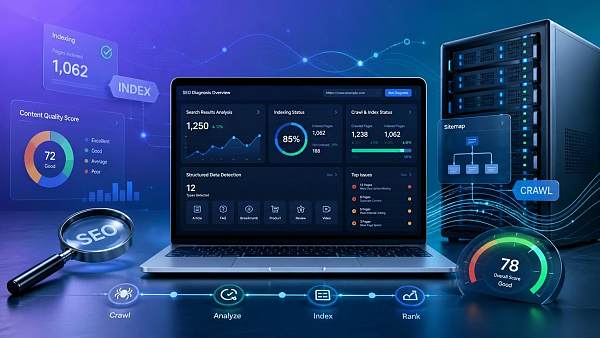
Here is the conclusion first: passing the test only means that the structured data can be recognized; it does not mean that Google will definitely display rich results. Many practitioners get stuck here because they mistake “recognizable” for “guaranteed to be displayed.”
Google evaluates rich results in multiple layers. The first layer is whether the code can be parsed, the second is whether the page can be effectively indexed, and only the third is whether the page is eligible for display. Ultimately, it also depends on whether the search context warrants displaying it.
In other words, the fact that the Rich Results Test and Google Search Console show normal results only indicates that you have completed part of the basic requirements; it does not constitute a final promise of display. This is the most easily overlooked misconception.
For website operators and SEO practitioners, the real question is not “Why do the tools say there is no problem?” but “Why is Google still unwilling to display the result?” These correspond to completely different troubleshooting approaches.
The most common cause is not the code, but page eligibility
Many pages have comprehensive structured data, but Google may still not display rich results if the page itself is of weak quality. Pages with thin content, substantial duplication, infrequent updates, or unclear user value are especially likely to encounter this situation.
A common example is a product page with Product, Review, and FAQ markup that passes the test, but whose main content contains only a few lines of specifications and lacks a genuine introduction, usage scenarios, and differentiated content. Such a page will generally have a low probability of being displayed.
Google is not trying to reward pages that include schema; it is trying to improve the quality of search results. If the page itself does not provide enough information, it may continue to show only a standard blue link for a long time, even when the markup is fully compliant.
This is also why some corporate portals have begun to place greater emphasis on optimizing content structure and page experience together when presenting products. For example, on automotive pages, simply piling up images and specifications is often less effective for gaining search signals than also adding application scenarios, technical specifications, and genuine reviews.
Being indexed does not mean that the structured data has been officially adopted
Another frequent issue is that although the page has been indexed, the version currently in Google's index may not be the same version you tested. A local test showing normal results does not mean that Google has recrawled the page and adopted the latest structured data.
In Search Console, it is recommended to focus on the “Page indexing” status and the screenshot version under “View crawled page.” If the crawl took place a long time ago, or the cached content differs from the current page, you should first resolve the recrawling issue.
Sometimes, immediately after a page template is modified, the Rich Results Test checks the real-time page code, while the search results still use the old indexed version. This creates the illusion that “the test is normal but nothing has changed on the front end,” which is especially common on new websites and sites that are updated infrequently.
If the website has a limited crawl budget, pages are buried too deeply, internal linking is weak, or the server responds slowly, structured data may also take longer to enter the official index. In this case, the issue is essentially not schema syntax, but crawl and indexing efficiency.
Whether rich results appear is also affected by queries and search contexts
Even if a page is fully compliant, Google may not display rich results for every keyword. Whether rich results are triggered depends on the user's search terms, device type, region, the performance of competing pages, and the layout of the results page.
For example, the same page may display an FAQ result for a branded query but not for a generic query; it may show richer results on mobile while appearing ordinary on desktop. This is not an anomaly, but part of Google's dynamic decision-making process.
Therefore, when determining whether the Rich Results Test or Google Search Console has “stopped working,” practitioners should not draw a conclusion based on searching one keyword only once. A more reliable approach is to observe multiple groups of keywords, multiple regional environments, and a defined period of time.
If the target keyword is highly competitive and the results page already contains ads, maps, videos, images, or shopping modules, the visual space available to ordinary web pages will be compressed, and the probability of triggering rich results will decrease accordingly.
Which types of structured data are most likely to pass testing but not be displayed?
FAQ, Review, HowTo, and Product are among the most common types, but they are also the ones most likely to create a gap between expectations and actual results. Although these markups are widely used, Google has become increasingly cautious about their display scope, industry suitability, and content authenticity.
For example, if the questions and answers on an FAQ page are highly templated, repetitive, or not genuinely relevant to users, the result may not be displayed even if the syntax passes. Reviews are also unlikely to trigger consistently if they lack a credible source.
Product markup depends even more on page completeness. Price, availability, brand, rating, and description are only basic fields. More importantly, the page must look like a genuine, understandable, and purchase-ready product page rather than something temporarily pieced together for SEO.
This is also a common optimization focus in overseas marketing website development. Whether the page is for industrial equipment or a showcase product, its content, interaction logic, and structured data should be consistent. It should not have complete back-end code while the front-end presentation remains empty.
During practical troubleshooting, check these five points first
First, confirm that the page is indexable. Check canonical, noindex, robots, JavaScript rendering, and mobile accessibility to avoid a situation where the page can be tested but has not entered the effective index pool at all.
Second, confirm that the structured data matches the visible content. Do not place content only in schema if it is not written on the page. Google places great importance on the consistency between information visible on the front end and markup data.
Third, check whether you have used a type that is not supported in the current context or whether key fields are missing. Testing tools will tell you whether the data can be recognized, but they will not guarantee that your business page will receive a display opportunity.
Fourth, assess page quality. Check whether the main content is sufficiently complete and whether it includes genuine use cases, specifications, reviews, visual and textual explanations, and clear navigation. A page with immersive visual storytelling and a technical specifications module is generally more likely to build trust than an empty shell.
Fifth, give Google time and continue monitoring. Structured data often does not take effect immediately, especially for new pages, new domains, or websites with average authority. Such sites usually need to go through crawling, recalculation, and results-page testing.
How should you adjust your strategy if rich results do not appear for a long time?
When you have seen no change for several consecutive weeks, it is not advisable to keep focusing only on code details. A more effective approach is to optimize the page as a “search product” rather than treating it as a “technical tag container.”
You can prioritize reworking three areas: the page's thematic presentation, the completeness of its core content, and its alignment with search intent. When users search for this term, are they trying to verify the cause of a problem, find official guidelines, or locate troubleshooting steps? The page should provide a clear answer.
If your site targets overseas customers or B2B business, you should also consider consistency across multilingual versions, template standardization, loading speed, and the layout of conversion information. SEO display opportunities are essentially linked to the overall quality of the site.
In the long term, pages that consistently obtain rich results are often not those with “the most tags,” but those with “the most complete and credible information that best matches the search task.” This is more important than simply pursuing a green pass in the testing tool.
In conclusion: Treat “passing the test” as a starting point, not the finish line
It is not unusual for the Rich Results Test and Google Search Console to show normal results while rich results fail to appear. This usually means that your technical foundation has passed, but the hurdles of index adoption, page quality, and search context have not yet been fully cleared.
For practitioners, the correct approach is to first confirm whether the page has entered the effective index, then assess whether the content quality matches the search intent, and finally observe actual display performance under different query environments rather than repeatedly fixating on screenshots from the tools.
If you are responsible for a corporate website, product site, or overseas independent site, this type of issue often also reflects deeper website development quality. Structured data is only an amplifier; what truly determines the result is whether the page itself deserves to be displayed.
When you shift the troubleshooting focus from “Is there an error in the code?” to “Does this page really provide value to search users?”, you can usually find the answer to the rich-results issue more quickly, and subsequent optimization will have a clearer direction.
Related Articles



Related Products
 Yiyingbao SaaS Intelligent Website Building and Marketing SystemYiyingbao SaaS Intelligent Website Building and Marketing System, AI-powered no-code website building, rapid creation of multilingual B2B international websites in 10 minutes, global server acceleration, AI-powered SEO optimization, helping businesses connect efficiently with global markets. The perfect integration of technology and operation makes building an international trade website remarkably simple
 AI+SEM Intelligent Advertising Marketing SystemAI+SEM drives intelligent ad creation, empowering full-funnel precision advertising marketing. The system automatically generates weekly/monthly reports, AI recommends keywords and target countries, monitors core metrics in real-time with intelligent alerts, and enables one-click high-conversion ad solutions to help quickly acquire customers and improve ROI.
 AI+SEO Dual-Engine System Optimization ServicesYiyingbao’s AI+SEO dual-engine optimization system helps foreign trade enterprises acquire high-quality organic traffic through AI-powered keyword research, content generation, and comprehensive technical optimization, significantly improving search rankings and conversion rates.
 AI+SNS Social Media Marketing SystemYingbao AI+SNS Social Media Marketing System - Precision social capture for the social media era. Supports one-click content synchronization across major platforms like Facebook and LinkedIn. AI intelligently rewrites posts for enhanced relevance. 24/7 AI customer service and user profiling analysis empower businesses to efficiently expand into global markets.
 AI+SEO营销解决方案易营宝AI+SEO营销解决方案,通过AI批量写作、智能生成TDK、精准关键词扩词等功能,全面优化网站SEO效果,提升流量与转化率。助力企业构建高效智能网站新生态。
 AI+SEM Advertising Marketing SolutionsAI+SEM Advertising Marketing Solution leverages AI technology to deeply empower SEM ad campaigns. It automatically generates weekly/monthly reports using AI, presenting account data across multiple dimensions for comprehensive insights into campaign performance and trends. The system precisely recommends keywords and target countries, intelligently generates high-conversion ad copy, and enables one-click activation of efficient campaign plans to help businesses rapidly acquire customers. Simultaneously, it monitors core metrics in real time, intelligently identifies abnormal fluctuations, and issues timely alerts to ensure stable, high-return advertising results.
 Domain Name ServicesEasyWin provides professional domain name services, including intelligent queries, one-stop registration, brand protection, and full lifecycle management, helping businesses build a digital brand image.
 EasyOperate B2C Cross-Border E-Commerce Platform & Independent WebsiteEasyStore B2C Cross-border E-commerce Independent Store is an intelligent website building and cross-border e-commerce integrated solution independently developed by EasyStore Information Technology (Beijing) Co., Ltd. The system is specially designed for small and medium-sized as well as large export enterprises, integrating 'website building, operation, marketing, advertising, and conversion' into one, helping enterprises quickly establish cross-border e-commerce independent stores to achieve brand globalization and global sales growth.
The platform supports multiple languages, multiple currencies, and multi-channel marketing, with built-in AI intelligent translation and SEO optimization systems, suitable for mainstream markets such as Southeast Asia, Europe and America, Latin America, and the Middle East, assisting Chinese manufacturing enterprises in efficiently deploying international e-commerce strategies. SSL证书易营宝提供专业SSL安全证书服务,包括单域名和泛域名证书,确保网站数据传输加密、身份验证和完整性保护,助力企业建立安全可信的在线业务环境。









