









- Which customer acquisition channels will be affected by cross-border marketing trends in 2026?Sep 06, 2026View details
- Which homogenization risks should be considered in an analysis of the AI-powered website building industry?Aug 30, 2026View details
- How Will AI Marketing Trends 2026 Change Advertising Budget AllocationAug 28, 2026View details
- Is the EV SSL certificate market shrinking or upgrading? How should companies assess certificate procurement?Aug 11, 2026View details
- Why the old AMP SEO 2020 practices no longer work and what has changed in current optimization prioritiesAug 02, 2026View details
- How to Choose Topics for an Industry News Section to Attract More Organic Search TrafficJul 29, 2026View details
resultados seo tiempo: How long does it take to see changes in organic traffic?
Many businesses are asking: how long does resultados seo tiempo actually take before they can see real organic traffic growth? In fact, SEO does not deliver results overnight. It depends on industry competition, the website foundation, and the execution strategy. This article will help you quickly understand the key influencing factors.
For business decision-makers, the real question behind this is not simply “how long does SEO take to work?” but rather: When will this investment enter a verifiable stage, when is it worth increasing the investment, and when does it indicate that the strategy itself may be flawed?
SEO timelines are often misunderstood because many businesses treat “launching a website,” “having pages indexed,” “ranking for keywords,” “growing organic traffic,” and “receiving more inquiries” as the same thing. In reality, these stages do not occur simultaneously and may even be several months apart.
First, clarify the timeline: SEO results are usually not measured by the week
For a new website, especially a B2B website targeting overseas markets, the first 1 to 3 months are often spent building the foundation and allowing search engines to become familiar with the site again. During this period, you may see pages being indexed and a small number of long-tail keywords beginning to rank, but changes in organic traffic are usually not significant, let alone stable inquiries.
After 3 to 6 months, websites with solid execution often begin to show observable changes: some core pages improve their rankings, long-tail keyword coverage expands, and the organic traffic curve is no longer completely flat. If industry competition is not particularly intense, and the website’s technical structure, content quality, and backlink development are all handled properly, this is the first window when many businesses begin to “see hope.”
A relatively stable growth period often takes 6 to 12 months, or even longer. This is particularly true for overseas B2B industries such as industrial products, equipment, components, and engineering services. Their decision-making cycles are long, search terms are fragmented, and the threshold for professional content is high. SEO results are often slower than those for consumer products, but once sustainable rankings are established, customer acquisition costs are generally more controllable.
Therefore, if you want a responsible answer to resultados seo tiempo, it can only be this: some signals may appear within a few weeks, but meaningful changes in organic traffic for a business usually need to be evaluated quarterly; changes that matter to sales results generally need to be evaluated over six months or even a year.
Why do different businesses see results at such different speeds?
The speed at which SEO produces results varies greatly between businesses. The key is not whether SEO is being done, but whether the starting conditions are comparable.
The first difference comes from the website foundation. If an older website already has a certain level of indexing, historical content, accumulated backlinks, and branded search volume, subsequent technical corrections and content restructuring may produce results faster than with a new website, even if previous optimization was relatively粗放. Conversely, if the website has a confusing structure, slow loading speed, poor mobile experience, or extensive duplicate pages, the SEO timeline will inevitably be extended.
The second difference comes from industry competition. Businesses often ask, “Why did our competitors grow in three months while we still have no results after six months?” Yet they rarely compare keyword competition levels first. The competitive environment is completely different for general machinery, packaging equipment, chemical raw materials, and building material accessories than for LED lighting, consumer electronics, and household products. In English-speaking markets in particular, leading websites often have years of accumulated authority, making it difficult for new entrants to catch up quickly.
The third difference comes from content quality. SEO does not become effective simply by uploading dozens of articles. Search engines increasingly focus on whether content solves real problems, matches user search intent, and demonstrates expertise. For B2B businesses, the quality of product parameter pages, application pages, solution pages, FAQ pages, and case study pages often has a greater impact on actual inquiries than generic informational content.
The fourth difference comes from execution continuity. Some businesses publish extensively during the first two months, stop in the third month, and then expect results in the fourth month. Others frequently change service providers, redesign their websites, or adjust their URL structures, causing search engines to repeatedly reassess the site. What SEO fears most is not slowness, but constantly changing strategies.
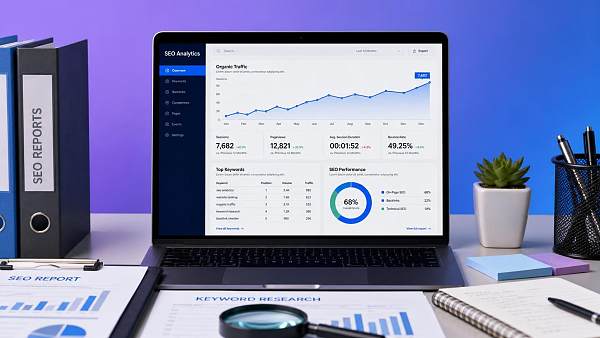
What businesses most often misjudge is not the length of time, but the wrong metrics
When evaluating SEO progress, many management teams focus only on whether there has been obvious traffic growth. This view is too simplistic.
A more reasonable approach is to evaluate metrics by stage:
At the initial stage, look at whether technical fixes have been completed, whether pages are being crawled normally, whether core pages have entered the index, and whether keywords have begun to receive impressions.
At the intermediate stage, look at whether long-tail keyword rankings are increasing in the target countries and languages, whether key product pages are gradually entering the top 20, and whether organic traffic sources are becoming more precise.
At the later stage, look at whether visits to inquiry pages are increasing, whether the conversion path is becoming smoother, and whether the quality of business opportunities generated by organic traffic is stable.
If a website has not experienced a dramatic traffic increase after three months, that does not necessarily mean SEO has failed. Conversely, if indexing has improved, keyword coverage has broadened, and target page rankings continue to rise, this usually indicates that the direction is correct. The real risks are that technical issues remain unresolved after several months, content has not developed into a topic-based system, and traffic sources are unrelated to the business products.
The logic for judging timelines differs for new websites, established websites, and overseas trade websites
The biggest challenge for a new website doing SEO is not insufficient effort, but a lack of accumulated trust. Search engines usually need time to determine whether a website is stable, whether its content is updated consistently, and whether its topics are clearly defined. Therefore, new websites should focus more on site architecture, country- and language-version logic, product categorization, and page indexing management during the initial stage, rather than rushing to pursue rankings for highly competitive keywords.
The situation with older websites is often the opposite. They may have a certain history, but their content may be disorganized, they may have too many outdated pages, their tags and categories may be out of control, or they may have previously built low-quality backlinks. In such cases, the SEO timeline will not naturally be shorter; in many cases, the site must first “clean up its historical baggage.”
Overseas trade websites also face a special factor: multiple languages and regions. Many businesses assume that translating a Chinese website into English completes the foundation of overseas SEO. In reality, search methods, keyword expressions, and purchasing information structures differ across markets. If the English, French, Spanish, and Russian versions are merely mechanically translated, both rankings and conversions will be difficult to optimize. If business decision-makers overlook this point, they will underestimate the true resultados seo tiempo timeline.
Which situations indicate that slow SEO is normal, and which indicate that the direction is wrong?
Normal “slowness” generally has several characteristics: the number of indexed pages increases steadily; core pages receive impressions but their rankings are still improving; organic traffic fluctuates but trends upward overall; long-tail keywords gain traction first and then gradually drive more core keywords; and although inquiries are not yet numerous, their relevance is improving.
Slow progress caused by the wrong direction is often reflected in the following: a large amount of content has been created without corresponding business topics; traffic growth mainly comes from irrelevant informational keywords; website technical problems remain unresolved for a long time; pages are indexed but do not rank; the target market is unclear, with an English website attempting to cover every country; and service providers report only the number of articles and backlinks without explaining changes in business-related pages.
What decision-makers most need to avoid is mistaking “taking action” for “building accumulated value.” SEO is not a competition based on workload; it is asset development. Rankings, content, page authority, user signals, and technical stability are the true sources of long-term compounding returns.
For businesses, whether SEO is worth waiting for depends mainly on the business model
Not every business is suited to making SEO its primary growth channel. Before making a decision, three points should be considered.
First, do customers actually search for suppliers online? If your target customers rely heavily on industry trade shows, distributors, or offline relationship networks, SEO is more of a brand supplement than a primary customer acquisition channel.
Second, does the product have sustained search demand? Products with a high degree of standardization, clear specifications, and a purchasing process that involves repeated comparison are more suitable for long-term SEO development. For highly customized, completely non-standard businesses with unstable search terms, the role of SEO will be relatively limited.
Third, is the business willing to accept a medium- to long-term investment model? Unlike advertising, where you can open an account today and generate traffic tomorrow, SEO is more like managing a digital asset. If a business has a short budget approval cycle and must see clear ROI within three months, a pure SEO strategy will often come under pressure.
This is why many mature businesses are beginning to adopt a coordinated model combining “website development, SEO, advertising, and social media”: use advertising in the short term to obtain validation and cash flow, rely on SEO in the medium term to reduce customer acquisition costs, and use content and branding in the long term to improve organic visibility. This approach is more stable than relying entirely on a single channel.
From a management perspective, this logic of “long-term development plus phased validation” is not limited to marketing. In digital operations, the optimization of many management systems also requires laying the foundation first and then evaluating efficiency gains. For example, the topic How to Optimize Personnel and Payroll Management in Public Institutions in the Digital Economy Era essentially involves first establishing process and data systems and then gradually unlocking management value. SEO follows a similar logic.
If you are evaluating an SEO project, what questions should you ask the service provider?
Businesses do not necessarily need to execute SEO themselves, but they must know how to determine whether a service is reliable.
Instead of asking “How long will it take to see results?”, you should ask:
How will the target markets and language versions be divided?
During the first three months, will the focus be on technical fixes, content development, or page restructuring?
Which metrics will be used to demonstrate that the project is progressing in the right direction?
Which business pages will receive the core traffic, rather than which generic traffic articles?
If there is no significant improvement after six months, what is the most likely cause?
Teams that can answer these questions are generally more trustworthy than those that only promise to “get you to the top of the search results quickly.” For overseas trade businesses targeting international markets in particular, SEO is no longer simply a matter of publishing articles and building links. It requires comprehensive capabilities in site technology, content architecture, localized expression, and channel coordination.
Having the right expectations about results is more important than blindly pursuing speed
SEO is never simply a matter of faster being better. For businesses, what matters more is whether results are sustainable, whether traffic matches the business, and whether it can later accumulate into a long-term asset.
If your website is just getting started, the focus during the first few months should not be anxiety over “why there has been no breakout,” but confirming that the direction is correct. If you have already been working on SEO for some time, you need to determine whether organic traffic is truly being concentrated on high-value pages, rather than remaining at the level of superficial visit growth.
Therefore, the answer to resultados seo tiempo is not mysterious: it usually takes time, but that does not mean waiting without a plan. How quickly you can see changes in organic traffic depends on whether the business has the right website foundation, a clear target market, continuous content development, and an actionable evaluation mechanism.
For business decision-makers, the most valuable step is not to keep asking for a universal answer to “how many months until results?” but to place SEO within the broader business decision: Is it suitable for your industry? Do your customers actually search? Is your team willing to build value over the long term? Once these questions are clear, time will no longer be merely a source of anxiety, but a manageable investment cycle.
When a business truly understands this, SEO is no longer just a marketing action, but foundational capability building within an overseas growth system. Including digital management topics such as How to Optimize Personnel and Payroll Management in Public Institutions in the Digital Economy Era, nearly all long-term effective system optimization follows the same principle: establish the right structure first, then allow compounding value to emerge.
Related Articles


Related Products
 Yiyingbao SaaS Intelligent Website Building and Marketing SystemYiyingbao SaaS Intelligent Website Building and Marketing System, AI-powered no-code website building, rapid creation of multilingual B2B international websites in 10 minutes, global server acceleration, AI-powered SEO optimization, helping businesses connect efficiently with global markets. The perfect integration of technology and operation makes building an international trade website remarkably simple
 AI+SEM Intelligent Advertising Marketing SystemAI+SEM drives intelligent ad creation, empowering full-funnel precision advertising marketing. The system automatically generates weekly/monthly reports, AI recommends keywords and target countries, monitors core metrics in real-time with intelligent alerts, and enables one-click high-conversion ad solutions to help quickly acquire customers and improve ROI.
 AI+SEO Dual-Engine System Optimization ServicesYiyingbao’s AI+SEO dual-engine optimization system helps foreign trade enterprises acquire high-quality organic traffic through AI-powered keyword research, content generation, and comprehensive technical optimization, significantly improving search rankings and conversion rates.
 AI+SNS Social Media Marketing SystemYingbao AI+SNS Social Media Marketing System - Precision social capture for the social media era. Supports one-click content synchronization across major platforms like Facebook and LinkedIn. AI intelligently rewrites posts for enhanced relevance. 24/7 AI customer service and user profiling analysis empower businesses to efficiently expand into global markets.
 AI+SEO营销解决方案易营宝AI+SEO营销解决方案,通过AI批量写作、智能生成TDK、精准关键词扩词等功能,全面优化网站SEO效果,提升流量与转化率。助力企业构建高效智能网站新生态。
 AI+SEM Advertising Marketing SolutionsAI+SEM Advertising Marketing Solution leverages AI technology to deeply empower SEM ad campaigns. It automatically generates weekly/monthly reports using AI, presenting account data across multiple dimensions for comprehensive insights into campaign performance and trends. The system precisely recommends keywords and target countries, intelligently generates high-conversion ad copy, and enables one-click activation of efficient campaign plans to help businesses rapidly acquire customers. Simultaneously, it monitors core metrics in real time, intelligently identifies abnormal fluctuations, and issues timely alerts to ensure stable, high-return advertising results.
 Domain Name ServicesEasyWin provides professional domain name services, including intelligent queries, one-stop registration, brand protection, and full lifecycle management, helping businesses build a digital brand image.
 EasyOperate B2C Cross-Border E-Commerce Platform & Independent WebsiteEasyStore B2C Cross-border E-commerce Independent Store is an intelligent website building and cross-border e-commerce integrated solution independently developed by EasyStore Information Technology (Beijing) Co., Ltd. The system is specially designed for small and medium-sized as well as large export enterprises, integrating 'website building, operation, marketing, advertising, and conversion' into one, helping enterprises quickly establish cross-border e-commerce independent stores to achieve brand globalization and global sales growth.
The platform supports multiple languages, multiple currencies, and multi-channel marketing, with built-in AI intelligent translation and SEO optimization systems, suitable for mainstream markets such as Southeast Asia, Europe and America, Latin America, and the Middle East, assisting Chinese manufacturing enterprises in efficiently deploying international e-commerce strategies. SSL证书易营宝提供专业SSL安全证书服务,包括单域名和泛域名证书,确保网站数据传输加密、身份验证和完整性保护,助力企业建立安全可信的在线业务环境。









