









- Can the average annual growth rate reflect real opportunities in overseas markets?Oct 07, 2026View details
- Which customer acquisition channels will be affected by cross-border marketing trends in 2026?Sep 06, 2026View details
- Which homogenization risks should be considered in an analysis of the AI-powered website building industry?Aug 30, 2026View details
- How Will AI Marketing Trends 2026 Change Advertising Budget AllocationAug 28, 2026View details
- Is the EV SSL certificate market shrinking or upgrading? How should companies assess certificate procurement?Aug 11, 2026View details
- Why the old AMP SEO 2020 practices no longer work and what has changed in current optimization prioritiesAug 02, 2026View details
Which page issues should be checked first when SEO rankings fluctuate significantly?
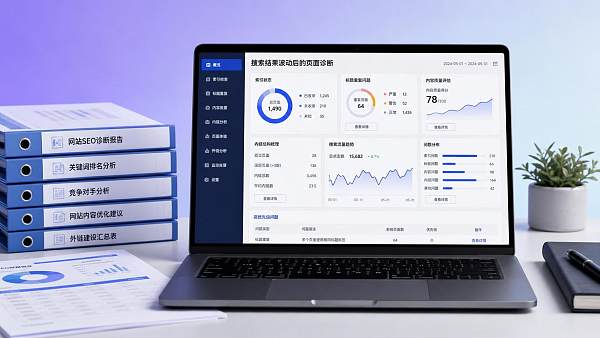
What people doing SEO fear most is not a temporary drop in rankings, but not knowing where to start investigating. When many websites experience ranking seo fluctuations, the first reaction is to change titles, replace keywords, or add backlinks. In reality, the more common problems often lie in the page fundamentals: whether the page is properly indexed, whether titles conflict with one another, whether the content has been judged to be low value, whether internal links are passing authority in the wrong direction, and whether page speed and accessibility have suddenly deteriorated. Only after checking these areas can you avoid taking the wrong troubleshooting path.
If you have recently noticed that several core keywords are rising and falling, or that a page was still on the first two pages yesterday but disappeared today, do not rush to conclude that an algorithm update is responsible, and do not revise the entire site all at once. A more practical approach is to isolate the fluctuating pages and examine them one by one.
First, check whether the page itself has an indexing or inclusion problem
This should be the first priority. Many so-called ranking seo fluctuations may look like ranking changes, but are actually caused by an unstable page indexing status.
The most common situations include:
- The page still exists but has been removed from the index;
- The page can be crawled but has been classified as crawled but not indexed;
- There are too many pages covering the same topic, so the search engine has selected another URL as the representative page;
- The page has been negatively affected by canonical, noindex, parameter URLs, or an incorrect redirect.
Do not check only the homepage or category pages at this stage. Directly inspect the URLs with the greatest fluctuations. Multilingual websites, B2B websites with many product pages, and cross-border e-commerce sites are especially likely to encounter a situation where the page exists, but not the page you expect is actually participating in ranking.
One useful rule of thumb is this: if ranking fluctuations are accompanied by a sudden, cliff-like drop in impressions, while you have not made any significant changes to the page content, suspect the indexing status before questioning the keyword strategy.
Duplicate titles, descriptions, and H tags are an old problem many people overlook
This problem is not new, but it remains common. Websites that use templates to generate pages in bulk often have the homepage, category pages, and detail pages sharing the same title structure. As a result, multiple pages compete for the same set of search terms.
On the surface, several pages may appear to be targeting the same keyword. In practice, the search engine often cannot determine which page should rank, so the ranking switches repeatedly and none of the pages remains stable.
Focus on three areas:
- Whether Title tags are duplicated on a large scale, especially on bulk pages where only the city name, model name, or country name has been replaced;
- Whether H1 matches the Title and the main topic of the body content, or whether a separate version was written solely to insert keywords;
- Although Meta descriptions do not directly determine rankings, whether they reveal a high degree of similarity in page topics.
Many practitioners mistakenly believe that the more consistently a keyword appears, the safer it is. That is not necessarily true. Consistency does not equal clarity. Unclear boundaries between page topics are more likely to make ranking seo unstable.
Content quality is not about word count, but whether the page deserves to rank
Many pages lose rankings not because they have no content, but because they have content without value. These are very different situations.
For example, some product pages may not be short, but their content consists almost entirely of generic descriptions. Some service pages may contain a considerable amount of text, yet fail to clearly explain the delivery scope, applicable scenarios, limitations, regional differences, and frequently asked questions that users actually care about. Such pages may initially rank by relying on the website's overall authority, but once they enter a more detailed quality assessment, their rankings may begin to fluctuate.
When evaluating content quality, I recommend considering the following perspectives:
- Is the page answering a specific question, or merely repeating generic industry statements?
- Does the content match search intent? For example, if users want to solve a problem, have you written a company introduction instead?
- Does it include real usage scenarios, operational details, and limitation reminders, rather than only advantages, features, and professional services?
- Are multiple pieces of content on the same site discussing essentially the same thing, creating internal competition?
In practical optimization, foreign trade websites, manufacturing websites, and independent sites are especially prone to one misconception: making a page look like a corporate brochure instead of a landing page that search engines can understand. This directly affects ranking stability.
For websites targeting overseas markets over the long term, content quality must also take localized expression into account. Platforms such as 易营宝, which provide long-term services for overseas marketing scenarios, are able to combine intelligent website building, SEO, advertising, and multilingual content precisely because many ranking seo problems do not occur only at the keyword level. They also arise from page structure, language adaptation, and whether conversion content matches search intent.
Do not underestimate the internal linking structure; it often determines which page is the primary page
Many websites have unstable rankings not because they lack internal links, but because their internal links are arranged too casually.
A typical scenario is that article pages, product pages, and case study pages use similar anchor text to point to different URLs. The signals received by the search engine become confusing. You may think you are strengthening the topic, but in practice you are dispersing it.
During an investigation, focus on the following:
- Whether the main landing page corresponding to the core keyword is consistently linked from multiple locations across the site;
- Whether multiple similar pages link to one another in a cross-linked pattern, causing authority to be passed back and forth;
- Whether the navigation, breadcrumbs, related recommendations, and body anchor text convey consistent topic signals;
- Whether pages that are no longer important or have become outdated still occupy a large number of internal-link entry points.
If a keyword should clearly be handled by a service page, but most internal links instead pass the signal to an old article, ranking fluctuations are not surprising. A page's performance is not determined solely by what it contains. It also depends on how the entire site tells the search engine how important that page is.
Speed, accessibility, and the mobile experience are often triggers for a sudden decline
These problems are especially likely to appear after a redesign, the addition of plugins, a server change, or the integration of third-party scripts. The fact that a page can open does not mean that its condition is normal. Heavier above-the-fold resources, blocked JS, abnormal image loading, and misaligned mobile buttons can all cause a previously stable page to begin fluctuating.
The following situations should be checked first:
- Whether the page template has recently been changed or pop-ups and tracking code have been added;
- Whether the mobile version has CLS layout shifts, slow font loading, or the main content being pushed downward;
- Whether overseas users are experiencing an excessively high TTFB because of node-related issues;
- Whether important content is rendered after a delay by scripts, preventing crawlers from retrieving the complete body content.
Many practitioners focus only on position changes in keyword tools and do not check whether the page has undergone recent technical adjustments. This can delay diagnosis. Technical abnormalities that cause ranking seo fluctuations often do not result in a gradual decline, but rather a sudden drop.
Some fluctuations are not caused by a poor page, but by incorrect page positioning
This point is critical. You may have made a page very comprehensive, but it may not be suitable for targeting the current keyword at all.
For example, users may search for terms with clear comparison or problem-solving intent, while you provide a company introduction page. Users may search for a product term, while you use a general educational article to compete for the ranking. Users may want localized procurement information, while you provide a global template page. There may be no obvious problem with the page itself, yet its ranking remains unstable because the search intent does not match.
When making an assessment, ask yourself one question: If I were the searcher, could I confirm within 30 seconds of entering this page that it is exactly what I need? If not, even if the page ranks temporarily, it will be difficult for it to maintain that position.
It is also worth noting that informational content and conversion-oriented pages should not be forced into the same format. A title such as Research on the Current Status and Optimization Strategies of Human Resource Management in Public Hospitals is more suitable for a specialized study or knowledge content addressing a specific search need, rather than being placed in a marketing landing page and forced to drive conversions. Matching the page type with keyword intent generally results in greater stability.
The investigation order is more important than whether the list of items is comprehensive
If you have many pages and cannot check them all at once, we recommend following this order:
- First confirm the indexing and crawling status;
- Then check whether the title, H1, and canonical conflict;
- Next examine whether the page content is duplicated or deviates from search intent;
- Then check whether internal links have confused the signals for the primary page;
- Finally inspect speed, mobile performance, and recent technical changes.
The advantage of this order is that it eliminates the most fundamental and impactful problems first. Many people begin by rewriting copy or rebuilding pages, only to discover that the canonical was misconfigured and that most of the earlier work was unnecessary.
If the website has a multilingual, multi-region, or multi-product structure, or runs SEO, advertising, and social media traffic acquisition at the same time, page problems are often not isolated faults but chain-related problems. The value of platforms such as 易营宝, which provide integrated intelligent website building and overseas marketing services, lies in viewing website structure, content strategy, SEO optimization, and subsequent advertising within the same framework. This makes it easier to identify the real reason why certain pages are always unstable, instead of treating only the immediate symptom.
Several common misconceptions: the earlier you avoid them, the more time you save
First, making major changes to a page whenever rankings fluctuate. Many pages are only experiencing short-term turbulence. Frequently changing the title and body content or deleting paragraphs may instead cause the system to reassess the page and extend the recovery time.
Second, looking at only a single keyword. What matters more is the impressions, clicks, long-tail keyword coverage, and stability cycle generated by the entire page. A drop in one keyword does not necessarily mean that there is a problem with the page.
Third, attributing every problem to an algorithm. Algorithms can affect rankings, but not every fluctuation is caused by an algorithm. Site structure, duplicate content, and loading abnormalities are more common causes.
Fourth, adding pages blindly. Before existing pages have been organized properly, continuing to expand content in bulk can make internal competition even more severe.
If you are currently dealing with ranking seo fluctuations, the most reliable approach is not to immediately take more action, but to first confirm which type of page is declining and whether the decline concerns indexing, topic interpretation, or experience signals. Once this is clear, subsequent optimization will have a direction.
FAQ
1. If ranking fluctuates for several days, does it need to be addressed immediately?
Not necessarily. First determine whether it is a fluctuation in a single keyword or a sustained decline in impressions and clicks for the entire page. Short-term fluctuations are common. It is more prudent to assess the situation together with the page status after the decline has continued for 1 to 2 weeks.
2. Why is the ranking still unstable when the page is indexed normally?
Indexing is only a prerequisite. It does not mean that the page quality, topic relevance, internal-link signals, and user experience are all free of problems. For many unstable pages, the problem lies in one of these later factors.
3. Will adding more keywords to the title make recovery easier?
Usually not. An overly full title and a scattered topic can instead make the page positioning unclear and affect stability.
4. If an old page loses rankings, should it be deleted and rebuilt directly?
Do not rush. First determine whether the cause is outdated content, page conflicts, or a technical problem. Many old pages can recover through consolidation, supplementation, and structural corrections; deletion is not always necessary.
Image placeholder checklist
img_01: Recommended after the section on indexing and inclusion troubleshooting to show a flowchart of the page troubleshooting process; alt text: Illustration of the page troubleshooting sequence when SEO rankings fluctuate
Internal-link anchor text recommendations
- How to troubleshoot abnormal Google indexing: Recommended link to the special topic page on indexing and crawling issues
- How to handle duplicate website titles: Recommended link to the on-site SEO fundamentals optimization page
- SEO structural optimization for multilingual websites: Recommended link to the multilingual website building solutions page
- How to optimize independent-site page loading speed: Recommended link to the website technical optimization services page
- How to match search intent with landing pages: Recommended link to the content strategy or SEO content planning page
Recommended authoritative external sources
- Official webmaster documentation from search engines
- Official technical documentation for website performance evaluation tools
- Research materials from academic institutions or industry research organizations on web page quality and usability
What is truly difficult to deal with is not ranking seo fluctuations, but consistently using the wrong troubleshooting sequence. Once page problems are identified, you will know which issues to change and which to leave alone for the time being. For practitioners, this is more effective than blindly chasing trending tactics and is closer to achieving stable growth.
Related Articles

Related Products
 Yiyingbao SaaS Intelligent Website Building and Marketing SystemYiyingbao SaaS Intelligent Website Building and Marketing System, AI-powered no-code website building, rapid creation of multilingual B2B international websites in 10 minutes, global server acceleration, AI-powered SEO optimization, helping businesses connect efficiently with global markets. The perfect integration of technology and operation makes building an international trade website remarkably simple
 AI+SEM Intelligent Advertising Marketing SystemAI+SEM drives intelligent ad creation, empowering full-funnel precision advertising marketing. The system automatically generates weekly/monthly reports, AI recommends keywords and target countries, monitors core metrics in real-time with intelligent alerts, and enables one-click high-conversion ad solutions to help quickly acquire customers and improve ROI.
 AI+SEO Dual-Engine System Optimization ServicesYiyingbao’s AI+SEO dual-engine optimization system helps foreign trade enterprises acquire high-quality organic traffic through AI-powered keyword research, content generation, and comprehensive technical optimization, significantly improving search rankings and conversion rates.
 AI+SNS Social Media Marketing SystemYingbao AI+SNS Social Media Marketing System - Precision social capture for the social media era. Supports one-click content synchronization across major platforms like Facebook and LinkedIn. AI intelligently rewrites posts for enhanced relevance. 24/7 AI customer service and user profiling analysis empower businesses to efficiently expand into global markets.
 AI+SEO营销解决方案易营宝AI+SEO营销解决方案,通过AI批量写作、智能生成TDK、精准关键词扩词等功能,全面优化网站SEO效果,提升流量与转化率。助力企业构建高效智能网站新生态。
 AI+SEM Advertising Marketing SolutionsAI+SEM Advertising Marketing Solution leverages AI technology to deeply empower SEM ad campaigns. It automatically generates weekly/monthly reports using AI, presenting account data across multiple dimensions for comprehensive insights into campaign performance and trends. The system precisely recommends keywords and target countries, intelligently generates high-conversion ad copy, and enables one-click activation of efficient campaign plans to help businesses rapidly acquire customers. Simultaneously, it monitors core metrics in real time, intelligently identifies abnormal fluctuations, and issues timely alerts to ensure stable, high-return advertising results.
 Domain Name ServicesEasyWin provides professional domain name services, including intelligent queries, one-stop registration, brand protection, and full lifecycle management, helping businesses build a digital brand image.
 EasyOperate B2C Cross-Border E-Commerce Platform & Independent WebsiteEasyStore B2C Cross-border E-commerce Independent Store is an intelligent website building and cross-border e-commerce integrated solution independently developed by EasyStore Information Technology (Beijing) Co., Ltd. The system is specially designed for small and medium-sized as well as large export enterprises, integrating 'website building, operation, marketing, advertising, and conversion' into one, helping enterprises quickly establish cross-border e-commerce independent stores to achieve brand globalization and global sales growth.
The platform supports multiple languages, multiple currencies, and multi-channel marketing, with built-in AI intelligent translation and SEO optimization systems, suitable for mainstream markets such as Southeast Asia, Europe and America, Latin America, and the Middle East, assisting Chinese manufacturing enterprises in efficiently deploying international e-commerce strategies. SSL证书易营宝提供专业SSL安全证书服务,包括单域名和泛域名证书,确保网站数据传输加密、身份验证和完整性保护,助力企业建立安全可信的在线业务环境。









