









- Hapag-Lloyd’s $4.2 billion acquisition of ZIM faces a closing delay; ZIM reports third-quarter net profit of $830 millionNov 24, 2026View details
- SCFI falls for a third straight week to 3,503.78 points, with blank sailings on trans-Pacific routes rising to 10Nov 24, 2026View details
- Lazada 11.11 Mega Sale: LazMall Contributes Nearly Two-Thirds of GMVNov 23, 2026View details
- Shein’s European Revenue Falls 16% as Tighter Rules on Low-Value Direct Shipments Take EffectNov 23, 2026View details
- EU Low-Value Parcel Rules Impact Cargo Flows: Air Freight Volume from China to Europe Down 17% in OctoberNov 23, 2026View details
- Indonesia and the EU Sign Comprehensive Economic Partnership Agreement, 90.4% of Tariff Lines to Become Duty-Free ImmediatelyNov 23, 2026View details
Is an SEO ranking decline caused by duplicate content?

When traffic trends and keyword rankings decline at the same time, operators often first suspect, “Could the content be duplicated?” This assessment has some merit, but the two cannot be directly equated: duplicate content may weaken page indexing, authority consolidation, and search result display, but it is not the only cause of declining SEO rankings. Incorrectly deleting pages on a large scale may instead result in the loss of existing long-tail traffic and established backlink signals.
A more prudent approach is to first confirm whether search engines regard multiple pages as substitutes serving the same intent; whether ranking declines occur sitewide, within a directory, or on only a few pages; and whether the duplication is in the main content, page parameters, or technical versions. Once the scope is confirmed, decide whether to consolidate, canonicalize, rewrite, or retain the pages.
First, distinguish which types of “duplication” truly affect rankings
The presence of similar text on a website does not necessarily create a problem. Product specification pages, regional service pages, multilingual pages, or paginated listing pages often share navigation, footers, explanatory modules, and certain fixed fields. Search engines can generally recognize this type of template-based duplication. What warrants more attention is when multiple independently accessible URLs provide nearly identical main content and compete for the same set of search terms.
For example, the same service introduction may exist at URLs with and without parameters; HTTP, HTTPS, www, and non-www versions may all be accessible; the same product may differ only in model name, color, or city name while the main text remains nearly unchanged; or multiple articles in a content library may answer the same question, with slightly different titles but no additional information. These situations can make it difficult for search engines to determine which page should be displayed first, ultimately resulting in pages taking turns ranking, reduced indexing, or a target page being unable to consistently reach higher positions.
Determine whether duplicate content is the cause based on ranking performance
Do not rely solely on the percentage shown by “duplication rate” tools. It is more valuable to observe actual signals in search results and webmaster tools. First, select pages that have experienced significant ranking declines over a recent period, record their primary queries, impressions, clicks, and current landing pages, and then compare them with similar pages on the site.
- Multiple landing pages for the same query: If different URLs receive impressions on different dates and rankings switch frequently, page intent may overlap.
- Replacement notices in indexing status: For example, the system selected another canonical page or found a duplicate page but did not index it. Check whether the canonicalization settings align with the actual intent.
- A page is indexed but receives almost no impressions: If its content is highly similar to an older page on the site and the new page lacks unique information, search engines may not grant it additional display opportunities.
- Only a group of similar pages declines: For example, if batch-generated regional pages or tag pages perform worse, first check whether the main content merely replaces a small number of words.
Conversely, if SEO rankings decline across multiple directories and topics without obvious overlap between pages, prioritize checking crawl anomalies, site redesigns, indexing restrictions, changes in internal links, page loading issues, or fluctuations in search demand. Attributing all sitewide issues to duplicate content often slows down the remediation process.
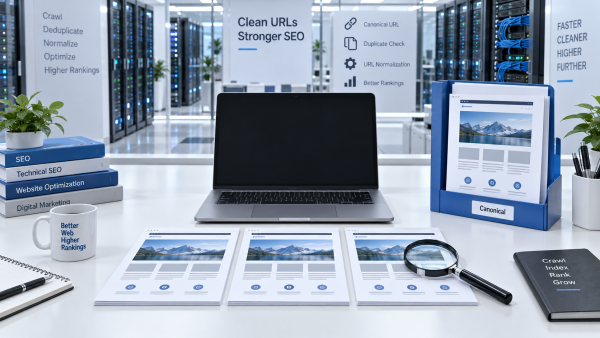
Check URLs first, then review the page content
Technical duplication is more concealed than copy duplication and is more likely to arise after a website redesign, the launch of filtering features, or adjustments to multilingual settings. First, use site search, crawling tools, or the website management backend to export URLs and check whether the same page can be accessed in multiple forms. Focus on uppercase and lowercase URLs, trailing slashes, index files, tracking parameters, filter parameters, print pages, and separate mobile URLs.
Do not point canonical pages to the homepage indiscriminately
For pages with identical or highly similar content where only one version should be retained for ranking, use a canonical tag pointing to the preferred URL. The canonical page should contain complete content, be accessible, be allowed to be indexed, and be the page you most want to rank. Canonicalizing a large number of unrelated pages to the homepage will not make the homepage inherit all their value; instead, it may cause search engines to ignore the declaration.
For filter combinations, internal search pages, or duplicate parameter pages that clearly do not need to appear in search results, use noindex as appropriate, or restrict the generation of indexable URLs at the source. Old URLs that no longer have visit value and have one-to-one replacement pages can use permanent redirects. These three approaches serve different purposes: canonical is used for version consolidation, noindex is used to exclude pages from indexing, and redirects are used for URL migration. They cannot replace one another.
When content overlaps, decide whether to “keep, consolidate, or revise”
Whether a page should be retained should not be determined solely by publication date or word count, but by whether it serves an independent search intent. If two pages address the same user questions, decision-making stage, and information they can provide, they should generally be consolidated into one page. When consolidating, retain the URL with more stable historical performance and more concentrated backlinks and internal links, add the other page’s useful paragraphs, image descriptions, Q&A, or parameters to the main page, and then implement a redirect.
For pages that need rewriting, the focus is not on replacing original sentences with synonyms, but on adding information users cannot obtain from other pages. You can add applicable scenarios, limitations, operating procedures, specification differences, delivery scope, frequently asked questions, and selection criteria. Page titles, main headings, descriptions, and internal anchor text should also reflect an independent topic, avoiding minor variations around the same core term across multiple pages.
Do not judge success by rankings immediately after remediation
After completing consolidation or canonicalization, first check whether redirects are single-hop, whether canonicals point correctly, whether the target page can be crawled, and whether site navigation, related recommendations, and links in older articles have been unified to the main page. Then observe index coverage in search console tools and continue comparing whether the queries generating impressions for the main page have become more concentrated.
Ranking recovery does not necessarily occur immediately, because search engines need to recrawl, process duplicate relationships, and reassess pages. However, if URL rotation still occurs after a period of time, return to the question of whether search intent overlaps. This is especially important for batch-generated pages: correct technical settings do not mean the content has independent value. Only when every retained page can answer a clear and different question will duplicate content no longer continue to drag down SEO rankings.
Related Articles
 Google Confirms Completion of the November 2026 Core Algorithm Update Rollout
 How to Expand Website Content Topics Using Competitor Keywords
 How can you detect markup errors in structured data on a webpage?


Related Products
 Yiyingbao SaaS Intelligent Website Building and Marketing SystemYiyingbao SaaS Intelligent Website Building and Marketing System, AI-powered no-code website building, rapid creation of multilingual B2B international websites in 10 minutes, global server acceleration, AI-powered SEO optimization, helping businesses connect efficiently with global markets. The perfect integration of technology and operation makes building an international trade website remarkably simple
 AI+SEM Intelligent Advertising Marketing SystemAI+SEM drives intelligent ad creation, empowering full-funnel precision advertising marketing. The system automatically generates weekly/monthly reports, AI recommends keywords and target countries, monitors core metrics in real-time with intelligent alerts, and enables one-click high-conversion ad solutions to help quickly acquire customers and improve ROI.
 AI+SEO Dual-Engine System Optimization ServicesYiyingbao’s AI+SEO dual-engine optimization system helps foreign trade enterprises acquire high-quality organic traffic through AI-powered keyword research, content generation, and comprehensive technical optimization, significantly improving search rankings and conversion rates.
 AI+SNS Social Media Marketing SystemYingbao AI+SNS Social Media Marketing System - Precision social capture for the social media era. Supports one-click content synchronization across major platforms like Facebook and LinkedIn. AI intelligently rewrites posts for enhanced relevance. 24/7 AI customer service and user profiling analysis empower businesses to efficiently expand into global markets.
 AI+SEO营销解决方案易营宝AI+SEO营销解决方案,通过AI批量写作、智能生成TDK、精准关键词扩词等功能,全面优化网站SEO效果,提升流量与转化率。助力企业构建高效智能网站新生态。
 AI+SEM Advertising Marketing SolutionsAI+SEM Advertising Marketing Solution leverages AI technology to deeply empower SEM ad campaigns. It automatically generates weekly/monthly reports using AI, presenting account data across multiple dimensions for comprehensive insights into campaign performance and trends. The system precisely recommends keywords and target countries, intelligently generates high-conversion ad copy, and enables one-click activation of efficient campaign plans to help businesses rapidly acquire customers. Simultaneously, it monitors core metrics in real time, intelligently identifies abnormal fluctuations, and issues timely alerts to ensure stable, high-return advertising results.
 Domain Name ServicesEasyWin provides professional domain name services, including intelligent queries, one-stop registration, brand protection, and full lifecycle management, helping businesses build a digital brand image.
 EasyOperate B2C Cross-Border E-Commerce Platform & Independent WebsiteEasyStore B2C Cross-border E-commerce Independent Store is an intelligent website building and cross-border e-commerce integrated solution independently developed by EasyStore Information Technology (Beijing) Co., Ltd. The system is specially designed for small and medium-sized as well as large export enterprises, integrating 'website building, operation, marketing, advertising, and conversion' into one, helping enterprises quickly establish cross-border e-commerce independent stores to achieve brand globalization and global sales growth.
The platform supports multiple languages, multiple currencies, and multi-channel marketing, with built-in AI intelligent translation and SEO optimization systems, suitable for mainstream markets such as Southeast Asia, Europe and America, Latin America, and the Middle East, assisting Chinese manufacturing enterprises in efficiently deploying international e-commerce strategies. SSL证书易营宝提供专业SSL安全证书服务,包括单域名和泛域名证书,确保网站数据传输加密、身份验证和完整性保护,助力企业建立安全可信的在线业务环境。









