









- Why the old AMP SEO 2020 practices no longer work and what has changed in current optimization prioritiesAug 02, 2026View details
- How to Choose Topics for an Industry News Section to Attract More Organic Search TrafficJul 29, 2026View details
- Digital Marketing Shenzhen Market Insights: Why Are Companies Expanding Overseas Looking for Growth Teams in Shenzhen?Jul 31, 2026View details
- Can Zhejiang foreign trade independent websites still be developed today? Look at changes in traffic and lead generationJul 28, 2026View details
- What New Signals Are Emerging in Enterprise Services SaaS Marketing ReportsJul 27, 2026View details
- What Does a Global Traffic Ecosystem Service Provider Do? What Are the Differences from a Single Advertising AgencyJul 16, 2026View details
Multilingual SEO experience: How to determine whether a service provider truly has hands-on experience
When Evaluating a Multilingual SEO Service Provider, Don't Be Misled by “Many Case Studies”
The most common mistake procurement teams make when evaluating multilingual seo experience is equating “having worked on multilingual websites” with “having actually delivered results.” These are two very different things. Being able to build multilingual websites, translate pages, and submit them to search engines for indexing only shows that a service provider understands the basic process. Whether they can grow traffic in different countries and languages, and whether they can turn visits into inquiries, registrations, or orders, is what truly demonstrates practical experience.
Truly experienced teams usually do not simply show you a collection of website screenshots or repeatedly emphasize that “we have served many industries.” They are more willing to discuss target markets, page indexing, keyword segmentation, localized content, conversion paths, and which metrics should increase or which problems should be addressed after three months. If procurement teams focus their evaluation on these areas, the screening process will be much more efficient.
First Clarify: Are They Delivering “Multilingual Pages” or “Multi-Market Growth”?
Many service providers make multilingual SEO sound simple, but their actual delivery often remains at the technical level: creating directories for several languages, configuring hreflang, and translating Chinese content into other languages. This is not necessarily wrong, but it is still far from genuine organic growth in overseas markets.
During discussions, procurement teams can ask three direct questions:
- Do you work by language or by national market?
- How do you differentiate the content strategy for the same language across different countries?
- Is the project goal growth in indexing, or growth in business-related metrics such as inquiries and transactions?
If the other party remains focused on “being able to create English, Japanese, and Spanish pages” but cannot clearly explain the differences between American and British English, Latin American Spanish and European Spanish, or the search habits of different Arabic-speaking regions, their experience is likely more focused on website-building delivery than growth delivery.
Don't Look Only at the Number of Case Studies—See Whether They Can Break Them Down by Market, Keyword, and Page
The statement “we have worked on many projects” has limited reference value. What you need to evaluate is not the number of case studies, but whether they can explain them clearly in detail.
A more useful approach is to see whether the service provider can explain where the target market was, whether the main focus was on branded keywords, category keywords, or scenario-based keywords; which pages attracted traffic and which pages handled conversions; whether indexing issues were addressed first or the site structure was revised first; and why one language grew quickly while another grew slowly.
If they cannot explain these details, it often means they merely “participated in” the case rather than “led and reviewed” it.
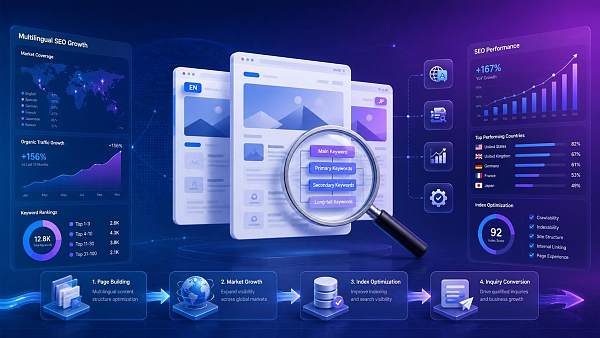
Ranking Data Matters, but Rankings Alone Are Not Enough
Procurement teams are often impressed when “certain keywords reach the first page.” This is understandable, but the assessment is still incomplete. Keywords differ in search volume and business value. Ranking for a low-volume keyword with weak transaction intent does not mean the project was successful.
A more reliable approach is to break the data down into four levels:
- Whether visible ranking growth has occurred in the target country or region;
- Whether the traffic comes from keywords relevant to the core business;
- Whether the bounce rate, time on site, and conversion path after users enter the site are normal;
- Whether the growth is sustained rather than a short-term fluctuation.
If a service provider only shows ranking screenshots without presenting traffic structure and conversion performance, procurement teams should take a closer look. SEO is not a screenshot production exercise. Especially in multilingual projects, search volume, competition, and conversion thresholds differ across markets, so relying on a single ranking can easily lead to an incorrect assessment.
Localization Is Not Translation: Procurement Should Focus on These Areas
The most common reason multilingual SEO fails is not that the technical work was incomplete, but that the content looks too much like a “translated version.” Search engines can recognize semantics, and users can also sense unnatural wording. A page may appear grammatically correct, but if its title, selling points, units, delivery methods, contact details, and trust elements do not match local habits, the traffic will not stay or convert.
During procurement, you can ask the service provider to demonstrate the following:
- Whether the titles and descriptions on pages in different languages use the same writing approach or have been adjusted to local search habits;
- Whether product or service pages change units of measurement, delivery-time expressions, payment details, or logistics information according to the market;
- Whether form fields, button copy, telephone country codes, and address formats are adapted to local users;
- Whether the content contains obvious signs of machine translation.
These details may not seem impressive, but they reveal a great deal. Teams with genuine multilingual seo experience generally view localization as part of conversion optimization, rather than as a translation task left until the final step before launch.
Technical Capabilities Should Be Evaluated by Their Ability to Handle Common Structural Issues on Multilingual Websites
Multilingual SEO is not purely a content task. If the technical foundation is unstable, much of the subsequent content work can be wasted. Procurement teams do not need to be developers, but they should at least know whether the service provider has handled these common issues:
A few rounds of discussion on these topics are usually enough to reveal the depth of their experience. Many teams will simply say, “We can handle all of that.” Those that can clearly explain the trade-offs based on the site architecture are closer to truly experienced service providers.
Don't Overlook the Conversion Journey—Even Excellent SEO Is Useless If the Site Cannot Handle the Traffic
Ultimately, evaluating multilingual SEO must come back to business results. In scenarios such as B2B inquiry generation, cross-border e-commerce orders, and overseas landing-page lead generation, traffic is only the first half of the process. Whether the service provider has considered conversion can usually be seen from the following areas: whether pages are structured according to search intent, whether forms are concise, whether inquiry buttons are prominent, whether mobile loading is smooth, and whether the contact process matches the habits of overseas users.
If a service provider also has coordinated capabilities in website building, SEO, advertising, and content, it is generally easier to connect organic traffic with subsequent conversions. For procurement teams, the value of this integrated capability does not lie in “bundling projects,” but in being able to identify more quickly whether a problem comes from content, technology, or the page's ability to handle visitors.
How Reports Are Delivered Reveals More About Real Capabilities Than Whether They “Can Do the Work”
Experienced service providers usually do not fill their reports with data alone. They will tell you which language pages were newly indexed this month, which countries are seeing increased clicks, which keywords have impressions but no clicks, which pages need additional content, which pages need revised titles, and which problems will slow future growth if left unresolved.
Procurement teams can directly request to see a redacted monthly report. The key is not the layout, but whether it contains action recommendations and causal analysis. If a report only describes results such as “traffic increased” and “rankings improved” without corresponding actions, it may simply be data repackaging.
Some procurement teams also use checklist-based methods to manage projects. For example, when conducting cross-departmental evaluations, they may refer to materials such as Application Strategies for Performance Budget Management in Public Institution Financial Management. The underlying logic is actually similar: the focus is not only on what was invested, but on whether objectives, processes, and results are connected.
Ask How They Handle Ongoing Optimization—This Step Is Critical
Multilingual SEO does not end when a website goes live. Markets differ, content decay rates, competitor actions, and search result formats all change. Without continuous optimization capabilities, a service provider may appear effective during the first two months but then easily stagnate.
You can ask about the following details:
- How long after a new language page goes live do they recheck indexing, clicks, and bounce rates?
- Which data triggers a page rewrite, and which data triggers a structural adjustment?
- When traffic in a particular country fails to increase, do they first investigate content, backlinks, or technical issues?
- Will they combine AI search visibility, traditional search results, and advertising keyword data to refine content topics?
If they can clearly explain the optimization schedule, it shows that they are not only capable of one-time delivery, but also understand how to move the project forward.
When Implementing the Procurement Process, Consider Screening Providers in This Order
In practice, I recommend dividing service provider screening into three rounds. The first round evaluates market understanding and confirms whether the provider treats multilingual SEO as multi-market growth. The second round evaluates case-study details and technical capabilities, focusing on whether they can explain the relationship between rankings, indexing, localization, and conversion. The third round evaluates sample monthly reports and optimization mechanisms to determine whether the project can continue progressing after delivery.
In the end, do not base the decision solely on “who offers the lowest price” or “whose case-study page looks the best.” What procurement teams are really buying is not several language pages or a keyword list, but a team capable of connecting target markets, site structure, content localization, and conversion results. A service provider that can withstand this evaluation will usually have multilingual seo experience that is more than just a phrase written in a proposal.
Related Articles


Related Products
 Yiyingbao SaaS Intelligent Website Building and Marketing SystemYiyingbao SaaS Intelligent Website Building and Marketing System, AI-powered no-code website building, rapid creation of multilingual B2B international websites in 10 minutes, global server acceleration, AI-powered SEO optimization, helping businesses connect efficiently with global markets. The perfect integration of technology and operation makes building an international trade website remarkably simple
 AI+SEM Intelligent Advertising Marketing SystemAI+SEM drives intelligent ad creation, empowering full-funnel precision advertising marketing. The system automatically generates weekly/monthly reports, AI recommends keywords and target countries, monitors core metrics in real-time with intelligent alerts, and enables one-click high-conversion ad solutions to help quickly acquire customers and improve ROI.
 AI+SEO Dual-Engine System Optimization ServicesYiyingbao’s AI+SEO dual-engine optimization system helps foreign trade enterprises acquire high-quality organic traffic through AI-powered keyword research, content generation, and comprehensive technical optimization, significantly improving search rankings and conversion rates.
 AI+SNS Social Media Marketing SystemYingbao AI+SNS Social Media Marketing System - Precision social capture for the social media era. Supports one-click content synchronization across major platforms like Facebook and LinkedIn. AI intelligently rewrites posts for enhanced relevance. 24/7 AI customer service and user profiling analysis empower businesses to efficiently expand into global markets.
 AI+SEO营销解决方案易营宝AI+SEO营销解决方案,通过AI批量写作、智能生成TDK、精准关键词扩词等功能,全面优化网站SEO效果,提升流量与转化率。助力企业构建高效智能网站新生态。
 AI+SEM Advertising Marketing SolutionsAI+SEM Advertising Marketing Solution leverages AI technology to deeply empower SEM ad campaigns. It automatically generates weekly/monthly reports using AI, presenting account data across multiple dimensions for comprehensive insights into campaign performance and trends. The system precisely recommends keywords and target countries, intelligently generates high-conversion ad copy, and enables one-click activation of efficient campaign plans to help businesses rapidly acquire customers. Simultaneously, it monitors core metrics in real time, intelligently identifies abnormal fluctuations, and issues timely alerts to ensure stable, high-return advertising results.
 Domain Name ServicesEasyWin provides professional domain name services, including intelligent queries, one-stop registration, brand protection, and full lifecycle management, helping businesses build a digital brand image.
 EasyOperate B2C Cross-Border E-Commerce Platform & Independent WebsiteEasyStore B2C Cross-border E-commerce Independent Store is an intelligent website building and cross-border e-commerce integrated solution independently developed by EasyStore Information Technology (Beijing) Co., Ltd. The system is specially designed for small and medium-sized as well as large export enterprises, integrating 'website building, operation, marketing, advertising, and conversion' into one, helping enterprises quickly establish cross-border e-commerce independent stores to achieve brand globalization and global sales growth.
The platform supports multiple languages, multiple currencies, and multi-channel marketing, with built-in AI intelligent translation and SEO optimization systems, suitable for mainstream markets such as Southeast Asia, Europe and America, Latin America, and the Middle East, assisting Chinese manufacturing enterprises in efficiently deploying international e-commerce strategies. SSL证书易营宝提供专业SSL安全证书服务,包括单域名和泛域名证书,确保网站数据传输加密、身份验证和完整性保护,助力企业建立安全可信的在线业务环境。









