









- Why the old AMP SEO 2020 practices no longer work and what has changed in current optimization prioritiesAug 02, 2026View details
- How to Choose Topics for an Industry News Section to Attract More Organic Search TrafficJul 29, 2026View details
- Digital Marketing Shenzhen Market Insights: Why Are Companies Expanding Overseas Looking for Growth Teams in Shenzhen?Jul 31, 2026View details
- Can Zhejiang foreign trade independent websites still be developed today? Look at changes in traffic and lead generationJul 28, 2026View details
- What New Signals Are Emerging in Enterprise Services SaaS Marketing ReportsJul 27, 2026View details
- What Does a Global Traffic Ecosystem Service Provider Do? What Are the Differences from a Single Advertising AgencyJul 16, 2026View details
What content coordination issues should be addressed first when building a multilingual manufacturing website
Don't Rush into Page Design—First Organize the Content Source
When building multilingual manufacturing websites, what is most often underestimated is neither the front-end design nor translation speed, but content collaboration. Many projects start with page design. By the time the English, Russian, and Arabic sites are developed together, teams discover that product names are inconsistent, technical parameter versions conflict, and sales messaging does not match engineering documentation. The website may eventually go live, but the quality of inquiries is poor and internal maintenance becomes increasingly burdensome.
If you are evaluating a multilingual manufacturing website development plan, first check whether the following elements are connected: where product information comes from, who can edit it, how updates are synchronized to multilingual pages, and whether marketing and technical content share the same underlying data. This sequence is more important than choosing a CMS or template.
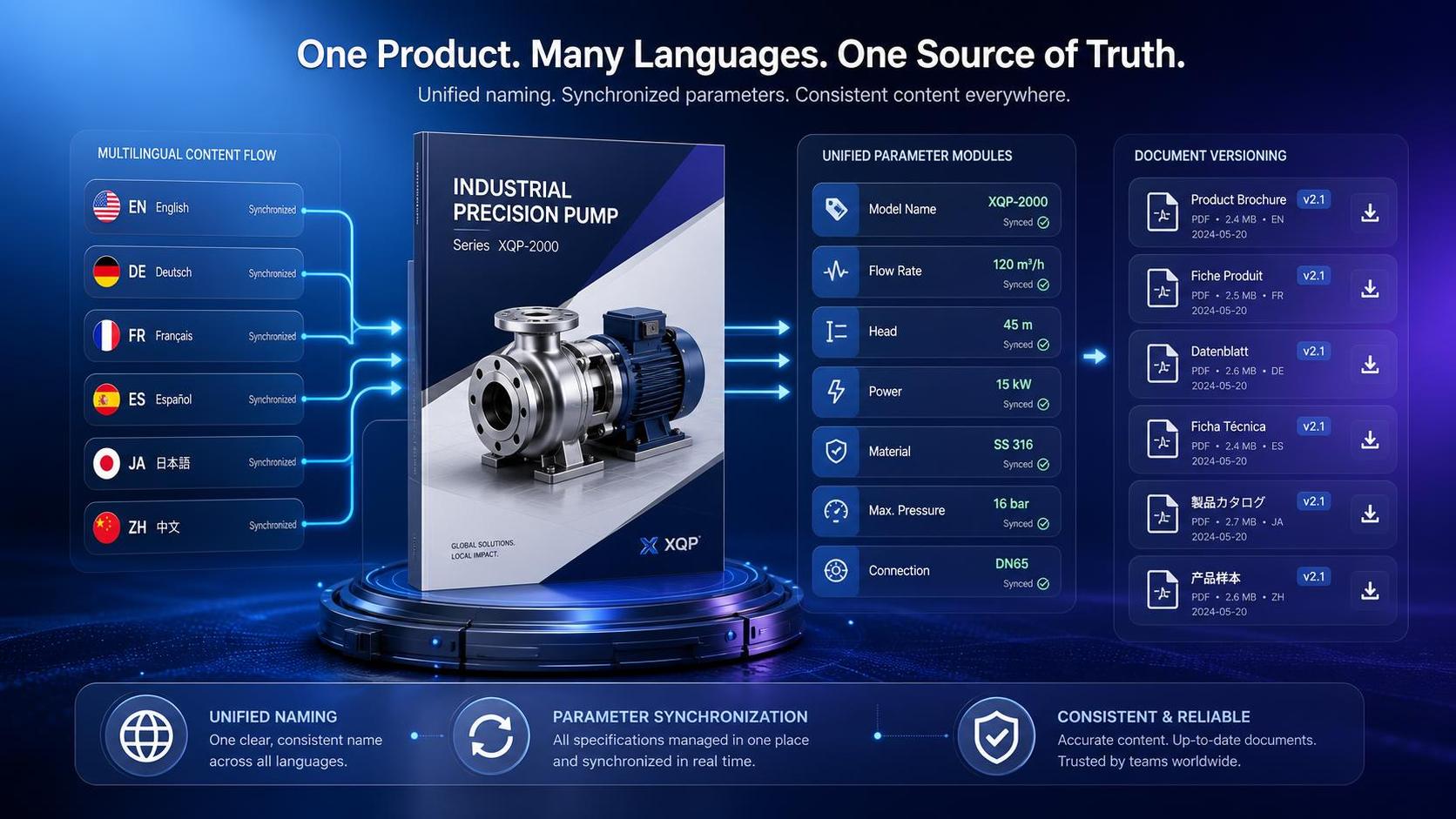
First Confirm Whether There Is a “Single Source of Truth”
The biggest concern for a manufacturing website is that one product has three different descriptions: one from the business department, one from R&D, and another revised independently by the international sales team. On the page, this may appear to be merely a copywriting difference, but it directly affects search indexing, inquiry evaluation, and subsequent quotation processes.
During the technical assessment, the first thing to examine is not the number of pages, but whether unified master data exists. At a minimum, clarify which master document is responsible for the following fields:
- Product names, product series names, and model-naming rules
- Core parameter fields, such as dimensions, power, materials, voltage, and applicable standards
- Application scenarios and industry descriptions
- Certifications, testing, delivery scope, and optional configurations
- Corresponding relationships between images, drawings, videos, and downloadable materials
The verification method is straightforward: randomly select three models and check whether the names in the Chinese materials, English pages, PDF catalog, and inquiry form follow the same system. If even the model names are inconsistent, subsequent multilingual expansion will essentially become uncontrollable.
Language Versions Are Not a Translation Issue but a Field Management Issue
Many teams understand multilingual content as “translating Chinese pages into other languages.” In manufacturing, this is usually not enough. The reason is simple: not every field should be translated, and not all content should correspond word for word.
For example, model numbers, standard numbers, material grades, and interface names often need to retain their original expressions, while application descriptions, delivery instructions, after-sales commitments, and industry scenarios should be adapted to the reading habits of the target market. During the technical assessment, fields can be divided into three categories:
- Strictly synchronized fields: parameters, model numbers, units, and drawing numbers
- Fields that allow localized rewriting: selling points, industry applications, page titles, and summaries
- Fields maintained separately by market: compliance statements, delivery conditions, and contact channels
If the system does not have this hierarchy, the translation team may modify technical fields that should remain unchanged, while the marketing team mechanically translates content that should be localized. The result is pages that are neither professional nor effective at generating conversions.
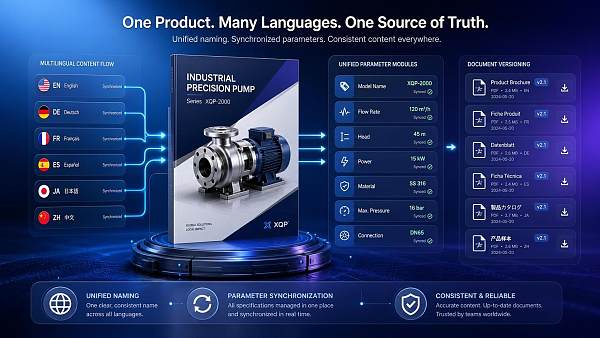
Whether Parameter Tables Can Be Structured Determines Long-Term Maintenance Costs
A common issue with manufacturing websites is that parameters are written directly into the body text. This allows for quick initial launch, but makes long-term maintenance difficult. As the number of models increases, every parameter update requires changes page by page, and omissions are also more likely across different language versions.
A more reliable approach is to convert key technical parameters into structured fields, allowing product listing pages, detail pages, filter pages, comparison pages, and download pages to share the same data. A single update can then be synchronized across multiple pages, while also making it easier for search engines to understand the page topic.
Units and conversion rules require special attention here. When targeting different markets, determine whether both metric and imperial units should be displayed, how they should be ordered, how many decimal places should be retained, and whether manual overrides are allowed. These details may seem minor, but many misunderstandings in inquiries result from inconsistent parameter presentation.
Do Product, Industry, and Solution Pages Share the Same Content Logic?
A mature multilingual manufacturing website does not allow product pages and marketing pages to be written independently. Customers do not browse a website according to your internal departmental structure. They may first search for an application scenario, then enter a product page, and later return to download materials.
During the assessment, check whether the three levels of content are connected:
If these three types of pages do not share fields and navigation logic, content will have to be produced repeatedly when conducting SEO, creating advertising landing pages, or attracting traffic from social media, resulting in very low efficiency.
Downloaded Materials and Web Content Must Use the Same Version
The problem with many factory websites is not a lack of page content, but inconsistencies between web pages, PDFs, brochures, and specification sheets. A customer may find a product suitable after viewing the webpage, only to discover different parameters in the downloaded materials. This immediately undermines trust.
During the technical assessment, it is recommended to ask two direct questions: Does the system retain a version number after materials are uploaded? When webpage parameters are updated, can the system identify which downloadable files also need to be synchronized? If this cannot be done, content collaboration relies on people remembering what to update, which will inevitably lead to errors as the business grows.
Do Not Overlook Coordination Between Domains and Language Directories
Content collaboration on a multilingual website does not take place only at the back-end field level; it also takes place at the domain and directory structure level. Whether you use a primary domain with language directories or separate domains for different regions affects brand consistency, permission management, SEO inheritance, and operational complexity.
If your company is still preparing an overseas brand website, domain planning should be carried out in advance. Capabilities such as domain services are not limited to registering an available address. More importantly, they can integrate management of the primary domain, common extensions, spelling variations, DNS resolution, and renewals into a single process. For manufacturing companies that will later expand into multilingual and multi-regional websites, the later this is addressed, the higher the cost of remediation.
Inquiry Forms Must Match the Content Structure—Do Not Leave Only a “Contact Us” Form
Manufacturing inquiries are not the same as ordinary consumer product inquiries. Customers often need to submit model numbers, quantities, target markets, electrical standards, application scenarios, and even attached drawings. If form fields are disconnected from page content, it is difficult for sales teams to quickly determine lead priority.
Two points are sufficient for the check: First, can the product page automatically provide the product name or model number? Second, can different page types use different form fields? Industry pages are suitable for collecting operating-condition information, product pages for model numbers and quantities, and download pages for collecting email addresses and country information in exchange for materials. This is not a form-design issue, but a lead usability issue.
Permissions and Update Processes Determine Whether a Website Remains Usable Long Term
Many websites are well organized at the beginning but become disordered six months later. Usually, the problem is not the system itself, but the lack of clear responsibility for maintaining different types of content. Can R&D modify parameters? Can international sales modify selling points? Can the translation team publish directly? If the marketing department changes an industry page, will this affect its relationship with product pages? All of these questions should be clarified before development begins.
A practical approach is to divide updateable items into “high-risk fields” and “low-risk fields.” Parameters, certifications, and downloadable files are high-risk and should preferably undergo review. News, case studies, and campaign landing pages can be managed more flexibly. Without this level of control, the more multilingual content there is, the faster errors will spread.
Before Launch, Test More Than Page Display—Test the Collaboration Workflow
What truly needs to be tested is not only whether pages open correctly, but also which steps content passes through from a source update to its front-end display. Before launch, conduct a minimum closed-loop test: modify a key parameter for one model and check whether the Chinese site, foreign-language sites, listing pages, detail pages, download pages, and form fields are all synchronized.
Also perform a frequently overlooked check: whether search entry points are consistent. In other words, do the site search, filters, related product recommendations, and breadcrumb navigation use the same product names and classification system? If these elements are maintained separately, customers will become increasingly confused as they search the site, and search engines will also have greater difficulty understanding the site structure.
In practice, the process can follow this order: first define product master data, then establish multilingual rules for each field, followed by parameter structuring, page relationships, downloadable-material version control, and form mapping. Visual design and bulk launch should come last. For technical evaluators, determining whether a multilingual manufacturing website solution is worth implementing is not about how complete the demo pages look, but whether the system can reliably deliver the correct information to every language version, every page entry point, and every inquiry whenever content changes.
Related Articles
 How to Choose Digital Marketing Services in Guangzhou: Which Delivery Metrics Should Be Verified First?
 What content coordination issues should be addressed first when building a multilingual manufacturing website
 Which social media platforms should manufacturing companies entering overseas markets start with for a more reliable approach?
Related Products
 Yiyingbao SaaS Intelligent Website Building and Marketing SystemYiyingbao SaaS Intelligent Website Building and Marketing System, AI-powered no-code website building, rapid creation of multilingual B2B international websites in 10 minutes, global server acceleration, AI-powered SEO optimization, helping businesses connect efficiently with global markets. The perfect integration of technology and operation makes building an international trade website remarkably simple
 AI+SEM Intelligent Advertising Marketing SystemAI+SEM drives intelligent ad creation, empowering full-funnel precision advertising marketing. The system automatically generates weekly/monthly reports, AI recommends keywords and target countries, monitors core metrics in real-time with intelligent alerts, and enables one-click high-conversion ad solutions to help quickly acquire customers and improve ROI.
 AI+SEO Dual-Engine System Optimization ServicesYiyingbao’s AI+SEO dual-engine optimization system helps foreign trade enterprises acquire high-quality organic traffic through AI-powered keyword research, content generation, and comprehensive technical optimization, significantly improving search rankings and conversion rates.
 AI+SNS Social Media Marketing SystemYingbao AI+SNS Social Media Marketing System - Precision social capture for the social media era. Supports one-click content synchronization across major platforms like Facebook and LinkedIn. AI intelligently rewrites posts for enhanced relevance. 24/7 AI customer service and user profiling analysis empower businesses to efficiently expand into global markets.
 AI+SEO营销解决方案易营宝AI+SEO营销解决方案,通过AI批量写作、智能生成TDK、精准关键词扩词等功能,全面优化网站SEO效果,提升流量与转化率。助力企业构建高效智能网站新生态。
 AI+SEM Advertising Marketing SolutionsAI+SEM Advertising Marketing Solution leverages AI technology to deeply empower SEM ad campaigns. It automatically generates weekly/monthly reports using AI, presenting account data across multiple dimensions for comprehensive insights into campaign performance and trends. The system precisely recommends keywords and target countries, intelligently generates high-conversion ad copy, and enables one-click activation of efficient campaign plans to help businesses rapidly acquire customers. Simultaneously, it monitors core metrics in real time, intelligently identifies abnormal fluctuations, and issues timely alerts to ensure stable, high-return advertising results.
 Domain Name ServicesEasyWin provides professional domain name services, including intelligent queries, one-stop registration, brand protection, and full lifecycle management, helping businesses build a digital brand image.
 EasyOperate B2C Cross-Border E-Commerce Platform & Independent WebsiteEasyStore B2C Cross-border E-commerce Independent Store is an intelligent website building and cross-border e-commerce integrated solution independently developed by EasyStore Information Technology (Beijing) Co., Ltd. The system is specially designed for small and medium-sized as well as large export enterprises, integrating 'website building, operation, marketing, advertising, and conversion' into one, helping enterprises quickly establish cross-border e-commerce independent stores to achieve brand globalization and global sales growth.
The platform supports multiple languages, multiple currencies, and multi-channel marketing, with built-in AI intelligent translation and SEO optimization systems, suitable for mainstream markets such as Southeast Asia, Europe and America, Latin America, and the Middle East, assisting Chinese manufacturing enterprises in efficiently deploying international e-commerce strategies. SSL证书易营宝提供专业SSL安全证书服务,包括单域名和泛域名证书,确保网站数据传输加密、身份验证和完整性保护,助力企业建立安全可信的在线业务环境。









