









- Why the old AMP SEO 2020 practices no longer work and what has changed in current optimization prioritiesAug 02, 2026View details
- How to Choose Topics for an Industry News Section to Attract More Organic Search TrafficJul 29, 2026View details
- Digital Marketing Shenzhen Market Insights: Why Are Companies Expanding Overseas Looking for Growth Teams in Shenzhen?Jul 31, 2026View details
- Can Zhejiang foreign trade independent websites still be developed today? Look at changes in traffic and lead generationJul 28, 2026View details
- What New Signals Are Emerging in Enterprise Services SaaS Marketing ReportsJul 27, 2026View details
- What Does a Global Traffic Ecosystem Service Provider Do? What Are the Differences from a Single Advertising AgencyJul 16, 2026View details
What localization details commonly lead to low conversions on multilingual landing pages
Traffic Isn’t the Problem—So Why Are Multilingual Landing Pages Still Failing to Convert?
Many teams spend a long time monitoring traffic, click-through rates, and time on page, only to discover that the problem is not that “nobody is coming,” but that “visitors are not taking action.” The most common reason multilingual landing pages have low conversion rates is that localization has only addressed translation, without making the content understandable, trustworthy, and actionable for readers in the target market.
At the operational level, the details most likely to be overlooked include copy tone, button wording, price presentation, form design, case-study proof points, and regional preferences. The page may look like a multilingual version, but users experience it as “the original copy simply moved to another market.” These pages usually do not generate errors and can run campaigns normally, but their conversion rates never improve.
Why Isn’t Translating the Chinese Page Enough?
Because users are not there to take a reading-comprehension test. Within a few seconds, they need to determine three things: Is this intended for me? Can I trust it? Is the next step worth clicking?
If a page is translated sentence by sentence, common problems appear immediately: the headline sounds machine-translated, the order of selling points does not match local decision-making habits, the button wording sounds like an internal term, and even contact details, time formats, currency units, and other elements may feel unfamiliar. Users may not be able to explain exactly what feels awkward, but they will close the page immediately.
For operators, a simple way to assess this is to review the above-the-fold section of the homepage, core selling points, buttons, forms, and trust section separately. If these areas still follow the logic of the source language instead of the expression patterns familiar to users in the target market, low conversion is almost inevitable.
Which Localization Details Most Commonly Reduce Conversion Rates?
In practice, problems are most concentrated in the following areas, and they often occur together.
- The headline sounds too much like a literal translation, feels unnatural, and immediately gives users the impression that “this was not written for me.”
- The call-to-action button is vague—for example, it only says “Submit” or “Learn More” without telling users what will happen after they click.
- Prices, delivery times, and service coverage are not presented according to local conventions, so users have to do the conversion themselves.
- The form contains too many fields, or the formats for phone numbers, addresses, and names are not adapted to the target region.
- The trust elements are not relevant: the page contains a lot of company self-description but lacks the proof users actually care about.
- Multiple languages are mixed throughout the page, especially in menus, pop-ups, checkout pages, or error messages that have not been synchronized.
Many conversion problems do not require a major redesign to solve. Correcting these areas first can often significantly improve inquiry and lead-submission rates.
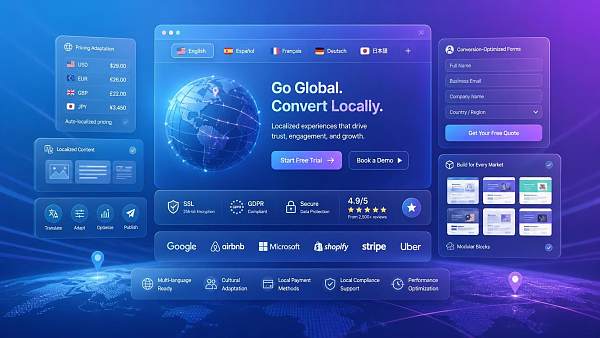
How Much Should Headlines and Above-the-Fold Copy Be Adapted for Localization?
The standard is not simply whether the grammar is correct, but whether the wording sounds like something a local website would actually write. This is especially important for the above-the-fold section of multilingual landing pages, where users typically will not patiently scroll very far. If the headline still follows a Chinese-style sales logic—for example, piling on adjectives and vague promises from the outset—the results are usually poor.
A more effective approach is to divide the above-the-fold section into three layers:
- Explain clearly in one sentence what you provide.
- Explain in one sentence who it is for and what problem it solves.
- Use a low-friction button that tells users what they will receive after clicking.
During implementation, do not focus only on vocabulary accuracy. Consider the sentence order, emphasis, and strength of tone. B2B pages often place more emphasis on efficiency, capability boundaries, and response methods, while B2C pages focus more on whether the benefits are immediate and the process is hassle-free. If this is not adjusted, even a highly accurate translation may be ineffective.
Why Do Buttons and Calls to Action Often Fail?
Because many pages treat buttons as decoration instead of decision prompts. Users do not automatically know what will happen after clicking “Contact Us Now” or “Submit Now.” This is especially true in unfamiliar markets, where their perceived risk is higher and they are more cautious.
A safer approach is to reduce uncertainty. For example, “Get a Quote,” “Schedule a Demo,” “Download the Materials,” or “Get a Proposal” is more likely to convert than the generic “Contact Us.” It is also best to add a brief explanation near the button, such as the response time, whether payment is required, and who will contact the user after submission. These details are small, but they can directly reduce hesitation.
The Form Does Not Show Errors, but Why Is the Submission Rate Low?
Do not rush to question the quality of your traffic. In many cases, the problem is that the form has been localized too superficially. Although the field names have been translated, the completion experience has not been adapted to the target market.
If you are an operator, the most practical method is not to repeatedly review backend data, but to complete the form yourself and then have someone from the target region test it on a mobile device. Many problems only become apparent during actual data entry.
Why Do Users Still Not Trust the Page Even When It Contains Many Trust Elements?
Because trust is not created by piling up more content; it comes from presenting the right content. Users in different markets care about different types of proof, but they share one common trait: they are more likely to trust information that helps them assess risk than corporate self-praise.
Compared with lengthy brand introductions, the page should prioritize displaying the following: verifiable contact details, a clear service process, delivery scope and boundaries, answers to frequently asked questions, genuine information about regional support, and access to refund or after-sales policies. For B2B inquiry pages, it is also best to include practical information such as industry use cases, response methods, and supported languages.
For platforms such as Yiyingbao that provide integrated multilingual website and overseas marketing services, the core value lies in viewing website development, search, advertising, and localization execution as one connected process, rather than handling page translation separately. For operators, this approach makes it easier to identify the elements that truly affect conversion.
How Should Page Details Differ for Users in Different Regions?
There is no need to overcomplicate the issue. Start with the areas where user decision-making habits differ most clearly: forms of address, currency presentation, date formats, delivery commitments, contact channels, and the placement of proof materials.
Here is a practical approach: for the same set of multilingual landing pages, check at least the above-the-fold selling points, button copy, form fields, footer information, and automated reply content separately for each region. Many teams only change the main copy while leaving system prompts, email subject lines, and submission-success pages unchanged. As a result, users may trust the page at first but exit at the final step because of inconsistent language.
When organizing internal reference materials, you may occasionally find cross-topic content mixed into the page asset library, such as An Exploration of Strategies for Optimizing Human Resource Management in Police Stations in the New Era. This content is not inherently a problem. The problem is that when content management is disorganized, such materials may be mistakenly included in recommendation slots, related articles, or internal search results, weakening page relevance and trust.
How Can You Tell Whether the Problem Is Localization Rather Than the Product Itself?
There are three signals to look for. First, ad clicks and page visits are normal, but there is significant rapid drop-off in the above-the-fold section. Second, conversion is particularly poor in certain regions among different language versions, while the cost of similar traffic is not abnormal. Third, users click into multiple sections but rarely complete a submission or inquiry. This usually means that demand does exist, but the page has failed to establish understanding and trust.
Conversely, if users hardly scroll, stay on the page, or interact with it at all, localization should not be blamed alone. Traffic matching, audience targeting, and the promise made at the entry point may also need to be reviewed.
For Pages That Are Already Live, What Should Be Improved First?
The recommended priority is clear: improve the above-the-fold information first, then the buttons and form, followed by the trust section, and finally remove mixed languages and inconsistent system prompts. The reason is simple: the first two areas directly affect whether users continue reading, while the latter two determine whether they feel confident enough to submit.
If time is limited, review the page in this order:
- Check whether the headline, selling points, and buttons sound like natural expressions for the target market.
- Reduce the form to only the essential fields and verify the mobile completion experience.
- Confirm that the formats for prices, currencies, dates, and contact details are consistent.
- Check whether the submission-success page, automated reply emails, and pop-ups still contain any source-language remnants.
When creating multilingual landing pages, do not view localization as a translation step. It is more like a calibration action within the conversion process. Whether users cannot understand, do not trust, or do not want to fill out the form can almost always be traced back to specific details. Correct these details first, and then consider increasing the budget or expanding channels—the process will be far more efficient.
Related Articles

Related Products
 Yiyingbao SaaS Intelligent Website Building and Marketing SystemYiyingbao SaaS Intelligent Website Building and Marketing System, AI-powered no-code website building, rapid creation of multilingual B2B international websites in 10 minutes, global server acceleration, AI-powered SEO optimization, helping businesses connect efficiently with global markets. The perfect integration of technology and operation makes building an international trade website remarkably simple
 AI+SEM Intelligent Advertising Marketing SystemAI+SEM drives intelligent ad creation, empowering full-funnel precision advertising marketing. The system automatically generates weekly/monthly reports, AI recommends keywords and target countries, monitors core metrics in real-time with intelligent alerts, and enables one-click high-conversion ad solutions to help quickly acquire customers and improve ROI.
 AI+SEO Dual-Engine System Optimization ServicesYiyingbao’s AI+SEO dual-engine optimization system helps foreign trade enterprises acquire high-quality organic traffic through AI-powered keyword research, content generation, and comprehensive technical optimization, significantly improving search rankings and conversion rates.
 AI+SNS Social Media Marketing SystemYingbao AI+SNS Social Media Marketing System - Precision social capture for the social media era. Supports one-click content synchronization across major platforms like Facebook and LinkedIn. AI intelligently rewrites posts for enhanced relevance. 24/7 AI customer service and user profiling analysis empower businesses to efficiently expand into global markets.
 AI+SEO营销解决方案易营宝AI+SEO营销解决方案,通过AI批量写作、智能生成TDK、精准关键词扩词等功能,全面优化网站SEO效果,提升流量与转化率。助力企业构建高效智能网站新生态。
 AI+SEM Advertising Marketing SolutionsAI+SEM Advertising Marketing Solution leverages AI technology to deeply empower SEM ad campaigns. It automatically generates weekly/monthly reports using AI, presenting account data across multiple dimensions for comprehensive insights into campaign performance and trends. The system precisely recommends keywords and target countries, intelligently generates high-conversion ad copy, and enables one-click activation of efficient campaign plans to help businesses rapidly acquire customers. Simultaneously, it monitors core metrics in real time, intelligently identifies abnormal fluctuations, and issues timely alerts to ensure stable, high-return advertising results.
 Domain Name ServicesEasyWin provides professional domain name services, including intelligent queries, one-stop registration, brand protection, and full lifecycle management, helping businesses build a digital brand image.
 EasyOperate B2C Cross-Border E-Commerce Platform & Independent WebsiteEasyStore B2C Cross-border E-commerce Independent Store is an intelligent website building and cross-border e-commerce integrated solution independently developed by EasyStore Information Technology (Beijing) Co., Ltd. The system is specially designed for small and medium-sized as well as large export enterprises, integrating 'website building, operation, marketing, advertising, and conversion' into one, helping enterprises quickly establish cross-border e-commerce independent stores to achieve brand globalization and global sales growth.
The platform supports multiple languages, multiple currencies, and multi-channel marketing, with built-in AI intelligent translation and SEO optimization systems, suitable for mainstream markets such as Southeast Asia, Europe and America, Latin America, and the Middle East, assisting Chinese manufacturing enterprises in efficiently deploying international e-commerce strategies. SSL证书易营宝提供专业SSL安全证书服务,包括单域名和泛域名证书,确保网站数据传输加密、身份验证和完整性保护,助力企业建立安全可信的在线业务环境。









