









- Can the average annual growth rate reflect real opportunities in overseas markets?Oct 07, 2026View details
- Which customer acquisition channels will be affected by cross-border marketing trends in 2026?Sep 06, 2026View details
- Which homogenization risks should be considered in an analysis of the AI-powered website building industry?Aug 30, 2026View details
- How Will AI Marketing Trends 2026 Change Advertising Budget AllocationAug 28, 2026View details
- Is the EV SSL certificate market shrinking or upgrading? How should companies assess certificate procurement?Aug 11, 2026View details
- Why the old AMP SEO 2020 practices no longer work and what has changed in current optimization prioritiesAug 02, 2026View details
Is Google indexing optimization still effective for older websites?
Is Google indexing optimization still effective for an old website?
Many businesses are asking whether Google indexing optimization techniques still work for an existing old website. The answer is not simply “yes” or “no.” An old website is neither an advantage nor an inherent problem. What truly determines the results is what the site has accumulated over time: whether its technical structure is holding it back, whether its content has become inaccurate over the years, whether its pages still match today’s search needs, and whether there is an ongoing ability to repair and update the site.
In actual projects, many businesses’ old websites still have opportunities, but they are stuck in a common misconception: believing that the older a website is, the more trust Google will automatically place in it. The reality is not that simple. Google reassesses page quality, crawling efficiency, content uniqueness, and user value. A website that has been online for seven or eight years may still experience indexing problems if its structure is chaotic, its pages are repetitive, and its content has not been updated for years. Conversely, if an old website has clear industry expertise, a complete page structure, and continuously evolving content, it is often easier for it to restore crawling and expand its index than a new site.
Therefore, when discussing whether Google indexing optimization techniques still work for an existing old website, the focus should not remain on the techniques themselves. The first step is to determine whether the old site is worth saving, whether it should be repaired locally, or whether it needs to be rebuilt.
Why do old websites remain unindexed despite having been online for many years?
Indexing problems on old websites are usually not caused by a single factor. Several causes are particularly common.
The first is excessive historical baggage. In the past, for example, businesses may have created large numbers of copied product descriptions, regional pages, and tag pages to increase the number of pages, resulting in extensive similar content across the site. Google does not focus on how many pages you have, but on whether each page is valuable enough to enter the index independently. Many old websites appear to have thousands of pages, but in reality, only a small number offer unique value.
The second is an outdated technical architecture. Common problems with old websites include excessively deep link hierarchies, poor mobile experiences, an excessive number of parameter pages, invalid sitemaps, disorganized canonical tags, and even large numbers of old links returning abnormal status codes. These issues may not make a website completely impossible to crawl, but they can significantly reduce crawling efficiency and gradually affect overall indexing.
The third is that the content direction has become disconnected from the market. This is particularly common on foreign trade websites. English pages created several years ago may consist mainly of basic translations and company-focused descriptions, lacking purchasing scenarios, technical specifications, application details, and language adaptations for different regions. Today, Google places greater emphasis on whether a page can solve a specific problem, rather than on who has written the longest company introduction.
The fourth is a disconnect between the website and marketing activities. The site exists, but there are no subsequent content updates, link promotion, advertising validation, or social media coordination. What Google sees is a website that has remained static for a long time. Indexing is not a one-time action; it is closely related to whether a website remains active and continues to be discovered.

Which old websites are suitable for continued optimization, and which are better rebuilt?
This step is more important than simply learning a few techniques.
If an old website already has a certain indexing foundation, its core section logic remains intact, its domain history is normal, and it has no obvious violation records, while its main problems are thin content, slow updates, and a poor page experience, continuing with indexing optimization is usually effective. By removing low-quality pages, supplementing topical content, repairing crawling paths, and resubmitting important links, these websites can often gradually recover.
However, if the website backend is extremely outdated, the template cannot be maintained, the multilingual structure is disorganized, the URL system is out of control, or even changing a title requires code modifications, continuing to patch the original site may cost more than rebuilding it. For businesses targeting overseas markets, especially when the site must later support advertising campaigns, social media landing pages, and multilingual expansion, merely being able to open the website is far from enough. It must also support coordination among crawling, conversion, and content expansion.
This is why more and more businesses now view website development, SEO, advertising, and content operations as an integrated framework, rather than treating “indexing” as an isolated task. Simply fixing indexing without addressing the website foundation and traffic conversion often fails to deliver significant results.
For Google indexing optimization on old websites, what really works is not a “secret trick”
Many businesses look for shortcuts, such as submitting links in bulk, frequently changing titles, stuffing popular keywords, or aggressively building backlinks. Today, these practices have limited value and may even create more noise. To solve indexing problems on an old website, priorities should usually be addressed in sequence.
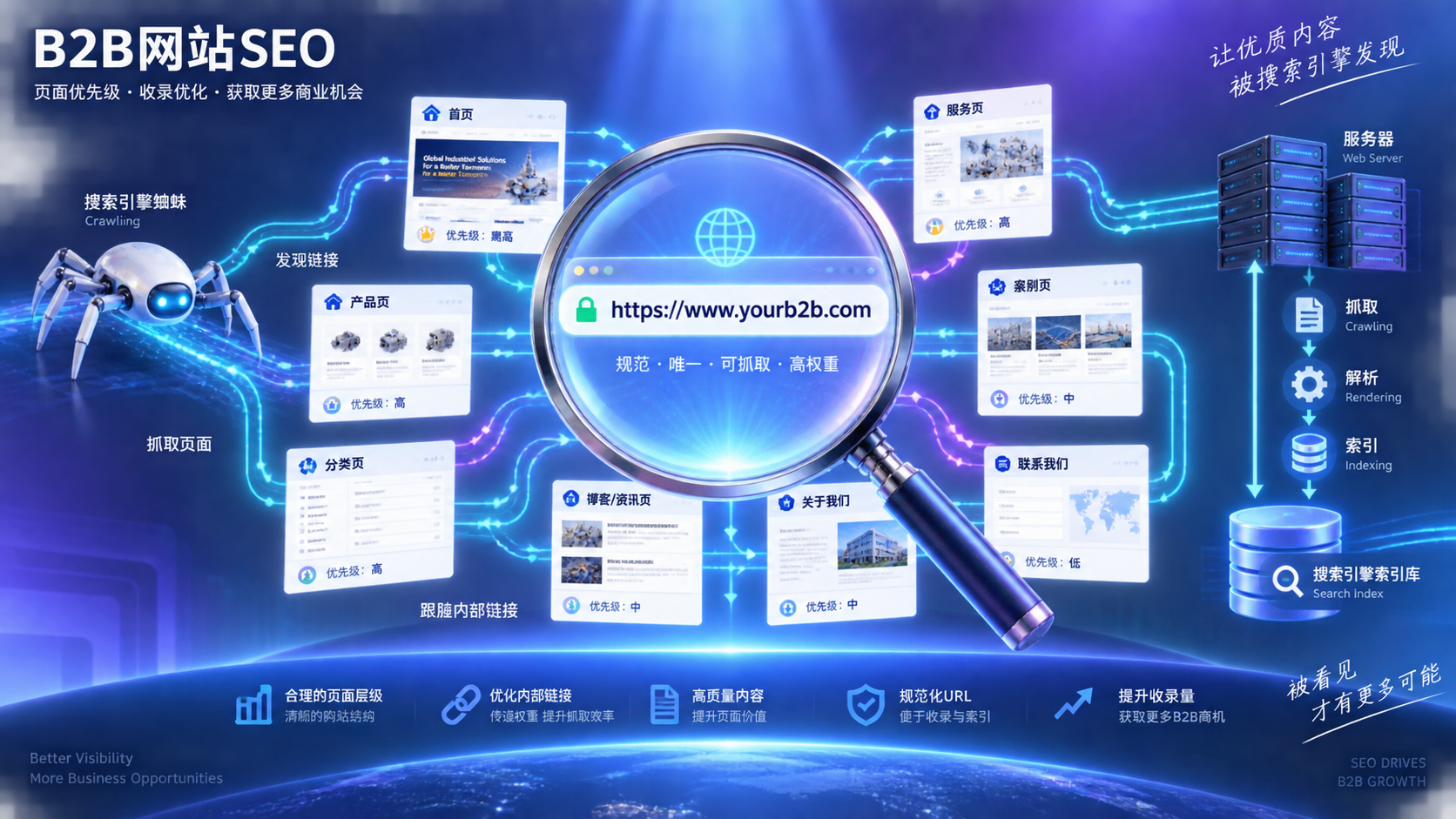
First, examine index quality rather than the number of indexed pages. Which pages should be indexed but are not, and which pages should not be indexed but are consuming crawl budget? The order of these questions should not be reversed. For B2B websites, the truly important pages are often product category pages, core product pages, application scenario pages, industry solution pages, and technical FAQ pages—not a large number of repetitive news articles.
Next, examine whether internal links can direct authority and crawling paths toward key pages. Many old websites do not lack content; their problem is that the content is isolated. Pages may be buried too deeply, or the navigation may be organized only around the company rather than the buyer. As a result, it is difficult for Google to determine which pages are important, and users also find it difficult to continue browsing.
Only then should content be rewritten and new content added. This is especially important for manufacturing websites, foreign trade websites, and multilingual websites: “rewriting” should not be understood as merely changing a few sentences. Content that can genuinely improve indexing and subsequent rankings usually includes clear product boundaries, applicable scenarios, specifications, delivery considerations, common misconceptions, regional differences, and other information. In other words, a page should function more like a purchasing decision support page than a corporate promotional page.
Several signals that are easily overlooked when optimizing an old website
One is the residue of old pages. After a redesign, many old URLs may still exist, return 404 errors, redirect to incorrect pages, or duplicate new pages. This issue is particularly common on websites that have undergone multiple redesigns.
Another is poor handling of language versions. When creating a multilingual website for overseas markets, if pages are generated in bulk through machine translation without adapting the structure and wording to the target market, indexing is often unstable. Search habits vary greatly between regions. The fact that English pages can be indexed does not mean that Spanish, German, or Arabic pages can simply be handled in the same way.
There is also an imbalance in the content update schedule. Some businesses publish many pages at once and then make no changes for several months; others publish articles every week, but each article is extremely thin. The former may be perceived as low-activity, while the latter may accumulate low-quality content. Old websites are better suited to systematically developing core topics than to pursuing superficial publishing frequency.
Why is greater emphasis now placed on integrated “website + marketing services”?
Because indexing has never been something that the website department can complete independently. Whether a page can continue to be crawled and remain in the index often involves technology, content, channels, and data feedback. When a website is built properly, search engines can understand it more easily; when advertising and social media bring visits, pages are more likely to be rediscovered; and when the content system continues to expand, the site’s topical focus becomes clearer. Once any link in this chain breaks, an old website can easily become trapped in a cycle of repeated repairs without overall improvement.
For these types of requirements, platforms such as E-Yingbao, which have long provided integrated smart website development and overseas marketing services, take an approach that is closer to real business needs. Rather than focusing only on a few SEO actions, they place the website’s underlying structure, content expansion, advertising conversion, overseas social media, and AI search visibility within the same system. For foreign trade businesses, manufacturing factories, and cross-border sellers, this approach is more suitable for upgrading old websites because the goal is not merely to “get a few more pages indexed by Google,” but to turn the website back into a growth asset that can be promoted, indexed, and converted.
E-Yingbao was established in 2013 and is headquartered in Beijing. It has long provided services covering smart website development, SEO, advertising, and social media operations. Its recent direction is also representative of the industry: using AI and big data to improve the efficiency of page production, structural optimization, and coordination across multiple channels. For old websites, the value of this capability does not lie in “automatically generating many pages,” but in more quickly identifying which pages should be retained, which should be consolidated, and which topics should be developed first.
How can a business determine whether its old website is still worth optimizing?
You can start by asking yourself several practical questions.
Can the website’s current core pages still accurately represent your business and market? If your product lines, export regions, and customer types have changed while the website still uses wording from several years ago, optimizing indexing is merely a superficial action.
Does the backend support ongoing maintenance? If every redesign, language addition, or new page launch is difficult, even a clear SEO strategy will be hard to implement.
Can the website convert the traffic it receives? Some websites may regain indexing, but their pages have no inquiry entry points, trust-building information, or scenario explanations. In the end, they only have “pages without results.”
If the answer to two or more of these three questions is no, optimization of the old website should not focus only on indexing. Instead, it should be evaluated as part of a broader website upgrade project.
The conclusion is not that “old websites are always effective,” but that “old websites are still worth optimizing correctly”
Returning to the original question: Is Google indexing optimization still effective for old websites? Yes, but only if the approach does not remain tied to outdated practices. Today, the focus is not on publishing pages in bulk or changing a few tags, but on rebuilding the website’s crawlability and comprehensibility around site structure, content quality, language and market adaptation, and marketing coordination.
If your old website has only aged slightly, repairing and optimizing it is usually more cost-effective than starting over. If it has become seriously disconnected from current needs, “indexing optimization” should be treated as part of a website upgrade rather than as an independent task. What businesses truly need is not a standard answer to the question “Are Google indexing optimization techniques still effective for an existing old website?” but a decision-making framework based on the current state of the website, target markets, and subsequent customer acquisition methods.
Examine the site before discussing keywords; examine the structure before discussing content; determine whether the site can support business conversion before discussing the number of indexed pages. By following this approach, an old website has the opportunity to transform from a “historical asset” into an effective asset once again.
Related Articles


Related Products
 Yiyingbao SaaS Intelligent Website Building and Marketing SystemYiyingbao SaaS Intelligent Website Building and Marketing System, AI-powered no-code website building, rapid creation of multilingual B2B international websites in 10 minutes, global server acceleration, AI-powered SEO optimization, helping businesses connect efficiently with global markets. The perfect integration of technology and operation makes building an international trade website remarkably simple
 AI+SEM Intelligent Advertising Marketing SystemAI+SEM drives intelligent ad creation, empowering full-funnel precision advertising marketing. The system automatically generates weekly/monthly reports, AI recommends keywords and target countries, monitors core metrics in real-time with intelligent alerts, and enables one-click high-conversion ad solutions to help quickly acquire customers and improve ROI.
 AI+SEO Dual-Engine System Optimization ServicesYiyingbao’s AI+SEO dual-engine optimization system helps foreign trade enterprises acquire high-quality organic traffic through AI-powered keyword research, content generation, and comprehensive technical optimization, significantly improving search rankings and conversion rates.
 AI+SNS Social Media Marketing SystemYingbao AI+SNS Social Media Marketing System - Precision social capture for the social media era. Supports one-click content synchronization across major platforms like Facebook and LinkedIn. AI intelligently rewrites posts for enhanced relevance. 24/7 AI customer service and user profiling analysis empower businesses to efficiently expand into global markets.
 AI+SEO营销解决方案易营宝AI+SEO营销解决方案,通过AI批量写作、智能生成TDK、精准关键词扩词等功能,全面优化网站SEO效果,提升流量与转化率。助力企业构建高效智能网站新生态。
 AI+SEM Advertising Marketing SolutionsAI+SEM Advertising Marketing Solution leverages AI technology to deeply empower SEM ad campaigns. It automatically generates weekly/monthly reports using AI, presenting account data across multiple dimensions for comprehensive insights into campaign performance and trends. The system precisely recommends keywords and target countries, intelligently generates high-conversion ad copy, and enables one-click activation of efficient campaign plans to help businesses rapidly acquire customers. Simultaneously, it monitors core metrics in real time, intelligently identifies abnormal fluctuations, and issues timely alerts to ensure stable, high-return advertising results.
 Domain Name ServicesEasyWin provides professional domain name services, including intelligent queries, one-stop registration, brand protection, and full lifecycle management, helping businesses build a digital brand image.
 EasyOperate B2C Cross-Border E-Commerce Platform & Independent WebsiteEasyStore B2C Cross-border E-commerce Independent Store is an intelligent website building and cross-border e-commerce integrated solution independently developed by EasyStore Information Technology (Beijing) Co., Ltd. The system is specially designed for small and medium-sized as well as large export enterprises, integrating 'website building, operation, marketing, advertising, and conversion' into one, helping enterprises quickly establish cross-border e-commerce independent stores to achieve brand globalization and global sales growth.
The platform supports multiple languages, multiple currencies, and multi-channel marketing, with built-in AI intelligent translation and SEO optimization systems, suitable for mainstream markets such as Southeast Asia, Europe and America, Latin America, and the Middle East, assisting Chinese manufacturing enterprises in efficiently deploying international e-commerce strategies. SSL证书易营宝提供专业SSL安全证书服务,包括单域名和泛域名证书,确保网站数据传输加密、身份验证和完整性保护,助力企业建立安全可信的在线业务环境。









