









- Hengqin Cooperation Zone Shares Cross-Border E-Commerce Developments, Focusing on Macao-Hengqin Collaboration and International MarketsOct 24, 2026View details
- A Shenyang study highlights the development of the “cross-border e-commerce + industrial cluster” modelOct 24, 2026View details
- Three China Advertising Association GEO group standards take effect on October 23Oct 24, 2026View details
- Amazon Raises Fulfillment Fees Twice, Yet the Median Platform Fee Remains Around 40%Oct 22, 2026View details
- AliExpress and YouTube Partner to Expand Marketing Opportunities for Chinese Brands Going GlobalOct 22, 2026View details
- Publicis says AI marketing is developing at two speeds, with agentic AI helping win clientsOct 21, 2026View details
Is SEO for cross-border standalone websites worth a long-term investment?
A message from the overseas sales team arrived early this morning: “Inquiries are down again this month. Once Google Ads are paused, hardly anyone visits the website.” Many export-oriented teams encounter this situation: the website is already live, with plenty of product pages, and search engines occasionally bring in visits, but traffic fluctuates significantly; results appear to improve when the advertising budget increases, while leads immediately decline when the budget is tightened. This raises a procurement and management question: Is it worthwhile to invest in SEO for an independent cross-border website over the long term?
What usually causes hesitation is not whether SEO works, but rather the investment cycle, the cost of internal coordination, and uncertainty about results. Especially for businesses with long decision-making cycles, such as industrial products, heavy equipment, and logistics services, customers typically search for specifications, application scope, delivery capabilities, and supplier qualifications before deciding whether to make contact. If a website cannot address these search needs, even traffic may consist only of low-quality browsing.
Before calculating the budget, first assess whether the website has the conditions to build momentum
SEO is not simply about adding a few articles to a website, nor is it about repeatedly inserting keywords into titles. It is more like continuously building an overseas digital asset that can be found, understood, and trusted. Whether it is worth pursuing over the long term depends first on whether the existing website has three fundamental foundations.
- Can pages be crawled properly: Whether multilingual pages contain duplicate content, broken links, or incorrect redirects; whether product details are accessible to search engines; and whether the site performs smoothly on mobile devices.
- Does the content address real procurement questions: Customers may not search for a company name. They are more likely to search for product models, load capacity, transportation methods, application industries, technical standards, or maintenance issues.
- Is there a clear next step after a visit: Whether product materials, filtering options, inquiry forms, contact details, and delivery information are clearly presented. Traffic without a conversion path can hardly support a decision for long-term investment.
The issue with many websites arises at the first stage: the pages may appear visually complete, but product categories are disorganized, English content is translated directly, key specifications are hidden in images, and multiple markets share the same set of information. Pursuing rankings directly on such a foundation can easily result in spending the budget on repeated rework.
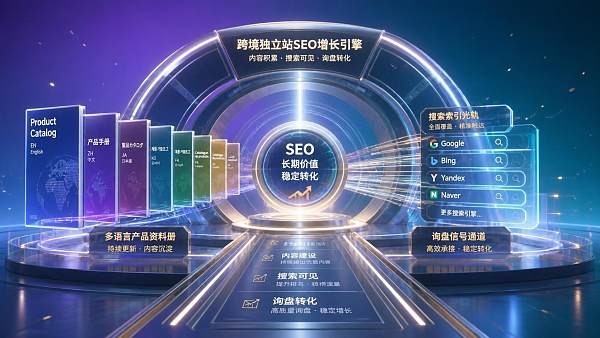
Assessing SEO alongside advertising leads to a more accurate judgment
Advertising is suitable for validating markets and capturing short-term opportunities, and it is also suitable for quickly generating visits for new products, new regions, or promotional campaigns. SEO serves a different purpose: it gradually covers recurring search terms with clear purchasing intent. The two are not substitutes; they perform customer acquisition tasks at different stages.
If keywords for a certain product category have stable search volume, a relatively high average order value, and a long customer decision cycle, SEO is usually more worthwhile to build continuously. This is because a complete product page, application page, or technical information page can continue to capture relevant searches over time after optimization. Conversely, if the business relies heavily on temporary trends, inventory changes rapidly, or the product itself lacks differentiated information, it may be more prudent to test demand through advertising first.
A practical evaluation method is to review advertising search terms from a recent period together with frequently asked questions in sales emails and questions from trade show customers. Recurring questions are candidate directions for SEO content. Do not look only at search volume; also consider whether they are close to inquiries and purchasing decisions. For example, terms such as “heavy vehicle transportation solutions,” “logistics equipment supply scope,” and “technical specifications for certain vehicle models” usually align with real demand more easily than broad industry terms.
Long-term investment does not mean blind investment over the long term
A more reasonable approach is to first complete a website audit, then validate with a limited number of pages, rather than publishing large amounts of content from the outset. A website audit should at least cover indexing status, page speed, URL structure, language versions, titles and descriptions, image text, internal links, and form submission paths. For multi-market websites, it is also necessary to confirm whether pages in different languages genuinely serve local users rather than merely changing the language layer.
The next step can prioritize pages closest to conversion: core product pages, solution pages, industry application pages, and inquiry landing pages. For industrial export businesses, buyers typically want to quickly confirm the scope of supply, product diversity, service regions, and communication methods. If a website structures this information clearly, it will be easier for search engines to understand and for visitors to continue browsing.
For heavy equipment and logistics-related businesses, the way a digital portal is presented is particularly important. A presentation approach similar to heavy vehicles, logistics can combine a product search center, professional consultation forms, overseas business coverage information, and visual data modules; interactive maps, customer logo displays, and responsive animation effects should not serve merely as decoration, but should help visitors assess the company’s coverage capabilities and partnership fit more quickly.
What signals indicate that the investment direction is off track
A common SEO misconception is focusing only on ranking screenshots. Ranking highly for a particular term does not mean that a website has gained effective business opportunities. More worthwhile metrics to monitor continuously include: which pages receive organic search visits; whether users view specifications, download materials, or submit forms after staying on the site; which countries and language versions receive stable traffic; and whether the inquiries received by the sales team are more aligned with target products.
If traffic increases but inquiries do not improve, do not rush to increase the number of articles. Check in sequence: whether keyword intent is too broad; whether the landing page answers customers’ key questions; whether product specifications and application scenarios are clear; whether form fields are too numerous; and whether the page lacks localized units, delivery instructions, or contact details. SEO-driven visits are only the entry point; whether the website itself can build trust determines the ultimate quality of the investment.
Situations suitable for long-term implementation, and situations where it should be postponed
When a company has clearly defined target countries, a relatively stable product line, the ability to continuously provide technical materials or business information, and the willingness to have sales, marketing, and website teams jointly refine content, SEO is suitable as a long-term channel. It is particularly suitable for businesses that need to repeatedly explain product capabilities, have long transaction cycles, and rely on professional trust to win orders.
If the website cannot yet be indexed properly, product positioning changes frequently, target markets have not been determined, or the organization cannot provide basic materials internally, it is more practical to first resolve website architecture and content collaboration issues. Directly purchasing a large volume of “optimization services” at this stage often results only in superficial updates and makes it difficult to build sustainable search assets.
Therefore, whether SEO for an independent cross-border website is worth a long-term investment should not be summarized simply as “worthwhile” or “not worthwhile.” It deserves to be treated as an ongoing operational effort: first make the website visible, then make it understandable to target customers, and finally continuously refine pages using traffic and inquiry data. For businesses that need to steadily expand overseas markets, this kind of accumulation is usually more valuable as a reference than fluctuations in one-time traffic.
Related Articles
 How Can an SEO Content Strategy Prevent Keyword Cannibalization?
 How can you check whether Schema markup matches the visible page content?
 Why Are Core Web Vitals Still Failing After Website Speed Optimization?
Related Products
 Yiyingbao SaaS Intelligent Website Building and Marketing SystemYiyingbao SaaS Intelligent Website Building and Marketing System, AI-powered no-code website building, rapid creation of multilingual B2B international websites in 10 minutes, global server acceleration, AI-powered SEO optimization, helping businesses connect efficiently with global markets. The perfect integration of technology and operation makes building an international trade website remarkably simple
 AI+SEM Intelligent Advertising Marketing SystemAI+SEM drives intelligent ad creation, empowering full-funnel precision advertising marketing. The system automatically generates weekly/monthly reports, AI recommends keywords and target countries, monitors core metrics in real-time with intelligent alerts, and enables one-click high-conversion ad solutions to help quickly acquire customers and improve ROI.
 AI+SEO Dual-Engine System Optimization ServicesYiyingbao’s AI+SEO dual-engine optimization system helps foreign trade enterprises acquire high-quality organic traffic through AI-powered keyword research, content generation, and comprehensive technical optimization, significantly improving search rankings and conversion rates.
 AI+SNS Social Media Marketing SystemYingbao AI+SNS Social Media Marketing System - Precision social capture for the social media era. Supports one-click content synchronization across major platforms like Facebook and LinkedIn. AI intelligently rewrites posts for enhanced relevance. 24/7 AI customer service and user profiling analysis empower businesses to efficiently expand into global markets.
 AI+SEO营销解决方案易营宝AI+SEO营销解决方案,通过AI批量写作、智能生成TDK、精准关键词扩词等功能,全面优化网站SEO效果,提升流量与转化率。助力企业构建高效智能网站新生态。
 AI+SEM Advertising Marketing SolutionsAI+SEM Advertising Marketing Solution leverages AI technology to deeply empower SEM ad campaigns. It automatically generates weekly/monthly reports using AI, presenting account data across multiple dimensions for comprehensive insights into campaign performance and trends. The system precisely recommends keywords and target countries, intelligently generates high-conversion ad copy, and enables one-click activation of efficient campaign plans to help businesses rapidly acquire customers. Simultaneously, it monitors core metrics in real time, intelligently identifies abnormal fluctuations, and issues timely alerts to ensure stable, high-return advertising results.
 Domain Name ServicesEasyWin provides professional domain name services, including intelligent queries, one-stop registration, brand protection, and full lifecycle management, helping businesses build a digital brand image.
 EasyOperate B2C Cross-Border E-Commerce Platform & Independent WebsiteEasyStore B2C Cross-border E-commerce Independent Store is an intelligent website building and cross-border e-commerce integrated solution independently developed by EasyStore Information Technology (Beijing) Co., Ltd. The system is specially designed for small and medium-sized as well as large export enterprises, integrating 'website building, operation, marketing, advertising, and conversion' into one, helping enterprises quickly establish cross-border e-commerce independent stores to achieve brand globalization and global sales growth.
The platform supports multiple languages, multiple currencies, and multi-channel marketing, with built-in AI intelligent translation and SEO optimization systems, suitable for mainstream markets such as Southeast Asia, Europe and America, Latin America, and the Middle East, assisting Chinese manufacturing enterprises in efficiently deploying international e-commerce strategies. SSL证书易营宝提供专业SSL安全证书服务,包括单域名和泛域名证书,确保网站数据传输加密、身份验证和完整性保护,助力企业建立安全可信的在线业务环境。









