









- Which customer acquisition channels will be affected by cross-border marketing trends in 2026?Sep 06, 2026View details
- Which homogenization risks should be considered in an analysis of the AI-powered website building industry?Aug 30, 2026View details
- How Will AI Marketing Trends 2026 Change Advertising Budget AllocationAug 28, 2026View details
- Is the EV SSL certificate market shrinking or upgrading? How should companies assess certificate procurement?Aug 11, 2026View details
- Why the old AMP SEO 2020 practices no longer work and what has changed in current optimization prioritiesAug 02, 2026View details
- How to Choose Topics for an Industry News Section to Attract More Organic Search TrafficJul 29, 2026View details
Which technical issues should be checked first in a Google ranking optimization audit?
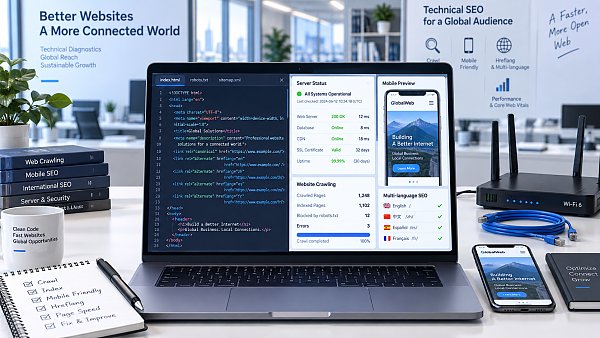
When diagnosing Google ranking optimization, you should not start with titles, keyword density, or the number of backlinks. The higher priority is to confirm whether Google can consistently crawl the pages, whether it is willing to include them in its index, whether users can access them properly on mobile devices, and whether the website clearly communicates its content structure and language versions to search engines.
If these technical issues are not properly addressed, adding content, running ads, or building backlinks afterward may simply direct resources to a website that cannot be effectively indexed or understood. The diagnostic process should proceed in the order of “whether it can be accessed, whether it can be indexed, whether it can be understood, and whether it can be used smoothly,” rather than fixing issues one by one simply because a tool reports an error.
First, Confirm That Crawl Access Has Not Been Accidentally Blocked
Crawling issues are usually the highest-priority items to investigate. Even if a website page can be opened in a browser, this does not mean that Googlebot can access it properly. Common obstacles include robots.txt blocking important directories, pages being set to noindex, server restrictions on overseas visitors or crawler access, login verification covering public content, and CDN or security rules mistakenly identifying normal crawling as risky requests.
During diagnosis, first distinguish between “the page does not exist” and “the crawler cannot access the page.” If important product pages, category pages, or article pages return 404, 403, or 5xx status codes, it is difficult for search engines to retain these pages over the long term. If a page is redirected to the homepage or an irrelevant page, its value for independent indexing will also be reduced. Especially after a website redesign, domain migration, or URL rule adjustment, whether 301 redirects between old and new URLs correspond one-to-one often has a greater impact on organic rankings than visual page updates.
Another issue that is easily overlooked is the XML Sitemap. A sitemap is not a ranking tool, but it should contain only pages that are accessible, indexable, and have canonical URLs. Including noindex pages, parameterized pages, duplicate pages, or broken links in a Sitemap sends conflicting signals to search engines.
For Indexing Issues, Examine the Cause Rather Than Just the Number of Indexed Pages
In Google ranking optimization diagnostics, “how many pages have been indexed” is only a symptom, not a conclusion. A page may not be indexed because it has not yet been crawled, or because Google considers its content duplicate, of insufficient informational value, or determines that another URL is the more appropriate canonical version.
Focus on whether canonical tags are correct. A page should have only one clear preferred URL: versions involving protocol, www versus non-www, trailing slashes, capitalization, filtering parameters, and so on should be unified as much as possible. E-commerce websites and multi-condition filtered pages are particularly likely to generate large numbers of similar URLs. If every filter result is allowed to be indexed, crawl resources will be diluted, while important products and core category pages may not receive sufficient attention.
Do not treat canonical tags as a universal solution for “removing duplicate pages.” They only express a preference to search engines, provided that the main content of the pages is genuinely similar and that internal links, sitemaps, and redirect strategies are also consistent with that preference. If pages have clearly different content but are forcibly assigned to the same canonical page, pages that should participate in rankings may be unable to perform independently.
Performance Diagnostics Should Focus on Real Pages, Not Just Homepage Scores
Speed issues affect crawl efficiency, user engagement, and conversions, but you cannot draw conclusions from running a speed test on the homepage once. What should actually be sampled are the main traffic entry points: product detail pages, category pages, blog article pages, inquiry pages, ad landing pages, and loading performance when accessed from different countries or regions.
Common issues include uncompressed large images and videos, too many third-party scripts loading above the fold, image carousels consuming substantial resources, excessive font files, duplicate loading of theme plugins, and excessively long server response times. For B2B websites, a common above-the-fold mistake is placing autoplay videos, maps, chat tools, and multiple tracking codes together. As a result, a large amount of unnecessary resources has already loaded before product information even appears.
Optimization priorities should be based on page functionality. The main hero image, product selling points, and primary call-to-action buttons should appear first; images, reviews, or recommendation modules that users see only after scrolling can use lazy loading. Removing critical scripts is not necessarily correct. For example, excessive compression of form validation, payment, or multilingual switching functions may cause more serious business losses. Technical fixes need to check both page usability and the conversion path.
Mobile Is Not a Reduced Desktop Version, but an Independent Access Scenario
Google primarily relies on the mobile version to understand page content. Therefore, if the mobile version hides body content, product specifications, internal links, or structured data, it may affect crawling and ranking assessment even when the desktop version is complete.
When troubleshooting, actually complete a key action: enter the page from search results, review product information, switch languages, fill out a form, or complete an order. Check whether text is obscured, menus cannot expand, pop-ups block the main content, buttons are too densely placed, and horizontal scrolling is caused by tables, images, or embedded components. A poor mobile experience is not always a design issue; in many cases, it results from compatibility conflicts between old templates and newly added plugins.
Structured Data Should Accurately Describe Pages Rather Than Create Misleading Rich Results
Structured data helps search engines understand entity relationships involving products, businesses, articles, breadcrumbs, FAQs, and other information on a page. Adding code will not directly improve rankings, but correct markup can reduce ambiguity in understanding and provide a foundation for eligible search displays.
During diagnosis, check whether the marked-up content is consistent with the visible information on the page. For example, fields such as price, inventory, rating, and review count must not exist only in the code without corresponding content on the page; product pages should not use article page markup, and multiple pages should not copy the same set of product information. When structured data is generated in bulk, issues such as missing template variables, incorrect currency formats, and inconsistent brand fields are common, so it is best to validate samples by page type.
Multilingual and Multi-Regional Websites Need to Handle Version Relationships
For websites targeting overseas markets, language version configurations are often more complex than for single-language sites. English, German, Japanese, and other language pages should have independent and stable URLs, with hreflang used to indicate the corresponding language or regional versions. Each version should reference the others and include a self-reference; when a page does not exist, it should not be forcibly directed to an unrelated language homepage.
Unreviewed machine translations, completely identical content across different language pages, language switching that relies only on browser scripts, and regional versions that automatically redirect without allowing users to return can all interfere with search engine recognition. If you are not yet able to continuously maintain a certain language, it is better to retain core versions with complete content and clear navigation than to create numerous language pages with superficial content or dysfunctional switching.
Turn Diagnostic Results into an Actionable Fix List
Technical issues are usually not handled in parallel. It is recommended to first divide them by scope of impact: prioritize issues that block crawling and indexing; then resolve conflicts involving canonicalization, redirects, and sitemaps; next address mobile usability, performance, and structured data; and finally move on to content expansion, internal link building, and keyword page layout.
- Errors affecting sitewide access or a large number of core pages should be fixed and reviewed first.
- Warnings affecting only individual low-value pages can be scheduled based on traffic and business value.
- Each change should record the URL, cause of the issue, fix method, and verification result to avoid being unable to determine the impact when multiple changes go live simultaneously.
- Website redesigns, website development, and marketing campaigns should share the same set of URL and indexing rules to prevent technical and operations teams from maintaining different page logic versions separately.
For businesses that need to manage website development, multilingual content, SEO, and promotional landing pages at the same time, the key platform capability is not the number of features listed, but whether it can centrally manage page templates, indexing settings, language versions, and marketing pages. Yiyingbao provides services including intelligent website building, multilingual website development, and Google SEO, making it suitable for incorporating indexing, promotion, and conversion requirements into the same development process from the website-building stage, reducing the need for large-scale rework after a website goes live.
Only after completing technical checks is it worthwhile to further determine whether pages match search intent, whether content is competitive, whether internal links support core pages, and whether traffic can generate inquiries or orders after arriving. Technical diagnostics cannot replace content and marketing, but they determine whether subsequent optimization is built on a foundation that can be crawled, indexed, and used.
Related Articles

Related Products
 Yiyingbao SaaS Intelligent Website Building and Marketing SystemYiyingbao SaaS Intelligent Website Building and Marketing System, AI-powered no-code website building, rapid creation of multilingual B2B international websites in 10 minutes, global server acceleration, AI-powered SEO optimization, helping businesses connect efficiently with global markets. The perfect integration of technology and operation makes building an international trade website remarkably simple
 AI+SEM Intelligent Advertising Marketing SystemAI+SEM drives intelligent ad creation, empowering full-funnel precision advertising marketing. The system automatically generates weekly/monthly reports, AI recommends keywords and target countries, monitors core metrics in real-time with intelligent alerts, and enables one-click high-conversion ad solutions to help quickly acquire customers and improve ROI.
 AI+SEO Dual-Engine System Optimization ServicesYiyingbao’s AI+SEO dual-engine optimization system helps foreign trade enterprises acquire high-quality organic traffic through AI-powered keyword research, content generation, and comprehensive technical optimization, significantly improving search rankings and conversion rates.
 AI+SNS Social Media Marketing SystemYingbao AI+SNS Social Media Marketing System - Precision social capture for the social media era. Supports one-click content synchronization across major platforms like Facebook and LinkedIn. AI intelligently rewrites posts for enhanced relevance. 24/7 AI customer service and user profiling analysis empower businesses to efficiently expand into global markets.
 AI+SEO营销解决方案易营宝AI+SEO营销解决方案,通过AI批量写作、智能生成TDK、精准关键词扩词等功能,全面优化网站SEO效果,提升流量与转化率。助力企业构建高效智能网站新生态。
 AI+SEM Advertising Marketing SolutionsAI+SEM Advertising Marketing Solution leverages AI technology to deeply empower SEM ad campaigns. It automatically generates weekly/monthly reports using AI, presenting account data across multiple dimensions for comprehensive insights into campaign performance and trends. The system precisely recommends keywords and target countries, intelligently generates high-conversion ad copy, and enables one-click activation of efficient campaign plans to help businesses rapidly acquire customers. Simultaneously, it monitors core metrics in real time, intelligently identifies abnormal fluctuations, and issues timely alerts to ensure stable, high-return advertising results.
 Domain Name ServicesEasyWin provides professional domain name services, including intelligent queries, one-stop registration, brand protection, and full lifecycle management, helping businesses build a digital brand image.
 EasyOperate B2C Cross-Border E-Commerce Platform & Independent WebsiteEasyStore B2C Cross-border E-commerce Independent Store is an intelligent website building and cross-border e-commerce integrated solution independently developed by EasyStore Information Technology (Beijing) Co., Ltd. The system is specially designed for small and medium-sized as well as large export enterprises, integrating 'website building, operation, marketing, advertising, and conversion' into one, helping enterprises quickly establish cross-border e-commerce independent stores to achieve brand globalization and global sales growth.
The platform supports multiple languages, multiple currencies, and multi-channel marketing, with built-in AI intelligent translation and SEO optimization systems, suitable for mainstream markets such as Southeast Asia, Europe and America, Latin America, and the Middle East, assisting Chinese manufacturing enterprises in efficiently deploying international e-commerce strategies. SSL证书易营宝提供专业SSL安全证书服务,包括单域名和泛域名证书,确保网站数据传输加密、身份验证和完整性保护,助力企业建立安全可信的在线业务环境。









