









- Can the average annual growth rate reflect real opportunities in overseas markets?Oct 07, 2026View details
- Which customer acquisition channels will be affected by cross-border marketing trends in 2026?Sep 06, 2026View details
- Which homogenization risks should be considered in an analysis of the AI-powered website building industry?Aug 30, 2026View details
- How Will AI Marketing Trends 2026 Change Advertising Budget AllocationAug 28, 2026View details
- Is the EV SSL certificate market shrinking or upgrading? How should companies assess certificate procurement?Aug 11, 2026View details
- Why the old AMP SEO 2020 practices no longer work and what has changed in current optimization prioritiesAug 02, 2026View details
What Issues Should Be Covered in a Google SEO Technical Audit?
Many websites invest considerable effort in content, backlinks, and keyword placement, yet their rankings never improve. Technical evaluators often find that the problem does not necessarily lie in “what was written,” but more likely in whether Google can crawl the site smoothly, understand it correctly, and provide users with a seamless browsing experience. For businesses that need to acquire overseas organic traffic over the long term, a Google SEO technical audit is not simply a matter of running a tool once; it is a systematic examination of the website’s underlying health. This is especially true for complex sites such as overseas-facing corporate websites, multilingual sites, and cross-border e-commerce stores, where technical issues are often more hidden—and more damaging—than content issues.
A truly valuable technical audit is not about listing a series of errors. Its focus is on determining which issues directly affect crawling and indexing, which weaken the understanding of page topics, which slow down the conversion path, and which merely “look serious” but are not high priorities in practice. For technical evaluators, audit standards should align as closely as possible with Google’s actual working logic rather than remaining at the level of superficial scores.
Check Whether the Crawling Path Is Accessible Before Focusing on Ranking Fluctuations
The first layer of a Google SEO technical audit is checking whether search engines can enter the website smoothly and continuously crawl its core pages. Many sites are accessible on the surface but are not crawler-friendly. Common issues include incorrect blocking in robots.txt, important directories marked noindex, content that becomes invisible after JS rendering, large numbers of invalid URLs generated by pagination or filtering pages, and overly deep internal-link hierarchies.
During a technical evaluation, attention should be focused on three questions: Can Googlebot discover the important pages? After discovering them, can it retrieve their complete content normally? Are crawling resources being wasted on low-value URLs? This is particularly important for product sites, content sites, and multilingual sites. If parameter pages, tag pages, and search-result pages are opened too broadly, the crawl budget can easily be consumed by invalid URLs, ultimately causing priority pages to remain unindexed or preventing updated pages from being recrawled for a long time.
This is also an aspect that many businesses tend to overlook during the website-building stage: a website being “able to go live” does not mean it is “suitable for efficient processing by Google.” The value of an integrated service model such as Yiyingbao, which combines intelligent website building with overseas marketing, lies in considering website structure, URL standards, crawlability, and subsequent SEO growth within the same system rather than passively repairing problems after the website has been completed.
Indexing Anomalies Are Often Caused by Conflicting Signals Rather Than Poor Content
The second key point in a technical audit is indexing quality. A page not being indexed does not necessarily mean that Google does not recognize the value of its content. It may also be because the website is sending conflicting signals to Google. For example, an incorrect canonical setting may point Page A to Page B; a page may be allowed to be indexed while simultaneously being weakened by internal site logic; or multilingual pages may lack clear hreflang relationships, making it difficult for search engines to determine the correspondence between regional and language versions.
Technical evaluators need to pay particular attention to the following situations: submitted sitemap pages that remain unindexed, pages that have been crawled but not indexed, duplicate pages for which Google has selected another canonical page, a large number of soft 404 pages, and an excessively high proportion of thin-content pages. These phenomena generally reflect issues at the level of information architecture or technical markup, rather than problems with the content of individual pages alone.
For B2B overseas-trade websites, product categories, application-scenario pages, and industry solution pages often serve as entry points for inquiries. Once the indexing of these pages becomes unstable, the effectiveness of subsequent content promotion and link building will be reduced.
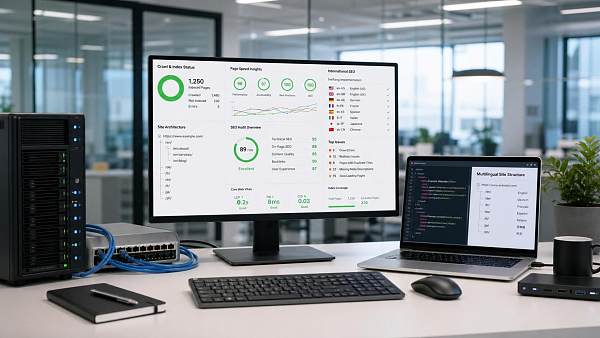
Page Speed Should Not Be Judged by Scores Alone, but by Its Impact on the Real User Experience
When conducting a Google SEO technical audit, many teams tend to interpret speed issues as “the higher the PageSpeed score, the better.” For technical evaluators, however, it is more important to identify which performance issues are actually hindering crawling, rankings, and conversions. Excessively heavy above-the-fold resources, uncompressed images, too many third-party scripts, CSS and JS blocking rendering, slow server responses, and sluggish mobile interactions can all make things difficult for both Google and users.
If a website targets multiple regions such as North America, Europe, and Southeast Asia, the technical audit should also consider the stability of cross-regional access. A website that loads reasonably well domestically may not perform equally well overseas. This is especially true for multilingual independent sites and cross-border e-commerce stores, which typically contain many page modules, scripts, and marketing plugins. Without performance controls at the architectural level, they can easily develop the problems of being “displayable but not fast enough; accessible but not stable enough.”
Therefore, a speed audit should not stop at screenshots from tools. It should further break down whether the problem lies in frontend resources, the server environment, caching strategies, image processing, or third-party tag management. Only when the root cause is identified can optimization actions avoid becoming superficial.
Mobile Adaptation Involves More Than Responsive Design
Google has long regarded the mobile experience as an important reference point. In practice, however, many corporate websites still perform poorly in mobile SEO even though they use responsive templates. The reasons usually lie in finer details: buttons with insufficient spacing, pop-ups blocking the main content, overly dense mobile fonts, confusing information hierarchy above the fold, difficult-to-complete forms, images and tables compressing the layout, and even some key content being collapsed or hidden on mobile devices.
During a technical evaluation, it is not enough to determine whether the site “can open on a mobile phone.” The evaluation should determine whether Google can fully understand the page on mobile and whether users can complete reading and conversion without obstacles. This is particularly important for marketing-oriented websites. After organic traffic arrives on a page, what truly determines inquiries and lead submissions is often not the ranking itself, but whether the landing page is easy to use, credible, and efficient in reducing the user’s decision-making cost.
Structured Data and Semantic Markup Determine How Accurately Google Understands a Page
Another easily underestimated focus of a Google SEO technical audit is whether the page’s semantic expression is clear. Search engines do not simply “understand the text and consider the job done.” They also rely on supporting signals such as page structure, heading hierarchy, Schema structured data, breadcrumbs, product information, and organization information to understand the identity of a page.
Technical evaluators should check whether article pages have a clear heading hierarchy, whether product pages include the necessary attributes, whether structured data such as FAQ, Breadcrumb, and Organization has been correctly deployed without errors, and whether the page contains multiple H1 headings, titles that deviate from the main topic of the body text, or excessive templated duplicate descriptions. For multilingual sites, they should also examine whether the semantic structures of pages in different languages are consistent, avoiding situations in which some versions have “translated the content but lost the SEO structure.”
If a business is developing visibility in AI search, technical standards at the semantic level become even more important. Whether in traditional Google Search or AI retrieval environments that are gradually influencing traffic entry points, clear page structures, explicit entity information, and stable topic boundaries all increase the likelihood that content will be recognized and cited.
Whether the Internal Architecture Supports Long-Term Growth Is the Most Easily Overlooked Part of an Audit
Many technical audits check only errors and ignore scalability. For technical evaluators, however, whether a website is worth continued SEO investment depends fundamentally on whether it has an architectural foundation for “sustainable growth.” For example, does the section planning support the addition of content in the future? Is the directory hierarchy clear? Can internal links transfer authority to core pages? Are URLs standardized and maintainable? Is the sitemap updated dynamically? Do the templates facilitate the bulk generation of high-quality pages?
This is why the website-building system itself affects the upper limit of SEO. If the underlying system makes it difficult to customize TDK, cannot flexibly configure canonical, cannot handle multilingual hreflang, or has confusing URL rules, even the strongest optimization team will remain constantly constrained. Conversely, if website building, content publishing, SEO rule configuration, and data tracking can work together, a technical audit can not only identify problems but also genuinely drive implementation.
Logs, Indexing Status, and Cross-Validation of Data Are More Reliable Than a Single Tool
The biggest risk in a technical audit is drawing conclusions from only one tool. Mature judgments usually come from cross-validation: Search Console shows indexing coverage and crawling anomalies, crawler tools show site structure and status codes, logs show Googlebot’s actual access paths, and analytics tools show traffic landing pages and exit behavior. Only when these types of data are considered together does the priority of each problem become clear.
Consider a common scenario: a group of product pages has no traffic. The reason may not be a lack of keyword placement; logs may show that Googlebot barely crawls these URLs. Alternatively, the pages may have been crawled, while Search Console has displayed “Discovered, currently not indexed” for a long time. Or they may technically be indexed but unable to obtain rankings because of template duplication, thin content, or weak internal links. Problems at different stages require completely different solutions.
A Useful Technical Audit Report Should Answer These Four Questions
To determine whether a Google SEO technical audit is professional, consider whether it can clearly answer the following four questions: Which problems are directly affecting crawling and indexing? Which problems affect ranking performance but are not the highest priorities? Which are structural deficiencies in the user experience and conversion layers? Which fixes require coordination among the website-building system, development, content, and operations teams?
In other words, a technical audit is not an “error list,” but an actionable optimization roadmap. It should provide priorities, the scope of impact, repair recommendations, and validation methods rather than presenting every issue in the same way. For technical evaluators, what truly matters is not how many problems can be found, but whether they can identify the critical points that represent the 20% determining 80% of SEO results.
If a business targets overseas markets and its website is responsible for customer acquisition, the technical audit also needs to be considered together with website-building capabilities, marketing objectives, and multilingual strategies. A website suitable for growth is not merely “problem-free” at the code level. It must establish a balance among crawling, indexing, speed, semantics, mobile experience, and scalability. Only in this way can SEO become more than one-time patchwork and serve as an underlying capability for the website’s long-term growth.
Related Articles



Related Products
 Yiyingbao SaaS Intelligent Website Building and Marketing SystemYiyingbao SaaS Intelligent Website Building and Marketing System, AI-powered no-code website building, rapid creation of multilingual B2B international websites in 10 minutes, global server acceleration, AI-powered SEO optimization, helping businesses connect efficiently with global markets. The perfect integration of technology and operation makes building an international trade website remarkably simple
 AI+SEM Intelligent Advertising Marketing SystemAI+SEM drives intelligent ad creation, empowering full-funnel precision advertising marketing. The system automatically generates weekly/monthly reports, AI recommends keywords and target countries, monitors core metrics in real-time with intelligent alerts, and enables one-click high-conversion ad solutions to help quickly acquire customers and improve ROI.
 AI+SEO Dual-Engine System Optimization ServicesYiyingbao’s AI+SEO dual-engine optimization system helps foreign trade enterprises acquire high-quality organic traffic through AI-powered keyword research, content generation, and comprehensive technical optimization, significantly improving search rankings and conversion rates.
 AI+SNS Social Media Marketing SystemYingbao AI+SNS Social Media Marketing System - Precision social capture for the social media era. Supports one-click content synchronization across major platforms like Facebook and LinkedIn. AI intelligently rewrites posts for enhanced relevance. 24/7 AI customer service and user profiling analysis empower businesses to efficiently expand into global markets.
 AI+SEO营销解决方案易营宝AI+SEO营销解决方案,通过AI批量写作、智能生成TDK、精准关键词扩词等功能,全面优化网站SEO效果,提升流量与转化率。助力企业构建高效智能网站新生态。
 AI+SEM Advertising Marketing SolutionsAI+SEM Advertising Marketing Solution leverages AI technology to deeply empower SEM ad campaigns. It automatically generates weekly/monthly reports using AI, presenting account data across multiple dimensions for comprehensive insights into campaign performance and trends. The system precisely recommends keywords and target countries, intelligently generates high-conversion ad copy, and enables one-click activation of efficient campaign plans to help businesses rapidly acquire customers. Simultaneously, it monitors core metrics in real time, intelligently identifies abnormal fluctuations, and issues timely alerts to ensure stable, high-return advertising results.
 Domain Name ServicesEasyWin provides professional domain name services, including intelligent queries, one-stop registration, brand protection, and full lifecycle management, helping businesses build a digital brand image.
 EasyOperate B2C Cross-Border E-Commerce Platform & Independent WebsiteEasyStore B2C Cross-border E-commerce Independent Store is an intelligent website building and cross-border e-commerce integrated solution independently developed by EasyStore Information Technology (Beijing) Co., Ltd. The system is specially designed for small and medium-sized as well as large export enterprises, integrating 'website building, operation, marketing, advertising, and conversion' into one, helping enterprises quickly establish cross-border e-commerce independent stores to achieve brand globalization and global sales growth.
The platform supports multiple languages, multiple currencies, and multi-channel marketing, with built-in AI intelligent translation and SEO optimization systems, suitable for mainstream markets such as Southeast Asia, Europe and America, Latin America, and the Middle East, assisting Chinese manufacturing enterprises in efficiently deploying international e-commerce strategies. SSL证书易营宝提供专业SSL安全证书服务,包括单域名和泛域名证书,确保网站数据传输加密、身份验证和完整性保护,助力企业建立安全可信的在线业务环境。









