









- Can the average annual growth rate reflect real opportunities in overseas markets?Oct 07, 2026View details
- Which customer acquisition channels will be affected by cross-border marketing trends in 2026?Sep 06, 2026View details
- Which homogenization risks should be considered in an analysis of the AI-powered website building industry?Aug 30, 2026View details
- How Will AI Marketing Trends 2026 Change Advertising Budget AllocationAug 28, 2026View details
- Is the EV SSL certificate market shrinking or upgrading? How should companies assess certificate procurement?Aug 11, 2026View details
- Why the old AMP SEO 2020 practices no longer work and what has changed in current optimization prioritiesAug 02, 2026View details
Page Structure and Evidence Design to Improve Product Page Conversion Rates with Answer Engine Optimization
When visitors arrive at a product page from Google, ChatGPT, Perplexity, or other AI search entry points, they are often no longer “just browsing.” They come with more specific questions: Is this product suitable for my application? Are the specifications reliable? Is delivery stable? Is there evidence that it has actually solved similar problems?
Therefore, increasing product page conversion rates with answer engine optimization is not merely about making the page easier for AI search to cite. More importantly, it transforms the product page from a “display catalog” into a clear, verifiable answer path that supports decision-making: search engines can extract key points, AI can understand the applicable conditions, and real visitors can quickly determine whether they should make an inquiry.
First, change one perception: a product page is not an information repository, but a decision-making environment
The issue with many product pages is not a lack of information, but that the information is not arranged according to the user's decision-making sequence. The page begins with a lengthy brand introduction, places specification tables in the middle, and only presents lead times, certifications, after-sales service, or inquiry entry points at the end. For users who arrive with a purchasing task, this structure amplifies hesitation: the answers they need are buried deep in the page, or are not answered directly at all.
Answer engine optimization emphasizes content organization around “question—conclusion—evidence.” It requires a page to provide a standalone answer to a specific question, rather than asking users to piece together fragmented information themselves. A strong product page should retain complete meaning and reliable boundaries even when AI extracts a single section from it.
Operators can first review their existing pages and ask themselves three questions: Within ten seconds of entering the page, can visitors understand what the product is, who it is for, and what problem it solves? As they continue browsing, can they see verifiable evidence? When they are ready to take action, do they know what requirement information to submit and what will happen next? If the answer to any of these questions is no, there is a break in the conversion path.
Use an above-the-fold section with “conclusions first” to capture high-intent visits
The above-the-fold section does not need to handle every introductory task, but it must establish positioning. It is recommended to place the title, applicable scenarios, key outcomes, and call to action in the same information group. Rather than writing “high-performance industrial solution,” clearly state “XX equipment for continuous production lines, capable of processing XX materials and supporting an XX specification range.” The former sounds broad, while the latter is easier for search engines to understand and enables purchasers to screen options more quickly.
The above-the-fold section can follow this expression framework:
- What the product is: Use commonly recognized industry terminology and avoid using only internal model numbers or promotional names.
- Who it is for and where it is used: Specify the industry, process stage, operating environment, or order type.
- Why it is worth reading further: Use one to three explainable capability summaries instead of stacking words such as “outstanding” or “leading.”
- What to do next: Clearly indicate whether users should obtain a specification sheet, request a quotation, confirm a suitable configuration, or schedule a demonstration.
For export-oriented B2B pages, the call to action should particularly reduce communication barriers. Button copy does not always need to be “Contact Us Now”; it can also be “Send Your Requirements for Selection Recommendations” or “Confirm Configurations Suitable for Your Local Market.” This wording lets users know what they will receive after submitting the form, making their intent generally clearer.
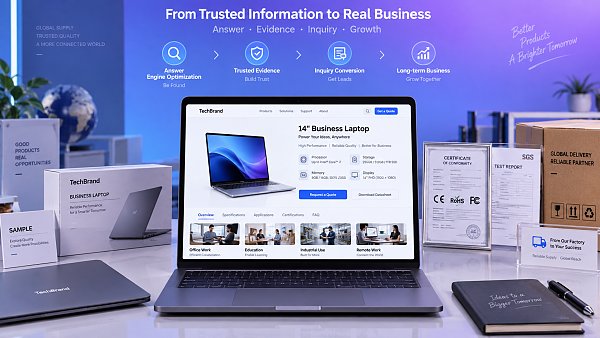
Evidence design: turn “we say it works” into “why it can be trusted”
The key to improving conversion rates is often not adding another selling point, but providing the missing evidence that prevents users from submitting an inquiry. Answer engines likewise tend to cite content with clear sources, explicit conditions, and complete context. Therefore, product pages should establish layered evidence rather than simply displaying a few performance images.
The first layer is factual evidence. This includes dimensions, materials, power, compatible standards, operating temperatures, delivery scope, optional configurations, and more. Specification tables should not list numbers alone; key items should preferably explain their impact on usage. For example, “supports a certain interface” should also explain which devices it can connect to and whether an additional module is required.
The second layer is scenario evidence. Explain product capabilities within actual usage situations. You may write “suitable for small-batch customized orders” or “suitable for continuous operation in high-humidity environments,” while also stating the applicable prerequisites and unsuitable situations. Appropriately explaining boundaries will not weaken sales; instead, it can reduce ineffective inquiries and make genuinely matched customers more willing to trust the page.
The third layer is process evidence. Users are not purchasing a single product alone; they are also purchasing controllability in selection, sampling, production, delivery, and after-sales service. Explaining the process through timelines, configuration confirmation checklists, quality inspection milestones, or frequently asked questions can significantly reduce concerns about “what happens after purchase.” If no public materials are available for display, do not fabricate certifications, customer names, or test data; it is more prudent to state “relevant documents can be provided for confirmation based on requirements” than to make vague promises.
A page information hierarchy that both AI and users can understand
A product page that is more suitable for answer engine extraction generally does not rely on complex copy, but on a stable semantic structure. It is recommended to arrange content according to the user’s decision-making process: product summary, application scenarios, core specifications, differentiated capabilities, delivery and support, frequently asked questions, and inquiry guidance. Give each section a subheading that directly answers a question, such as “What production conditions is this product suitable for?” or “What information is required for minimum order quantity or customization confirmation?”
FAQ should not become an area for keyword stuffing. First collect questions repeatedly received by sales, customer service, and operations staff, then respond with concise answers. A useful Q&A usually includes a conclusion, conditions, and the next step: for example, “Does it support customization? Yes, but dimensions, operating environment, and target market standards must be confirmed; further evaluation can be conducted after submitting existing drawings or specifications.” Such content has both search value and helps visitors move forward.
Multilingual pages should especially avoid simple literal translation. Different markets focus differently on product terminology, units of measurement, payment, and delivery information. For Russian-speaking markets, Eastern Europe, or CIS markets, in addition to linguistic accuracy, local search habits, domain names, and indexing logic of search platforms should also be considered. Teams that need to build a Russian-language website and plan their promotion path at the same time can incorporate Russian industry website development and marketing solutions to include Russian website development, AI-assisted translation, Yandex optimization, keyword expansion, and basic security configuration in the same implementation process, avoiding the need to rework the structure after the site goes live.
Do not let “too many specifications” conceal “difficulty choosing”
Products with many models and complex configurations are most likely to experience high bounce rates but few inquiries. Users are not uninterested; they simply do not know which option they should consider. In this case, rather than listing all models side by side, provide lightweight selection logic: categorize by industry of use, processing capacity, budget range, or “standard model—enhanced model—customized model.”
Each option should provide a reason for selection, rather than only a model link. For example: “If on-site space is limited, prioritize a compact configuration; if long-term continuous operation is required, focus on the cooling solution and maintenance cycle.” This type of explanation can turn the page from a product catalog into a selection assistant, making it more likely to become a trusted information source for AI answers to “how to choose.”
Conduct an “answer path” check before launch
Before publishing the page, consider asking a colleague unfamiliar with the product to browse it as a target customer: Can they restate the product value from the above-the-fold section? Can they find key specifications and applicable boundaries within two minutes? Do they know what materials to prepare before requesting a quotation? If any individual module is extracted, does the information remain complete and avoid being misleading?
At the same time, observe search terms and on-site behavior. Questions that users frequently search for but the page does not answer should be added to scenario descriptions or FAQ; for pages with high visits but low form submissions, check whether evidence is insufficient, whether the CTA appears too early, or whether the form requests too much information that is not yet necessary. Answer engine optimization is not a one-time redesign, but an ongoing process of turning real questions into page answers.
Ultimately, the value of increasing product page conversion rates with answer engine optimization does not lie in catering to a particular algorithm, but in giving every visitor who arrives with a question less guesswork and more certainty. When a page can clearly explain what the product can do, why it is trustworthy, whether it is suitable, and how to start communicating, traffic has a better chance of becoming qualified business opportunities.
Related Articles


Related Products
 Yiyingbao SaaS Intelligent Website Building and Marketing SystemYiyingbao SaaS Intelligent Website Building and Marketing System, AI-powered no-code website building, rapid creation of multilingual B2B international websites in 10 minutes, global server acceleration, AI-powered SEO optimization, helping businesses connect efficiently with global markets. The perfect integration of technology and operation makes building an international trade website remarkably simple
 AI+SEM Intelligent Advertising Marketing SystemAI+SEM drives intelligent ad creation, empowering full-funnel precision advertising marketing. The system automatically generates weekly/monthly reports, AI recommends keywords and target countries, monitors core metrics in real-time with intelligent alerts, and enables one-click high-conversion ad solutions to help quickly acquire customers and improve ROI.
 AI+SEO Dual-Engine System Optimization ServicesYiyingbao’s AI+SEO dual-engine optimization system helps foreign trade enterprises acquire high-quality organic traffic through AI-powered keyword research, content generation, and comprehensive technical optimization, significantly improving search rankings and conversion rates.
 AI+SNS Social Media Marketing SystemYingbao AI+SNS Social Media Marketing System - Precision social capture for the social media era. Supports one-click content synchronization across major platforms like Facebook and LinkedIn. AI intelligently rewrites posts for enhanced relevance. 24/7 AI customer service and user profiling analysis empower businesses to efficiently expand into global markets.
 AI+SEO营销解决方案易营宝AI+SEO营销解决方案,通过AI批量写作、智能生成TDK、精准关键词扩词等功能,全面优化网站SEO效果,提升流量与转化率。助力企业构建高效智能网站新生态。
 AI+SEM Advertising Marketing SolutionsAI+SEM Advertising Marketing Solution leverages AI technology to deeply empower SEM ad campaigns. It automatically generates weekly/monthly reports using AI, presenting account data across multiple dimensions for comprehensive insights into campaign performance and trends. The system precisely recommends keywords and target countries, intelligently generates high-conversion ad copy, and enables one-click activation of efficient campaign plans to help businesses rapidly acquire customers. Simultaneously, it monitors core metrics in real time, intelligently identifies abnormal fluctuations, and issues timely alerts to ensure stable, high-return advertising results.
 Domain Name ServicesEasyWin provides professional domain name services, including intelligent queries, one-stop registration, brand protection, and full lifecycle management, helping businesses build a digital brand image.
 EasyOperate B2C Cross-Border E-Commerce Platform & Independent WebsiteEasyStore B2C Cross-border E-commerce Independent Store is an intelligent website building and cross-border e-commerce integrated solution independently developed by EasyStore Information Technology (Beijing) Co., Ltd. The system is specially designed for small and medium-sized as well as large export enterprises, integrating 'website building, operation, marketing, advertising, and conversion' into one, helping enterprises quickly establish cross-border e-commerce independent stores to achieve brand globalization and global sales growth.
The platform supports multiple languages, multiple currencies, and multi-channel marketing, with built-in AI intelligent translation and SEO optimization systems, suitable for mainstream markets such as Southeast Asia, Europe and America, Latin America, and the Middle East, assisting Chinese manufacturing enterprises in efficiently deploying international e-commerce strategies. SSL证书易营宝提供专业SSL安全证书服务,包括单域名和泛域名证书,确保网站数据传输加密、身份验证和完整性保护,助力企业建立安全可信的在线业务环境。









