









- Lazada 11.11 Mega Sale: LazMall Contributes Nearly Two-Thirds of GMVNov 23, 2026View details
- Shein’s European Revenue Falls 16% as Tighter Rules on Low-Value Direct Shipments Take EffectNov 23, 2026View details
- EU Low-Value Parcel Rules Impact Cargo Flows: Air Freight Volume from China to Europe Down 17% in OctoberNov 23, 2026View details
- Indonesia and the EU Sign Comprehensive Economic Partnership Agreement, 90.4% of Tariff Lines to Become Duty-Free ImmediatelyNov 23, 2026View details
- Qingdao Port's Imports and Exports Exceed RMB 23.699 Trillion in the First 10 Months, Drawing Attention to Port IntelligenceNov 22, 2026View details
- Ningbo Cross-Border E-Commerce Export Value Surges 94.87% Year on Year, Opening Up a New Billion-Yuan Growth TrackNov 22, 2026View details
How can brands improve their visibility in AI answer engines?
Your brand’s website is live and it has plenty of product information, but when users ask AI answer engines about suppliers, product features, or how to choose a product, your brand is nowhere to be seen—or the answers contain outdated information. To improve this, the priority is not to repeat your brand name over and over. First, make sure relevant pages can be accessed and understood, then provide verifiable information that directly answers users’ questions, and regularly check how your brand performs for different queries.
For marketing professionals searching “comment améliorer la visibilité de ma marque dans les moteurs de réponse ia ?”, the most practical starting point is to consider how target customers might phrase their questions: they may search for a specific product category or ask about customization processes, delivery terms, or product differences. Whether your brand is mentioned depends on the query, the information sources, and how the engine generates its answer, so there is no guarantee it will appear every time.
First, determine whether your brand is going undiscovered or lacks information that can be cited
Prepare a set of questions in the languages of your target markets, covering category awareness, supplier selection, product comparisons, and brand-name searches. For example, a fragrance company could test “How do I choose a fragrance OEM supplier?” and then try a query that includes its brand name. Record whether the brand is mentioned, whether the information is accurate, and whether source links are shown.
If information is also incomplete when you search for the brand directly, first check whether the website is accessible, whether key pages are indexed by search engines, and whether the brand name, business scope, and contact details are clear and consistent. Being indexed by search engines does not guarantee inclusion in AI answers, but inaccessible pages or information that is difficult to identify can make discovery more difficult.
If brand searches return mostly accurate information but the brand rarely appears in category-related answers, check whether your website actually addresses the choices users need to make. Brand slogans and product images alone are often not enough to explain use cases, service scope, or product differences. On the other hand, generic industry articles may make it difficult for readers to understand how the content relates to your brand.
Organize website content into answers that are easy to understand and verify
Prioritize your homepage, core product pages, service pages, and FAQ pages. Each page should have a clear topic and use copyable body text to describe the product or service. Do not put all important information in images, video captions, or areas that are visible only after user interaction.
- Clearly state entity information: Prominently display your brand name, main products, target customers, and contact channels on your website. Use consistent brand identifiers across language versions, and avoid using conflicting names for the same business.
- Answer specific questions: Organize content around customer concerns, such as application requirements, customization steps, material selection, or after-sales processes. For information that may change, such as minimum order quantities and lead times, state the conditions you can actually provide and keep them up to date.
- Provide evidence for verification: For claims about production capabilities, quality standards, or product specifications, provide specific explanations and publicly verifiable materials where possible. Do not use rankings, certifications, or absolute claims that cannot be substantiated.
- Connect related pages: Link product pages to relevant processes, FAQs, and contact pages so readers and search systems can understand how the pages relate to one another, rather than having information scattered across disconnected pages.
The level of detail should also match the questions users ask. For example, when describing OEM services, do more than say “customization is available.” Explain each stage—such as discussing requirements, making samples, confirming specifications, and production—as well as the conditions that need to be confirmed by both parties. This helps answer engines understand the service and gives potential customers a clearer idea of what to ask next.
Make visual presentation and written information work together
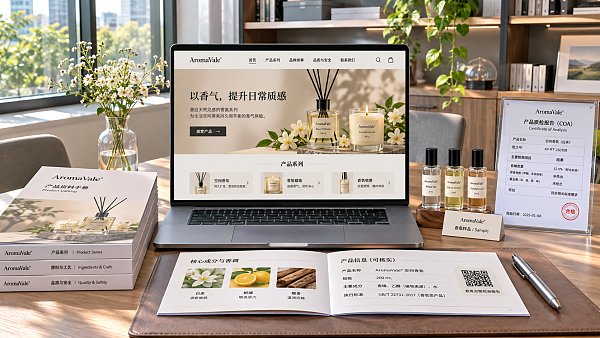
Fragrance and lifestyle companies often rely on packaging and lifestyle images to convey their brand identity, but AI systems may not be able to accurately identify product information from images alone. Product pages can retain large images and white space while adding text near the images to explain the category, specifications, manufacturing process, and use cases. Alt text should describe the image, not be stuffed with unrelated keywords.
Website layout also affects how easily information can be found. The fragrance, personal care, and beauty solution uses a vertical hierarchy, product matrix, and responsive design, and can present the OEM customization process as a timeline. When using these layouts, provide accurate text descriptions for process steps, benefit cards, and data dashboards so that pages are not only visually appealing but also answer questions that come up repeatedly in business inquiries.
Check technical accessibility and multilingual versions
Ask your developers or website provider to check that pages return a normal status and that important content is visible without logging in or completing complex interactions. Access rules that block pages, incorrect redirects, loading failures, or body content generated entirely by scripts may all affect access to information. Distinguish between access controls for search indexing and those for purposes such as AI training. Follow the latest guidance from the relevant services for specific crawling rules; do not assume that allowing all crawlers guarantees that your content will be cited.
For overseas markets, start with the languages and regions you actually serve, and improve the relevant pages individually rather than translating only the homepage. Product names, units of measurement, delivery scope, and contact information should be consistent with the content of each local page. Language-version tags can be used to link translated pages to their corresponding versions. After machine translation, review industry terminology and commercial terms to avoid making inaccurate commitments.
Structured data can help search systems understand information about organizations, products, and other elements on a page, but it must match the visible content and cannot replace complete body text. After adding it, check the format and the actual page content. It does not guarantee that your content will be cited by AI.
Keep validating with a set of questions instead of focusing on a single answer
Create a simple tracking sheet to record the test date, query language, full question, brand mentions in the answer, source links, and factual errors. Retest the same questions after a while, and try varying the wording. Answers can change depending on context, region, engine updates, and user settings, so a single result is not enough to prove that optimization has or has not worked.
When you find an incorrect answer, first trace it back to its source. If the information on your own website is outdated, update the original page first. If the error comes from another publicly available page, contact its publisher to request verification and correction. After making changes, keep a record of the date and page, then monitor subsequent answers for changes. In addition to whether your brand appears, check whether the reasons given for recommending it are accurate, whether links point to suitable pages, and whether visitors can easily find the inquiry form.
If resources are limited, first improve your most important category and service pages, then add multilingual content and ensure consistency with external information. Do not publish large batches of similar articles without factual support, and do not treat paid promotion as a guarantee of organic citations. The issues that truly need priority are the places where your website has no clear answer to customers’ key questions.
Related Articles
 How Long Does AI Search Optimization Take to Show Results? What Factors Affect the Timeline?
 Google, ChatGPT, and other platforms are starting to provide promo codes directly in search results
 How do the optimization priorities of AI SEO and traditional SEO differ?


Related Products
 Yiyingbao SaaS Intelligent Website Building and Marketing SystemYiyingbao SaaS Intelligent Website Building and Marketing System, AI-powered no-code website building, rapid creation of multilingual B2B international websites in 10 minutes, global server acceleration, AI-powered SEO optimization, helping businesses connect efficiently with global markets. The perfect integration of technology and operation makes building an international trade website remarkably simple
 AI+SEM Intelligent Advertising Marketing SystemAI+SEM drives intelligent ad creation, empowering full-funnel precision advertising marketing. The system automatically generates weekly/monthly reports, AI recommends keywords and target countries, monitors core metrics in real-time with intelligent alerts, and enables one-click high-conversion ad solutions to help quickly acquire customers and improve ROI.
 AI+SEO Dual-Engine System Optimization ServicesYiyingbao’s AI+SEO dual-engine optimization system helps foreign trade enterprises acquire high-quality organic traffic through AI-powered keyword research, content generation, and comprehensive technical optimization, significantly improving search rankings and conversion rates.
 AI+SNS Social Media Marketing SystemYingbao AI+SNS Social Media Marketing System - Precision social capture for the social media era. Supports one-click content synchronization across major platforms like Facebook and LinkedIn. AI intelligently rewrites posts for enhanced relevance. 24/7 AI customer service and user profiling analysis empower businesses to efficiently expand into global markets.
 AI+SEO营销解决方案易营宝AI+SEO营销解决方案,通过AI批量写作、智能生成TDK、精准关键词扩词等功能,全面优化网站SEO效果,提升流量与转化率。助力企业构建高效智能网站新生态。
 AI+SEM Advertising Marketing SolutionsAI+SEM Advertising Marketing Solution leverages AI technology to deeply empower SEM ad campaigns. It automatically generates weekly/monthly reports using AI, presenting account data across multiple dimensions for comprehensive insights into campaign performance and trends. The system precisely recommends keywords and target countries, intelligently generates high-conversion ad copy, and enables one-click activation of efficient campaign plans to help businesses rapidly acquire customers. Simultaneously, it monitors core metrics in real time, intelligently identifies abnormal fluctuations, and issues timely alerts to ensure stable, high-return advertising results.
 Domain Name ServicesEasyWin provides professional domain name services, including intelligent queries, one-stop registration, brand protection, and full lifecycle management, helping businesses build a digital brand image.
 EasyOperate B2C Cross-Border E-Commerce Platform & Independent WebsiteEasyStore B2C Cross-border E-commerce Independent Store is an intelligent website building and cross-border e-commerce integrated solution independently developed by EasyStore Information Technology (Beijing) Co., Ltd. The system is specially designed for small and medium-sized as well as large export enterprises, integrating 'website building, operation, marketing, advertising, and conversion' into one, helping enterprises quickly establish cross-border e-commerce independent stores to achieve brand globalization and global sales growth.
The platform supports multiple languages, multiple currencies, and multi-channel marketing, with built-in AI intelligent translation and SEO optimization systems, suitable for mainstream markets such as Southeast Asia, Europe and America, Latin America, and the Middle East, assisting Chinese manufacturing enterprises in efficiently deploying international e-commerce strategies. SSL证书易营宝提供专业SSL安全证书服务,包括单域名和泛域名证书,确保网站数据传输加密、身份验证和完整性保护,助力企业建立安全可信的在线业务环境。









