









- Can the average annual growth rate reflect real opportunities in overseas markets?Oct 07, 2026View details
- Which customer acquisition channels will be affected by cross-border marketing trends in 2026?Sep 06, 2026View details
- Which homogenization risks should be considered in an analysis of the AI-powered website building industry?Aug 30, 2026View details
- How Will AI Marketing Trends 2026 Change Advertising Budget AllocationAug 28, 2026View details
- Is the EV SSL certificate market shrinking or upgrading? How should companies assess certificate procurement?Aug 11, 2026View details
- Why the old AMP SEO 2020 practices no longer work and what has changed in current optimization prioritiesAug 02, 2026View details
Should Localized Content for Overseas Markets Change the Language or the Structure First?
For Localizing Content for Overseas Markets, Should You Change the Language or the Structure First?
When localizing content for overseas markets, many teams instinctively start with translation. This is perfectly understandable, but in practice, what truly determines whether a website can be found, understood, and converted is often not the wording itself, but the content structure. Language is only the surface; structure is the framework that enables information to be communicated effectively.
If you simply replace each sentence on a Chinese page with English, German, or Arabic, the page may appear to have an “overseas version,” but it often still follows a domestic mindset: the headlines are too vague, the module order does not match local purchasing habits, product benefits are buried too deeply, and inquiry access is not direct enough. As a result, search engines may identify the keywords, but users leave after only a brief glance.
Changing the Language First Usually Only Solves “Being Understandable”
The main value of language localization is removing barriers to understanding. For example, many Western B2B customers prefer concise and direct expressions and do not appreciate roundabout introductions. In markets such as the Middle East, Latin America, and Southeast Asia, however, some industries may rely more heavily on clear product descriptions, application scenarios, and contact prompts. When language translation is not done properly, the most obvious problems are not that the content seems “less sophisticated,” but that the information is incomplete, the terminology is inaccurate, and the tone does not match local conventions.
However, changing only the language creates a common misconception: every paragraph is translated carefully and fluently, without considering whether the content itself needs to exist in the target market. The common structure of Chinese websites—writing ten lines of company introduction first, placing certificates and awards near the top, and hiding product parameters toward the end—does not necessarily work overseas. Many buyers care more about what you sell, whether it suits their application scenarios, what the delivery scope is, and whether they can quickly reach someone.
In other words, language is a necessary step, but it solves the problem of whether users can keep reading. If the structure is not optimized, the underlying problem remains.
Changing the Structure First Is Often Closer to “Whether It Can Convert”
Structural adjustment is essentially about reordering information priorities. A mature overseas independent website usually does not begin by explaining “how impressive we are.” Instead, it first answers three questions: What does the company do? What problems can it solve? Why is it worth continuing to explore? This is especially true for B2B export websites. The roles of the homepage, product pages, solution pages, case study pages, and FAQ should be clearly separated rather than placing all information on one long page.
Consider a common scenario: a website for exporting mechanical equipment. Chinese websites often place “corporate culture, messages from company leaders, qualifications, and awards” at the beginning. But when overseas customers search for “industrial mixer supplier,” they are more likely to want to see the model range, applicable industries, technical specifications, lead times, after-sales service, and certification requirements first. If the structure remains unchanged, even the best translation can only turn the content into “correct foreign-language content,” not a “usable sales page.”
Therefore, changing the structure first can usually improve page discoverability and conversion efficiency more quickly. This is particularly important when an independent website is developed for Google SEO. Information hierarchy, heading logic, internal linking, and semantic distribution across the page all affect how easily the content can be understood. When the structure is disorganized, even a large number of keywords can easily become scattered.
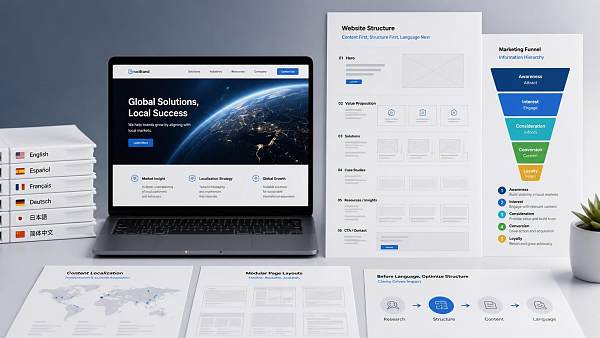
A More Practical Judgment: Whether to Change the Language or Structure First Depends on the Goal, Not Habit
If the website is only for brand presentation and the target market already has some awareness of your brand, language can come first. You can quickly turn Chinese content into a version that local users can understand, and then gradually optimize the structure. The prerequisite is that the content itself is not complex and does not involve intense comparison or strong conversion requirements.
However, if you are building an overseas customer-acquisition website—especially one that needs to support organic search, advertising landing pages, social media traffic, and inquiry conversion—you should usually examine the structure first and then work on the language. The reason is practical: page structure determines how information is received, while language determines how that information is expressed. The former is the framework; the latter is the presentation.
This can be understood in three simple steps:
- First, clarify the page’s purpose: is it for lead generation, presentation, solution explanation, or receiving advertising traffic?
- Next, adjust the content order: place the information users care about most at the front.
- Finally, localize the language: review the terminology, tone, units, time zones, and contact details together.
This sequence sounds simple, but in actual projects, the first step is precisely the one most likely to be skipped.
Several Common Pitfalls Where Many Websites Get Stuck
First, Chinese content is too information-dense and becomes even harder to read after translation. Chinese pages often place multiple points of information in a single sentence. After being translated into English, the result can become long and rigid. When browsing websites, overseas users generally respond better to “short sentences + clear headings + layered content,” especially on mobile devices.
Second, section names are not localized. Terms such as “Solutions,” “About Us,” and “Contact Us” are not inherently wrong, but in different markets, users may be more accustomed to seeing industry applications, product types, or service scopes. If section names are too abstract, they can affect click-through rates and also influence how search engines determine the page topic.
Third, localization is treated as pure translation, while the pace of local purchasing decisions is overlooked. Some markets place greater emphasis on certifications, delivery, and after-sales service; others care more about price ranges and minimum order quantities; still others look at case studies and application scenarios first. If the structure does not fit the market, users may feel that “this company understands the product, but does not understand me.”
Fourth, the technical aspects are not addressed. If a multilingual website merely duplicates content, URL structures, hreflang, internal links, and duplicate-page control must also be handled. Otherwise, no matter how localized the language is, search engines may still treat the pages as duplicate content, affecting indexing and ranking performance. This aspect generally needs to be considered together with website development, SEO, and content rather than handled separately.
This Is Where an Integrated Website and Marketing Service Creates Value
Content localization for overseas markets is not a standalone task. Teams that execute it effectively usually consider website development, SEO, advertising, and social media content together. For example, an integrated website and marketing service platform such as 易营宝 does more than simply “build a website.” It considers multilingual websites, marketing-oriented pages, search engine indexing logic, and traffic conversion methods within the same framework. The benefit is that the content structure serves not merely to “look complete,” but to ensure that the content can be found, understood, and converted.
This approach is especially important for foreign trade companies, manufacturing factories, and cross-border e-commerce sellers. Your website does not exist in isolation. It receives advertising traffic, Google search traffic, and social media traffic, and may even provide summary content in AI search results. If the logic between sections is unclear, both systems and users will have difficulty “reading” the page smoothly.
Incidentally, content strategy restructuring does not occur only on marketing websites. Topics such as Restructuring the Core Competencies of Corporate Finance Professionals in the Age of Artificial Intelligence, although not a direct page for an overseas website, reflect a very real change: content and business capabilities are both being reorganized. Those who understand new information structures first are more likely to adapt to new ways of communicating in the market.
A More Reliable Approach Is Not to Choose One, but to Proceed in Layers
If I had to recommend a practical sequence, I would suggest defining the structure first, then working on the language, and finally revisiting the copy to refine the details. Structure is the skeleton and language is the skin. Both are important, but the order should not be reversed. In particular, when localizing content for overseas markets, the greatest risk is to “translate very carefully while taking the wrong direction.”
The truly experienced approach is to review the page from the perspective of the target-market user journey: Where do users enter? What do they want to know first? Where might they hesitate? Where do they need evidence? Where should an immediate call to action be provided? After these questions are clarified, you can decide how the language should be written, how the modules should be arranged, and which content should be retained or removed.
If you are currently preparing to build an overseas independent website or a multilingual website, it is best not to underestimate “localization.” It is not simply changing Chinese into another language, nor is it making the homepage more elaborate. It is a reorganization of information that makes the website look and feel like something users in the target market would actually browse, rather than a version where internal staff are simply talking to themselves.
Related Articles


Related Products
 Yiyingbao SaaS Intelligent Website Building and Marketing SystemYiyingbao SaaS Intelligent Website Building and Marketing System, AI-powered no-code website building, rapid creation of multilingual B2B international websites in 10 minutes, global server acceleration, AI-powered SEO optimization, helping businesses connect efficiently with global markets. The perfect integration of technology and operation makes building an international trade website remarkably simple
 AI+SEM Intelligent Advertising Marketing SystemAI+SEM drives intelligent ad creation, empowering full-funnel precision advertising marketing. The system automatically generates weekly/monthly reports, AI recommends keywords and target countries, monitors core metrics in real-time with intelligent alerts, and enables one-click high-conversion ad solutions to help quickly acquire customers and improve ROI.
 AI+SEO Dual-Engine System Optimization ServicesYiyingbao’s AI+SEO dual-engine optimization system helps foreign trade enterprises acquire high-quality organic traffic through AI-powered keyword research, content generation, and comprehensive technical optimization, significantly improving search rankings and conversion rates.
 AI+SNS Social Media Marketing SystemYingbao AI+SNS Social Media Marketing System - Precision social capture for the social media era. Supports one-click content synchronization across major platforms like Facebook and LinkedIn. AI intelligently rewrites posts for enhanced relevance. 24/7 AI customer service and user profiling analysis empower businesses to efficiently expand into global markets.
 AI+SEO营销解决方案易营宝AI+SEO营销解决方案,通过AI批量写作、智能生成TDK、精准关键词扩词等功能,全面优化网站SEO效果,提升流量与转化率。助力企业构建高效智能网站新生态。
 AI+SEM Advertising Marketing SolutionsAI+SEM Advertising Marketing Solution leverages AI technology to deeply empower SEM ad campaigns. It automatically generates weekly/monthly reports using AI, presenting account data across multiple dimensions for comprehensive insights into campaign performance and trends. The system precisely recommends keywords and target countries, intelligently generates high-conversion ad copy, and enables one-click activation of efficient campaign plans to help businesses rapidly acquire customers. Simultaneously, it monitors core metrics in real time, intelligently identifies abnormal fluctuations, and issues timely alerts to ensure stable, high-return advertising results.
 Domain Name ServicesEasyWin provides professional domain name services, including intelligent queries, one-stop registration, brand protection, and full lifecycle management, helping businesses build a digital brand image.
 EasyOperate B2C Cross-Border E-Commerce Platform & Independent WebsiteEasyStore B2C Cross-border E-commerce Independent Store is an intelligent website building and cross-border e-commerce integrated solution independently developed by EasyStore Information Technology (Beijing) Co., Ltd. The system is specially designed for small and medium-sized as well as large export enterprises, integrating 'website building, operation, marketing, advertising, and conversion' into one, helping enterprises quickly establish cross-border e-commerce independent stores to achieve brand globalization and global sales growth.
The platform supports multiple languages, multiple currencies, and multi-channel marketing, with built-in AI intelligent translation and SEO optimization systems, suitable for mainstream markets such as Southeast Asia, Europe and America, Latin America, and the Middle East, assisting Chinese manufacturing enterprises in efficiently deploying international e-commerce strategies. SSL证书易营宝提供专业SSL安全证书服务,包括单域名和泛域名证书,确保网站数据传输加密、身份验证和完整性保护,助力企业建立安全可信的在线业务环境。









