









- Can the average annual growth rate reflect real opportunities in overseas markets?Oct 07, 2026View details
- Which customer acquisition channels will be affected by cross-border marketing trends in 2026?Sep 06, 2026View details
- Which homogenization risks should be considered in an analysis of the AI-powered website building industry?Aug 30, 2026View details
- How Will AI Marketing Trends 2026 Change Advertising Budget AllocationAug 28, 2026View details
- Is the EV SSL certificate market shrinking or upgrading? How should companies assess certificate procurement?Aug 11, 2026View details
- Why the old AMP SEO 2020 practices no longer work and what has changed in current optimization prioritiesAug 02, 2026View details
Why Should Japanese Website Development Separate Product Pages from Article Pages?
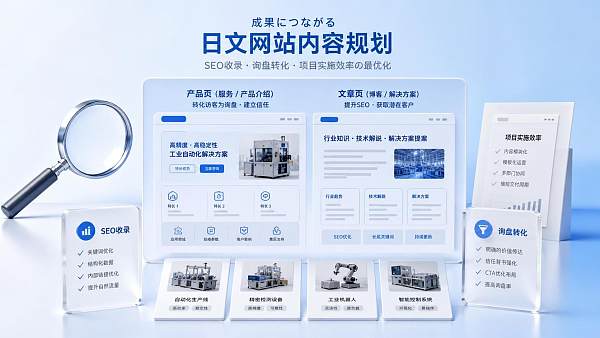
In Japanese website development, product pages and article pages should ideally be created separately. This is not about making the website structure more complicated, but because these two types of pages serve fundamentally different purposes: product pages help visitors understand and trust your offerings and submit inquiries, while article pages capture search traffic and gradually expand your reach. When they are mixed together, the usual result is unfocused content, poor SEO indexing, and unstable conversion rates.
Many projects get stuck not because the design is inadequate, but because the page objectives have not been clearly defined. If you are developing a Japanese website, first separate the questions of “what you sell” and “how users find you through search.” Once this distinction is clear, the structure, content, and technical implementation will become much easier to plan.
Why Product Pages and Article Pages Should Not Be Mixed in Japanese Website Development
Here is the conclusion first: product pages are like sales pages, while article pages are like entry pages. Product pages need to answer questions such as “Is this product right for me?”, “Can I trust your company?”, and “How do I contact you next?” Article pages need to answer questions such as “What is this issue?”, “How would Japanese users search for it?”, and “Can I find you first?”
When the two are mixed on one page, three problems are most likely to occur. First, the page topic becomes scattered, making it difficult for search engines to determine which type of keywords it should match. Second, the visitor’s reading path is interrupted: people who originally wanted to view specifications may be led away by lengthy explanations, while those seeking knowledge may be pushed toward sales content too early. Third, page templates become difficult to standardize, making later content updates very slow and increasing project management costs.
For people working on Japanese website development, this is not merely a matter of format; it is an information architecture issue. Particularly when targeting the Japanese market, users are more accustomed to content that is clearly organized, restrained, and categorized. The more focused a page’s function is, the easier it is to produce accurate content.
What Should Product Pages Cover, and What Should Article Pages Handle?
The core purpose of a product page is conversion. It should focus on a specific product, service, or solution and clearly explain its specifications, applicable scenarios, advantages, delivery methods, and frequently asked questions. For engineering project managers, the most important thing about a product page is not whether the copy is attractive, but whether the information is complete enough to support internal evaluation and external communication.
The core purpose of an article page is to cover search demand. It is more suitable for answering questions involving methods, comparisons, and evaluations, such as “Is it necessary to create separate sections for Japanese website development?”, “How should the content structure of a Japanese website be organized?”, and “What do Japanese customers value most?” This type of content may not generate direct sales immediately, but it determines whether users can find you. When many projects receive no traffic at the beginning, the problem is not that the website has not gone live, but that the article pages have not fulfilled their role as content entry points.
Here is a practical evaluation criterion: if the primary purpose of a page is to help users make a decision, it belongs on a product page; if its primary purpose is to help users first understand an issue, it belongs on an article page. Do not expect one page to accomplish both tasks at the same time. Usually, neither objective will be addressed in sufficient depth.
This separation also offers benefits in website development technology. Once content types are clearly defined, it becomes easier to manage section permissions, URL rules, internal-link distribution, on-site search, and data analytics. If the website also needs to support multiple languages, overseas access, and resource loading, distribution strategies for images, scripts, and media files should also be considered at the same time. When necessary, basic resource solutions such as website traffic packages can be planned separately to prevent bandwidth or traffic cost fluctuations during peak periods from affecting the user experience.
Common Pitfalls in Project Management
The first pitfall is turning a product introduction into an article. The content may appear extensive, but it lacks a clear call to action. After reading it, visitors may understand many concepts but still not know how to request a quotation, choose a solution, or contact the person in charge.
The second pitfall is turning an article page into a “soft sales page.” The title, body, and conclusion all promote the product. In the short term, this may appear to generate traffic, but in the long term, it causes the article page to lose its independent value. Search engines need content that answers questions, not promotional pages in disguise.
The third pitfall is a disorganized section structure from the very beginning. Many projects focus only on “getting the website built first” during the planning stage and fail to distinguish between content types. As a result, adding sections, changing templates, and migrating URLs after launch can affect the entire site. For project managers, this type of rework is the most time-consuming and is also highly likely to cause budget overruns.
Another easily overlooked point is that the pace and style of Japanese content differ from those of Chinese content. Article pages require more natural narration and clear context, while product pages require higher information density and a clearer structure. Directly transferring the writing style of a Chinese website often makes the content seem too dense or too sparse.
How to Separate Them in a Way That Supports Both SEO and Conversion
In practice, there is no need to make the rules overly complicated. You can first organize the content by purpose and then implement it through the appropriate sections.
Product pages should generally retain the following information: what the product is, who it is suitable for, what problem it solves, how it differs from comparable solutions, and where users can find delivery and consultation entry points. The page should not be unnecessarily long, but it should present all the information required for decision-making in one place.
Article pages should be built around search questions: each page should address one topic, have a clear title, respond directly to the question at the beginning, and then expand through explanations, comparisons, or guidance on avoiding common pitfalls. Internal links should be added between article pages to form topic clusters, making the website more suitable for long-term indexing and continuous lead generation in Japanese website development.
If project resources are limited, the priority is also clear: first build the core product pages properly, then develop the content matrix for the article pages. Starting by writing many articles without pages to support conversion often means generating traffic for others.
Based on the experience of one-stop service platforms such as Yiyingbao, truly stable overseas websites are usually not those with “more pages,” but those with “clearer page responsibilities.” Yiyingbao Information Technology (Beijing) Co., Ltd., established in 2013, provides integrated services covering intelligent website development, SEO optimization, social media marketing, and advertising, serving scenarios such as multilingual website development, foreign trade marketing websites, cross-border online stores, and GEO Generative Engine Optimization. Its approach is actually very close to this principle: first align page types with business objectives, and then discuss content growth.
One-Sentence Advice for Project Managers
If you are developing a Japanese website, do not first ask, “Can the page be made richer?” Instead, ask, “Is this page responsible for generating conversions or acquiring traffic?” Once this distinction is clear, the subsequent sections, content, internal links, and promotion will not work against one another.
Websites that truly perform well usually use product pages to handle inquiries and article pages to capture search traffic: the former focuses on conversion, while the latter focuses on reach. Getting this right is the point at which Japanese website development begins to move onto the right track.
FAQ
Q1: Is it necessary to create a separate article section for Japanese website development?
Not necessarily. However, if you want to generate organic search traffic, a separate article section is usually more stable. Without an independent section, content can easily become mixed with product pages, making it difficult to maintain later.
Q2: Can a product page also include a lot of educational content?
It can include some, but educational content should not overshadow the main purpose. The primary objective of a product page is still conversion, and too much educational content can dilute the core information.
Q3: Should inquiry buttons be placed directly on article pages?
They can be included, but their placement should be restrained. The primary task of an article page is to answer questions; the button is supplementary and should not become the focus of the article.
Q4: If only one person is responsible for content, which type of page should be created first?
Start with the core product pages, followed by articles addressing the questions most frequently searched for. This makes it easier to establish a minimum viable closed loop.
Q5: In Japanese website development, will separating the pages affect the consistency of the overall style?
No. The visual design and components remain consistent; what is separated is the responsibility of the content. The two do not conflict.
Related Articles


Related Products
 Yiyingbao SaaS Intelligent Website Building and Marketing SystemYiyingbao SaaS Intelligent Website Building and Marketing System, AI-powered no-code website building, rapid creation of multilingual B2B international websites in 10 minutes, global server acceleration, AI-powered SEO optimization, helping businesses connect efficiently with global markets. The perfect integration of technology and operation makes building an international trade website remarkably simple
 AI+SEM Intelligent Advertising Marketing SystemAI+SEM drives intelligent ad creation, empowering full-funnel precision advertising marketing. The system automatically generates weekly/monthly reports, AI recommends keywords and target countries, monitors core metrics in real-time with intelligent alerts, and enables one-click high-conversion ad solutions to help quickly acquire customers and improve ROI.
 AI+SEO Dual-Engine System Optimization ServicesYiyingbao’s AI+SEO dual-engine optimization system helps foreign trade enterprises acquire high-quality organic traffic through AI-powered keyword research, content generation, and comprehensive technical optimization, significantly improving search rankings and conversion rates.
 AI+SNS Social Media Marketing SystemYingbao AI+SNS Social Media Marketing System - Precision social capture for the social media era. Supports one-click content synchronization across major platforms like Facebook and LinkedIn. AI intelligently rewrites posts for enhanced relevance. 24/7 AI customer service and user profiling analysis empower businesses to efficiently expand into global markets.
 AI+SEO营销解决方案易营宝AI+SEO营销解决方案,通过AI批量写作、智能生成TDK、精准关键词扩词等功能,全面优化网站SEO效果,提升流量与转化率。助力企业构建高效智能网站新生态。
 AI+SEM Advertising Marketing SolutionsAI+SEM Advertising Marketing Solution leverages AI technology to deeply empower SEM ad campaigns. It automatically generates weekly/monthly reports using AI, presenting account data across multiple dimensions for comprehensive insights into campaign performance and trends. The system precisely recommends keywords and target countries, intelligently generates high-conversion ad copy, and enables one-click activation of efficient campaign plans to help businesses rapidly acquire customers. Simultaneously, it monitors core metrics in real time, intelligently identifies abnormal fluctuations, and issues timely alerts to ensure stable, high-return advertising results.
 Domain Name ServicesEasyWin provides professional domain name services, including intelligent queries, one-stop registration, brand protection, and full lifecycle management, helping businesses build a digital brand image.
 EasyOperate B2C Cross-Border E-Commerce Platform & Independent WebsiteEasyStore B2C Cross-border E-commerce Independent Store is an intelligent website building and cross-border e-commerce integrated solution independently developed by EasyStore Information Technology (Beijing) Co., Ltd. The system is specially designed for small and medium-sized as well as large export enterprises, integrating 'website building, operation, marketing, advertising, and conversion' into one, helping enterprises quickly establish cross-border e-commerce independent stores to achieve brand globalization and global sales growth.
The platform supports multiple languages, multiple currencies, and multi-channel marketing, with built-in AI intelligent translation and SEO optimization systems, suitable for mainstream markets such as Southeast Asia, Europe and America, Latin America, and the Middle East, assisting Chinese manufacturing enterprises in efficiently deploying international e-commerce strategies. SSL证书易营宝提供专业SSL安全证书服务,包括单域名和泛域名证书,确保网站数据传输加密、身份验证和完整性保护,助力企业建立安全可信的在线业务环境。









