









- Can the average annual growth rate reflect real opportunities in overseas markets?Oct 07, 2026View details
- Which customer acquisition channels will be affected by cross-border marketing trends in 2026?Sep 06, 2026View details
- Which homogenization risks should be considered in an analysis of the AI-powered website building industry?Aug 30, 2026View details
- How Will AI Marketing Trends 2026 Change Advertising Budget AllocationAug 28, 2026View details
- Is the EV SSL certificate market shrinking or upgrading? How should companies assess certificate procurement?Aug 11, 2026View details
- Why the old AMP SEO 2020 practices no longer work and what has changed in current optimization prioritiesAug 02, 2026View details
How to View GEO-Driven Search Performance in Google Search Console
To determine whether generative engine optimization has delivered real search performance using google search console geo, you first need to accept one fact: Google Search Console cannot directly tell you that “this click came from GEO.” It is better suited to observing whether, after GEO content is published, related pages, topic terms, and branded terms gain more Google search impressions, clicks, and effective rankings, thereby establishing a verifiable assessment of growth.
After opening Search Console, many people look only at total clicks and conclude that GEO is ineffective if there is no noticeable increase after a few weeks. This conclusion is usually too early and too broad. The value of GEO is often first reflected in content being understood and indexed, covering more long-tail questions, and increasing brand visibility in specific answer-oriented searches; these changes need to be assessed together with queries, pages, countries, and time periods.
What can Google Search Console GEO data actually reveal?
The goal of GEO is not simply to make a page appear for a single keyword, but to make enterprise content easier for search engines and generative search systems to identify, cite, and organize into answers. Google Search Console provides website performance data in Google Search, primarily including impressions, clicks, average click-through rate, and average position.
Therefore, the correct use of Google Search Console GEO is not to look for a standalone report called “GEO traffic,” but to observe whether the following signals appear before and after GEO optimization:
- An increase in the number of long-tail queries related to products, scenarios, and questions;
- Pages carrying answer-oriented content receive more impressions, rather than just an increase in homepage traffic;
- Expanded impressions for branded terms and “brand + product/solution” searches;
- Changes in click quality for key countries, language versions, or directories;
- Whether pages, after gaining exposure, further generate inquiries, form submissions, or store orders.
Among these indicators, impression growth does not equal customer acquisition growth, but it is usually the earliest signal of a change in content visibility. Growth in clicks does not necessarily represent business growth either, especially because informational content may generate many low-intent visits. Ultimately, Search Console should still be combined with website analytics, CRM, or form source records to confirm whether visits enter an actual conversion path.
Establish a baseline first, then assess changes
Before publishing GEO content, adjusting page structure, or adding entity information, first export a baseline dataset. It is recommended to select a continuous period of 28 days or 3 months; the period should not be too short. Foreign trade websites are often affected by seasons, trade shows, advertising campaigns, market fluctuations, and the launch of multilingual pages, so drawing conclusions from weekly data alone can easily lead to misjudgment.
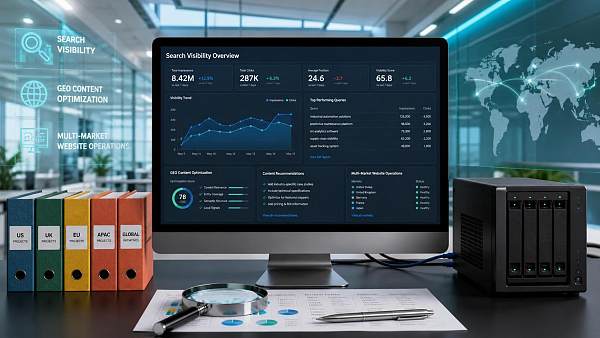
After entering the “Performance” report in Search Console, first confirm that the property scope is correct: a Domain property can aggregate data from http, https, www, and non-www versions; if only a specific URL prefix has been verified, data from other versions may be missed. Then enable the four metrics of clicks, impressions, average CTR, and average position, and use the “Compare” feature to select two equal-length periods before and after optimization.
In practice, it is recommended to filter by page first rather than focusing on the entire site from the start. Group GEO-related pages by content type, such as product description pages, solution pages, industry Q&A pages, knowledge base articles, and multilingual landing pages. This helps prevent fluctuations in advertising pages, old articles, or the brand homepage from masking real changes.
Evaluate from both the “Queries” and “Pages” dimensions
The “Queries” tab answers what questions users used to find you, while the “Pages” tab answers which page received those searches. The two must be reviewed together; looking at only one side can easily lead to one-sided conclusions.
For example, content about selecting industrial components may gain more impressions after optimization, but if the new queries are concentrated on broad informational terms such as “what is” and “definition,” with low click-through rates and no inquiries after visits, this indicates that the page may have expanded informational coverage without yet addressing procurement decision-making questions. In this case, do not rush to add more broad content. Instead, add specifications, application boundaries, certification information, lead times, customization requirements, and inquiry entry points.
Conversely, if a page does not show a significant increase in clicks but its impressions and average position continue to improve, it should not simply be considered a failure. When rankings move from lower search result positions into the first few pages, changes in impressions often appear first; actual click growth depends on the title, description, search intent match, and competing pages. During the observation period, prioritize whether the trend is stable rather than focusing on a spike on a particular day.
For multilingual websites, also apply the “Country/Region” and “Queries” filters. If an English page is growing in the United States while a German page mainly receives impressions in other markets, this may indicate deviations in hreflang, page language, product terminology, or localized wording. Search Console can indicate where the issue may lie, but it cannot replace a review of page content and technical configuration.
Do not attribute all growth to GEO
This is the most common misconception in practice. Changes in organic search performance may result from Google algorithm updates, page redesigns, backlink changes, site indexing recovery, brand exposure, advertising synergy, or seasonal demand. If GEO optimization goes live alongside other marketing activities, the data should not be directly attributed to GEO.
A more reliable approach is to maintain a content change log: record the page launch date, which modules were modified, whether structured data was added, whether FAQs were updated, whether titles were changed, and whether advertising or social media activities were conducted simultaneously. When data changes are observed later, you can at least trace back the possible influencing factors.
There is also a technical limitation to note: query data in Search Console is aggregated and privacy-processed, so low-frequency queries may not be fully displayed; “average position” is an aggregated metric and does not represent a fixed position for a particular user, country, or search. It is suitable for observing direction, not for promising specific rankings.
Which pages are more suitable for inclusion in a GEO monitoring list?
Prioritize pages that are directly related to business decisions and whose content can be continuously maintained. Examples include product application pages, solution pages, specification comparison pages, industry question-and-answer pages for B2B procurement, as well as brand pages that explain service scope and delivery processes. Content that merely follows trends without supporting business conversion may not be worth long-term investment, even if it generates impressions.
The page itself should provide clear information: who the entity is, what it provides, which scenarios it is suitable for, how it differs from other solutions, and where its basis or sources can be found. Generative search can more easily process content with a clear structure, verifiable facts, and complete context, but this does not mean piling up Q&As or mechanically adding keywords. Vague content, inconsistent product parameters, and literal translations between different language versions will all weaken the search system’s understanding of the page.
A service model such as Yiyingbao’s, which covers intelligent website building, SEO, and GEO optimization, is suitable for companies that need unified management of multilingual sites, content, and customer acquisition workflows. Before actual configuration, it is even more important to confirm whether the website can be crawled properly, whether language versions are correct, and whether conversion tracking is available. If fundamental technical issues are not addressed, even detailed subsequent analysis of Search Console will produce distorted conclusions.
When conducting a monthly review, retain these four questions
First, which pages have shown the most significant impression growth, and what types of queries correspond to that growth? Second, are the new terms broad traffic terms, or questions close to product, application, and procurement intent? Third, is the decline in click-through rate due to impressions expanding to more low-ranking terms, or because the title and description do not answer the searcher’s question? Fourth, have organic visits from key markets generated trackable conversion actions?
These four questions are closer to business decision-making than “how many clicks has GEO generated?” Websites with small data volumes in particular should observe patiently and avoid frequent redesigns due to minor click fluctuations; websites with stable existing traffic should segment by page group and country to avoid sitewide averages masking opportunities and issues.
Frequently Asked Questions
Can Search Console separately filter AI search or GEO traffic?
Usually, GEO cannot be directly filtered as an independent source. It should be evaluated by comparing related pages, query topics, countries, and time periods, with referral sources and conversion data from website analytics tools used to support the assessment.
Impressions have increased but clicks have declined. Should the content be revised immediately?
First check which queries and ranking ranges are generating the new impressions. If the page has begun covering many relevant long-tail terms, a short-term CTR decline may be normal; if rankings are stable but clicks remain low over the long term, then check whether the title, description, and search intent are misaligned.
How often is it reasonable to review the data?
In day-to-day operations, anomalies can be checked weekly, while formal reviews are more suitable every 28 days or monthly. New pages need time for crawling, indexing, and ranking fluctuations to complete, so evaluating them too early often has little reference value.
Finally, when using google search console geo for analysis, the key is not to find a seemingly precise “AI traffic number,” but to use repeatable comparisons of pages, queries, and time periods to determine whether content visibility is moving toward more valuable search demand. Only data that can be verified and linked to conversions can truly guide the next round of optimization.
Related Articles



Related Products
 Yiyingbao SaaS Intelligent Website Building and Marketing SystemYiyingbao SaaS Intelligent Website Building and Marketing System, AI-powered no-code website building, rapid creation of multilingual B2B international websites in 10 minutes, global server acceleration, AI-powered SEO optimization, helping businesses connect efficiently with global markets. The perfect integration of technology and operation makes building an international trade website remarkably simple
 AI+SEM Intelligent Advertising Marketing SystemAI+SEM drives intelligent ad creation, empowering full-funnel precision advertising marketing. The system automatically generates weekly/monthly reports, AI recommends keywords and target countries, monitors core metrics in real-time with intelligent alerts, and enables one-click high-conversion ad solutions to help quickly acquire customers and improve ROI.
 AI+SEO Dual-Engine System Optimization ServicesYiyingbao’s AI+SEO dual-engine optimization system helps foreign trade enterprises acquire high-quality organic traffic through AI-powered keyword research, content generation, and comprehensive technical optimization, significantly improving search rankings and conversion rates.
 AI+SNS Social Media Marketing SystemYingbao AI+SNS Social Media Marketing System - Precision social capture for the social media era. Supports one-click content synchronization across major platforms like Facebook and LinkedIn. AI intelligently rewrites posts for enhanced relevance. 24/7 AI customer service and user profiling analysis empower businesses to efficiently expand into global markets.
 AI+SEO营销解决方案易营宝AI+SEO营销解决方案,通过AI批量写作、智能生成TDK、精准关键词扩词等功能,全面优化网站SEO效果,提升流量与转化率。助力企业构建高效智能网站新生态。
 AI+SEM Advertising Marketing SolutionsAI+SEM Advertising Marketing Solution leverages AI technology to deeply empower SEM ad campaigns. It automatically generates weekly/monthly reports using AI, presenting account data across multiple dimensions for comprehensive insights into campaign performance and trends. The system precisely recommends keywords and target countries, intelligently generates high-conversion ad copy, and enables one-click activation of efficient campaign plans to help businesses rapidly acquire customers. Simultaneously, it monitors core metrics in real time, intelligently identifies abnormal fluctuations, and issues timely alerts to ensure stable, high-return advertising results.
 Domain Name ServicesEasyWin provides professional domain name services, including intelligent queries, one-stop registration, brand protection, and full lifecycle management, helping businesses build a digital brand image.
 EasyOperate B2C Cross-Border E-Commerce Platform & Independent WebsiteEasyStore B2C Cross-border E-commerce Independent Store is an intelligent website building and cross-border e-commerce integrated solution independently developed by EasyStore Information Technology (Beijing) Co., Ltd. The system is specially designed for small and medium-sized as well as large export enterprises, integrating 'website building, operation, marketing, advertising, and conversion' into one, helping enterprises quickly establish cross-border e-commerce independent stores to achieve brand globalization and global sales growth.
The platform supports multiple languages, multiple currencies, and multi-channel marketing, with built-in AI intelligent translation and SEO optimization systems, suitable for mainstream markets such as Southeast Asia, Europe and America, Latin America, and the Middle East, assisting Chinese manufacturing enterprises in efficiently deploying international e-commerce strategies. SSL证书易营宝提供专业SSL安全证书服务,包括单域名和泛域名证书,确保网站数据传输加密、身份验证和完整性保护,助力企业建立安全可信的在线业务环境。









