









- Can the average annual growth rate reflect real opportunities in overseas markets?Oct 07, 2026View details
- Which customer acquisition channels will be affected by cross-border marketing trends in 2026?Sep 06, 2026View details
- Which homogenization risks should be considered in an analysis of the AI-powered website building industry?Aug 30, 2026View details
- How Will AI Marketing Trends 2026 Change Advertising Budget AllocationAug 28, 2026View details
- Is the EV SSL certificate market shrinking or upgrading? How should companies assess certificate procurement?Aug 11, 2026View details
- Why the old AMP SEO 2020 practices no longer work and what has changed in current optimization prioritiesAug 02, 2026View details
Which tool should you choose for GEO in multiple languages?
If you want to answer directly, “which tool should be chosen for GEO on a multilingual site?”, the priority is usually not to look at the feature list first, but to examine the content source, URL structure, language-switching logic, and the way content is rendered for crawling. GEO focuses on the comprehensibility of generative search and answer engines. Once language content, structured data, page entity relationships, and regional versions are separated on a multilingual site, even the most powerful tool can only perform superficial optimization. A truly suitable tool should cover page production, language-version management, entity annotation, log feedback, and publishing validation at the same time, rather than merely translating titles and body copy in bulk.
When evaluating which tool to choose for GEO on a multilingual site, many teams first look for a translation plugin or an AI rewriting tool. This conclusion is often premature. GEO is not simply about turning a Chinese article into French, English, or Spanish versions. It is about enabling pages in different languages to form a stable mapping around the same topic: primary keywords, question formats, application scenarios, material terminology, transportation units, dimensional expressions, installation practices, and after-sales explanations must all align with the search habits of the target language. For example, in content related to architecture, renovation, and interior design, terms such as “material texture,” “facade detailing,” “wear-resistance rating,” and “delivery lead time” do not have exactly corresponding high-frequency expressions in every language. If a tool only offers machine translation without a terminology database or segment-reuse capabilities, subsequent pages can easily develop synonym drift, affecting how generative systems classify the page topic.
First determine which category the tool belongs to
The available tools can generally be divided into three categories. The first consists of multilingual and content-model capabilities built into website-building systems; the second includes independent translation and localization management tools; and the third covers tools focused on GEO content generation, structured annotation, and data collection. In practice, purchasing only one category is often insufficient. The key is determining which system serves as the primary platform.
If the site has a limited number of pages and the content structure is largely consistent across language versions, the website-building platform should usually serve as the primary system. The reason is straightforward: hreflang, canonical tags, language directories, regional directories, sitemap segmentation, breadcrumbs, FAQ blocks, and product specification tables all exist at the template layer. Patching them later with additional tools will create increasing disorder. In contrast, if the site has been operating for many years, contains numerous historical URLs, and content updates depend on multiple departments, an independent localization tool will provide greater value because it is better suited to translation memories, terminology approvals, version comparisons, and rollbacks.
The truly useful part of a GEO tool is not “automatically writing articles,” but whether it can convert a page into knowledge units that are easier for answer engines to extract. For example, in addition to paragraph text, a page presenting an architectural project should be able to consistently output fields such as project type, spatial style, primary colors, materials, area range, construction period, applicable regions, and maintenance requirements. Generative search generally favors pages with clear semantic boundaries like these, rather than pages with lengthy copy whose information cannot be broken down.
Website compatibility matters more than the number of languages
Multilingual tools often promote support for dozens of languages as a selling point, but compatibility is what actually determines whether they can be used. First, check whether the URL scheme is controllable: will it use subdirectories, subdomains, or parameter-based switching? Parameter-based switching is the most prone to problems, as crawling, indexing, and language-version mapping are all unstable. Next, check whether pages are rendered server-side or depend entirely on the front end to render after execution. If important body copy, product specifications, and FAQ sections are loaded later through scripts, generative engines may not fully understand the page.
You should also check whether template components can be driven by the same set of fields. For an architecture or renovation website, for example, a project page may contain spatial type, material, color, lighting method, construction stages, and installation conditions at the same time. If different language versions are formatted manually, field order will gradually become inconsistent, making structured extraction costly later. Conversely, if the system supports using a unified content model to drive multilingual templates, the way titles are written, specifications are translated, and image sections are positioned will all be more consistent. Pages such as interior design, renovation, and architecture, which emphasize immersive scrolling, panoramic banners, and detailed grilles, may have strong visual impact. However, without unified field constraints, the French and English versions often develop missing image captions, inconsistent material names, and misplaced elements on mobile devices, causing GEO extraction performance to fluctuate as well.
Before publishing, it is best to conduct a technical review. Do not simply check whether the page “opens.” Instead, verify whether the following details remain stable: after switching languages, does the corresponding content remain displayed rather than reverting to the default language; is the body copy directly visible in the source code; does the same page accidentally generate multiple canonical tags; are sitemaps separated by language; do image alt texts change synchronously with the language; and are dimensions, currencies, and units for different regions hard-coded into the template?
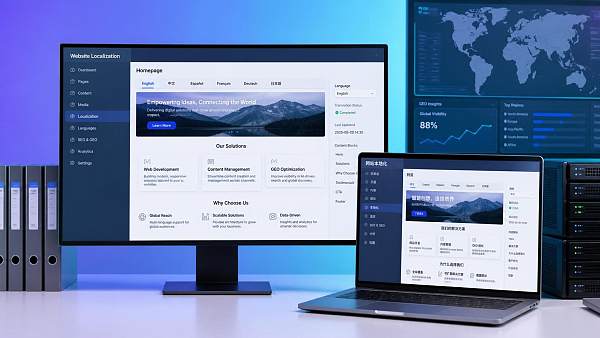
Data capabilities determine whether GEO can be continuously optimized
Many tools can quickly generate multilingual pages during demonstrations, but soon encounter a second problem after launch: they do not know which pages should be modified, supplemented, or consolidated. This is where data capabilities matter, rather than one-time generation capabilities. A suitable tool should at least be able to receive three types of data.
The first type is crawling and indexing feedback, including whether a page has been discovered, whether its language version has been correctly identified, and whether structured data contains errors. The second type is on-site content data, such as which fields are empty, which language versions still use segments from the source language, and which project pages lack material or installation information. Only the third type concerns traffic and inquiry data, which is used to determine which topics need further expansion in different languages.
If a tool cannot write this data back to the content layer, teams will repeatedly fall into a “write first and figure it out later” pattern. GEO iteration is more like maintaining a knowledge base than continuously accumulating articles. On multilingual sites in particular, a common misjudgment is to translate all high-traffic keywords into versions in different languages without completing the entity relationships. For example, architectural materials content may mention only “black finish” without adding the surface treatment, stain-resistant maintenance requirements, and applicable spaces; or mention only “white wall panels” without explaining transport packaging, installation substrates, and restrictions in humid environments. From the perspective of generative search, such pages lack sufficient information density. Even if a tool can generate many articles, it will be difficult to establish stable citations.
Localization support means more than accurate translation
When selecting a tool, localization support is often understood as “whether the translation sounds like it was written by a native speaker.” That is only the starting point. More important is whether the tool can handle regional differences, industry terminology, and collaboration workflows. French content does not necessarily have only one way of being written. When targeting different European markets, search habits, inquiry wording, and product specification formats may all vary. When evaluating which tool to choose for GEO on a multilingual site, it will be difficult to control content consistency later if the tool does not support glossaries, prohibited terms, approval comments, and version history.
Content collaboration stages must also be considered. Architecture and renovation pages are often not completed by one person. The front-end team may be responsible for layout, the content team may organize spatial descriptions, the product team may add material specifications, an external translator may complete the target-language version, and someone must finally proofread image titles, downloaded file names, and PDF attachments. If the tool cannot connect these stages, the body copy may be updated while the specification table remains unchanged, or the French version may be updated while the English attachment is not. Generative search can easily detect such inconsistencies, thereby reducing the page’s credibility.
In addition, localization does not mean splitting every page into completely independent versions. For standardized information such as installation steps, maintenance intervals, packaging and transportation, and processing techniques, maintaining multiple language pages separately is costly. A more reliable approach is to store the original parameters in structured fields and let the language layer call them. In this way, dimensions, materials, colors, and edge-finishing methods can be updated once and synchronized across the entire site, reducing errors and omissions.
Do not overlook publishing risks
When multilingual GEO tools are launched, the most common risks do not concern content quality but the publishing process itself. For example, after language directories are generated in bulk, robots rules may not be updated accordingly; the sitemap for a new language site may be submitted while old redirects remain in a loop; directory slugs may be translated automatically and conflict with existing media paths; or image file names may not be localized, causing pages in different languages to share vague alt text. These issues can directly slow indexing and comprehension.
Another risk comes from “excessive automation.” If a tool allows titles, Q&A blocks, and product descriptions to be rewritten in bulk without review, highly similar passages will appear across pages, especially during multilingual back-translation. GEO does not favor content that appears complete but is actually highly templated. During evaluation, priority should be given to whether the tool supports layered publishing: preview first, compare at the field level, and then publish selected sections, rather than pushing the entire site live with one click.
How to determine the right combination in the end
If the site is still being built, prioritize a website-building tool with a stable content model, controllable templates, and the ability to output clear source code. Then add a localization tool with a terminology database and approval workflow. GEO capabilities should focus on structured data, entity annotation, and data feedback rather than relying entirely on a generator.
If the site is already operating and has many historical pages and mixed language versions, do not rush to replace the platform. A more practical approach is to first verify the URLs, canonical tags, hreflang, and sitemaps, then integrate a tool that manages language assets and validates fields. Organize the existing content into a unified model before deciding whether to add a dedicated GEO module. Rebuilding is meaningful only when the existing system cannot guarantee template fields, source-code output, or publishing history.
Therefore, when faced with the question, “which tool should be chosen for GEO on a multilingual site?”, the most reliable answer is usually not the name of a single tool, but a sequence of evaluations: first confirm that the site can consistently generate crawlable multilingual pages; then confirm that terminology and versions can be controlled; and finally check whether GEO data can flow back into content maintenance. If this order is reversed, most subsequent optimization will become repetitive rework.
Related Articles



Related Products
 Yiyingbao SaaS Intelligent Website Building and Marketing SystemYiyingbao SaaS Intelligent Website Building and Marketing System, AI-powered no-code website building, rapid creation of multilingual B2B international websites in 10 minutes, global server acceleration, AI-powered SEO optimization, helping businesses connect efficiently with global markets. The perfect integration of technology and operation makes building an international trade website remarkably simple
 AI+SEM Intelligent Advertising Marketing SystemAI+SEM drives intelligent ad creation, empowering full-funnel precision advertising marketing. The system automatically generates weekly/monthly reports, AI recommends keywords and target countries, monitors core metrics in real-time with intelligent alerts, and enables one-click high-conversion ad solutions to help quickly acquire customers and improve ROI.
 AI+SEO Dual-Engine System Optimization ServicesYiyingbao’s AI+SEO dual-engine optimization system helps foreign trade enterprises acquire high-quality organic traffic through AI-powered keyword research, content generation, and comprehensive technical optimization, significantly improving search rankings and conversion rates.
 AI+SNS Social Media Marketing SystemYingbao AI+SNS Social Media Marketing System - Precision social capture for the social media era. Supports one-click content synchronization across major platforms like Facebook and LinkedIn. AI intelligently rewrites posts for enhanced relevance. 24/7 AI customer service and user profiling analysis empower businesses to efficiently expand into global markets.
 AI+SEO营销解决方案易营宝AI+SEO营销解决方案,通过AI批量写作、智能生成TDK、精准关键词扩词等功能,全面优化网站SEO效果,提升流量与转化率。助力企业构建高效智能网站新生态。
 AI+SEM Advertising Marketing SolutionsAI+SEM Advertising Marketing Solution leverages AI technology to deeply empower SEM ad campaigns. It automatically generates weekly/monthly reports using AI, presenting account data across multiple dimensions for comprehensive insights into campaign performance and trends. The system precisely recommends keywords and target countries, intelligently generates high-conversion ad copy, and enables one-click activation of efficient campaign plans to help businesses rapidly acquire customers. Simultaneously, it monitors core metrics in real time, intelligently identifies abnormal fluctuations, and issues timely alerts to ensure stable, high-return advertising results.
 Domain Name ServicesEasyWin provides professional domain name services, including intelligent queries, one-stop registration, brand protection, and full lifecycle management, helping businesses build a digital brand image.
 EasyOperate B2C Cross-Border E-Commerce Platform & Independent WebsiteEasyStore B2C Cross-border E-commerce Independent Store is an intelligent website building and cross-border e-commerce integrated solution independently developed by EasyStore Information Technology (Beijing) Co., Ltd. The system is specially designed for small and medium-sized as well as large export enterprises, integrating 'website building, operation, marketing, advertising, and conversion' into one, helping enterprises quickly establish cross-border e-commerce independent stores to achieve brand globalization and global sales growth.
The platform supports multiple languages, multiple currencies, and multi-channel marketing, with built-in AI intelligent translation and SEO optimization systems, suitable for mainstream markets such as Southeast Asia, Europe and America, Latin America, and the Middle East, assisting Chinese manufacturing enterprises in efficiently deploying international e-commerce strategies. SSL证书易营宝提供专业SSL安全证书服务,包括单域名和泛域名证书,确保网站数据传输加密、身份验证和完整性保护,助力企业建立安全可信的在线业务环境。









