









- Which customer acquisition channels will be affected by cross-border marketing trends in 2026?Sep 06, 2026View details
- Which homogenization risks should be considered in an analysis of the AI-powered website building industry?Aug 30, 2026View details
- How Will AI Marketing Trends 2026 Change Advertising Budget AllocationAug 28, 2026View details
- Is the EV SSL certificate market shrinking or upgrading? How should companies assess certificate procurement?Aug 11, 2026View details
- Why the old AMP SEO 2020 practices no longer work and what has changed in current optimization prioritiesAug 02, 2026View details
- How to Choose Topics for an Industry News Section to Attract More Organic Search TrafficJul 29, 2026View details
Is low overseas advertising ROI really a landing page issue?
Is low ROI in overseas advertising really a landing page problem?
Is low ROI in overseas ad campaigns caused by the landing page? Many teams’ first reaction is to change the page: replace the hero image, add a countdown timer, or make the “Request a Quote” button a more prominent color. The page may indeed have issues, but attributing low ROI entirely to the landing page often sends optimization in the wrong direction.
In actual campaigns, ROI is an outcome, not a single metric. It is influenced by traffic sources, keyword or audience intent, ad promises, bidding methods, website loading speed, form paths, sales follow-up, and attribution methods. Especially for export-oriented B2B and cross-border brand businesses, the path from a user’s first ad click to submitting an inquiry and completing a purchase is usually not linear. A low page conversion rate does not necessarily mean the page copy is unconvincing; it may also mean that the traffic brought in from the front end is simply not the right audience.
Before changing the page, identify where the “low ROI” occurs
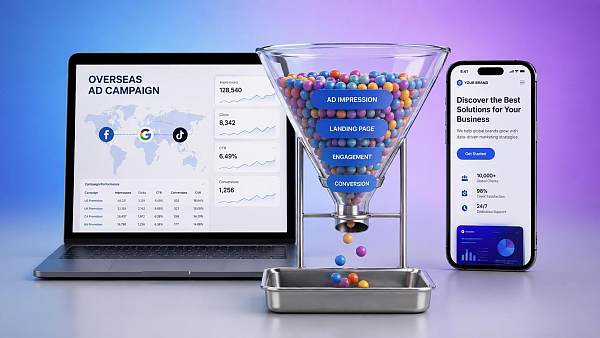
Before troubleshooting, break down the funnel. If ad impressions and clicks are both low, the issue is likely with budget, bids, keyword coverage, or audience size. If impressions and clicks are both good but the click-through rate is low, review whether the ad creative is disconnected from search terms or user scenarios. If the click-through rate is normal but landing page visits are very short, check whether the ad promise matches the page content, while also ruling out basic issues such as slow page loading, abnormal redirects, or misaligned mobile layouts.
What is most often misjudged is “having visits but no inquiries.” For example, a manufacturing company bidding on a broad industry keyword may attract purchasers, students, peers, repair users, or even individual buyers looking for small retail items. No matter how complete the page design is, it is difficult to turn visitors without purchasing qualifications into valid leads. Continuing to lower the form threshold at this point may generate more invalid submissions, exhaust the sales team, and make ROI even worse.
A more practical approach is to review data layer by layer: “impressions—clicks—qualified visits—form submissions or add-to-cart—qualified leads—closed deals.” Do not focus only on conversion figures in the advertising platform. For B2B businesses, downloading a catalog, starting a WhatsApp conversation, and submitting an inquiry should not be mechanically treated as having equal value. For B2C stores, first-order revenue, repurchase potential, refund rates, and logistics coverage can also change the true picture of ROI.
What signals indicate that the landing page should indeed be prioritized
A landing page is not simply a scapegoat, but it is often the weakest link in the conversion funnel. A typical signal is that users from different ad groups all have high bounce or quick-exit rates, while the above-the-fold section does not clearly answer three questions: what you sell, who it is for, and what the next step should be. Overseas users will not patiently study corporate promotional messaging. Especially on mobile, if they cannot find the product range, key specifications, lead time, or contact details within seconds, they will leave.
Another common issue is that the ad and the page are “not talking about the same thing.” The ad says “custom aluminum parts supplier,” but the click leads to a group homepage covering dozens of product categories; the ad promises “request a quote,” but the page only directs users to subscribe to emails. User expectations are interrupted, and conversions naturally decline. For high-intent search traffic, it is best to create a consistent message across keywords, ad headlines, landing page headlines, and form objectives, rather than relying on the homepage to handle every need.
Export-oriented websites should also pay particular attention to whether there is sufficient trust-building information. Buyers may not require an elaborate page, but they usually care about product applications, material or process scope, minimum order quantities, lead-time communication methods, quality control documentation, factory capabilities, and response channels. There is no need to fill the page with unverified certifications or service promises. Instead, clearly present what can be confirmed, along with downloadable materials, genuine product specifications, and a clear inquiry entry point, which is often more effective.
Poor traffic quality cannot be saved by revising the page ten times
Google Ads and social media ads do not operate under the same logic. Search ads capture people with existing demand, focusing on search terms, match types, negative keywords, and geographic settings. Social channels such as Facebook are more about creating or stimulating demand through interests, behaviors, and content consumption scenarios, making creatives, audience segmentation, and remarketing more important. Directing these two types of traffic to the same page and evaluating them by the same standards often leads to distorted conclusions.
For example, if search ads frequently appear for search terms such as “job,” “free,” “repair,” or “used” that do not align with business objectives, prioritize keyword matching and negative keywords instead of questioning the page button. If social ads have acceptable video completion or engagement rates but poor visit quality after clicks, the creative may be attracting spectators rather than pre-qualifying purchase intent. In this case, adjust the product positioning, target customers, price range, or purchasing requirements in the creative so that unsuitable users are less likely to click.
Geography is also often overlooked. For the same product, typical purchasing cycles, payment habits, language preferences, and logistics concerns differ across North America, Europe, the Middle East, and Southeast Asia. If an ad account targets countries broadly and the page offers only a single English version, it may not address the comprehension barriers of local users. Multilingual does not simply mean translating text; currencies, units, contact methods, delivery details, and content priorities should all be revalidated based on the target market.
Do not overlook what happens “after conversion”: sales follow-up can consume your ad budget
Many companies see an acceptable inquiry cost in the platform dashboard, but when reviewing results at the end of the month, they find that orders have not increased and conclude that the ads are ineffective. Here, a more direct question should be asked: were these leads followed up promptly and thoroughly? After overseas customers submit a form, do they receive only an automated confirmation email, or a targeted response within a reasonable time? Can sales staff identify the customer’s purchasing stage, target market, and actual needs?
If the CRM does not record sources and sales teams manually assign leads using spreadsheets, the advertising team will struggle to determine which keywords bring in closed customers and which generate only low-quality inquiries. As a result, campaign optimization can only revolve around the shallow goal of “form submissions.” For B2B projects with high average order values and long decision-making cycles, it is advisable to at least distinguish between raw leads, qualified leads, quotation opportunities, and closed leads, then feed these results back to the marketing team for review. Without this step, ROI can easily be masked by superficial conversions.
A more reliable troubleshooting sequence
In practice, it is not advisable to change ads, pages, and forms at the same time. When all variables change simultaneously, even if data improves after a few weeks, it is impossible to know which change made the difference. You can proceed in the following order: first verify that conversion tracking is accurate to avoid duplicate counting or missed records; then review the visit quality generated by search terms, placements, regions, devices, and audiences; next check whether the ad promise is consistent with the above-the-fold landing page content; and only then optimize form fields, content order, trust information, page speed, and related elements.
Page testing should not be limited to changing colors and buttons. For B2B inquiry websites, try comparing the paths of “inquire by product model” and “get product selection guidance.” The former is suitable for buyers with clear requirements, while the latter is better for customers still in the comparison stage. For cross-border stores, focus on whether product detail pages clearly state prices, inventory, delivery coverage, tax notices, and return policies. When users abandon before checkout, the issue may not be the payment button; shipping costs may simply appear only at the final step.
Put the website and campaigns on the same operational map
For overseas customer acquisition, website building, advertising, SEO, and social media operations should not be handled separately. Ads can quickly validate demand and page direction, SEO can build long-term search visibility, and social media content can help strengthen brand awareness and remarketing touchpoints. The website itself should serve to receive, qualify, and record user behavior, rather than being a temporary display page built only after ads have been launched.
Yiyingbao has long served export-oriented enterprises, manufacturing factories, cross-border sellers, and global expansion brand teams. Its intelligent website building, advertising marketing, and SEO/GEO optimization capabilities are well suited to scenarios that require coordinated troubleshooting: examining both who is brought in by ads and whether the multilingual website can properly receive them, then returning to lead quality and long-term content planning to evaluate investment. For companies entering multiple overseas markets, this integrated perspective usually makes it easier to identify problems than purchasing traffic separately or redesigning a corporate website separately.
Therefore, when overseas advertising ROI is low, the landing page is worth examining, but it should not be assumed to be the cause from the outset. First confirm whether the data is reliable, then identify whether the traffic is relevant, and only then determine whether the page needs to be rebuilt, fine-tuned, or simply supplemented with a more suitable dedicated landing page for a particular type of ad. Only by locating the issue at a specific stage can you prevent the budget from continuing to be spent on the wrong optimization direction.
Related Articles


Related Products
 Yiyingbao SaaS Intelligent Website Building and Marketing SystemYiyingbao SaaS Intelligent Website Building and Marketing System, AI-powered no-code website building, rapid creation of multilingual B2B international websites in 10 minutes, global server acceleration, AI-powered SEO optimization, helping businesses connect efficiently with global markets. The perfect integration of technology and operation makes building an international trade website remarkably simple
 AI+SEM Intelligent Advertising Marketing SystemAI+SEM drives intelligent ad creation, empowering full-funnel precision advertising marketing. The system automatically generates weekly/monthly reports, AI recommends keywords and target countries, monitors core metrics in real-time with intelligent alerts, and enables one-click high-conversion ad solutions to help quickly acquire customers and improve ROI.
 AI+SEO Dual-Engine System Optimization ServicesYiyingbao’s AI+SEO dual-engine optimization system helps foreign trade enterprises acquire high-quality organic traffic through AI-powered keyword research, content generation, and comprehensive technical optimization, significantly improving search rankings and conversion rates.
 AI+SNS Social Media Marketing SystemYingbao AI+SNS Social Media Marketing System - Precision social capture for the social media era. Supports one-click content synchronization across major platforms like Facebook and LinkedIn. AI intelligently rewrites posts for enhanced relevance. 24/7 AI customer service and user profiling analysis empower businesses to efficiently expand into global markets.
 AI+SEO营销解决方案易营宝AI+SEO营销解决方案,通过AI批量写作、智能生成TDK、精准关键词扩词等功能,全面优化网站SEO效果,提升流量与转化率。助力企业构建高效智能网站新生态。
 AI+SEM Advertising Marketing SolutionsAI+SEM Advertising Marketing Solution leverages AI technology to deeply empower SEM ad campaigns. It automatically generates weekly/monthly reports using AI, presenting account data across multiple dimensions for comprehensive insights into campaign performance and trends. The system precisely recommends keywords and target countries, intelligently generates high-conversion ad copy, and enables one-click activation of efficient campaign plans to help businesses rapidly acquire customers. Simultaneously, it monitors core metrics in real time, intelligently identifies abnormal fluctuations, and issues timely alerts to ensure stable, high-return advertising results.
 Domain Name ServicesEasyWin provides professional domain name services, including intelligent queries, one-stop registration, brand protection, and full lifecycle management, helping businesses build a digital brand image.
 EasyOperate B2C Cross-Border E-Commerce Platform & Independent WebsiteEasyStore B2C Cross-border E-commerce Independent Store is an intelligent website building and cross-border e-commerce integrated solution independently developed by EasyStore Information Technology (Beijing) Co., Ltd. The system is specially designed for small and medium-sized as well as large export enterprises, integrating 'website building, operation, marketing, advertising, and conversion' into one, helping enterprises quickly establish cross-border e-commerce independent stores to achieve brand globalization and global sales growth.
The platform supports multiple languages, multiple currencies, and multi-channel marketing, with built-in AI intelligent translation and SEO optimization systems, suitable for mainstream markets such as Southeast Asia, Europe and America, Latin America, and the Middle East, assisting Chinese manufacturing enterprises in efficiently deploying international e-commerce strategies. SSL证书易营宝提供专业SSL安全证书服务,包括单域名和泛域名证书,确保网站数据传输加密、身份验证和完整性保护,助力企业建立安全可信的在线业务环境。









