









- General Administration of Customs Issues New Rules on Import and Export Cosmetic Labeling, Effective December 1Nov 26, 2026View details
- U.S. to Announce Section 301 Investigation Findings on 16 Economies, Potentially Proposing New TariffsNov 26, 2026View details
- Hapag-Lloyd’s $4.2 billion acquisition of ZIM faces a closing delay; ZIM reports third-quarter net profit of $830 millionNov 24, 2026View details
- SCFI falls for a third straight week to 3,503.78 points, with blank sailings on trans-Pacific routes rising to 10Nov 24, 2026View details
- Lazada 11.11 Mega Sale: LazMall Contributes Nearly Two-Thirds of GMVNov 23, 2026View details
- Shein’s European Revenue Falls 16% as Tighter Rules on Low-Value Direct Shipments Take EffectNov 23, 2026View details
Why Does Social Media Ad Landing Page Optimization for Standalone Websites Affect Inquiry Costs?
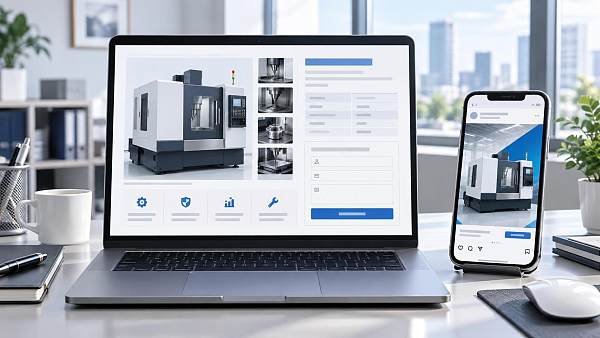
Social media ads may generate clicks without producing qualified inquiries, often indicating that the promises made in the ads are not being effectively carried through on the landing page of the independent website. The cost per inquiry is not determined solely by cost per click; it also depends on whether visitors are willing to stay after entering the page, whether they can quickly confirm that the product meets their needs, and whether they can submit their requirements with minimal friction. Every unnecessary exit from the landing page spreads the front-end advertising budget across fewer qualified leads.
When diagnosing the issue, first distinguish between “many clicks but few inquiries” and “few clicks and few inquiries.” For the former, prioritize checking the landing page; for the latter, review the audience, creatives, and ad messaging. If an ad group's click-through rate is acceptable and page visits match the data, but form submissions, phone clicks, or instant communication channels show almost no activity, the page experience and conversion path of the independent website are usually the more direct areas to investigate.
A Disconnect Between Ad Messaging and the First Screen Wastes the Most Expensive Visits
The browsing behavior of social media traffic differs from that of search traffic. Many visitors are attracted by an image, short video, or a selling point while scrolling through content, and they do not enter the page with a predefined purchasing path. If the first screen starts with a lengthy company introduction, a carousel banner, or generic homepage content unrelated to the ad creative, visitors must reassess whether “this is what I am looking for,” and the likelihood of exiting rises quickly.
The first screen of the landing page should continue the core subject and action presented in the ad. If the ad features a certain type of equipment, customization capabilities, sample requests, or quotation requests, the page should immediately display the corresponding product name, main applications, clear product images or application images, and an actionable next step. When the ad emphasizes lead time, materials, or specification ranges, the first screen does not need to repeat all the copy, but it must provide content that verifies those promises.
A common misconception is that a beautifully designed page automatically provides sufficiently clear information. For inquiry-focused pages, visitors first need to determine whether the product is suitable, rather than whether the brand visuals are rich. If images show only partial details without indicating dimensions, interfaces, load-bearing conditions, or application environments, they may attract curious clicks but fail to encourage visitors with actual needs to continue reading.
Loading Speed Affects More Than Just Bounce Rate
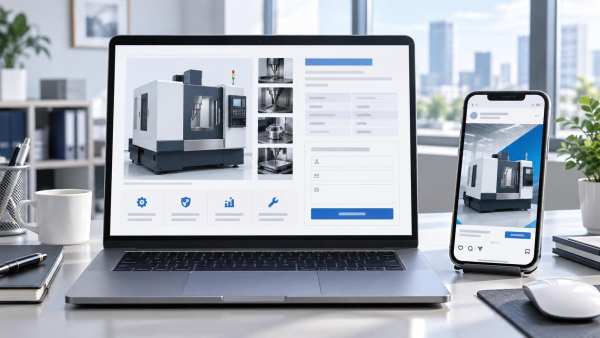
Social media visits are primarily mobile, and differences in network conditions, device performance, and regional connections can all amplify loading issues. Large first-screen videos, uncompressed product images, multiple tracking scripts, and external fonts can all delay the availability of buttons, forms, or main content. When visitors see blank areas, image placeholders, or continuously shifting layouts, the click cost already paid for the ad does not stop accumulating simply because the page has not finished loading.
Optimization should not focus only on homepage speed test scores. Instead, directly test the actual links used by the ads, accessing them through mobile networks and in common regions. Pay close attention to when first-screen content becomes visible, when consultation buttons become clickable, and whether loaded images push body content and forms downward. Product images can be exported at their display dimensions and compressed appropriately; first-screen videos can be replaced with static covers and played on demand; plugins, pop-ups, and third-party code unrelated to the current conversion should be reduced. After improving page speed, also verify that analytics scripts trigger correctly to avoid mistaking lost tracking data for a decline in actual inquiries.
Too Much or Too Little Content Can Both Reduce Lead Quality
B2B inquiry pages often swing between two extremes: some contain only a few images and an “Request a Quote Now” button, leaving visitors without enough basis to submit their needs; others pack the entire product catalog, company history, and multi-level navigation into one page, making key specifications difficult to find. Decision-making information differs by product, so page content should be organized around the questions visitors most need answered before submitting an inquiry.
The purpose of content is not to make a page appear complete, but to shorten the evaluation process. If an ad targets a specific industry application, do not direct visitors to a general catalog covering all product lines; if the creative highlights a single best-selling product, the page should first address that product's core specifications and delivery details. The closer the entry point aligns with the intent expressed in the ad, the less information loss occurs after the click.
Form Friction Can Keep Genuine Interest Out
Form fields are neither better when fewer nor when more detailed. Requiring a company’s full name, complete address, purchasing budget, annual usage volume, and similar information on the first contact can cause visitors who are still comparing options to stop; collecting only a name and email may increase the subsequent communication cost of repeatedly confirming the product, quantity, and intended use. Fields should serve the transaction complexity of the current page.
For products with clear specifications, model, quantity, contact information, and requirement notes are sufficient to form a basic lead. For customized projects, drawing uploads, target dimensions, material selection, or application descriptions can be added, but projects with uncertain details should be allowed to describe their needs through notes first. Dropdown options cannot replace open input: if a visitor's requirements fall outside the preset range, forcing a selection will contaminate the data and distort subsequent evaluation.
The expected action after submission should also be stated near the submit button, such as “Get a Quote” or “Send Specification Requirements,” rather than using an ambiguous “Submit.” Contact details, instant communication channels, and forms can coexist, but multiple buttons with similar colors and different copy should not compete for attention. On mobile devices, pay particular attention to whether input fields are obscured by the keyboard, verification codes are difficult to recognize, and file uploads support common formats.
Use Funnel Data for Diagnosis Instead of Focusing Only on Total Inquiries
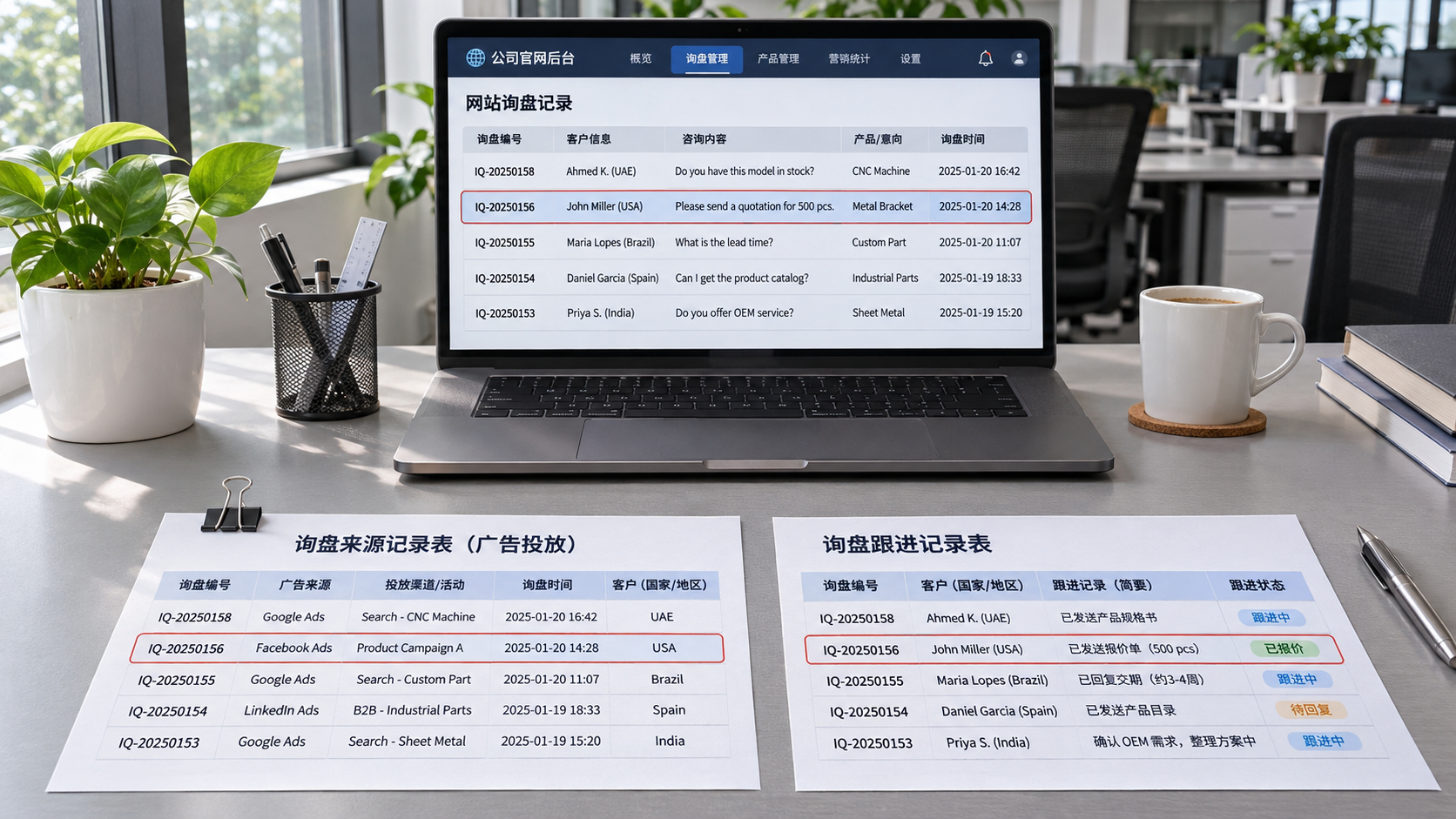
Landing page optimization requires viewing advertising data and on-site behavior along the same path: ad clicks, valid arrivals, first-screen reading, key content views, form starts, and successful submissions. Only when a specific step drops sharply can you determine whether the issue is loading, content, or the form. For example, if visit volume is normal but the form start rate is low, the value proposition or entry point placement is likely not clear enough; if many visitors start filling out the form but few submit it, prioritize checking the fields, error messages, and mobile interactions.
Do not replace ad creatives, audiences, page structures, and form fields all within the same period. Otherwise, even if the cost per inquiry changes, it will be difficult to identify the actual cause. Adjust only one primary variable at a time and retain sufficient traffic to observe trends; meanwhile, distinguish performance by country, language, and device. The loading performance, unit conventions, and communication methods of the same page are not entirely consistent across markets. Directly copying one version often mistakes localized issues for universal patterns.
The value of optimizing independent website landing pages for social media ads lies in enabling every paid click to move more quickly toward effective evaluation and clear action. Ads are responsible for generating interest, pages for resolving questions, and forms for capturing requirements. Only when these three connect smoothly can the cost per inquiry have a foundation for stable reduction.
Related Articles
 How do you define the target audience for a Facebook advertising campaign?
 With a Limited Overseas Advertising Budget, Should You Prioritize Search or Social Media?
 How can you track qualified inquiries generated by overseas advertising?
Related Products
 Yiyingbao SaaS Intelligent Website Building and Marketing SystemYiyingbao SaaS Intelligent Website Building and Marketing System, AI-powered no-code website building, rapid creation of multilingual B2B international websites in 10 minutes, global server acceleration, AI-powered SEO optimization, helping businesses connect efficiently with global markets. The perfect integration of technology and operation makes building an international trade website remarkably simple
 AI+SEM Intelligent Advertising Marketing SystemAI+SEM drives intelligent ad creation, empowering full-funnel precision advertising marketing. The system automatically generates weekly/monthly reports, AI recommends keywords and target countries, monitors core metrics in real-time with intelligent alerts, and enables one-click high-conversion ad solutions to help quickly acquire customers and improve ROI.
 AI+SEO Dual-Engine System Optimization ServicesYiyingbao’s AI+SEO dual-engine optimization system helps foreign trade enterprises acquire high-quality organic traffic through AI-powered keyword research, content generation, and comprehensive technical optimization, significantly improving search rankings and conversion rates.
 AI+SNS Social Media Marketing SystemYingbao AI+SNS Social Media Marketing System - Precision social capture for the social media era. Supports one-click content synchronization across major platforms like Facebook and LinkedIn. AI intelligently rewrites posts for enhanced relevance. 24/7 AI customer service and user profiling analysis empower businesses to efficiently expand into global markets.
 AI+SEO营销解决方案易营宝AI+SEO营销解决方案,通过AI批量写作、智能生成TDK、精准关键词扩词等功能,全面优化网站SEO效果,提升流量与转化率。助力企业构建高效智能网站新生态。
 AI+SEM Advertising Marketing SolutionsAI+SEM Advertising Marketing Solution leverages AI technology to deeply empower SEM ad campaigns. It automatically generates weekly/monthly reports using AI, presenting account data across multiple dimensions for comprehensive insights into campaign performance and trends. The system precisely recommends keywords and target countries, intelligently generates high-conversion ad copy, and enables one-click activation of efficient campaign plans to help businesses rapidly acquire customers. Simultaneously, it monitors core metrics in real time, intelligently identifies abnormal fluctuations, and issues timely alerts to ensure stable, high-return advertising results.
 Domain Name ServicesEasyWin provides professional domain name services, including intelligent queries, one-stop registration, brand protection, and full lifecycle management, helping businesses build a digital brand image.
 EasyOperate B2C Cross-Border E-Commerce Platform & Independent WebsiteEasyStore B2C Cross-border E-commerce Independent Store is an intelligent website building and cross-border e-commerce integrated solution independently developed by EasyStore Information Technology (Beijing) Co., Ltd. The system is specially designed for small and medium-sized as well as large export enterprises, integrating 'website building, operation, marketing, advertising, and conversion' into one, helping enterprises quickly establish cross-border e-commerce independent stores to achieve brand globalization and global sales growth.
The platform supports multiple languages, multiple currencies, and multi-channel marketing, with built-in AI intelligent translation and SEO optimization systems, suitable for mainstream markets such as Southeast Asia, Europe and America, Latin America, and the Middle East, assisting Chinese manufacturing enterprises in efficiently deploying international e-commerce strategies. SSL证书易营宝提供专业SSL安全证书服务,包括单域名和泛域名证书,确保网站数据传输加密、身份验证和完整性保护,助力企业建立安全可信的在线业务环境。









