









- Hapag-Lloyd’s $4.2 billion acquisition of ZIM faces a closing delay; ZIM reports third-quarter net profit of $830 millionNov 24, 2026View details
- SCFI falls for a third straight week to 3,503.78 points, with blank sailings on trans-Pacific routes rising to 10Nov 24, 2026View details
- Lazada 11.11 Mega Sale: LazMall Contributes Nearly Two-Thirds of GMVNov 23, 2026View details
- Shein’s European Revenue Falls 16% as Tighter Rules on Low-Value Direct Shipments Take EffectNov 23, 2026View details
- EU Low-Value Parcel Rules Impact Cargo Flows: Air Freight Volume from China to Europe Down 17% in OctoberNov 23, 2026View details
- Indonesia and the EU Sign Comprehensive Economic Partnership Agreement, 90.4% of Tariff Lines to Become Duty-Free ImmediatelyNov 23, 2026View details
How can you track qualified inquiries generated by overseas advertising?
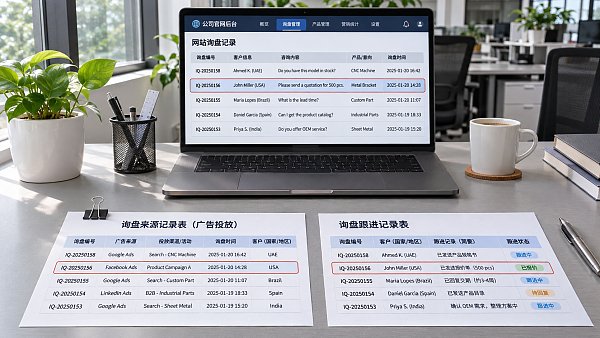
To track qualified inquiries generated by overseas advertising, connect ad clicks, website submissions, and sales follow-up in a single record: first identify where the inquiry came from, then determine whether it meets your business criteria, and finally see whether it progresses to the quotation or opportunity stage. Looking only at the number of conversions in the advertising dashboard can include duplicate submissions, spam, and inquiries from people with no purchasing needs.
For people responsible for advertising and website operations, the focus of analyzing and tracking ad results is to make advertising data correspond with sales outcomes. Even without a sophisticated customer management system, you can start by standardizing fields, saving traffic sources, and regularly updating records with follow-up results.
First, agree on what qualifies as a valid inquiry
A successful form submission only shows that a visitor has completed an action. Before tracking results, agree with the sales team on criteria for determining whether an inquiry is valid. At a minimum, these should include usable contact details, a request related to your core products or services, and the potential for further communication. You can also add criteria such as target market, order quantity, and delivery requirements based on your business needs.
For example, if a factory that only accepts bulk orders receives an inquiry about purchasing a sample at retail, the inquiry may not meet its current lead-generation goals, even if the contact details are complete. However, a visitor who has not yet provided an order quantity is not necessarily an invalid lead; you can mark it as “Pending confirmation” first. Separating pending, valid, and invalid inquiries is more practical than requiring sales to make an immediate decision on every lead.
Avoid making the criteria too elaborate. Too many form fields increase the burden on visitors, while collecting only an email address may make it difficult for sales to assess their needs. Start with essential information such as contact details, country or region, and product requirements, and collect the rest during follow-up.
Make sure every inquiry includes its advertising source
Tracking starts with the ad link. Set consistent UTM parameters for different platforms, campaigns, and ad content—for example, use utm_source to identify the source, utm_medium to identify the advertising medium, and utm_campaign to identify the campaign. Use a consistent naming convention to avoid multiple names for the same channel, which can fragment your reports later.
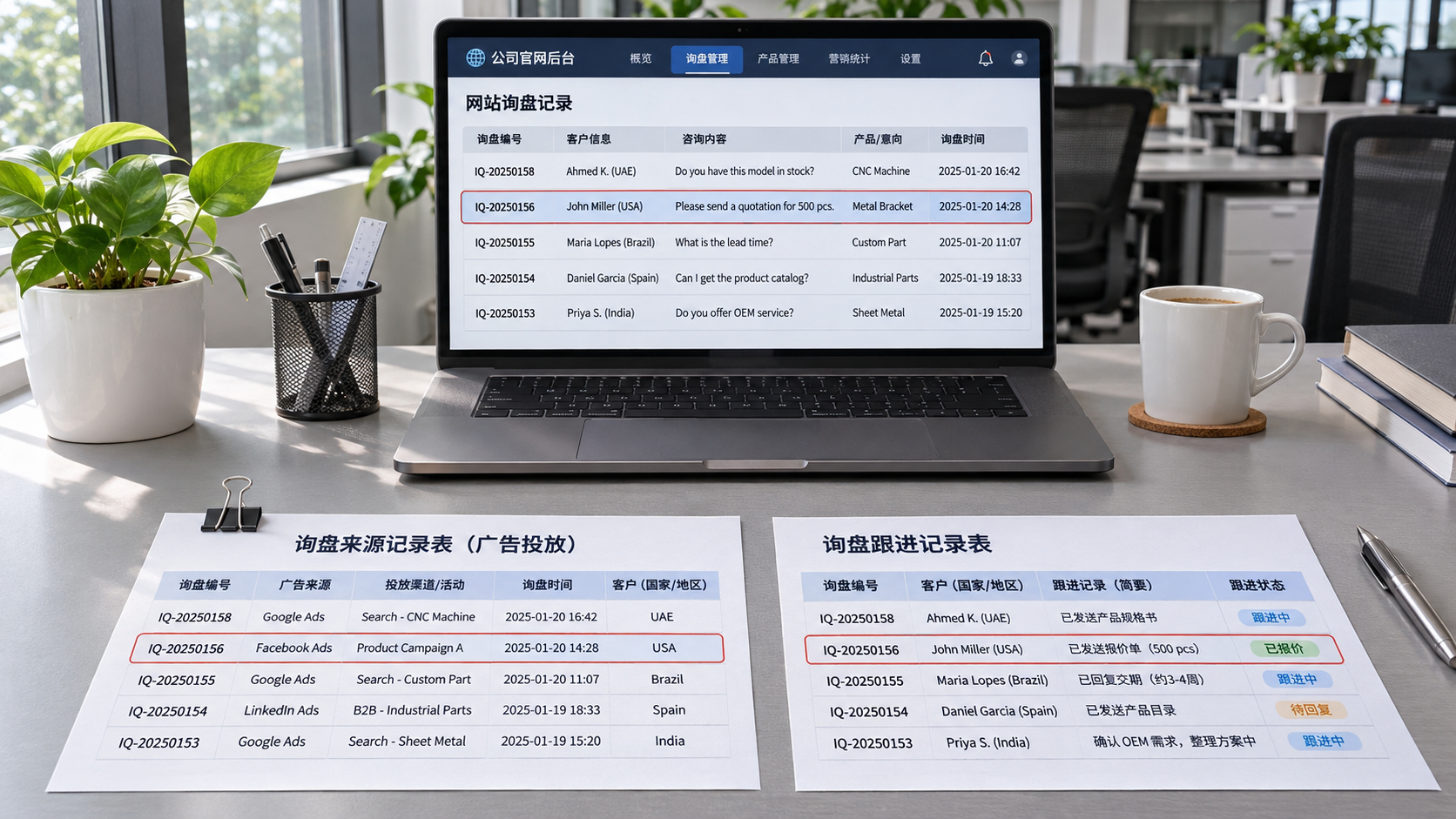
After visitors arrive on a landing page, the website needs to save the source parameters and include them in the inquiry record when a form is submitted. Fields that can be saved with contact information include the source, campaign, first page visited, submission time, and inquiry ID. If visitors browse multiple pages before submitting a form, check that the source information is still retained. Otherwise, the ad click may be recorded while the inquiry received by sales is shown as having an unknown source.
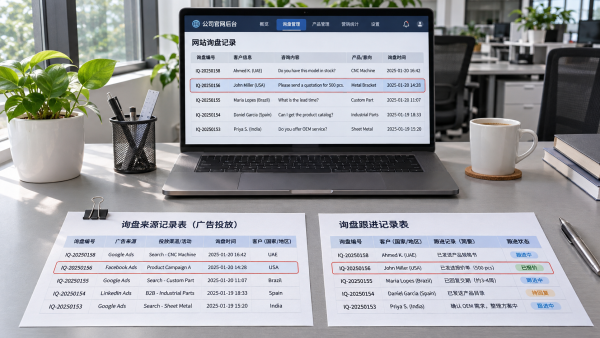
After launch, test the entire process using an ad link: open the landing page, browse other pages, then return to the form and submit it. Next, check the website backend, analytics tools, and sales receiving system separately to confirm that the record appears in each and that the source fields match. Mark test records separately to keep them out of official reporting.
If your website also receives inquiries by phone, email, or instant messaging, include these channels in your tracking as well. Clicking “Send email” or “Start chat” only shows that a visitor intends to make contact; it does not prove that they sent a message or expressed a valid need. Record the entry-point click when possible, then have sales add the source and outcome after an inquiry is actually received.
Feed sales assessments back into advertising data
Advertising platforms are good at recording clicks and predefined conversion events, while sales staff are better placed to determine whether a customer has purchasing intent. Link the two using an inquiry ID or another stable identifier to see which types of ads bring in customers worth following up with.
A shared spreadsheet can be a good starting point. Keep one row for each inquiry and record its source, campaign, submission time, follow-up status, and reason for invalidation. Follow-up statuses can reflect your business process, such as Awaiting contact, Valid, Invalid, Quoted, or Opportunity created. For invalidation reasons, use comparable options where possible, such as incorrect contact details, mismatched needs, duplicate inquiry, or spam.
Identify duplicate submissions before counting them. The same person might submit a form twice because the page responded slowly, or they might have a new purchasing need some time later. The former can be merged into one lead; whether to count the latter separately should be decided consistently by the business team. Do not automatically delete inquiries just because they share an email address, as this could mean missing future opportunities.
Once data can be linked reliably, you can, where supported by the platform, send reviewed valid inquiries or subsequent opportunities back to the advertising platform as offline conversions for analysis and optimization. Before sending data, check the identity-matching method, user consent, and applicable data protection requirements. Keep records that fail to upload or cannot be matched in internal reports as well, to avoid mistakenly assuming that no inquiries were generated.
Consider both quality and timing when comparing campaign performance
At a minimum, review three groups of figures regularly: advertising spend and clicks, the number of inquiries received, and the number of valid inquiries confirmed by sales. The cost per valid inquiry can be calculated by dividing the relevant advertising spend by the number of valid inquiries. The validity rate is the number of valid inquiries divided by the total number received. The former helps assess the cost of acquiring a lead worth following up with; the latter helps identify whether the traffic or landing page is attracting the wrong audience.
Suppose two campaigns have the same spend. Campaign A generates more form submissions, but most are retail inquiries; Campaign B generates fewer submissions, but more inquiries meet the requirements for bulk purchasing. Allocating budget based only on the cost per form submission could therefore lead you to cut a more valuable campaign. However, a small number of inquiries can be affected by individual records, so consider a sufficiently long observation period and actual business volume before adjusting budgets.
Allow time for sales follow-up as well. An inquiry received today may take several days to reach, and it can take longer to assess whether it has progressed to a quotation or an opportunity. When comparing campaigns, try to use the same inquiry-generation period and distinguish between “Not yet followed up” and “Confirmed invalid” so that delays in handling inquiries are not mistaken for poor advertising quality.
If a campaign gets many clicks but few form submissions, first check the landing page content, loading performance, and form submission process. If it gets many form submissions but has a low validity rate, check whether the ad promise, target regions, and product descriptions match the services you actually provide. Record the timing of each change and its corresponding results so that you have a basis for the next review.
Related Articles
 With a Limited Overseas Advertising Budget, Should You Prioritize Search or Social Media?
 How can you track qualified inquiries generated by overseas advertising?
 Does a Slow-Loading Google Ads Landing Page Affect Ad Performance?
Related Products
 Yiyingbao SaaS Intelligent Website Building and Marketing SystemYiyingbao SaaS Intelligent Website Building and Marketing System, AI-powered no-code website building, rapid creation of multilingual B2B international websites in 10 minutes, global server acceleration, AI-powered SEO optimization, helping businesses connect efficiently with global markets. The perfect integration of technology and operation makes building an international trade website remarkably simple
 AI+SEM Intelligent Advertising Marketing SystemAI+SEM drives intelligent ad creation, empowering full-funnel precision advertising marketing. The system automatically generates weekly/monthly reports, AI recommends keywords and target countries, monitors core metrics in real-time with intelligent alerts, and enables one-click high-conversion ad solutions to help quickly acquire customers and improve ROI.
 AI+SEO Dual-Engine System Optimization ServicesYiyingbao’s AI+SEO dual-engine optimization system helps foreign trade enterprises acquire high-quality organic traffic through AI-powered keyword research, content generation, and comprehensive technical optimization, significantly improving search rankings and conversion rates.
 AI+SNS Social Media Marketing SystemYingbao AI+SNS Social Media Marketing System - Precision social capture for the social media era. Supports one-click content synchronization across major platforms like Facebook and LinkedIn. AI intelligently rewrites posts for enhanced relevance. 24/7 AI customer service and user profiling analysis empower businesses to efficiently expand into global markets.
 AI+SEO营销解决方案易营宝AI+SEO营销解决方案,通过AI批量写作、智能生成TDK、精准关键词扩词等功能,全面优化网站SEO效果,提升流量与转化率。助力企业构建高效智能网站新生态。
 AI+SEM Advertising Marketing SolutionsAI+SEM Advertising Marketing Solution leverages AI technology to deeply empower SEM ad campaigns. It automatically generates weekly/monthly reports using AI, presenting account data across multiple dimensions for comprehensive insights into campaign performance and trends. The system precisely recommends keywords and target countries, intelligently generates high-conversion ad copy, and enables one-click activation of efficient campaign plans to help businesses rapidly acquire customers. Simultaneously, it monitors core metrics in real time, intelligently identifies abnormal fluctuations, and issues timely alerts to ensure stable, high-return advertising results.
 Domain Name ServicesEasyWin provides professional domain name services, including intelligent queries, one-stop registration, brand protection, and full lifecycle management, helping businesses build a digital brand image.
 EasyOperate B2C Cross-Border E-Commerce Platform & Independent WebsiteEasyStore B2C Cross-border E-commerce Independent Store is an intelligent website building and cross-border e-commerce integrated solution independently developed by EasyStore Information Technology (Beijing) Co., Ltd. The system is specially designed for small and medium-sized as well as large export enterprises, integrating 'website building, operation, marketing, advertising, and conversion' into one, helping enterprises quickly establish cross-border e-commerce independent stores to achieve brand globalization and global sales growth.
The platform supports multiple languages, multiple currencies, and multi-channel marketing, with built-in AI intelligent translation and SEO optimization systems, suitable for mainstream markets such as Southeast Asia, Europe and America, Latin America, and the Middle East, assisting Chinese manufacturing enterprises in efficiently deploying international e-commerce strategies. SSL证书易营宝提供专业SSL安全证书服务,包括单域名和泛域名证书,确保网站数据传输加密、身份验证和完整性保护,助力企业建立安全可信的在线业务环境。









