









- China’s Ministry of Commerce Responds to Additional Charges on Low-Value Imports Imposed by the EUNov 06, 2026View details
- Two Internet Development Reports Released at the 2026 World Internet ConferenceNov 05, 2026View details
- Internet Business Revenue of Enterprises Above the Designated Size Reached RMB 1.716 Trillion in the First Three Quarters, with Profits Up 17.6%Nov 05, 2026View details
- Shopify's Third-Quarter Revenue and GMV Fall Short of Expectations, Sending Shares Tumbling Before the Market OpensNov 04, 2026View details
- Temu Sellers See a Decline in Traffic as the Platform’s Traffic Allocation ShiftsNov 04, 2026View details
- UK Regulator Requires E-Commerce Businesses to Clearly Display Total Prices Including Mandatory Delivery ChargesNov 04, 2026View details
Is Video Advertising Worthwhile for Industrial Equipment Companies Expanding Overseas?
For industrial equipment companies expanding overseas, video advertising is worth considering, but the prerequisite is not that the equipment simply looks good on camera. Rather, the video should help overseas customers determine whether the equipment is suitable for their operating conditions and guide interested prospects into a follow-up inquiry process. Video is better suited to showcasing processing results, operating procedures, and application differences; it cannot replace technical documentation, quotation discussions, or proof of delivery capabilities.
If the website does not even explain the applicable materials, processing range, installation requirements, and service regions, increasing video exposure first can easily amplify wasted traffic. When the budget is limited, priority should be given to completing the landing pages and inquiry follow-up process, followed by small-scale advertising tests to verify whether the video can generate qualified leads.
What types of industrial equipment are worth promoting through video advertising?
The determining factor is not the price of the equipment, but whether its key value can be understood through dynamic visuals. For example, the changeover process of packaging equipment, the recognition performance of sorting equipment for different materials, and the processing paths of cutting equipment all provide content that can be demonstrated. Videos can lower the barrier to understanding and help customers determine more quickly whether further communication is worthwhile.
However, the visuals must be accompanied by operating conditions. When presenting production capacity, specify the material specifications, operating conditions, and measurement basis. When presenting processing accuracy, distinguish between visual results and inspection results. Without these conditions, even smoothly operating equipment will provide little support for equipment selection decisions.
For highly customized equipment, or equipment that depends on complete-line integration or on-site modifications, video advertising is more suitable for explaining the problems solved, process boundaries, and integration methods than for promising standardized results. If a product’s advantages mainly depend on parameters that are difficult to identify from visuals, technical documentation and search-based lead generation should receive higher priority.
Can video advertising accurately reach people with genuine purchasing needs?
Advertising platforms can filter audiences based on location, interests, content behavior, or certain professional information, but these labels do not equal purchasing intent. People watching machinery videos may also be students, maintenance enthusiasts, industry peers, or job seekers. High view counts only prove that the content attracted views; they do not prove that viewers are close to making a purchase.
More effective screening should take place in both the content and the landing page. Clearly stating the equipment’s purpose, applicable materials, and production conditions in the video can reduce irrelevant clicks. The landing page can then further explain the model range, supporting requirements, and service coverage, helping customers determine for themselves whether the equipment is a suitable match.
People who have visited a specific product page have different information needs from those seeing the advertisement for the first time. The former can be shown application demonstrations and technical Q&A content, while the latter first need to understand what problem the equipment solves. Remarketing is also subject to audience size, platform rules, and local privacy requirements. Website visitors cannot automatically be assumed to be continuously trackable.
What should a video show to help generate inquiries?
Compared with aerial footage of the factory or corporate promotional videos, priority should be given to segments that answer equipment-selection questions: how materials enter the equipment, how key processes are completed, what condition the finished product reaches, and what operations are required for changeovers, cleaning, or maintenance. Each video should focus on one clear question; there is no need to fit every function into a single advertisement.
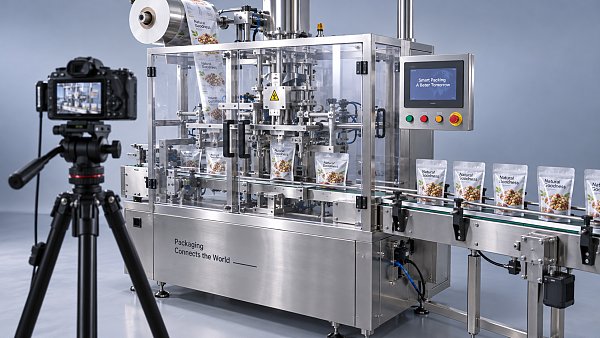
For example, when showcasing automatic packaging equipment, simply filming continuous bag production is not enough. The packaging material, bag type, and sample condition should also be explained. When showcasing dust removal equipment, filming only its appearance cannot prove its treatment performance; corresponding operating conditions and verifiable documentation are required. Video is suitable for presenting processes, but it should not replace inspection reports or compliance documents.
When advertising in different markets, ensure that subtitles, units, and terminology are easy to understand. Performance claims in the advertisement should also be consistent with the landing page and specifications to avoid creating promises beyond the equipment’s capabilities through editing or translation.
If there are clicks but no inquiries, does that mean the video advertising is ineffective?
The conversion path needs to be investigated step by step. If the equipment shown in the advertisement does not match the landing page, the page loads slowly on mobile devices, or the page contains only a company introduction, visitors who already have an interest may leave. Industrial equipment inquiries also require a certain amount of technical information. Simply asking visitors to “leave their contact details” may not be enough to encourage them to submit their requirements.
The landing page should directly follow up on the application shown in the video and provide key parameters, applicable boundaries, supporting conditions, and a clear consultation entry point. The form may ask about the material, target production capacity, country, and project stage, but it should not require a complete technical proposal at the first point of contact.
After receiving an inquiry, distinguish between equipment purchases, spare-part repairs, technical consultations, and irrelevant information, and record whether the inquiry has entered the equipment-selection, quotation, or sample-validation stage. If only the number of form submissions is counted, the campaign may be directed toward people who are more likely to submit a form but have no purchasing value.
How should the budget be set to determine whether the investment is worthwhile?
Do not set the budget based on view counts. Instead, work backward from the acceptable customer acquisition cost. Suppose that after deducting production, delivery, commission, and expected after-sales costs from an order, the contribution available to cover customer acquisition and profit is RMB 100,000, of which RMB 20,000 is planned for customer acquisition. If the closing rate for qualified leads is one in ten, the upper cost limit for each qualified lead would be approximately RMB 2,000. This is only a calculation example and does not represent industry benchmarks.
Video production, advertising services, landing pages, and lead-screening costs should all be included; media spending alone should not be the only consideration. When the closing rate lacks a historical basis, avoid inflating the budget with optimistic assumptions. First verify the quality of inquiries and how they progress.
Testing can focus on one target market, one type of equipment, and one primary application. Compare the qualified leads generated by different content rather than launching campaigns across multiple countries at the same time. Industrial equipment purchasing cycles may extend over a long period, so the absence of orders in the short term does not necessarily indicate failure. However, if there is continuously no demand match and no entry into technical discussions, testing should not be extended indefinitely under the label of “brand exposure.”
Should video advertising or search advertising be launched first?
If customers can already accurately search for the equipment name, model, or a specific process-related issue, search advertising is closer to existing demand and may be prioritized when the budget is tight. If the value of the equipment needs to be demonstrated to be understood, or if customers are not yet familiar with an alternative process, video can serve to explain the solution and identify demand.
When using both approaches together, pay attention to duplicate attribution. A customer may watch a video first, then search for the brand and submit an inquiry. The conversions reported by the two platforms cannot simply be added together. Only by combining website source records, inquiry feedback, and subsequent opportunity status can you determine whether the video generated new opportunities or merely reached existing customers again.
Ultimately, continued investment depends on whether the campaign can consistently generate application-matched opportunities that can be advanced. If it produces only inexpensive views and vague inquiries, adjust the content, audience, or landing page first rather than immediately increasing the budget.
Related Articles
 How can you optimize Facebook ads to reduce customer acquisition costs?
 How Can Overseas Advertising and Social Media Work Together? An Integrated Approach from Audience Reach to Lead Conversion
 How Can Ad Landing Page Design Reduce Form Abandonment?

Related Products
 Yiyingbao SaaS Intelligent Website Building and Marketing SystemYiyingbao SaaS Intelligent Website Building and Marketing System, AI-powered no-code website building, rapid creation of multilingual B2B international websites in 10 minutes, global server acceleration, AI-powered SEO optimization, helping businesses connect efficiently with global markets. The perfect integration of technology and operation makes building an international trade website remarkably simple
 AI+SEM Intelligent Advertising Marketing SystemAI+SEM drives intelligent ad creation, empowering full-funnel precision advertising marketing. The system automatically generates weekly/monthly reports, AI recommends keywords and target countries, monitors core metrics in real-time with intelligent alerts, and enables one-click high-conversion ad solutions to help quickly acquire customers and improve ROI.
 AI+SEO Dual-Engine System Optimization ServicesYiyingbao’s AI+SEO dual-engine optimization system helps foreign trade enterprises acquire high-quality organic traffic through AI-powered keyword research, content generation, and comprehensive technical optimization, significantly improving search rankings and conversion rates.
 AI+SNS Social Media Marketing SystemYingbao AI+SNS Social Media Marketing System - Precision social capture for the social media era. Supports one-click content synchronization across major platforms like Facebook and LinkedIn. AI intelligently rewrites posts for enhanced relevance. 24/7 AI customer service and user profiling analysis empower businesses to efficiently expand into global markets.
 AI+SEO营销解决方案易营宝AI+SEO营销解决方案,通过AI批量写作、智能生成TDK、精准关键词扩词等功能,全面优化网站SEO效果,提升流量与转化率。助力企业构建高效智能网站新生态。
 AI+SEM Advertising Marketing SolutionsAI+SEM Advertising Marketing Solution leverages AI technology to deeply empower SEM ad campaigns. It automatically generates weekly/monthly reports using AI, presenting account data across multiple dimensions for comprehensive insights into campaign performance and trends. The system precisely recommends keywords and target countries, intelligently generates high-conversion ad copy, and enables one-click activation of efficient campaign plans to help businesses rapidly acquire customers. Simultaneously, it monitors core metrics in real time, intelligently identifies abnormal fluctuations, and issues timely alerts to ensure stable, high-return advertising results.
 Domain Name ServicesEasyWin provides professional domain name services, including intelligent queries, one-stop registration, brand protection, and full lifecycle management, helping businesses build a digital brand image.
 EasyOperate B2C Cross-Border E-Commerce Platform & Independent WebsiteEasyStore B2C Cross-border E-commerce Independent Store is an intelligent website building and cross-border e-commerce integrated solution independently developed by EasyStore Information Technology (Beijing) Co., Ltd. The system is specially designed for small and medium-sized as well as large export enterprises, integrating 'website building, operation, marketing, advertising, and conversion' into one, helping enterprises quickly establish cross-border e-commerce independent stores to achieve brand globalization and global sales growth.
The platform supports multiple languages, multiple currencies, and multi-channel marketing, with built-in AI intelligent translation and SEO optimization systems, suitable for mainstream markets such as Southeast Asia, Europe and America, Latin America, and the Middle East, assisting Chinese manufacturing enterprises in efficiently deploying international e-commerce strategies. SSL证书易营宝提供专业SSL安全证书服务,包括单域名和泛域名证书,确保网站数据传输加密、身份验证和完整性保护,助力企业建立安全可信的在线业务环境。









