









- Can the average annual growth rate reflect real opportunities in overseas markets?Oct 07, 2026View details
- Which customer acquisition channels will be affected by cross-border marketing trends in 2026?Sep 06, 2026View details
- Which homogenization risks should be considered in an analysis of the AI-powered website building industry?Aug 30, 2026View details
- How Will AI Marketing Trends 2026 Change Advertising Budget AllocationAug 28, 2026View details
- Is the EV SSL certificate market shrinking or upgrading? How should companies assess certificate procurement?Aug 11, 2026View details
- Why the old AMP SEO 2020 practices no longer work and what has changed in current optimization prioritiesAug 02, 2026View details
Is it More Reliable to Use a Translation Company or AI for Overseas Localized Content?
Should You Choose a Translation Company or AI for Overseas Localized Content?
When pursuing overseas growth, deciding whether to use a translation company or AI to create localized content for overseas markets is no longer a simple matter of “choosing a tool.” It directly affects website indexing, advertising conversions, customer trust, and the efficiency of subsequent reuse. Many companies initially understand it as merely “translating Chinese into a foreign language.” Only after launching a website, running ads, and receiving low-quality inquiries do they realize that the real challenge is not translation itself, but whether the content sounds like something local people would say, aligns with search habits, and communicates the product’s selling points effectively.
If we had to answer in one sentence: neither approach can handle every scenario. AI is suitable for large volumes of fast-paced, highly structured content, while translation companies are better suited to high-risk content, content with demanding brand requirements, and content requiring in-depth local judgment. In practice, the most reliable approach is usually not choosing one over the other, but incorporating AI, human translation, market proofreading, and website operations into the same workflow.
Before Choosing, Identify Exactly What You Are Translating
One of the most common mistakes businesses make is applying the same standards to all content for overseas markets. In reality, content on a multilingual website varies greatly: product specification pages, industry solution pages, brand stories, advertising landing pages, blog articles, privacy policies, and after-sales instructions all have completely different requirements for language accuracy and marketing expression.
For example, product specifications, material descriptions, delivery methods, and compatible models on a manufacturing B2B website have very little room for error. A single mistranslated term can make customers question your professionalism. Blogs, FAQs, section descriptions, and long-tail keyword articles, on the other hand, place greater emphasis on update speed, coverage, and semantic completeness. Similarly, an advertising landing page for an independent website targeting North America cannot simply be “correctly translated.” The headline needs to be direct enough, trust elements must be positioned appropriately, and the call-to-action buttons should align with local reading patterns.
Therefore, the first step in discussing whether a translation company or AI is more reliable for overseas localized content is not comparing prices, but classifying the content.
When Is AI More Reliable?
The biggest change in AI over the past two years is not whether it can translate, but that it can now understand context, industry terminology, and page structure. As long as the source text is high quality and the instructions are clear, AI can indeed be more reliable than traditional manual processes in many scenarios, especially in terms of speed and consistency.
AI is generally suitable for handling several types of content first:
One type is large volumes of basic pages, such as dozens or hundreds of product detail pages, category pages, on-site FAQs, logistics instructions, and after-sales Q&As. These pages have similar structures and contain a great deal of repetitive information. Using AI to generate an initial version can significantly improve efficiency.
Another type is SEO content. Multilingual websites cannot rely on just a few main pages to generate organic search traffic. Industry knowledge articles, application scenario pages, and Q&A pages often require continuous updates. AI is highly useful for expanding long-tail content, generating multiple versions on the same topic, and restructuring titles and paragraphs. It is particularly suitable for operating at scale in combination with website-building systems and content management workflows.
Another scenario is initial validation across multiple markets. When companies first enter regions such as Southeast Asia, the Middle East, or Latin America, they usually need to test inquiry quality, bounce rates, and keyword matching in different countries. If everything is handed over to a traditional translation company from the beginning, costs will be high and iteration will be slow. Having AI produce a basic version first and then fine-tuning it based on data is often more suitable for early-stage trial and error.
This is also why more and more teams now place AI at the front end of website building, SEO, and advertising material preparation when providing integrated website and marketing services. Platforms such as 易营宝, which have long specialized in multilingual website development and overseas marketing, do not treat AI simply as a translation tool. Instead, they integrate it into the entire content production chain: from page creation and keyword organization to SEO/GEO content generation and coordination of advertising materials. In this way, content does not simply “end after translation”; it can continue to support promotion, indexing, and conversions.
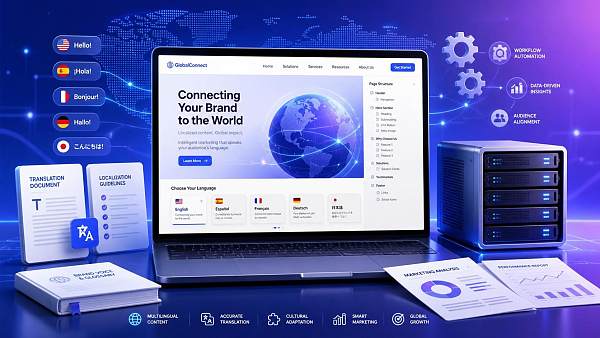
When Is a Translation Company Still More Reliable?
AI is advancing rapidly, but for some types of content, taking shortcuts is genuinely not recommended.
If your content involves legal matters, compliance, contracts, certification statements, technical white papers, or medical- or safety-related wording, human review is almost always essential. The reason is simple: for this type of text, being “close enough in meaning” is not sufficient. Small deviations may cause misunderstandings and even affect transactions or compliance decisions. This is especially true in areas such as the European market, medical devices, industrial equipment, and chemical materials, where terminology and liability boundaries are more sensitive.
In addition, content with demanding brand voice requirements also relies more heavily on professional human input. Examples include core homepage copy, brand stories, funding presentations, founders’ messages, and high-value service solution pages. AI can produce fluent writing, but it cannot naturally understand whether a company wants customers to perceive it as having “engineering capabilities,” “a strong design sensibility,” or “reliable delivery.” This is not a language issue, but a matter of brand judgment.
Another frequently overlooked situation involves industry-specific expressions in smaller-language markets. Spanish, Arabic, and Portuguese may appear to offer broad coverage, but business terminology, purchasing habits, and expression preferences vary significantly between countries. If your business depends heavily on local sales communication, relying solely on a generic AI version often achieves no more than “being understandable,” which is still a long way from making customers willing to contact you.
The Real Question for Businesses Is Not “Who Replaces Whom,” but “Who Handles Which Part?”
Based on actual projects, the best answer to whether a translation company or AI is more reliable for overseas localized content is usually layered collaboration.
A practical approach is as follows:
With this allocation, cost, speed, and quality can generally be balanced at the same time. For many businesses, the problem is not an insufficient budget, but wasting high-cost human resources on repetitive content while casually handing pages that require professional judgment over to machines.
Why Do Many Businesses Feel That “AI Translation Does Not Work Well”?
To be honest, the problem is often not AI itself, but the input and the workflow.
The first common situation is that the Chinese source text is unclear to begin with. Many Chinese website texts tend to pile up concepts, use long sentences, omit subjects, and present vague selling points. Even human translators may have to spend a long time interpreting them, so AI can easily go off track as well. The more the source text resembles an internal business report, the more the translation will sound like a literal translation.
The second issue is the absence of a terminology glossary. If a company’s product names, material names, process terms, and delivery methods are not standardized in a shared terminology database, the same terms may be translated differently from one day to the next. This not only affects professionalism, but also harms SEO because the core keywords on similar pages become inconsistent.
The third issue is misunderstanding “localization” as simply “completing the translation.” In reality, overseas website content must also take into account title length, menu structure, keyword placement, differences between country versions, currencies and units of measurement, form-field conventions, and even whether text embedded in images needs to be adjusted at the same time. Text is only one layer of the process.
When Building a Multilingual Website, Content Decisions Should Be Made Together with Marketing
This is also why many traditional translation projects deliver mediocre results: content and traffic are disconnected. The translation company delivers the copy, but whether the pages are suitable for Google indexing, advertising landing pages, or social media distribution may not fall within its service scope.
For companies expanding overseas, the real value lies not in “copying a Chinese website into a multilingual website,” but in giving content in different markets the ability to generate leads. For example, a B2B website needs to balance purchasing terms and technical terms; a B2C store needs to consider category keywords, review content, and the pace of promotional pages; and content designed for AI search must also take into account Q&A structures and the extractability of information. If content production is separated from website development, SEO, advertising, and social media, rework will be required later.
From this perspective, the value of a service model like 易营宝, which combines intelligent website building, multilingual content, SEO, advertising, and GEO, is not merely “saving labor.” It also reduces the losses caused by repeatedly rewriting content at different stages. In particular, when a company is targeting multiple regions such as North America, Europe, and Southeast Asia at the same time, a unified underlying system and coordinated content workflow are more convenient than one-off translation.
Several Common Questions, Answered
Will AI-Generated Content Affect Search Performance?
The key issue is not whether the content was written by AI, but whether it is useful, accurate, non-duplicative, and genuinely answers users’ questions. Pages filled with homogeneous or vague rewrites will not perform well regardless of whether they are produced by humans or AI.
Is a Translation Company Always More Natural Than AI?
Not necessarily. Many traditional translation services are skilled at language conversion, but may not understand your industry, website conversion, or search logic. Without industry knowledge and marketing editing capabilities, human translators may also produce writing that is very “proper” but not effective at selling.
How Should You Choose When the Budget Is Limited?
Prioritize allocating the budget to high-value pages: the homepage, core product pages, key landing pages, and legal and compliance pages. Let AI build out the remaining content first, and optimize it gradually. This is usually more practical than having every piece of content undergo a full professional translation.
If you are still wondering whether a translation company or AI is more reliable for overseas localized content, try changing the question: Is your goal to deliver copy or generate inquiries? Is it simply to build a website, or to make the website genuinely useful in the local market? Once the question changes, the content strategy becomes much clearer. Classify the content first, then decide whether AI will create the draft, human translators will calibrate it, and the marketing team will optimize it for conversions. This combination is often more reliable than relying entirely on either side.
Related Articles


Related Products
 Yiyingbao SaaS Intelligent Website Building and Marketing SystemYiyingbao SaaS Intelligent Website Building and Marketing System, AI-powered no-code website building, rapid creation of multilingual B2B international websites in 10 minutes, global server acceleration, AI-powered SEO optimization, helping businesses connect efficiently with global markets. The perfect integration of technology and operation makes building an international trade website remarkably simple
 AI+SEM Intelligent Advertising Marketing SystemAI+SEM drives intelligent ad creation, empowering full-funnel precision advertising marketing. The system automatically generates weekly/monthly reports, AI recommends keywords and target countries, monitors core metrics in real-time with intelligent alerts, and enables one-click high-conversion ad solutions to help quickly acquire customers and improve ROI.
 AI+SEO Dual-Engine System Optimization ServicesYiyingbao’s AI+SEO dual-engine optimization system helps foreign trade enterprises acquire high-quality organic traffic through AI-powered keyword research, content generation, and comprehensive technical optimization, significantly improving search rankings and conversion rates.
 AI+SNS Social Media Marketing SystemYingbao AI+SNS Social Media Marketing System - Precision social capture for the social media era. Supports one-click content synchronization across major platforms like Facebook and LinkedIn. AI intelligently rewrites posts for enhanced relevance. 24/7 AI customer service and user profiling analysis empower businesses to efficiently expand into global markets.
 AI+SEO营销解决方案易营宝AI+SEO营销解决方案,通过AI批量写作、智能生成TDK、精准关键词扩词等功能,全面优化网站SEO效果,提升流量与转化率。助力企业构建高效智能网站新生态。
 AI+SEM Advertising Marketing SolutionsAI+SEM Advertising Marketing Solution leverages AI technology to deeply empower SEM ad campaigns. It automatically generates weekly/monthly reports using AI, presenting account data across multiple dimensions for comprehensive insights into campaign performance and trends. The system precisely recommends keywords and target countries, intelligently generates high-conversion ad copy, and enables one-click activation of efficient campaign plans to help businesses rapidly acquire customers. Simultaneously, it monitors core metrics in real time, intelligently identifies abnormal fluctuations, and issues timely alerts to ensure stable, high-return advertising results.
 Domain Name ServicesEasyWin provides professional domain name services, including intelligent queries, one-stop registration, brand protection, and full lifecycle management, helping businesses build a digital brand image.
 EasyOperate B2C Cross-Border E-Commerce Platform & Independent WebsiteEasyStore B2C Cross-border E-commerce Independent Store is an intelligent website building and cross-border e-commerce integrated solution independently developed by EasyStore Information Technology (Beijing) Co., Ltd. The system is specially designed for small and medium-sized as well as large export enterprises, integrating 'website building, operation, marketing, advertising, and conversion' into one, helping enterprises quickly establish cross-border e-commerce independent stores to achieve brand globalization and global sales growth.
The platform supports multiple languages, multiple currencies, and multi-channel marketing, with built-in AI intelligent translation and SEO optimization systems, suitable for mainstream markets such as Southeast Asia, Europe and America, Latin America, and the Middle East, assisting Chinese manufacturing enterprises in efficiently deploying international e-commerce strategies. SSL证书易营宝提供专业SSL安全证书服务,包括单域名和泛域名证书,确保网站数据传输加密、身份验证和完整性保护,助力企业建立安全可信的在线业务环境。









