









- Which customer acquisition channels will be affected by cross-border marketing trends in 2026?Sep 06, 2026View details
- Which homogenization risks should be considered in an analysis of the AI-powered website building industry?Aug 30, 2026View details
- How Will AI Marketing Trends 2026 Change Advertising Budget AllocationAug 28, 2026View details
- Is the EV SSL certificate market shrinking or upgrading? How should companies assess certificate procurement?Aug 11, 2026View details
- Why the old AMP SEO 2020 practices no longer work and what has changed in current optimization prioritiesAug 02, 2026View details
- How to Choose Topics for an Industry News Section to Attract More Organic Search TrafficJul 29, 2026View details
- Digital Marketing Shenzhen Market Insights: Why Are Companies Expanding Overseas Looking for Growth Teams in Shenzhen?Jul 31, 2026View details
- Can Zhejiang foreign trade independent websites still be developed today? Look at changes in traffic and lead generationJul 28, 2026View details
How much does the conversion rate differ between multilingual and monolingual websites?
How much does the conversion rate differ between multilingual and single-language websites? The answer is often reflected not only in the data, but also depends on user trust, the localization experience, and the marketing funnel. If you want to improve overseas customer acquisition efficiency, this gap is worth understanding in depth.
How large is the conversion rate gap between multilingual and single-language websites usually?
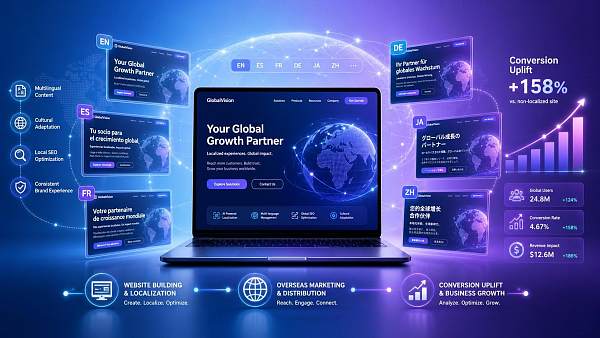
If the target market covers multiple countries or languages, multilingual websites generally have significantly higher conversion rates than single-language websites. This is especially true in B2B foreign trade, cross-border e-commerce, and brand globalization scenarios, where the gap is often not just a few percentage points, but may reach 20% to more than 100%.
The reasons are not complicated. When users see a language they are familiar with, their comprehension costs are lower, their sense of trust is stronger, and they stay longer. As a result, they are more likely to submit an inquiry, register an account, or complete a purchase. The closer the language is to the user, the lower the conversion resistance usually is.
However, it should first be made clear that not every company will automatically double its conversion rate simply by creating a multilingual website. If Chinese or English pages are mechanically translated into other languages without localized content or consideration of local search habits, the improvement may be limited and could even reduce overall performance.
Therefore, when users search for “how much does the conversion rate differ between multilingual and single-language websites,” what they really want to know is not just an average figure, but whether a multilingual website is worth building, when it should be built, and whether it can genuinely drive customer growth after launch.
Why are the same products more likely to convert when presented in the user's native language?
The first level of impact is comprehension efficiency. Whether they are procurement decision-makers or ordinary consumers, users prefer to quickly obtain key information when browsing a website. If a website only provides English, while customers are more accustomed to Spanish, German, or Arabic, friction can arise in understanding the information.
The second level of impact is trust building. Many overseas users will not assume that you understand the local market simply because you can provide an English page. By contrast, when a website can clearly introduce product advantages, delivery capabilities, and after-sales service in the local language, users can more easily determine whether you are reliable.
The third level of impact is behavioral conversion. When filling out forms, viewing quotations, confirming specifications, or reading shipping and payment instructions, users have higher requirements for language accuracy. The clearer the language on the page, the more willing users are to leave their contact details or proceed directly to an inquiry or purchase.
This gap is more noticeable in industries with high order values and long decision-making cycles. Fields such as foreign trade manufacturing, machinery and equipment, industrial products, and customized services already rely on professional communication. Multilingual pages can often directly reduce communication barriers and increase the proportion of qualified inquiries.
In which industries and scenarios is the improvement from multilingual websites most noticeable?
If a company's target market is concentrated in a single English-speaking country and customers generally accept English, a single-language website may not necessarily be a problem. However, if the business covers regions such as Europe, Latin America, the Middle East, or Southeast Asia, the value of multilingual development increases rapidly.
B2B foreign trade companies are the most typical example. When initially screening suppliers, buyers usually visit multiple websites at the same time. The supplier that can express its products, certifications, lead times, and cooperation methods in a language the buyer is more familiar with is more likely to gain the opportunity for further communication.
The same applies to B2C cross-border e-commerce. Consumers make purchase decisions more quickly, but they are also more sensitive. If product descriptions, shipping rules, return and exchange policies, or payment method instructions are not provided in a familiar language, customers can easily drop off at the final step, resulting in abandoned carts.
For brands expanding overseas, the focus is more on building long-term assets. A multilingual website affects not only current conversions, but also brand awareness, SEO coverage, and the ability to continuously acquire customers in different regional markets. From a growth perspective, it is not simply about creating pages, but about building market infrastructure.
What determines the conversion rate gap is not just the number of languages, but the degree of localization
Many companies mistakenly believe that “multilingual” means copying an English website several times and adding language switching. The actual results are often unsatisfactory because the key factor affecting conversions is not the number of pages, but whether the content matches local users' reading and decision-making habits.
For example, when introducing the same product advantages, German users may focus more on specifications, certifications, and delivery reliability; Middle Eastern customers may care more about cooperation methods, response speed, and communication convenience; and Latin American users may be more sensitive to local service support and pricing transparency.
If page copy, case studies, form fields, call-to-action buttons, contact details, and even time and measurement units are not adjusted for the target market, users may see a page in their native language but still not feel that the website was “prepared for them.”
Therefore, what truly creates a conversion rate gap between multilingual and single-language websites is the combination of “translation + localization + marketing structure,” rather than simply adding more languages. This is also the fundamental reason why results can vary significantly among companies after investment.
How should companies determine whether a multilingual website is worth building?
The most direct approach is to first examine the sources of customers. If your inquiries, orders, or potential markets already come from regions using multiple languages, a single-language website may have limited your conversion ceiling and may cause some high-intent customers to drop off at the very first step.
The second factor is the complexity of customer decision-making. The more professional the product, the higher the order value, and the longer the sales cycle, the more information users need to obtain from the website. In this case, the loss caused by language barriers is not merely wasted traffic, but also the loss of high-quality business opportunities.
The third factor is the structure of the marketing channels. If a company is carrying out Google SEO, Google advertising, social media advertising, or AI search visibility optimization, a multilingual website is usually more worthwhile. Once front-end traffic acquisition enters multiple markets, the back-end conversion capabilities must be upgraded accordingly.
Conversely, if a company is currently validating only one market and has a limited budget, it can start with the language of its core market instead of launching too many languages at once. The right approach is not to expand blindly, but to gradually extend coverage around markets with clear returns.
Why are the benefits of a multilingual website more than just a slight conversion increase?
When evaluating this initiative, many managers focus only on “how much the page conversion rate will increase.” In fact, its greater value lies in improving customer acquisition efficiency, traffic quality, and sales communication costs at the same time. Taken together, these benefits are often more important than a single conversion rate figure.
At the SEO level, multilingual websites have the opportunity to cover more local search terms and help companies enter search scenarios they could not previously reach. For foreign trade companies, this means not only obtaining more traffic, but also acquiring precise traffic that better matches regional purchasing habits.
At the advertising level, localized landing pages can generally improve ad relevance and page quality, reduce bounce rates, and lower lead costs. Many companies have substantial advertising budgets, but their landing pages remain single-language, which can significantly dilute the effectiveness of front-end campaigns on the back-end pages.
At the sales level, multilingual websites can also complete part of the explanatory work in advance. Sales staff do not need to repeatedly explain basic information, as customers already have an initial understanding of the products, qualifications, and cooperation methods. The quality of leads entering the communication stage will also be more consistent.
What are the most common pitfalls when building a multilingual website?
The first common problem is focusing only on literal translation without conducting local keyword research. Such a website may appear multilingual, but it is difficult to find through search and difficult to persuade users. Search terms, titles, descriptions, and content structures should all align with the way local users express their searches.
The second problem is excessive variation in page quality across languages. The English page may be complete, while other language versions contain only a few sections or even incomplete content. Once users discover inconsistencies in the information, their trust will be directly weakened. This impact is particularly obvious in B2B procurement scenarios.
The third problem is an unreasonable technical architecture. For example, confusing language switching, unclear URL structures, incorrect page indexing settings, and missing hreflang can all affect search engine recognition, making multilingual pages unfavorable for SEO and preventing them from generating stable traffic.
The fourth problem is the lack of conversion design. Many companies focus on “completing the translation” while overlooking forms, WhatsApp entry points, email touchpoints, CTA buttons, and local action paths. If the marketing funnel is not localized at the same time, even a large number of pages will have difficulty generating conversions.
If a company is ready to invest, what should it prioritize to achieve better results?
A more pragmatic approach is to first select key markets and priority languages rather than trying to do everything at once. Start by refining the most promising markets beyond the English website, such as Spanish, German, French, Arabic, Russian, or Japanese, and then decide whether to continue expanding based on the data.
In terms of content, prioritize high-conversion pages, including the homepage, product pages, solution pages, case study pages, About Us, Contact Us, and inquiry pages. These pages directly affect whether users continue learning about the company and whether they are willing to leave a lead, so they have a higher priority than the quantity of informational content.
From a marketing perspective, SEO and advertising conversion should be considered together. If a multilingual website has pages but lacks keyword planning, search optimization, and a localized landing page strategy, its actual effectiveness will be weakened. Website development and overseas marketing should essentially be advanced as an integrated effort.
For companies seeking to expand into overseas markets over the long term, a platform that coordinates AI website building, multilingual management, SEO optimization, and advertising can make it easier to implement consistent standards than scattered outsourcing, while also facilitating ongoing iteration and data review.
Conclusion: How much the conversion rate differs between multilingual and single-language websites depends on how the company implements them
Returning to the original question, how much does the conversion rate differ between multilingual and single-language websites? In multi-market business scenarios, the gap is often significant, especially when user trust, search coverage, and the localization experience are improved at the same time. The improvement will not remain limited to surface-level figures.
More importantly, the result is not determined by whether a company has multilingual pages, but by whether it has truly developed localized content, clear conversion design, and a sustainable overseas marketing strategy around its target markets. When done correctly, a multilingual website can become a growth asset.
For foreign trade companies, manufacturing factories, cross-border e-commerce sellers, and brands expanding overseas, a single-language website is probably no longer sufficient if they are facing markets that use multiple languages. The key question is not whether to build one, but which markets to prioritize and how to do it more effectively.
Related Articles

Related Products
 Yiyingbao SaaS Intelligent Website Building and Marketing SystemYiyingbao SaaS Intelligent Website Building and Marketing System, AI-powered no-code website building, rapid creation of multilingual B2B international websites in 10 minutes, global server acceleration, AI-powered SEO optimization, helping businesses connect efficiently with global markets. The perfect integration of technology and operation makes building an international trade website remarkably simple
 AI+SEM Intelligent Advertising Marketing SystemAI+SEM drives intelligent ad creation, empowering full-funnel precision advertising marketing. The system automatically generates weekly/monthly reports, AI recommends keywords and target countries, monitors core metrics in real-time with intelligent alerts, and enables one-click high-conversion ad solutions to help quickly acquire customers and improve ROI.
 AI+SEO Dual-Engine System Optimization ServicesYiyingbao’s AI+SEO dual-engine optimization system helps foreign trade enterprises acquire high-quality organic traffic through AI-powered keyword research, content generation, and comprehensive technical optimization, significantly improving search rankings and conversion rates.
 AI+SNS Social Media Marketing SystemYingbao AI+SNS Social Media Marketing System - Precision social capture for the social media era. Supports one-click content synchronization across major platforms like Facebook and LinkedIn. AI intelligently rewrites posts for enhanced relevance. 24/7 AI customer service and user profiling analysis empower businesses to efficiently expand into global markets.
 AI+SEO营销解决方案易营宝AI+SEO营销解决方案,通过AI批量写作、智能生成TDK、精准关键词扩词等功能,全面优化网站SEO效果,提升流量与转化率。助力企业构建高效智能网站新生态。
 AI+SEM Advertising Marketing SolutionsAI+SEM Advertising Marketing Solution leverages AI technology to deeply empower SEM ad campaigns. It automatically generates weekly/monthly reports using AI, presenting account data across multiple dimensions for comprehensive insights into campaign performance and trends. The system precisely recommends keywords and target countries, intelligently generates high-conversion ad copy, and enables one-click activation of efficient campaign plans to help businesses rapidly acquire customers. Simultaneously, it monitors core metrics in real time, intelligently identifies abnormal fluctuations, and issues timely alerts to ensure stable, high-return advertising results.
 Domain Name ServicesEasyWin provides professional domain name services, including intelligent queries, one-stop registration, brand protection, and full lifecycle management, helping businesses build a digital brand image.
 EasyOperate B2C Cross-Border E-Commerce Platform & Independent WebsiteEasyStore B2C Cross-border E-commerce Independent Store is an intelligent website building and cross-border e-commerce integrated solution independently developed by EasyStore Information Technology (Beijing) Co., Ltd. The system is specially designed for small and medium-sized as well as large export enterprises, integrating 'website building, operation, marketing, advertising, and conversion' into one, helping enterprises quickly establish cross-border e-commerce independent stores to achieve brand globalization and global sales growth.
The platform supports multiple languages, multiple currencies, and multi-channel marketing, with built-in AI intelligent translation and SEO optimization systems, suitable for mainstream markets such as Southeast Asia, Europe and America, Latin America, and the Middle East, assisting Chinese manufacturing enterprises in efficiently deploying international e-commerce strategies. SSL证书易营宝提供专业SSL安全证书服务,包括单域名和泛域名证书,确保网站数据传输加密、身份验证和完整性保护,助力企业建立安全可信的在线业务环境。









