









- Can the average annual growth rate reflect real opportunities in overseas markets?Oct 07, 2026View details
- Which customer acquisition channels will be affected by cross-border marketing trends in 2026?Sep 06, 2026View details
- Which homogenization risks should be considered in an analysis of the AI-powered website building industry?Aug 30, 2026View details
- How Will AI Marketing Trends 2026 Change Advertising Budget AllocationAug 28, 2026View details
- Is the EV SSL certificate market shrinking or upgrading? How should companies assess certificate procurement?Aug 11, 2026View details
- Why the old AMP SEO 2020 practices no longer work and what has changed in current optimization prioritiesAug 02, 2026View details
Is AI translation sufficient for product pages on a hardware fasteners foreign trade website?
A salesperson exporting bolts, nuts, and washers who is preparing to expand English product pages into the German, Spanish, and Russian markets often encounters this situation: the Chinese specifications have already been thoroughly organized, and the English pages are understandable, so AI is used directly for batch translation and dozens of pages go live within half a day. A few days later, when checking inquiries, they find that visitors stay on the pages for a considerable time, but few actually ask about specifications or request quotations.
The problem is often not whether translation has been done, but whether buyers can quickly confirm: Is this the standard fastener I need? Are the dimensions, materials, and strength grades unambiguous? Does the supplier understand local purchasing practices? Hardware fasteners may appear to be standardized products, but one inaccurate term, unit, or grade designation on a product page may cause a buyer to give up further communication.
What AI translation can do and which judgments it cannot replace
Here is a practical conclusion first: AI translation is suitable for improving first-draft efficiency, but it is not suitable for directly taking on the final publishing task for product pages without verification. For highly repetitive content, such as packaging instructions, standard company information, and general shipping procedures, it can be used relatively quickly after basic checks; however, parts involving product selection and technical confirmation must retain human review.
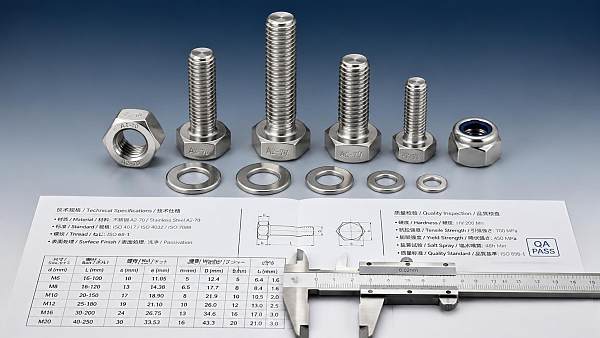
On fastener pages, the areas requiring the most caution are usually not the titles, but the specification tables and application descriptions. For example, translating “high-strength bolts” into an expression commonly used in a certain market does not necessarily mean buyers will understand it as a specific performance grade; “stainless steel” may also require further distinction regarding material grade, corrosion environment, and surface condition. AI can produce fluent sentences based on context, but it may not know which standards system the company actually uses internally.
Buyers do not simply read text; they are reducing procurement risk
A common misconception about foreign trade product pages is to regard multilingual content as “the same Chinese paragraph converted into several languages.” In practice, procurement personnel visiting a page usually first scan product images, model numbers, size ranges, applicable standards, minimum order quantities, delivery lead-time information, and contact details before deciding whether to send an inquiry. Language quality affects this process, but it is only one link in the chain of trust.
Therefore, when discussing whether acquiring overseas buyers mainly relies on websites or social media promotion, it is not advisable to frame the two as an either-or choice. Social media content or advertising can help unfamiliar buyers see a company for the first time, especially for demonstrating production processes, application scenarios, and new products; website product pages, on the other hand, serve more as destination pages, allowing visitors to verify specifications, download materials, and submit RFQs. Advertising brings visitors in, but if the product page cannot explain the product, traffic costs can easily be wasted.
For B2B purchasing decisions involving hardware fasteners, buyers may not place an order immediately because of a social media post, but they will repeatedly return to product pages when comparing suppliers. At this point, minor issues in machine translation that do not affect “understanding” may be exactly what affects the judgment of “whether this supplier is worth contacting.”
Build a terminology database first, then involve AI in batch translation
A more controllable process is not to translate entire pages first, but to first separate information that is prone to errors. It is recommended to start with product series that have higher sales, generate more inquiries, or are planned for promotion, and compile a terminology database that can be used continuously. It does not need to be overly complex, but it should at least include the Chinese name, standard English name, target-language name, abbreviations, vague expressions that must not be used, and necessary notes.
For example, on different pages for the same product category, thread specifications, surface treatments, and grade designations must be written consistently; if a company uses both DIN and ISO and also involves ASTM or imperial specifications, do not allow AI to replace them freely based on context. Values, model numbers, drawing numbers, and standard numbers should be handled as fields that must not be altered to avoid changes during translation or formatting.
Divide pages into “translatable” and “must be confirmed” sections
Translatable sections include product introductions, standard advantages, packaging methods, and general service descriptions. Even if these sections are completed by AI, check for excessive promises, absolute wording, or adjectives that do not conform to industry conventions.
Sections that must be confirmed include: product standards, size ranges, tolerance requirements, material grades, mechanical properties, coatings or surface treatments, testing items, applicable industries, and the boundaries of drawing-based customization. These areas are more suitable for the approach of “AI first draft—verification by sales or technical personnel—polishing by a native-language editor.” Where a native-language editor is unavailable, at minimum, find someone familiar with procurement communication in the target market to review key pages.
Review the page from a buyer's perspective before publication
Language review should not focus only on grammar. Open the page on mobile and desktop devices, assume you are looking for a specific specification, and see whether you can find the core information within half a minute. If a product page contains only a long introduction without a clear specification table, inquiry entry point, and related models, conversion may not be ideal even if the translation is polished.
- Does the title include a clear product category, key specification, or application clue, rather than vaguely stating “quality fasteners”?
- Do the units, symbols, decimal points, and range expressions in the specification table conform to the reading habits of the target market?
- Do the images and dimensional drawings correspond to the model numbers in the text, avoiding situations where the images and text show different styles?
- Do pages within the same series use consistent terminology so that buyers have no doubts when making side-by-side comparisons?
- Does the inquiry form allow users to enter drawing numbers, specifications, annual demand, or purchasing purposes, rather than only leaving an email address?
You can also check pages through search entry points. Search in the target language for product standard terms, material terms, and application terms, and observe how peers are typically named in search results. The purpose is not mechanical imitation, but to confirm that the terms you use are genuinely expressions used on the procurement side. This step is especially important if the website will later support SEO or advertising: if advertising keywords, landing page titles, and page content each say different things, visitors can easily feel a disconnect.
When it is safe to use AI and when publication should be paused
If a page introduces a basic product category, has an established content structure, a complete terminology database, and someone who can verify the specifications, AI translation can significantly reduce repetitive work. Conversely, if a product involves non-standard customization, special materials, complex assembly relationships, or the page targets industries sensitive to regulatory and certification requirements, do not treat “fluent translation” as the publication standard.
A more practical approach is to first select a small number of core product pages to establish review samples: confirm terminology, parameter formats, title formats, inquiry fields, and internal proofreading responsibilities. Once the samples are stable, language versions can then be expanded in batches. This approach neither delays progress through word-by-word manual translation nor results in the need to rework a large number of pages individually after publication.
Whether AI translation is sufficient depends on what role it plays in the process. Treating it as a tool for rapidly generating first drafts and maintaining consistency of expression is usually highly valuable; treating it as a substitute for technical documentation and localization judgment creates risks precisely where buyers examine most carefully. For fastener companies that rely on websites to generate inquiries over the long term, the goal of multilingual product pages is not simply to “translate them,” but to enable buyers in different markets to understand them, verify them accurately, and be willing to continue asking questions.
Related Articles

Related Products
 Yiyingbao SaaS Intelligent Website Building and Marketing SystemYiyingbao SaaS Intelligent Website Building and Marketing System, AI-powered no-code website building, rapid creation of multilingual B2B international websites in 10 minutes, global server acceleration, AI-powered SEO optimization, helping businesses connect efficiently with global markets. The perfect integration of technology and operation makes building an international trade website remarkably simple
 AI+SEM Intelligent Advertising Marketing SystemAI+SEM drives intelligent ad creation, empowering full-funnel precision advertising marketing. The system automatically generates weekly/monthly reports, AI recommends keywords and target countries, monitors core metrics in real-time with intelligent alerts, and enables one-click high-conversion ad solutions to help quickly acquire customers and improve ROI.
 AI+SEO Dual-Engine System Optimization ServicesYiyingbao’s AI+SEO dual-engine optimization system helps foreign trade enterprises acquire high-quality organic traffic through AI-powered keyword research, content generation, and comprehensive technical optimization, significantly improving search rankings and conversion rates.
 AI+SNS Social Media Marketing SystemYingbao AI+SNS Social Media Marketing System - Precision social capture for the social media era. Supports one-click content synchronization across major platforms like Facebook and LinkedIn. AI intelligently rewrites posts for enhanced relevance. 24/7 AI customer service and user profiling analysis empower businesses to efficiently expand into global markets.
 AI+SEO营销解决方案易营宝AI+SEO营销解决方案,通过AI批量写作、智能生成TDK、精准关键词扩词等功能,全面优化网站SEO效果,提升流量与转化率。助力企业构建高效智能网站新生态。
 AI+SEM Advertising Marketing SolutionsAI+SEM Advertising Marketing Solution leverages AI technology to deeply empower SEM ad campaigns. It automatically generates weekly/monthly reports using AI, presenting account data across multiple dimensions for comprehensive insights into campaign performance and trends. The system precisely recommends keywords and target countries, intelligently generates high-conversion ad copy, and enables one-click activation of efficient campaign plans to help businesses rapidly acquire customers. Simultaneously, it monitors core metrics in real time, intelligently identifies abnormal fluctuations, and issues timely alerts to ensure stable, high-return advertising results.
 Domain Name ServicesEasyWin provides professional domain name services, including intelligent queries, one-stop registration, brand protection, and full lifecycle management, helping businesses build a digital brand image.
 EasyOperate B2C Cross-Border E-Commerce Platform & Independent WebsiteEasyStore B2C Cross-border E-commerce Independent Store is an intelligent website building and cross-border e-commerce integrated solution independently developed by EasyStore Information Technology (Beijing) Co., Ltd. The system is specially designed for small and medium-sized as well as large export enterprises, integrating 'website building, operation, marketing, advertising, and conversion' into one, helping enterprises quickly establish cross-border e-commerce independent stores to achieve brand globalization and global sales growth.
The platform supports multiple languages, multiple currencies, and multi-channel marketing, with built-in AI intelligent translation and SEO optimization systems, suitable for mainstream markets such as Southeast Asia, Europe and America, Latin America, and the Middle East, assisting Chinese manufacturing enterprises in efficiently deploying international e-commerce strategies. SSL证书易营宝提供专业SSL安全证书服务,包括单域名和泛域名证书,确保网站数据传输加密、身份验证和完整性保护,助力企业建立安全可信的在线业务环境。









