









- Which customer acquisition channels will be affected by cross-border marketing trends in 2026?Sep 06, 2026View details
- Which homogenization risks should be considered in an analysis of the AI-powered website building industry?Aug 30, 2026View details
- How Will AI Marketing Trends 2026 Change Advertising Budget AllocationAug 28, 2026View details
- Is the EV SSL certificate market shrinking or upgrading? How should companies assess certificate procurement?Aug 11, 2026View details
- Why the old AMP SEO 2020 practices no longer work and what has changed in current optimization prioritiesAug 02, 2026View details
- How to Choose Topics for an Industry News Section to Attract More Organic Search TrafficJul 29, 2026View details
- Digital Marketing Shenzhen Market Insights: Why Are Companies Expanding Overseas Looking for Growth Teams in Shenzhen?Jul 31, 2026View details
- Can Zhejiang foreign trade independent websites still be developed today? Look at changes in traffic and lead generationJul 28, 2026View details
Can AI-Powered B2B Export Website Building Balance Lead Generation and Search Indexing?
Can B2B AI Website Building for Foreign Trade Balance Inquiries and Indexing
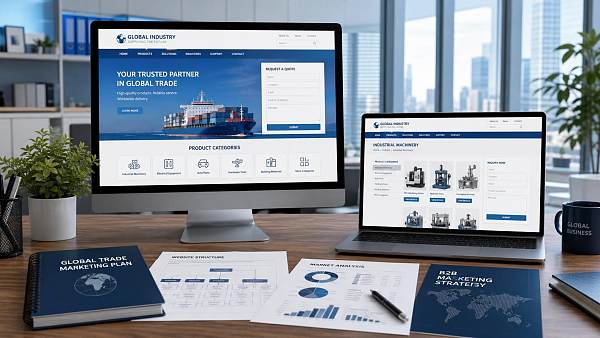
When many companies consider B2B AI website building for foreign trade, efficiency is often the first thing that comes to mind.
Fast templates, fast launch, and fast deployment sound highly appealing.
However, what truly affects results is usually not speed, but whether the underlying foundation is suitable for long-term customer acquisition.
If a website can only display information but is not easy for search engines to understand, indexing will be slow.
If a website only generates traffic without a conversion path, inquiries will not remain consistent.
Therefore, whether a B2B AI foreign trade website can balance inquiries and indexing mainly depends on three aspects.
The first is the technical architecture, the second is the content strategy, and the third is marketing coordination.
Only when these three aspects are connected can a website become more than an online business card—it can become an asset that supports continuous growth.
Why Do Many B2B AI Foreign Trade Website Projects Deliver Average Results After Launch?
Based on recent developments, the pitfalls companies most often encounter are usually not related to how attractive the pages look.
Instead, the website-building logic focuses too much on presentation and lacks systematic planning for inquiries and indexing.
Common issues mainly include the following.
- Pages rely excessively on script rendering, increasing the crawling cost for search engines.
- The site structure is confusing, with no clear hierarchy between product pages and industry pages.
- Content is highly repetitive, keyword coverage is shallow, and it is difficult to create long-tail entry points.
- There is only one form entry, with insufficient trust-building and conversion guidance.
- Website building, SEO, advertising, and social media are separated, preventing data from working together.
This also means that simply using AI to generate pages cannot automatically drive growth.
A truly effective B2B AI foreign trade website must consider both search visibility and sales actions.
The Prerequisite for Indexing Is Making the Website Easy for Search Engines to Understand
Indexing is not as simple as publishing a few articles; the underlying structure is the starting point.
For B2B AI foreign trade websites, search friendliness should cover at least four levels.
- URLs should be clear and stable, with independent paths for categories, products, and solutions.
- Pages should be capable of being rendered statically or provide good pre-rendering capabilities to facilitate crawling.
- Titles, descriptions, internal links, and breadcrumb structures should be complete, with clear topic relevance.
- Multilingual versions should be deployed according to standards to avoid duplicate content and indexing conflicts.
An even clearer signal is that Google is placing increasing importance on the completeness of page topics.
If a page only lists specifications, it is difficult to achieve stable rankings.
But if a page covers applications, use cases, specifications, delivery, case studies, and FAQs, the foundation for indexing will be more stable.
This is where B2B AI foreign trade websites distinguish themselves from traditional template-based sites.
The Key to Generating Inquiries Is Bringing Visitors into a Conversion Path
Indexing solves the problem of being seen, while inquiries solve the problem of being chosen.
In actual business operations, many foreign trade websites receive traffic but generate no qualified inquiries.
The reason is usually not poor visitor quality, but a lack of conversion design on the pages.
A B2B AI foreign trade website solution capable of generating inquiries usually refines the following elements.
- The homepage clearly communicates advantages without empty slogans, directly addressing purchasing concerns.
- Product pages highlight application scenarios, lead times, certifications, customization capabilities, and delivery experience.
- Solution pages address industry problems and help visitors quickly assess suitability.
- Forms should not only be placed at the end of a page but also distributed at key decision points.
- Inquiry actions should not be limited to one type and may include quotation requests, samples, catalogs, and solution consultations.
The benefit is straightforward: visitors do not need to guess what to do next.
The page actively guides decision-making, making it easier to increase the inquiry rate.
To Make B2B AI Foreign Trade Websites Work, Content Strategy Cannot Rely Only on Bulk Generation
AI can indeed increase content production speed, but speed is not the only metric.
If content differs only superficially, it will be difficult for both search engines and customers to accept it.
A more reliable approach is to divide content into three layers.
This structure enables a B2B AI foreign trade website to have both main-site conversion capabilities and long-term indexing potential.
At the same time, AI-generated content must undergo manual review and refinement.
In particular, terminology, specifications, certifications, delivery processes, and regional market expressions must not be generalized.
Integrated Services Are the Key to Sustained Results from B2B AI Foreign Trade Websites
Building the website is only the beginning; real growth comes from subsequent coordination.
This is why more and more companies are beginning to focus on integrated website-building and marketing solutions.
Taking Yiyingbao as an example, its core value is not limited to building websites, but lies in placing websites within a complete growth chain.
Supported by its self-developed cloud intelligent website-building system, cross-border e-commerce system, AI advertising and marketing system, and AI+SEO/GEO optimization system, a website can enter the promotion stage more quickly.
This model is particularly important for B2B AI foreign trade websites because customer acquisition in foreign trade is inherently based on multi-channel decision-making.
Search, advertising, social media, short-video marketing, and AI search visibility do not replace one another.
They need to continuously build up data and content assets around the same website.
Once page performance, advertising keywords, inquiry sources, and content topics are connected, the direction of optimization becomes much clearer.
What Should Companies Focus on When Choosing a B2B AI Foreign Trade Website Solution?
If the goal is to balance inquiries and indexing, evaluation should not focus only on price and the number of templates.
More valuable evaluation criteria can be developed from the following five aspects.
- Does it support an SEO-friendly technical structure and standardized multilingual deployment?
- Does it provide inquiry-oriented page planning and conversion component design?
- Can it develop tiered content strategies based on the industry, market, and products?
- Can it work together with Google SEO, advertising, and social media operations?
- Does it have a continuous optimization mechanism rather than simply handing over the project once and leaving it unmanaged?
Ultimately, B2B AI foreign trade website building is not about buying a website, but about acquiring a set of growth capabilities.
Whoever can connect technology, content, and marketing will have a better opportunity to turn the website into a customer acquisition channel.
Conclusion: Inquiries and Indexing Can Be Balanced, Provided the Right Approach Is Used
Returning to the original question: can B2B AI foreign trade website building balance inquiries and indexing?
The answer is yes, but it can never be achieved with a single content-generation button.
A truly effective B2B AI foreign trade website must meet four conditions at the same time: crawlability, understandability, convertibility, and continuous optimization.
For companies seeking long-term international growth, a website is not an isolated project but infrastructure for global marketing.
After choosing the right solution, first establish a solid architecture, then develop the content in depth, and finally coordinate promotion efforts.
Only this type of website has a better chance of achieving search engine indexing while continuously generating high-quality inquiries.
Related Articles


Related Products
 Yiyingbao SaaS Intelligent Website Building and Marketing SystemYiyingbao SaaS Intelligent Website Building and Marketing System, AI-powered no-code website building, rapid creation of multilingual B2B international websites in 10 minutes, global server acceleration, AI-powered SEO optimization, helping businesses connect efficiently with global markets. The perfect integration of technology and operation makes building an international trade website remarkably simple
 AI+SEM Intelligent Advertising Marketing SystemAI+SEM drives intelligent ad creation, empowering full-funnel precision advertising marketing. The system automatically generates weekly/monthly reports, AI recommends keywords and target countries, monitors core metrics in real-time with intelligent alerts, and enables one-click high-conversion ad solutions to help quickly acquire customers and improve ROI.
 AI+SEO Dual-Engine System Optimization ServicesYiyingbao’s AI+SEO dual-engine optimization system helps foreign trade enterprises acquire high-quality organic traffic through AI-powered keyword research, content generation, and comprehensive technical optimization, significantly improving search rankings and conversion rates.
 AI+SNS Social Media Marketing SystemYingbao AI+SNS Social Media Marketing System - Precision social capture for the social media era. Supports one-click content synchronization across major platforms like Facebook and LinkedIn. AI intelligently rewrites posts for enhanced relevance. 24/7 AI customer service and user profiling analysis empower businesses to efficiently expand into global markets.
 AI+SEO营销解决方案易营宝AI+SEO营销解决方案,通过AI批量写作、智能生成TDK、精准关键词扩词等功能,全面优化网站SEO效果,提升流量与转化率。助力企业构建高效智能网站新生态。
 AI+SEM Advertising Marketing SolutionsAI+SEM Advertising Marketing Solution leverages AI technology to deeply empower SEM ad campaigns. It automatically generates weekly/monthly reports using AI, presenting account data across multiple dimensions for comprehensive insights into campaign performance and trends. The system precisely recommends keywords and target countries, intelligently generates high-conversion ad copy, and enables one-click activation of efficient campaign plans to help businesses rapidly acquire customers. Simultaneously, it monitors core metrics in real time, intelligently identifies abnormal fluctuations, and issues timely alerts to ensure stable, high-return advertising results.
 Domain Name ServicesEasyWin provides professional domain name services, including intelligent queries, one-stop registration, brand protection, and full lifecycle management, helping businesses build a digital brand image.
 EasyOperate B2C Cross-Border E-Commerce Platform & Independent WebsiteEasyStore B2C Cross-border E-commerce Independent Store is an intelligent website building and cross-border e-commerce integrated solution independently developed by EasyStore Information Technology (Beijing) Co., Ltd. The system is specially designed for small and medium-sized as well as large export enterprises, integrating 'website building, operation, marketing, advertising, and conversion' into one, helping enterprises quickly establish cross-border e-commerce independent stores to achieve brand globalization and global sales growth.
The platform supports multiple languages, multiple currencies, and multi-channel marketing, with built-in AI intelligent translation and SEO optimization systems, suitable for mainstream markets such as Southeast Asia, Europe and America, Latin America, and the Middle East, assisting Chinese manufacturing enterprises in efficiently deploying international e-commerce strategies. SSL证书易营宝提供专业SSL安全证书服务,包括单域名和泛域名证书,确保网站数据传输加密、身份验证和完整性保护,助力企业建立安全可信的在线业务环境。









