









- Which customer acquisition channels will be affected by cross-border marketing trends in 2026?Sep 06, 2026View details
- Which homogenization risks should be considered in an analysis of the AI-powered website building industry?Aug 30, 2026View details
- How Will AI Marketing Trends 2026 Change Advertising Budget AllocationAug 28, 2026View details
- Is the EV SSL certificate market shrinking or upgrading? How should companies assess certificate procurement?Aug 11, 2026View details
- Why the old AMP SEO 2020 practices no longer work and what has changed in current optimization prioritiesAug 02, 2026View details
- How to Choose Topics for an Industry News Section to Attract More Organic Search TrafficJul 29, 2026View details
Will multilingual indexing drop after upgrading the AI website building system?
Many businesses are concerned: Will the number of indexed pages on a multilingual website drop after an AI-powered website building system is upgraded? In fact, fluctuations in indexing do not necessarily mean a decline in rankings. The key is whether the URL structure, tag rules, and multilingual SEO configuration remain stable after the upgrade.
For foreign trade enterprises, manufacturing factories, cross-border sellers, and brands expanding into overseas markets, multilingual websites often handle three tasks simultaneously: lead generation, brand presentation, and advertising landing. If crawling errors, mismatched language versions, or changes to page paths occur after a system upgrade, search engines' understanding of the website may be affected within 7 to 30 days.
Therefore, the real issue is not simply whether an upgrade will cause indexing losses, but whether the upgrade preserves the existing SEO assets and allows multilingual pages to remain crawlable, indexable, properly attributed, and conversion-oriented. For integrated website and marketing service projects, this directly affects subsequent SEO growth, advertising quality scores, and the cost of overseas inquiries.
Why Multilingual Indexing May Fluctuate After a System Upgrade
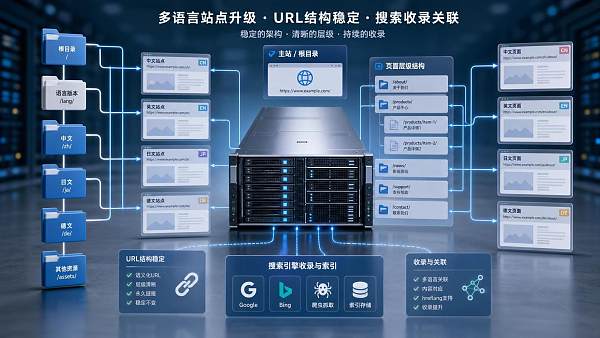
Whether multilingual website indexing will decline after an AI-powered website building system upgrade depends first on the scope of the upgrade. If the changes involve only front-end styles, the editor, or the component library, the impact is usually limited. If they involve URL logic, language directories, template rules, or rendering methods, search engines will need to re-identify page relationships, making short-term fluctuations relatively common.
The 4 Most Common Sources of Fluctuations
The first is URL changes. For example, if the website originally uses the “/en/” directory but switches to a subdomain or parameter-based language URL after the upgrade, and 301 redirects, canonical tags, and sitemaps are not updated accordingly, search engines may treat the old and new pages as two separate sets of resources, extending the indexing transition period to 2 to 8 weeks.
The second is abnormal hreflang configuration. A multilingual website must at least enable search engines to clearly identify the relationships between language and regional versions. For example, are the English, German, French, and Japanese pages properly annotated for one another? Are there any missing, conflicting, or incorrect references? A single misplaced tag may affect how an entire group of pages is attributed.
The third is changes to the page content structure. If headings, body modules, internal linking sections, product specification tables, or FAQ sections are extensively replaced after an AI website building system upgrade, search engines will reassess the page topic. For B2B product pages that previously had stable indexing, content structure changes exceeding 30% are more likely to trigger a reassessment period.
The fourth is changes to the technical crawling environment. For example, a higher proportion of JS rendering, bloated above-the-fold code, rewritten Canonical rules, incorrectly blocked Robots directives, or failed pagination logic can all affect crawl depth. This is particularly important for multilingual independent websites with more than 500 pages, where technical configuration errors can cause more noticeable indexing losses than copy-related issues.
Indexing Fluctuations Do Not Necessarily Mean Traffic Declines
Many businesses see a 10% to 20% decrease in the number of indexed pages in Search Console and conclude that the upgrade has failed. In reality, if the system upgrade also removes duplicate pages, filter parameter pages, and low-quality tag pages, a reduction in indexed pages is not necessarily a bad thing. It may instead increase the crawl frequency of core pages and improve topic concentration.
What really needs to be monitored is whether these three indicators are deteriorating at the same time: whether core keyword rankings are continuously declining, whether key inquiry pages have lost impressions, and whether important language versions have been incorrectly replaced. If only low-value pages leave the index while the main pages remain stable, this fluctuation is a normal adjustment during the upgrade process.
Key Dimensions Businesses Should Check When Assessing Risks
For a clearer understanding of the upgrade's impact, it is recommended to investigate six dimensions: indexing, crawling, redirects, tags, content, and conversions. The following table is suitable for foreign trade website development and overseas marketing teams to use for comparison before and after an upgrade.
From a practical perspective, the answer to whether multilingual website indexing will decline after an AI-powered website building system upgrade is usually not an absolute “yes” or “no.” It depends on whether technical migration, content inheritance, and multilingual SEO rules are handled properly at the same time. For corporate websites with fewer than 100 pages, risk control is relatively simple; for product websites with more than 1,000 pages, upgrades must be carried out in batches.
How to Reduce Indexing Losses and Preserve Core Rankings After an Upgrade
For integrated website and marketing service projects, a system upgrade should not focus only on the launch speed at the website development level. It must also consider SEO continuity, the stability of advertising landing pages, and the ability to expand content in the future. A more reliable approach is to set checkpoints before, during, and after the upgrade instead of waiting until launch to take corrective action.
Before the Upgrade: Inventory Your Assets Before Deciding What to Change
It is recommended that businesses complete a page asset audit at least 7 days before the upgrade. Key items to export include ranking pages, inquiry pages, product detail pages, blog content pages, and pages for major language versions. For B2B multilingual websites, approximately 20% of core pages typically generate more than 60% of organic traffic. These pages should not be casually modified in terms of titles, paths, or templates.
If the business is also running Google Ads, Facebook Ads, or social media advertising, it is also necessary to verify whether landing page links will change. URL failures caused by a system upgrade can affect not only organic search, but also ad review, conversion attribution, and the accumulation of remarketing data.
5 Key Types of Information to Preserve Before the Upgrade
- The existing URL list, especially pages that have been indexed and have rankings.
- The Title, Description, and H-tag structure for each language version.
- hreflang and Canonical rules.
- The locations of forms, buttons, WhatsApp, or email components on high-converting pages.
- XML sitemaps, Robots, and important internal linking paths.
During the Upgrade: Prioritize Stable Technical Rules
During the upgrade, the biggest risk is that “the visual design is complete, but the technical details have not caught up.” A multilingual website must at least keep four types of rules synchronized: language directory rules, page redirect rules, indexing tag rules, and sitemap update rules. If any one of them is missing, search engines' efficiency in recognizing the new website will decline significantly.
When an AI-powered website building system is used, the ideal approach is to enable templates, meta tags, structured fields, and internal linking modules to be inherited in batches. In this way, even with 300 product pages and 8 language versions, page consistency can be maintained within a relatively short period, reducing manual omissions.
The following table is more suitable for the upgrade implementation stage, helping businesses distinguish which actions must be completed before launch and which can be iterated within 7 days after launch.
As shown in the table, the key to stable multilingual indexing after an upgrade is not whether there is “absolutely no fluctuation” on the launch day, but whether the corrective loop is completed within 30 days. For most businesses, as long as core page mappings are accurate, tag rules are consistent, and crawling access points remain unobstructed, indexing will usually gradually recover and may even perform better than in the previous version.
After the Upgrade: Use Data to Determine Whether Indexing Has Actually Declined
To determine whether multilingual website indexing will decline after an AI-powered website building system upgrade, do not focus on just one report. It is recommended to review four types of data at the same time: the number of indexed pages, crawl status, organic impression trends, and visits to converting pages. If impressions for one language version decline while another version increases, investigate whether a regional or language attribution replacement has occurred.
For websites targeting North America, Europe, Southeast Asia, the Middle East, Japan and South Korea, and other regions, it is recommended to monitor performance separately by language or country directory. For example, set up separate tracking lists for the English, German, and Japanese websites. Each list should monitor at least 10 core keywords and 10 key URLs. Continuous observation over 14 to 28 days will provide a more accurate assessment of trends.
3 Easily Overlooked Misconceptions
- Misconception 1: Changing the template will not affect indexing. In reality, template changes often affect titles, internal links, and code structure.
- Misconception 2: Multilingual content only needs to be machine-translated. If the language expression is unnatural and keyword usage does not match local habits, the local version may have a low conversion rate even if it is indexed.
- Misconception 3: There is no need for further management once indexing has recovered. During the 30 to 90 days after an upgrade, content must still be continuously supplemented and low-quality pages repaired in order to truly stabilize rankings.
What Capabilities Should Businesses Look for When Choosing a Website Development Service Provider?
If a business does not have in-house technical SEO and multilingual operations capabilities, then whether an “AI website building system is easy to upgrade” is only a surface-level question. The deeper issue is whether the service provider can coordinate website development, SEO, advertising, social media, and subsequent growth. This is because an upgrade is not a one-time action, but part of ongoing operations.
A website designed to generate overseas leads must not only be capable of going live, but also of maintaining long-term indexing, achieving continuous growth, and delivering stable conversions. For foreign trade and overseas expansion businesses, the website building system, content strategy, advertising landing pages, inquiry paths, and AI search visibility are essentially one integrated whole rather than isolated modules.
Service Capabilities Suitable for Businesses Expanding Overseas
When selecting a partner, businesses are advised to evaluate at least four dimensions: whether the provider supports the development and application of multilingual SEO rules, whether it can manage URLs and templates in batches, whether it can coordinate Google SEO with advertising landing pages, and whether it provides ongoing monitoring and repair services after upgrades. These capabilities are more important than page aesthetics alone.
Yingyingbao has long served foreign trade enterprises, manufacturing factories, cross-border e-commerce sellers, and brands expanding into overseas markets. It has developed integrated capabilities in AI-powered website building, multilingual website development, Google SEO optimization, advertising, and GEO Generative Engine Optimization. For businesses that need to cover multiple overseas markets, this collaborative model is more conducive to reducing traffic fluctuations caused by system upgrades.
Why Integrated Solutions Are More Suitable for Multilingual Websites
The reason is straightforward. After a multilingual website is upgraded, problems often do not occur in only one area. The technical structure, page content, advertising links, social media landing pages, and conversion components may all be affected. If website development, SEO, and marketing execution are distributed among different teams, the repair cycle may be extended from 3 days to 3 weeks, causing the business to miss the traffic window during the peak season.
With systematic services, risk plans can be completed before the upgrade, while indexing, rankings, advertising visits, and form conversions can be tracked through a unified data dashboard after the upgrade. This enables the website to do more than simply “look good”—it can continue to serve as an overseas lead-generation asset.
Will multilingual website indexing decline after an AI-powered website building system upgrade? The answer depends on whether SEO assets are preserved, multilingual tag rules remain stable, and continuous post-launch monitoring is available. As long as URL mappings are clear, language configurations are standardized, and the content structure is not excessively disrupted, short-term fluctuations are usually controllable. Many websites can even achieve more stable indexing performance after one or two crawl cycles.
If you are planning to upgrade a multilingual corporate website, redesign a foreign trade independent website, or integrate website development, SEO, advertising, and overseas marketing into an actionable solution, please contact Yingyingbao to obtain a customized solution better suited to your business stage and learn more about our solutions and product details.
Related Articles
Related Products
 Yiyingbao SaaS Intelligent Website Building and Marketing SystemYiyingbao SaaS Intelligent Website Building and Marketing System, AI-powered no-code website building, rapid creation of multilingual B2B international websites in 10 minutes, global server acceleration, AI-powered SEO optimization, helping businesses connect efficiently with global markets. The perfect integration of technology and operation makes building an international trade website remarkably simple
 AI+SEM Intelligent Advertising Marketing SystemAI+SEM drives intelligent ad creation, empowering full-funnel precision advertising marketing. The system automatically generates weekly/monthly reports, AI recommends keywords and target countries, monitors core metrics in real-time with intelligent alerts, and enables one-click high-conversion ad solutions to help quickly acquire customers and improve ROI.
 AI+SEO Dual-Engine System Optimization ServicesYiyingbao’s AI+SEO dual-engine optimization system helps foreign trade enterprises acquire high-quality organic traffic through AI-powered keyword research, content generation, and comprehensive technical optimization, significantly improving search rankings and conversion rates.
 AI+SNS Social Media Marketing SystemYingbao AI+SNS Social Media Marketing System - Precision social capture for the social media era. Supports one-click content synchronization across major platforms like Facebook and LinkedIn. AI intelligently rewrites posts for enhanced relevance. 24/7 AI customer service and user profiling analysis empower businesses to efficiently expand into global markets.
 AI+SEO营销解决方案易营宝AI+SEO营销解决方案,通过AI批量写作、智能生成TDK、精准关键词扩词等功能,全面优化网站SEO效果,提升流量与转化率。助力企业构建高效智能网站新生态。
 AI+SEM Advertising Marketing SolutionsAI+SEM Advertising Marketing Solution leverages AI technology to deeply empower SEM ad campaigns. It automatically generates weekly/monthly reports using AI, presenting account data across multiple dimensions for comprehensive insights into campaign performance and trends. The system precisely recommends keywords and target countries, intelligently generates high-conversion ad copy, and enables one-click activation of efficient campaign plans to help businesses rapidly acquire customers. Simultaneously, it monitors core metrics in real time, intelligently identifies abnormal fluctuations, and issues timely alerts to ensure stable, high-return advertising results.
 Domain Name ServicesEasyWin provides professional domain name services, including intelligent queries, one-stop registration, brand protection, and full lifecycle management, helping businesses build a digital brand image.
 EasyOperate B2C Cross-Border E-Commerce Platform & Independent WebsiteEasyStore B2C Cross-border E-commerce Independent Store is an intelligent website building and cross-border e-commerce integrated solution independently developed by EasyStore Information Technology (Beijing) Co., Ltd. The system is specially designed for small and medium-sized as well as large export enterprises, integrating 'website building, operation, marketing, advertising, and conversion' into one, helping enterprises quickly establish cross-border e-commerce independent stores to achieve brand globalization and global sales growth.
The platform supports multiple languages, multiple currencies, and multi-channel marketing, with built-in AI intelligent translation and SEO optimization systems, suitable for mainstream markets such as Southeast Asia, Europe and America, Latin America, and the Middle East, assisting Chinese manufacturing enterprises in efficiently deploying international e-commerce strategies. SSL证书易营宝提供专业SSL安全证书服务,包括单域名和泛域名证书,确保网站数据传输加密、身份验证和完整性保护,助力企业建立安全可信的在线业务环境。









