









- China’s Tariff Commission of the State Council Adjusts Additional Tariffs on U.S. Goods: 24% Tariff Suspended for Two MonthsNov 10, 2026View details
- APEC Shenzhen Spotlight: Cross-Border E-Commerce Orders Promote Asia-Pacific Trade and Economic CooperationNov 08, 2026View details
- China-Europe Railway Express and CIIE Hold Business Matchmaking Event, Focusing on Cross-Border E-commerce B2B ExportsNov 07, 2026View details
- China’s Ministry of Commerce Responds to Additional Charges on Low-Value Imports Imposed by the EUNov 06, 2026View details
- Two Internet Development Reports Released at the 2026 World Internet ConferenceNov 05, 2026View details
- Internet Business Revenue of Enterprises Above the Designated Size Reached RMB 1.716 Trillion in the First Three Quarters, with Profits Up 17.6%Nov 05, 2026View details
What Website Maintenance Tasks Can AI Handle? Automated Monitoring, Updates, and Human Review
What tasks can AI website maintenance take off the hands of after-sales support staff? Overall, AI is well suited to repetitive monitoring, issue categorization, and low-risk updates, but key changes involving pricing, transactions, and security policies should still be overseen by people. Clearly define permissions first, then expand the scope of automation gradually to reduce support tickets without increasing incidents.
Which maintenance tasks can be delegated to AI?
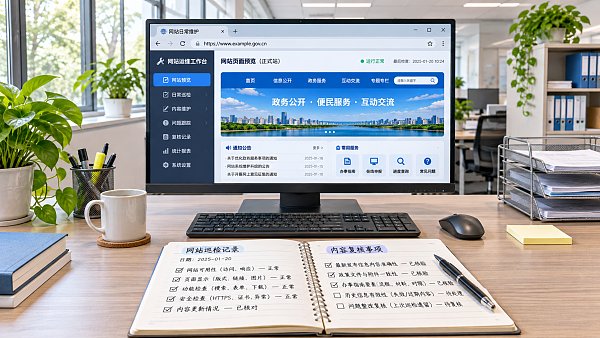
In practice, AI usually works alongside monitoring, content management, and ticketing systems: tools collect data and apply rules, while AI identifies anomalies, organizes clues, or generates suggested changes. It does not inherently have access to a website's backend, nor can it guarantee that it will independently detect every fault.
Tasks that are good candidates for initial automation include regularly checking page accessibility, identifying broken links, summarizing form errors, and generating inspection reports. These tasks are frequent and repetitive, and their results are relatively easy to verify. This frees after-sales staff to spend more time investigating causes and addressing customer issues.
Content updates should be handled according to risk level. Correcting confirmed typos or replacing approved images can usually be published automatically within a defined scope. Changes involving product specifications, prices, delivery commitments, or privacy terms should first be drafted and then verified by the business owner before publication.
What should automated monitoring check, and how should anomalies be handled?
Basic inspections should cover the homepage, main product pages, inquiry pages, and advertising landing pages. Check page status, certificate validity, loading performance, and whether key resources are working properly. For overseas websites, also run sample tests from target markets or different network environments, so that a site is not deemed fault-free merely because it works locally.
A normal status code does not mean customers can complete an action. Maintenance staff should regularly verify that inquiry forms can be submitted, notification emails are delivered, and shopping cart and checkout processes work, as well as check CAPTCHA and payment interfaces. For real payment transactions, use the test environment provided by the payment service provider.
AI can use logs, historical tickets, and page changes to categorize alerts as page failures, third-party interface issues, or content problems, and generate preliminary troubleshooting suggestions. Suggestions must include the time of occurrence, affected pages, and original evidence. Model-generated speculation must not be treated as a confirmed fault.
To prevent alerts from overwhelming the ticket queue, assign severity levels according to impact: immediately notify on-call staff if the entire site is inaccessible or orders cannot be submitted; send an image issue on a single page to the regular queue. Set up retesting and deduplication rules for intermittent timeouts, while retaining a channel for manual escalation.
Which updates can be published automatically, and which require review?
After-sales teams can create a change checklist that specifies the data source, approver, and publishing permissions for each type of task. For example, replacing an image with one from an approved asset library can be classified as low risk. Bulk changes to navigation, redirects, or page templates have a wider impact and should be tested and approved first.
Context requires particular attention on multilingual websites. AI translation can produce a first draft, but product parameters, units, certification names, and after-sales policies should be checked item by item against the source materials. For important markets, it is best to have people familiar with the local language and business review a sample to avoid accurately worded sentences conveying incorrect commitments.
System updates should not simply be set to run automatically across the board. Upgrading plugins, themes, and dependency packages may cause compatibility issues. First confirm that backups can be restored, check key processes in a test environment, and then schedule deployment during a period of low business activity. After deployment, monitor logs and conversion flows, and retain a version for rollback.
For resource pages such as A Discussion of Strategies for Optimizing Human Resource Management in Police Stations in the New Era, AI can check whether links are accessible and page titles are complete. However, the content and scope of applicability should still be confirmed by the relevant staff; facts must not be added automatically based on the title.
How can after-sales staff establish a practical review process?
The first step is to create an asset register documenting domain names, certificates, hosting environments, website backends, key pages, and the people responsible for third-party services. Specify which sites allow automated actions and which are read-only, and assign a reviewer and incident contact for every task.
The second step is to run a trial with a small number of low-risk tasks, such as daily reports on broken links and weekly summaries of certificate expiration dates. After manual verification over a period of time, adjust the rules based on false positives and missed alerts. Do not authorize automatic publishing for tasks without clear acceptance criteria.
The third step is to make every change traceable. At a minimum, tickets should record the trigger, content before and after the change, executing account, approver, publication time, and verification results. If an anomaly occurs, first stop the relevant automated task and assess the impact, then roll back according to the plan and notify affected people.
Permissions and data protection are equally important. Automation accounts should follow the principle of least privilege; store keys in a controlled environment, rotate them regularly, and retain operation logs. Before sending logs or customer inquiries to an external AI service, confirm the data processing agreement and remove unnecessary personal information and sensitive credentials.
How can you tell whether automation is genuinely reducing the maintenance workload?
Do not focus only on the number of reports generated or alerts handled. More useful metrics include fault detection time, mean time to recovery, the proportion of valid alerts, the number of duplicate tickets, and the number of rollbacks after automated changes. Record baseline figures before launch, then compare them using the same methodology.
You should also calculate the additional costs: tool subscriptions, API calls, rule configuration, manual review, and false-alert handling all require investment. If an automation task saves little time but frequently leads to extra review or rework, adjust its scope or even return to manual handling.
Teams that maintain multilingual websites, SEO pages, and marketing landing pages may consider integrating monitoring, ticketing, and their website-building platform. When evaluating services such as Yiyingbao, specifically confirm alert channels, approval permissions, log export, and rollback capabilities, and rely on actual demonstrations and service agreements.
In general, AI website maintenance is best suited to having machines continuously detect issues, organize evidence, and carry out clearly bounded actions, while people handle fact-checking, risk decisions, and incident response. Starting with small, verifiable tasks and regularly reviewing the results is the way to turn automation into a reliable maintenance capability.
Related Articles
 Can an AI website builder demo show how pages look on mobile?
 Is Your AI-Generated Website Not Being Indexed by Search Engines? Follow These Steps to Troubleshoot SEO Issues
 What Website Maintenance Tasks Can AI Handle? Automated Monitoring, Updates, and Human Review

Related Products
 Yiyingbao SaaS Intelligent Website Building and Marketing SystemYiyingbao SaaS Intelligent Website Building and Marketing System, AI-powered no-code website building, rapid creation of multilingual B2B international websites in 10 minutes, global server acceleration, AI-powered SEO optimization, helping businesses connect efficiently with global markets. The perfect integration of technology and operation makes building an international trade website remarkably simple
 AI+SEM Intelligent Advertising Marketing SystemAI+SEM drives intelligent ad creation, empowering full-funnel precision advertising marketing. The system automatically generates weekly/monthly reports, AI recommends keywords and target countries, monitors core metrics in real-time with intelligent alerts, and enables one-click high-conversion ad solutions to help quickly acquire customers and improve ROI.
 AI+SEO Dual-Engine System Optimization ServicesYiyingbao’s AI+SEO dual-engine optimization system helps foreign trade enterprises acquire high-quality organic traffic through AI-powered keyword research, content generation, and comprehensive technical optimization, significantly improving search rankings and conversion rates.
 AI+SNS Social Media Marketing SystemYingbao AI+SNS Social Media Marketing System - Precision social capture for the social media era. Supports one-click content synchronization across major platforms like Facebook and LinkedIn. AI intelligently rewrites posts for enhanced relevance. 24/7 AI customer service and user profiling analysis empower businesses to efficiently expand into global markets.
 AI+SEO营销解决方案易营宝AI+SEO营销解决方案,通过AI批量写作、智能生成TDK、精准关键词扩词等功能,全面优化网站SEO效果,提升流量与转化率。助力企业构建高效智能网站新生态。
 AI+SEM Advertising Marketing SolutionsAI+SEM Advertising Marketing Solution leverages AI technology to deeply empower SEM ad campaigns. It automatically generates weekly/monthly reports using AI, presenting account data across multiple dimensions for comprehensive insights into campaign performance and trends. The system precisely recommends keywords and target countries, intelligently generates high-conversion ad copy, and enables one-click activation of efficient campaign plans to help businesses rapidly acquire customers. Simultaneously, it monitors core metrics in real time, intelligently identifies abnormal fluctuations, and issues timely alerts to ensure stable, high-return advertising results.
 Domain Name ServicesEasyWin provides professional domain name services, including intelligent queries, one-stop registration, brand protection, and full lifecycle management, helping businesses build a digital brand image.
 EasyOperate B2C Cross-Border E-Commerce Platform & Independent WebsiteEasyStore B2C Cross-border E-commerce Independent Store is an intelligent website building and cross-border e-commerce integrated solution independently developed by EasyStore Information Technology (Beijing) Co., Ltd. The system is specially designed for small and medium-sized as well as large export enterprises, integrating 'website building, operation, marketing, advertising, and conversion' into one, helping enterprises quickly establish cross-border e-commerce independent stores to achieve brand globalization and global sales growth.
The platform supports multiple languages, multiple currencies, and multi-channel marketing, with built-in AI intelligent translation and SEO optimization systems, suitable for mainstream markets such as Southeast Asia, Europe and America, Latin America, and the Middle East, assisting Chinese manufacturing enterprises in efficiently deploying international e-commerce strategies. SSL证书易营宝提供专业SSL安全证书服务,包括单域名和泛域名证书,确保网站数据传输加密、身份验证和完整性保护,助力企业建立安全可信的在线业务环境。









