









- Levanta’s Inaugural China Summit Held in Shenzhen, Focusing on AI and Cross-Border Brand GrowthOct 20, 2026View details
- The October Edition of the 2026 GGE Shenzhen Cross-Border E-Commerce Expo OpensOct 20, 2026View details
- Dongguan’s foreign trade imports and exports reached RMB 1.29 trillion in the first three quarters, a record high for the same periodOct 20, 2026View details
- Liaoning Holds Province-Wide Meeting to Advance Cross-Border E-Commerce, Emphasizing the Need to Explore Differentiated Development PathsOct 20, 2026View details
- Advanced Manufacturing Seizes Global Opportunities as Guangdong’s Q3 Foreign Trade Surpasses RMB 3 Trillion for the First TimeOct 20, 2026View details
- Can the average annual growth rate reflect real opportunities in overseas markets?Oct 07, 2026View details
How to Optimize Product Search Experience by Vehicle Model and OE Number for an Automotive Parts Export Website
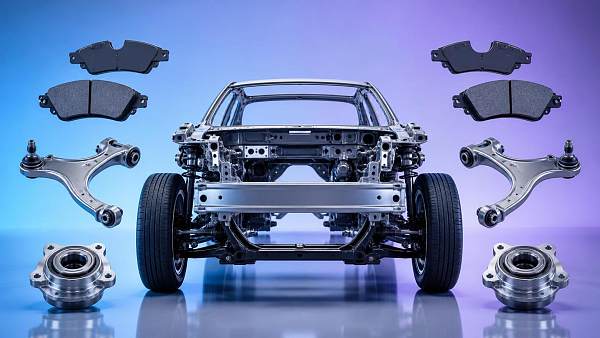
When buyers search for parts on overseas auto parts websites, they often do not enter just a product name. More commonly, they have an OE number, or have confirmed the vehicle brand, model year, displacement, and engine code, yet cannot determine whether products such as “Brake Pad” and “Control Arm” on the website are truly compatible. Overly broad search results force them to repeatedly browse through pages; too few or no results may cause them to abandon the inquiry altogether.
The core consideration in building an automotive parts export website is clear: vehicle filtering, OE number search, and fitment information should not be treated as separate functions, but integrated into the same product data set. Buyers should be able to find products by OE number and then verify compatible vehicles; they should also be able to filter progressively by vehicle and view replaceable OE numbers, specifications, and installation positions. This reduces repeated confirmation of whether a product can be used for a vehicle of a specific model year.
First Address the Two Real Purchasing Search Paths
One path is “finding products by a known part number.” Repair channels, wholesalers, and professional buyers usually have original equipment numbers, cross-reference numbers, or numbers from old packaging, and want to directly confirm availability and specification consistency. The other path is “finding parts by a known vehicle.” Buyers may only know vehicle information parsed from a VIN, or search for corresponding parts based on brand, vehicle series, year, engine, and drive type.
If a website supports only on-site keyword search, users often get no results after entering OE numbers with spaces, hyphens, or prefix variations. If it only provides vehicle filtering, parts for different engines, left- or right-hand drive configurations, front or rear axles, and brake system versions may be mixed together. Search design should support both “finding by number” and “finding by vehicle,” while establishing cross-verification on the results page instead of requiring users to guess for themselves.
Standardize Product Data First to Prevent Search Functions from Becoming Inaccurate
The foundation of the search experience is not the style of the search box, but product master data. Each SKU should at least clearly specify the product name, internal SKU, OE number, replacement number, brand, product category, installation position, compatible vehicles, key specifications, images, and packaging information. In particular, OE numbers must not be written only in product detail descriptions; they must be stored separately as searchable fields.
When entering numbers, the original format should be retained while a standardized index is established. For example, common separators such as spaces, hyphens, and periods should be normalized so that “1234-56-789,” “123456789,” and versions with brand prefixes can be linked to the same result. For cross-reference numbers from different manufacturers, their relationship type should be identified: original equipment reference number, replacement number, related number, or packaging number. This avoids directly treating numbers that are not fully equivalent as the same product.
Vehicle Filtering Should Not Stop at “Brand + Model”
The vehicle hierarchy should be designed according to product complexity. For universal parts with fewer fitment differences, brand, vehicle series, and model year may be sufficient; however, engine parts, chassis parts, brake parts, and electronic parts generally require more detailed filtering criteria. A more reasonable path may be brand, vehicle series, model year, engine or displacement, followed by necessary fields such as body style, drive type, and installation position.
More filter options are not always better. Filling the page with more than ten dropdown menus from the start instead increases purchasing steps. The previous-level selection should determine the available values at the next level. For example, after selecting a vehicle series, display only the model years that actually exist for that series; after selecting a model year, display the corresponding engines. For visitors who cannot fully confirm vehicle configuration, provide an “Search by OE Number” entry point, or allow them to first view products within a broader range and then verify through the detail page.
Fitment Results Pages Must Display the Basis for Confirmation
The results page should not display only product thumbnails and generic names. Each product card should at least show the core OE number, compatible vehicle range, position indication, and one or two differentiating specifications. After entering the detail page, the fitment table should clearly expand by dimensions such as brand, model, model year, and engine; where the same product differs between front and rear axles or left and right parts, this should be identified directly rather than hidden at the end of a lengthy description.
The term “fitment” should also be used with restraint. If the information can only indicate that a reference OE number is similar, state clearly that “please verify dimensions, interfaces, and vehicle configuration”; if the product truly corresponds to multiple numbers, list each number. Buyers need information they can use to make a judgment, not vague descriptions of “high compatibility.”
The Search Box Should Accommodate Purchasing Habits Rather Than Only Match Full Titles
On-site search should at least cover product names, SKUs, OE numbers, cross-reference numbers, and common spelling variants. When an OE number is entered, exact matches can be returned first, followed by related replacement parts; when names such as “wheel hub” or “hub bearing” are entered, results should be ranked by relevance, product category, and completeness of fitment information. A no-results page should not simply display a blank page; it should prompt users to check the number format, remove brand prefixes, or switch to vehicle filtering.
Consistency in multilingual search should also be considered. Overseas buyers may use English product names, commonly used terms in local markets, or numeric codes. Product names can be localized, but the correspondence of numbers, specification units, and vehicle fields must remain consistent. Otherwise, products that can be found on the English page may become unsearchable on another language page because of missing fields, resulting in hidden loss.
Use Three Types of Issues—“Cannot Find,” “Find the Wrong Item,” and “Cannot Understand”—for Pre-Launch Acceptance Testing
- Cannot find: Randomly select existing OE numbers and search using the original format, a format with symbols removed, and a format with prefixes to check whether all can return the correct products.
- Find the wrong item: Select easily confused model years, engines, or left/right parts, and confirm that clearly incompatible SKUs do not appear after filtering.
- Cannot understand: Open the detail page from the buyer’s perspective and check whether the OE number, fitment range, installation position, and specification differences can be found within a short time.
- Cannot proceed: When vehicle information is incomplete or search results are unavailable, the page should retain an inquiry entry point and allow users to submit vehicle information, required quantity, and target number.
Content pages should also establish entry points around actual search terms, such as OE number explanations for certain categories of parts, vehicle fitment descriptions, or specification comparison content, provided that the content corresponds to inventory products and data fields. With keyword recommendations, long-tail keyword research, and multilingual localization capabilities in SEO optimization, the numbers and category expressions actually used by buyers can be organized; after pages are published, ranking changes and technical metrics can be used to check indexing, duplicate content, and filtered-page inclusion issues.
Ultimately, automotive parts export website development should not treat “finding a product through search” as the end point. An effective search page should enable buyers to complete a continuous process: entering through a number or vehicle, viewing candidate parts, verifying the basis of fitment, confirming specifications, and submitting an inquiry. The more complex the vehicle data, the more important it is to prioritize accurate fields and clear relationships rather than using a larger number of products to conceal search gaps.
Related Articles


Related Products
 Yiyingbao SaaS Intelligent Website Building and Marketing SystemYiyingbao SaaS Intelligent Website Building and Marketing System, AI-powered no-code website building, rapid creation of multilingual B2B international websites in 10 minutes, global server acceleration, AI-powered SEO optimization, helping businesses connect efficiently with global markets. The perfect integration of technology and operation makes building an international trade website remarkably simple
 AI+SEM Intelligent Advertising Marketing SystemAI+SEM drives intelligent ad creation, empowering full-funnel precision advertising marketing. The system automatically generates weekly/monthly reports, AI recommends keywords and target countries, monitors core metrics in real-time with intelligent alerts, and enables one-click high-conversion ad solutions to help quickly acquire customers and improve ROI.
 AI+SEO Dual-Engine System Optimization ServicesYiyingbao’s AI+SEO dual-engine optimization system helps foreign trade enterprises acquire high-quality organic traffic through AI-powered keyword research, content generation, and comprehensive technical optimization, significantly improving search rankings and conversion rates.
 AI+SNS Social Media Marketing SystemYingbao AI+SNS Social Media Marketing System - Precision social capture for the social media era. Supports one-click content synchronization across major platforms like Facebook and LinkedIn. AI intelligently rewrites posts for enhanced relevance. 24/7 AI customer service and user profiling analysis empower businesses to efficiently expand into global markets.
 AI+SEO营销解决方案易营宝AI+SEO营销解决方案,通过AI批量写作、智能生成TDK、精准关键词扩词等功能,全面优化网站SEO效果,提升流量与转化率。助力企业构建高效智能网站新生态。
 AI+SEM Advertising Marketing SolutionsAI+SEM Advertising Marketing Solution leverages AI technology to deeply empower SEM ad campaigns. It automatically generates weekly/monthly reports using AI, presenting account data across multiple dimensions for comprehensive insights into campaign performance and trends. The system precisely recommends keywords and target countries, intelligently generates high-conversion ad copy, and enables one-click activation of efficient campaign plans to help businesses rapidly acquire customers. Simultaneously, it monitors core metrics in real time, intelligently identifies abnormal fluctuations, and issues timely alerts to ensure stable, high-return advertising results.
 Domain Name ServicesEasyWin provides professional domain name services, including intelligent queries, one-stop registration, brand protection, and full lifecycle management, helping businesses build a digital brand image.
 EasyOperate B2C Cross-Border E-Commerce Platform & Independent WebsiteEasyStore B2C Cross-border E-commerce Independent Store is an intelligent website building and cross-border e-commerce integrated solution independently developed by EasyStore Information Technology (Beijing) Co., Ltd. The system is specially designed for small and medium-sized as well as large export enterprises, integrating 'website building, operation, marketing, advertising, and conversion' into one, helping enterprises quickly establish cross-border e-commerce independent stores to achieve brand globalization and global sales growth.
The platform supports multiple languages, multiple currencies, and multi-channel marketing, with built-in AI intelligent translation and SEO optimization systems, suitable for mainstream markets such as Southeast Asia, Europe and America, Latin America, and the Middle East, assisting Chinese manufacturing enterprises in efficiently deploying international e-commerce strategies. SSL证书易营宝提供专业SSL安全证书服务,包括单域名和泛域名证书,确保网站数据传输加密、身份验证和完整性保护,助力企业建立安全可信的在线业务环境。









