









- Levanta’s Inaugural China Summit Held in Shenzhen, Focusing on AI and Cross-Border Brand GrowthOct 20, 2026View details
- The October Edition of the 2026 GGE Shenzhen Cross-Border E-Commerce Expo OpensOct 20, 2026View details
- Dongguan’s foreign trade imports and exports reached RMB 1.29 trillion in the first three quarters, a record high for the same periodOct 20, 2026View details
- Liaoning Holds Province-Wide Meeting to Advance Cross-Border E-Commerce, Emphasizing the Need to Explore Differentiated Development PathsOct 20, 2026View details
- Advanced Manufacturing Seizes Global Opportunities as Guangdong’s Q3 Foreign Trade Surpasses RMB 3 Trillion for the First TimeOct 20, 2026View details
- Can the average annual growth rate reflect real opportunities in overseas markets?Oct 07, 2026View details
How should a website development contract in Xi'an define the scope of source code delivery?
When signing a contract for website development in Xi’an, “delivery of all source code” is not sufficiently specific. Clearly specify which files will be delivered, how they may be used, whether the site can be deployed independently, and how it can be migrated if the service is discontinued. Receiving a compressed code package does not mean that you acquire all copyrights, nor does it mean another service provider can continue maintaining the site.
Before comparing quotes, first confirm whether the project involves custom development, secondary development of an open-source system, or website development on a SaaS platform. The scope of deliverables differs across these three models, so the contract should not use the same blanket statement, such as “the source code belongs to Party A,” to cover them all.
Distinguish custom code, third-party components, and platform licenses
For a custom development project, you can agree to delivery of the front-end and back-end code newly created for the project, along with the rights to modify, deploy, and commission its maintenance. Whether the service provider’s pre-existing general-purpose frameworks and tool libraries are included must be specified separately; do not assume they are automatically transferred with the project.
For a website developed based on an open-source system, distinguish the original program, commercial plugins, and newly developed code. Open source does not mean there are no terms of use. Even if a commercial plugin has been installed, it may be subject to requirements such as domain binding, limits on the number of sites, or renewal fees upon expiration.
SaaS website services generally provide access to a platform, and the platform’s underlying source code is usually outside the scope of delivery. In this case, pay closer attention to content and data export, domain management, renewal rules, and exit arrangements. If your business specifically requires self-hosted deployment, rule out options that do not support this requirement during the selection stage.
For example, when evaluating an integrated SaaS solution for website development and overseas marketing, such as 易营宝, ask separately about platform usage rights, website data export, and marketing account management. Do not interpret “website development services” as “delivery of the platform’s source code.”
Specify the source code scope in an appendix, matching each item to website functionality
The contract appendix can use a format such as “deliverable, file contents, scope of rights, and restrictions.” For anything that will not be delivered, specify its name, purpose, and replacement or renewal terms to avoid discovering during acceptance that a core function depends on an additional license.
- Website program: Front-end source files, back-end business code, styles, scripts, and related configuration templates. Providing only browser-accessible pages or compressed executable files does not constitute delivery of maintainable source code.
- Database and content: Database schema, data backups within the agreed scope, and uploaded files such as images, videos, and attachments. An empty database delivered before launch is not a substitute for migrating data generated during operation.
- Deployment materials: Runtime environment versions, dependency lists, installation steps, build commands, and scheduled task instructions, enabling the incoming team to deploy the site according to the documentation.
- Dependencies and licenses: A list of open-source components, commercial themes, fonts, plugins, and external interfaces, specifying the license holder, validity period, party responsible for fees, and migration restrictions.
Whether design source files, the complete development history, and internal testing tools will be delivered should also be specified separately, so they are not confused with code required to run the website. Sensitive information such as passwords and API keys should be transferred securely and changed after handover.
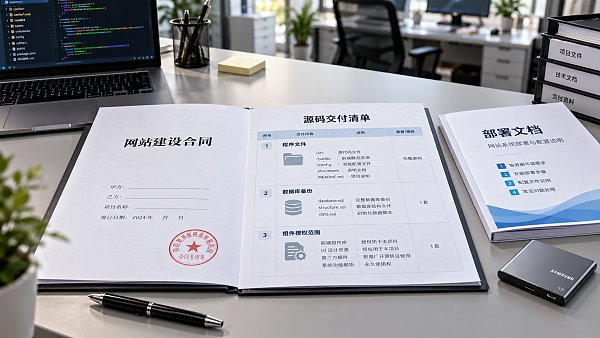
“Delivery of source code” and “ownership of copyright” must be agreed separately
Source code is a deliverable; copyright ownership and usage licenses are matters of rights allocation. The contract should distinguish among new project deliverables, the service provider’s pre-existing materials, and third-party deliverables, then specify ownership or the scope of licenses for each separately.
If the main goal is to avoid being dependent on the original service provider for future maintenance, clearly specify whether your business may modify the site independently, commission another team to maintain it, migrate it to another server, and deploy it within the agreed scope. Merely stating “perpetual use” may still leave deployment limits, authorized users, and modification rights unclear.
If you do require the relevant copyrights in custom-developed deliverables to be transferred, specify the particular rights, the deliverables they apply to, and the conditions under which the transfer takes effect. Third-party components must be used in accordance with their licenses; a blanket contractual provision cannot replace the original licensing terms.
Acceptance should involve more than checking whether a compressed package opens
A more valuable acceptance process is to deploy the site in an independent environment specified in the contract, using the delivered materials, and check core functions such as page access, admin login, content publishing, form submission, and file uploads. If the site uses inquiry email, payment, or logistics interfaces, also check that they work after the relevant accounts have been reconfigured.
This can reveal a common problem: the files appear complete, but the website still depends on undisclosed interfaces, license servers, or encryption modules provided by the service provider, and stops working when moved to a new environment. Any dependencies that are allowed to remain should have their usage terms and fees specified in advance.
When migrating a marketing website, also preserve valuable page URLs, SEO titles and descriptions, redirect rules, and any necessary analytics and conversion tracking configurations. Being able to open the website does not mean the existing promotional work has been fully carried over.
The contract should include source code delivery, deployment verification, and defect resolution as acceptance criteria, and link the corresponding payment milestones to the acceptance results. For code modified after launch, specify the delivery timeline for updates to prevent receiving an outdated version.
The price should account for the cost of taking over the site later
When comparing website development quotes in Xi’an, break down the development fee, source code delivery fee, third-party license fees, deployment and migration fees, and ongoing service fees. A low quote that depends on interfaces with long-term fees may increase exit costs; requiring the transfer of all general-purpose underlying code may also increase the initial investment.
Websites that require long-term secondary development, integration with multiple systems, or in-house operation and maintenance are better suited to arrangements that prioritize independent deployment and maintenance rights. For a standard informational website using SaaS services, focus on data export, predictable fees, and migration arrangements upon termination.
How to put the terms into practice
The following wording can serve as a basis for the delivery clause, with the specific details completed in an appendix:
“Party B shall deliver, in accordance with the appendix titled ‘Source Code and Supporting Materials Delivery List,’ the program source files, database schema and agreed data, resource files, dependency list, and deployment documentation corresponding to the version that has passed final acceptance. Ownership, license scope, and restrictions for new project deliverables, Party B’s pre-existing materials, and third-party components shall be governed separately by the appendix. The delivered materials must be deployable in the agreed environment by following the documentation and must pass the agreed functional acceptance tests. If an undisclosed essential dependency prevents deployment or operation, Party B shall provide or repair it within the agreed period.”
Also specify the delivery date, defect resolution period, scope of migration assistance, and remedies for breach. Before signing, ask the service provider to complete each item in the list. This makes it easier to determine what you are actually getting for the fee than retaining a vague statement that “all source code will be delivered.”
Related Articles


Related Products
 Yiyingbao SaaS Intelligent Website Building and Marketing SystemYiyingbao SaaS Intelligent Website Building and Marketing System, AI-powered no-code website building, rapid creation of multilingual B2B international websites in 10 minutes, global server acceleration, AI-powered SEO optimization, helping businesses connect efficiently with global markets. The perfect integration of technology and operation makes building an international trade website remarkably simple
 AI+SEM Intelligent Advertising Marketing SystemAI+SEM drives intelligent ad creation, empowering full-funnel precision advertising marketing. The system automatically generates weekly/monthly reports, AI recommends keywords and target countries, monitors core metrics in real-time with intelligent alerts, and enables one-click high-conversion ad solutions to help quickly acquire customers and improve ROI.
 AI+SEO Dual-Engine System Optimization ServicesYiyingbao’s AI+SEO dual-engine optimization system helps foreign trade enterprises acquire high-quality organic traffic through AI-powered keyword research, content generation, and comprehensive technical optimization, significantly improving search rankings and conversion rates.
 AI+SNS Social Media Marketing SystemYingbao AI+SNS Social Media Marketing System - Precision social capture for the social media era. Supports one-click content synchronization across major platforms like Facebook and LinkedIn. AI intelligently rewrites posts for enhanced relevance. 24/7 AI customer service and user profiling analysis empower businesses to efficiently expand into global markets.
 AI+SEO营销解决方案易营宝AI+SEO营销解决方案,通过AI批量写作、智能生成TDK、精准关键词扩词等功能,全面优化网站SEO效果,提升流量与转化率。助力企业构建高效智能网站新生态。
 AI+SEM Advertising Marketing SolutionsAI+SEM Advertising Marketing Solution leverages AI technology to deeply empower SEM ad campaigns. It automatically generates weekly/monthly reports using AI, presenting account data across multiple dimensions for comprehensive insights into campaign performance and trends. The system precisely recommends keywords and target countries, intelligently generates high-conversion ad copy, and enables one-click activation of efficient campaign plans to help businesses rapidly acquire customers. Simultaneously, it monitors core metrics in real time, intelligently identifies abnormal fluctuations, and issues timely alerts to ensure stable, high-return advertising results.
 Domain Name ServicesEasyWin provides professional domain name services, including intelligent queries, one-stop registration, brand protection, and full lifecycle management, helping businesses build a digital brand image.
 EasyOperate B2C Cross-Border E-Commerce Platform & Independent WebsiteEasyStore B2C Cross-border E-commerce Independent Store is an intelligent website building and cross-border e-commerce integrated solution independently developed by EasyStore Information Technology (Beijing) Co., Ltd. The system is specially designed for small and medium-sized as well as large export enterprises, integrating 'website building, operation, marketing, advertising, and conversion' into one, helping enterprises quickly establish cross-border e-commerce independent stores to achieve brand globalization and global sales growth.
The platform supports multiple languages, multiple currencies, and multi-channel marketing, with built-in AI intelligent translation and SEO optimization systems, suitable for mainstream markets such as Southeast Asia, Europe and America, Latin America, and the Middle East, assisting Chinese manufacturing enterprises in efficiently deploying international e-commerce strategies. SSL证书易营宝提供专业SSL安全证书服务,包括单域名和泛域名证书,确保网站数据传输加密、身份验证和完整性保护,助力企业建立安全可信的在线业务环境。









