









- Can the average annual growth rate reflect real opportunities in overseas markets?Oct 07, 2026View details
- Which customer acquisition channels will be affected by cross-border marketing trends in 2026?Sep 06, 2026View details
- Which homogenization risks should be considered in an analysis of the AI-powered website building industry?Aug 30, 2026View details
- How Will AI Marketing Trends 2026 Change Advertising Budget AllocationAug 28, 2026View details
- Is the EV SSL certificate market shrinking or upgrading? How should companies assess certificate procurement?Aug 11, 2026View details
- Why the old AMP SEO 2020 practices no longer work and what has changed in current optimization prioritiesAug 02, 2026View details
How Can Multilingual Product Pages Avoid SEO Impact When Switching Languages?
How can multilingual product pages avoid affecting SEO when switching languages? This is a question that many companies expanding overseas should address during the website development stage. The core conclusion is clear: language switching itself does not harm SEO. What truly affects rankings and indexing is the URL structure, automatic redirect logic, tag configuration, and content mapping relationships.
If an English product page, French product page, and German product page all share the same address, or rely on browser scripts to temporarily switch content, search engines will find it difficult to accurately understand whom the page is intended for and which version should be indexed. The result is often not a “multilingual advantage,” but confused indexing, keyword mismatches, and even declining conversions.
For foreign trade companies, manufacturing factories, cross-border brands, and teams operating independent websites, this is not merely a technical detail. It is a fundamental setup that directly affects the efficiency of acquiring overseas organic traffic. If multilingual product pages are built according to SEO standards from the outset, the subsequent costs of Google SEO, advertising landing page optimization, and localized operations will all be lower.
Why does language switching affect SEO? What is the underlying problem?
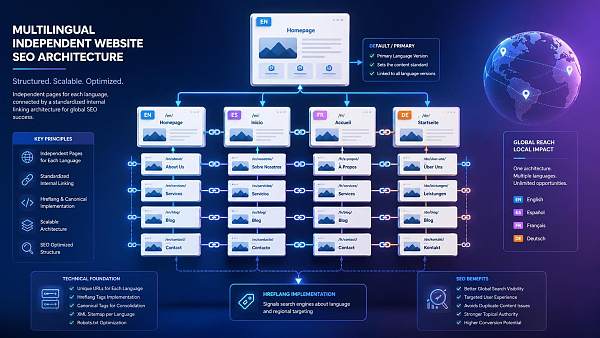
When many companies understand “language switching,” they focus on the front-end experience—for example, whether users can switch to English, French, or Spanish in the upper-right corner of the page. However, search engines do not click buttons and view pages like users do. They rely more heavily on URLs, HTML tags, and page structure to determine content ownership.
Therefore, the real issue is not whether there is a language switcher, but whether each language version has an independently crawlable, indexable, and identifiable page entity. If page text is merely replaced through JavaScript, or users are forcibly redirected based on their IP address, search engines usually cannot consistently identify each language version.
In other words, users may see “one page with switchable languages,” while search engines may see “unstable content at a single address.” This is the underlying logic that must be clarified first when considering how multilingual product pages can avoid the SEO impact of language switching.
The most common SEO risks for target readers are concentrated in these four areas
The first risk is that multiple language versions share the same URL. For example, the same product page may display different languages through parameters, cookies, or front-end switching. Although this may seem convenient for users, it makes it difficult for search engines to establish clear indexes for different languages, and keyword rankings become harder to match accurately.
The second risk is excessive automatic redirection. Many websites forcibly redirect both users and crawlers to a particular language site based on the visitor’s IP address or browser language. Although this may improve the experience in certain cases, it can prevent search engines from accessing other language versions, affecting the completeness of overall crawling and indexing.
The third risk is incorrect hreflang configuration. In theory, hreflang helps Google understand the relationship between different language or regional versions. However, if the language code is incorrect, the pages do not reference one another, or the tags point to the wrong URLs, search engines may instead form an inaccurate understanding.
The fourth risk is low-quality translated content. Many companies assume that creating multilingual pages means internationalization is complete. However, if a product page is merely machine-translated and its title, specifications, application scenarios, and inquiry copy do not match local search habits, its rankings and conversions are unlikely to be satisfactory even if it is indexed.
How should multilingual product pages be built to facilitate SEO indexing and rankings?
First, create an independent and stable URL for each language. This is the most basic step. Common approaches include subdirectories such as “/en/” and “/de/,” or separate subdomains. Regardless of the approach, each language version must have its own address that remains unchanged over the long term.
From the perspective of practical SEO implementation and subsequent management costs, most companies expanding overseas are better suited to a subdirectory structure. It facilitates the accumulation of authority across the site and makes website content management, product page expansion, and data analysis easier. It is particularly suitable for small and medium-sized foreign trade websites and independent brand websites.
Second, each language version should include complete page elements rather than translating only the body text. The URL slug, Title, Meta Description, H tags, image Alt text, breadcrumbs, product specification descriptions, and FAQ module should all be localized according to the target market’s language instead of being mechanically replaced.
Third, clear mapping relationships should be established between pages. The English version should correspond to the English version, and the German version should correspond to the German version. A language switch should not lead to the homepage, a category page, or an incorrect product page. Both search engines and users need to see one-to-one product relationships, which directly affects crawling comprehension and conversion paths.
How should hreflang be configured to avoid turning multilingual SEO into “ineffective work”?
The purpose of hreflang is to tell search engines that “these pages have similar content but target users in different languages or regions.” For example, English targeting global users can use “en”; English targeting the United States can use “en-us”; and a German page can use “de.” The prerequisite is that the codes must be accurate.
The most common problem is adding hreflang on only one page without having the corresponding pages reference one another. The correct approach is for all language versions to declare one another and include a self-referencing link. This allows search engines to understand more reliably that they belong to the same group of pages rather than being duplicate content.
Another easily overlooked point is the x-default page setting. If a website has a default entry page, or if users whose language does not match any available version should be directed to a general version, x-default can be configured. For websites targeting multiple countries with complex language structures, this can reduce the loss of user experience caused by incorrect landing pages.
However, note that hreflang is not a remedy. It cannot compensate for poor page quality, severe content duplication, or a confusing URL structure. When building multilingual product pages, companies should regard hreflang as an “identification enhancement layer,” not an “SEO problem fixer.”
How should language switchers be designed without affecting user experience and search engine crawling?
For users, the language switcher should be prominent and stable, and switching should keep them on the product page corresponding to the current page whenever possible rather than returning them to the homepage. Although this may appear to be an experience-level issue, it also affects user dwell time, bounce rate, and inquiry efficiency, thereby indirectly influencing SEO performance.
For search engines, the switching logic must be accessible and identifiable. The most reliable approach is to use standard HTML links pointing to different language URLs rather than relying entirely on JavaScript event triggers. Search engines understand directly crawlable links more consistently, and this is also more conducive to passing page relationships.
At the same time, it is not recommended to impose a non-skippable redirect on the first visit. A more appropriate approach is to provide a language suggestion, such as a pop-up prompt or a notice bar at the top, allowing users to make their own choice. This preserves the localized experience without blocking search engines from accessing other language versions.
If a company’s target markets cover North America, Europe, the Middle East, Russian-speaking regions, and Latin America, this “suggest switching rather than forcing switching” strategy is particularly important. It balances complete search indexing with the user experience across multiple regions and represents a more mature approach to international website development.
Which key points should companies prioritize during actual implementation?
First, check whether each language version has an independent URL and can be accessed and crawled directly. Second, check whether product pages in different languages correspond to one another rather than redirecting arbitrarily. Third, check whether hreflang and canonical are correctly deployed on the site to avoid conflicts between page relationships.
Fourth, check whether language switching depends on JS rendering, cookie memory, or the browser environment without providing crawlable links. Fifth, check whether product page translations are truly localized, especially whether product names, application industries, specification terminology, delivery methods, and inquiry wording conform to local search habits.
Sixth, check whether the sitemap covers all language versions and submit it to Google Search Console. Seventh, monitor logs and indexing data to confirm that Googlebot can consistently crawl each language directory. Many companies’ problems do not lie in the content but in the failure to establish accessible crawling entry points.
If a company is also responsible for multiple channels, such as advertising, social media traffic acquisition, and long-term SEO growth, the technical standards for multilingual product pages should not be overlooked. Once the underlying structure becomes confusing, the advertising landing page quality score, organic search performance, and subsequent content expansion will all be affected in a chain reaction.
From a business-results perspective, are properly built multilingual product pages worth the investment?
For managers, the most important question is not “Can it be done technically?” but “Is it worth doing?” The answer is usually yes. Multilingual SEO is not simply about increasing the number of pages; it is about establishing more accurate search entry points in different markets and improving the reach and relevance of organic customer acquisition.
The benefits of proper implementation are mainly reflected in three areas: first, improved indexing efficiency, allowing product pages in different languages to enter search indexes; second, more accurate keyword matching, enabling French users to see French pages and German users to see German pages; and third, improved conversion rates by reducing losses caused by visits in the wrong language.
For foreign trade companies and brands expanding overseas, multilingual websites often serve as long-term traffic assets. Compared with continuous reliance on paid advertising, SEO-friendly multilingual product pages are more like a long-term asset. If the structure is correct at the beginning, the marginal cost of adding each new product or market later will be lower.
Especially as AI-powered website development, SEO optimization, advertising, and content localization increasingly converge, multilingual pages are no longer merely “translated versions,” but important carriers of search visibility in overseas markets. Only a standardized structure can provide a sustainable foundation for all subsequent growth initiatives.
Conclusion: Avoiding the SEO impact of language switching depends not on “switching,” but on “page governance”
Returning to the original question, the key to avoiding the SEO impact of language switching on multilingual product pages is not to make the switcher as prominent as possible. Instead, each language version should become an independent, clear, crawlable, indexable, and conversion-oriented page.
Specifically, companies should prioritize an independent URL structure, standardized hreflang deployment, avoidance of forced redirects, one-to-one mapping between language pages, and product content that genuinely conforms to the search and reading habits of the target market. Only in this way can multilingual development become an SEO asset rather than a technical burden.
For companies currently developing overseas independent websites, the earlier multilingual SEO rules are incorporated into the website development stage, the lower the subsequent optimization costs and the more stable global traffic growth will be. These foundational tasks may not be the most visible, but they often determine whether an overseas website can continue to attract high-quality organic traffic.
Related Articles


Related Products
 Yiyingbao SaaS Intelligent Website Building and Marketing SystemYiyingbao SaaS Intelligent Website Building and Marketing System, AI-powered no-code website building, rapid creation of multilingual B2B international websites in 10 minutes, global server acceleration, AI-powered SEO optimization, helping businesses connect efficiently with global markets. The perfect integration of technology and operation makes building an international trade website remarkably simple
 AI+SEM Intelligent Advertising Marketing SystemAI+SEM drives intelligent ad creation, empowering full-funnel precision advertising marketing. The system automatically generates weekly/monthly reports, AI recommends keywords and target countries, monitors core metrics in real-time with intelligent alerts, and enables one-click high-conversion ad solutions to help quickly acquire customers and improve ROI.
 AI+SEO Dual-Engine System Optimization ServicesYiyingbao’s AI+SEO dual-engine optimization system helps foreign trade enterprises acquire high-quality organic traffic through AI-powered keyword research, content generation, and comprehensive technical optimization, significantly improving search rankings and conversion rates.
 AI+SNS Social Media Marketing SystemYingbao AI+SNS Social Media Marketing System - Precision social capture for the social media era. Supports one-click content synchronization across major platforms like Facebook and LinkedIn. AI intelligently rewrites posts for enhanced relevance. 24/7 AI customer service and user profiling analysis empower businesses to efficiently expand into global markets.
 AI+SEO营销解决方案易营宝AI+SEO营销解决方案,通过AI批量写作、智能生成TDK、精准关键词扩词等功能,全面优化网站SEO效果,提升流量与转化率。助力企业构建高效智能网站新生态。
 AI+SEM Advertising Marketing SolutionsAI+SEM Advertising Marketing Solution leverages AI technology to deeply empower SEM ad campaigns. It automatically generates weekly/monthly reports using AI, presenting account data across multiple dimensions for comprehensive insights into campaign performance and trends. The system precisely recommends keywords and target countries, intelligently generates high-conversion ad copy, and enables one-click activation of efficient campaign plans to help businesses rapidly acquire customers. Simultaneously, it monitors core metrics in real time, intelligently identifies abnormal fluctuations, and issues timely alerts to ensure stable, high-return advertising results.
 Domain Name ServicesEasyWin provides professional domain name services, including intelligent queries, one-stop registration, brand protection, and full lifecycle management, helping businesses build a digital brand image.
 EasyOperate B2C Cross-Border E-Commerce Platform & Independent WebsiteEasyStore B2C Cross-border E-commerce Independent Store is an intelligent website building and cross-border e-commerce integrated solution independently developed by EasyStore Information Technology (Beijing) Co., Ltd. The system is specially designed for small and medium-sized as well as large export enterprises, integrating 'website building, operation, marketing, advertising, and conversion' into one, helping enterprises quickly establish cross-border e-commerce independent stores to achieve brand globalization and global sales growth.
The platform supports multiple languages, multiple currencies, and multi-channel marketing, with built-in AI intelligent translation and SEO optimization systems, suitable for mainstream markets such as Southeast Asia, Europe and America, Latin America, and the Middle East, assisting Chinese manufacturing enterprises in efficiently deploying international e-commerce strategies. SSL证书易营宝提供专业SSL安全证书服务,包括单域名和泛域名证书,确保网站数据传输加密、身份验证和完整性保护,助力企业建立安全可信的在线业务环境。









