









- Can the average annual growth rate reflect real opportunities in overseas markets?Oct 07, 2026View details
- Which customer acquisition channels will be affected by cross-border marketing trends in 2026?Sep 06, 2026View details
- Which homogenization risks should be considered in an analysis of the AI-powered website building industry?Aug 30, 2026View details
- How Will AI Marketing Trends 2026 Change Advertising Budget AllocationAug 28, 2026View details
- Is the EV SSL certificate market shrinking or upgrading? How should companies assess certificate procurement?Aug 11, 2026View details
- Why the old AMP SEO 2020 practices no longer work and what has changed in current optimization prioritiesAug 02, 2026View details
What Long-Term Traffic Issues Can a B2B Website SEO Consultant Solve?
What Long-Term Traffic Problems Can a B2B Website SEO Consultant Solve?
When many companies build an overseas website, their initial expectations are actually quite straightforward: after the website goes live, Google will gradually index it, target customers will be able to find it, and inquiries will come in steadily. However, after six months to a year of actual operation, the common situation is often not that “no content has been created,” but that a considerable amount of content has been published and the number of pages keeps increasing, while traffic still fails to form a coherent system. Slow indexing, significant ranking fluctuations, core keywords that never improve, and irrelevant visitors are not problems that can be solved simply by changing a page title.
This is when the value of a B2B website SEO consultant begins to become apparent. A consultant is not simply someone who works on the rankings of a few keywords, but more like a professional who conducts systematic diagnosis across the website, search demand, conversion path, and business pace. Especially for foreign trade companies, manufacturing factories, and brands expanding overseas, SEO has never been as simple as “publishing articles.” It is directly related to the website’s underlying architecture, content organization, multilingual strategy, regional market differences, and even the quality of inquiries received by the sales team.
When Traffic Fails to Grow Over the Long Term, the Problem Is Often Not That “Too Little Has Been Done”
One of the easiest mistakes for companies to make is to interpret SEO problems as workload problems. For example, they may think, “We have been publishing two articles a week,” or “We have added a lot of product page content,” so traffic should logically increase. However, when a B2B website’s organic traffic stagnates, the root cause is often not the amount of content, but an unbalanced structure.
There are several typical situations. The first is that the website’s technical foundation is unsuitable for long-term optimization: pages load slowly, the navigation hierarchy is too deep, parameter pages are duplicated, and language versions interfere with one another. Search engines can crawl the site, but cannot fully understand it. The second is an inaccurate keyword strategy. The company repeatedly creates content around what it wants to say about its brand, but fails to cover the questions that buyers actually search for. The third is even more common: content is disconnected from conversion. The visitors attracted are not potential buyers, but competitors, students, or people far removed from the purchasing decision.
An experienced B2B website SEO consultant usually looks first not at “how many articles have been published,” but at which pages serve as customer acquisition entry points, which keywords correspond to early-stage purchasing research, which keywords are already close to inquiry decisions, and which sections are actually dispersing authority. If the sequence is wrong, the more investment is made later, the greater the waste.
The First Problems It Usually Solves Are Slow Indexing and Unclear Page Value
Many B2B websites have poor indexing performance after going live. It is not that they are not indexed at all; rather, important core pages are slow to enter the index, while less useful tag pages, filter pages, and old news pages are crawled first. On the surface, this may look as if the search engine is “not giving the site a chance.” In reality, the website often has not clearly told the search engine which pages deserve priority and which pages are merely supplementary.
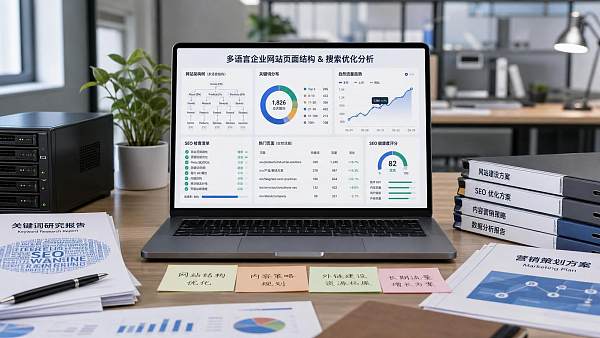
The work a consultant does here is much more complex than simply submitting a sitemap. The consultant will assess whether internal links direct authority to the right pages, whether the site structure is organized around product lines and purchasing scenarios, whether there is duplicated content between pages, and whether technical issues are affecting crawling and canonicalization. This step is especially important for companies operating multilingual websites. As the number of language versions increases, similar content, unclear regional targeting, and competition between pages are more likely to occur.
If a company itself provides an integrated “website + marketing services” solution, these problems can often be identified earlier. Truly effective long-term SEO should not be built on a website foundation whose structure will be difficult to modify later. For a service model such as EasyYingbao’s, which covers intelligent website building, SEO optimization, advertising, and social media marketing, the value lies in ensuring that website development and back-end customer acquisition are not disconnected. If the website is built from the outset according to the logic of being promotable, indexable, and conversion-oriented, the subsequent cost of SEO is usually much lower.
Significant Ranking Fluctuations Do Not Necessarily Mean the Content Is Poor; The Site’s Signals May Be Confused
Many companies encounter a frustrating situation: certain keywords achieve good rankings but drop again after a while, or performance differs significantly across regions and language versions. As a result, internal teams often attribute the issue to “another Google update.” The search environment does change, but if a website fluctuates over the long term, the more likely cause is unstable on-site signals.
The B2B sector differs from the consumer goods sector. Many keywords do not have exceptionally high search volumes, but their intent is highly specific. An industrial equipment keyword, for example, may represent a clear purchasing need. If the title, content, internal links, case study pages, and solution pages of such a page do not form a consistent semantic system, it becomes difficult for search engines to determine which question the website is best suited to answer. A consultant’s role is to clarify this kind of confusion, where the site appears to be discussing products everywhere but does not explain any one aspect thoroughly.
The consultant will also remind the company not to place all its traffic expectations on a few high-volume keywords. Truly stable growth in B2B SEO often comes from a large number of mid- and long-tail scenario keywords involving materials, processes, applications, industries, regions, certification requirements, purchasing comparisons, and solution-related questions. These keywords may not appear impressive individually, but they are closer to the actual buyer research journey and are less likely to lose momentum across the entire site because of fluctuations in a single algorithm.
When There Is Traffic but No Conversion, the Problem Is Often That “The Wrong People Are Coming”
This is something many management teams only realize at a later stage: growth in organic traffic does not equal growth in customer acquisition. What B2B websites should fear most is not a lack of visitors, but having many visitors without generating purchasing leads. There are usually two reasons. One is that the keyword direction is too broad, attracting a large number of information-seeking visitors. The other is that the page content remains focused on introducing the company itself and does not address the criteria buyers genuinely care about.
A common example is that a manufacturing company spends a great deal of space describing its factory size, number of machines, and corporate culture, while overseas buyers are often more concerned with whether the company can provide customization, how delivery schedules are controlled, which standards are supported, how minimum order quantities are negotiated, and what experience it has adapting products for different markets. If this information is not clearly organized on the website, the traffic generated by SEO will also have difficulty turning into qualified inquiries.
Therefore, a B2B website SEO consultant does not only manage “rankings,” but also revises the way content is presented. The consultant distinguishes which pages should capture awareness-stage traffic, which pages need to clearly explain specifications, capabilities, and delivery details, and which pages are suitable for regionalized content. This distinction is particularly clear for companies targeting different regions such as North America, Europe, Southeast Asia, and the Middle East. Buyer search terms, content preferences, and conversion actions are not exactly the same in every market. Multilingual does not necessarily mean that multiple markets have been fully addressed.
Many Long-Term Traffic Problems Are Embedded During the Website Development Stage
Anyone who has worked in overseas marketing for some time generally understands that SEO is rarely something that can be completely fixed through a simple “remedial effort” later. Website architecture, URL logic, page templates, mobile experience, language switching methods, and content publishing mechanisms all need to be considered during website development. If these aspects are not planned properly at the beginning, later optimization will continue to be held back.
This is also why more and more companies have stopped completely separating website development, SEO, advertising, and content operations in recent years. When the work is divided too finely, it may appear that every step is being handled by someone, but in the end, no one is responsible for long-term growth. EasyYingbao has provided enterprise-level SaaS intelligent website building and overseas digital marketing services since 2013. Its core approach is highly aligned with the actual needs of B2B websites: website development is not the delivery of a collection of pages, but the delivery of a site that can be continuously promoted and build lasting search assets. Combined with AI+SEO/GEO, multilingual websites, advertising, and social media channels, smooth team collaboration can make traffic acquisition more coherent and prevent situations such as “the ads are running, but SEO cannot support them” or “the website has content, but the technical architecture cannot support it.”
How Can a Company Determine Whether It Needs an SEO Consultant?
There is no need to wait until traffic has declined noticeably before consulting an expert. Several signals are usually worth monitoring:
- The website has been online for a long time, but core product pages are still indexed slowly, or do not receive search visibility even after being indexed;
- Content updates are continuing, but organic traffic remains flat over the long term and has not produced new growth pages;
- The number of inquiries is not particularly low, but there are many unqualified leads, and the sales team reports that there are “few relevant buyers”;
- The multilingual website continues to expand, but the company cannot clearly explain which types of pages are genuinely effective in each regional market;
- SEO, website development, advertising, and content are handled by different teams whose objectives are not aligned.
If two or three of these situations occur, the problem is generally beyond the level that can be solved by simply “adding a few more articles.” A more practical approach is to first identify the website’s long-term problems and distinguish between technical debt, content deviations, and misaligned market strategies. The value of a consultant lies precisely in helping the company avoid detours, rather than creating more tasks.
What Truly Deserves Attention Is Not Short-Term Rankings, but a Sustainable Customer Acquisition Structure
Ultimately, the long-term traffic problems that a B2B website SEO consultant can solve are not about where a particular keyword ranks. They are about whether the website can consistently cover the buyer’s research journey and gradually convert search traffic into inquiry assets. Indexing, rankings, clicks, engagement, and conversion are interconnected. Any long-term imbalance in one of these stages will eventually be reflected in customer acquisition costs.
If a company is currently expanding into overseas markets, especially if it is preparing to build a multilingual website or a B2B marketing website, or hopes to plan SEO, advertising, social media, and AI search visibility together, introducing a consultant’s perspective earlier will generally reduce the cost of rework later. In B2B, SEO has never been an “add-on.” It is more like a component of the website’s long-term operating capability. Once this is understood, many traffic problems will not have to wait a year before being exposed.
Related Articles


Related Products
 Yiyingbao SaaS Intelligent Website Building and Marketing SystemYiyingbao SaaS Intelligent Website Building and Marketing System, AI-powered no-code website building, rapid creation of multilingual B2B international websites in 10 minutes, global server acceleration, AI-powered SEO optimization, helping businesses connect efficiently with global markets. The perfect integration of technology and operation makes building an international trade website remarkably simple
 AI+SEM Intelligent Advertising Marketing SystemAI+SEM drives intelligent ad creation, empowering full-funnel precision advertising marketing. The system automatically generates weekly/monthly reports, AI recommends keywords and target countries, monitors core metrics in real-time with intelligent alerts, and enables one-click high-conversion ad solutions to help quickly acquire customers and improve ROI.
 AI+SEO Dual-Engine System Optimization ServicesYiyingbao’s AI+SEO dual-engine optimization system helps foreign trade enterprises acquire high-quality organic traffic through AI-powered keyword research, content generation, and comprehensive technical optimization, significantly improving search rankings and conversion rates.
 AI+SNS Social Media Marketing SystemYingbao AI+SNS Social Media Marketing System - Precision social capture for the social media era. Supports one-click content synchronization across major platforms like Facebook and LinkedIn. AI intelligently rewrites posts for enhanced relevance. 24/7 AI customer service and user profiling analysis empower businesses to efficiently expand into global markets.
 AI+SEO营销解决方案易营宝AI+SEO营销解决方案,通过AI批量写作、智能生成TDK、精准关键词扩词等功能,全面优化网站SEO效果,提升流量与转化率。助力企业构建高效智能网站新生态。
 AI+SEM Advertising Marketing SolutionsAI+SEM Advertising Marketing Solution leverages AI technology to deeply empower SEM ad campaigns. It automatically generates weekly/monthly reports using AI, presenting account data across multiple dimensions for comprehensive insights into campaign performance and trends. The system precisely recommends keywords and target countries, intelligently generates high-conversion ad copy, and enables one-click activation of efficient campaign plans to help businesses rapidly acquire customers. Simultaneously, it monitors core metrics in real time, intelligently identifies abnormal fluctuations, and issues timely alerts to ensure stable, high-return advertising results.
 Domain Name ServicesEasyWin provides professional domain name services, including intelligent queries, one-stop registration, brand protection, and full lifecycle management, helping businesses build a digital brand image.
 EasyOperate B2C Cross-Border E-Commerce Platform & Independent WebsiteEasyStore B2C Cross-border E-commerce Independent Store is an intelligent website building and cross-border e-commerce integrated solution independently developed by EasyStore Information Technology (Beijing) Co., Ltd. The system is specially designed for small and medium-sized as well as large export enterprises, integrating 'website building, operation, marketing, advertising, and conversion' into one, helping enterprises quickly establish cross-border e-commerce independent stores to achieve brand globalization and global sales growth.
The platform supports multiple languages, multiple currencies, and multi-channel marketing, with built-in AI intelligent translation and SEO optimization systems, suitable for mainstream markets such as Southeast Asia, Europe and America, Latin America, and the Middle East, assisting Chinese manufacturing enterprises in efficiently deploying international e-commerce strategies. SSL证书易营宝提供专业SSL安全证书服务,包括单域名和泛域名证书,确保网站数据传输加密、身份验证和完整性保护,助力企业建立安全可信的在线业务环境。









