









- Is the EV SSL certificate market shrinking or upgrading? How should companies assess certificate procurement?Aug 11, 2026View details
- Why the old AMP SEO 2020 practices no longer work and what has changed in current optimization prioritiesAug 02, 2026View details
- How to Choose Topics for an Industry News Section to Attract More Organic Search TrafficJul 29, 2026View details
- Digital Marketing Shenzhen Market Insights: Why Are Companies Expanding Overseas Looking for Growth Teams in Shenzhen?Jul 31, 2026View details
- Can Zhejiang foreign trade independent websites still be developed today? Look at changes in traffic and lead generationJul 28, 2026View details
- What New Signals Are Emerging in Enterprise Services SaaS Marketing ReportsJul 27, 2026View details
- What Does a Global Traffic Ecosystem Service Provider Do? What Are the Differences from a Single Advertising AgencyJul 16, 2026View details
- What should you focus on in the latest enterprise SaaS report? From renewal rates and delivery costs to overseas growth opportunitiesJul 12, 2026View details
Practical Steps for Setting Up 301 Redirects: How to Configure Apache, Nginx, and CMS Platforms
Don't Rush to Change the Configuration: Understand These Things Before the 301 Takes Effect
For many people searching for 301 weiterleitung einrichten, the real obstacle is not “how to write the code,” but “whether this redirect should actually point there.” If the judgment is wrong, the result is often not that the redirect fails, but that indexing, link equity, and the conversion path are all disrupted. Especially in scenarios such as website redesigns, domain changes, multilingual directory adjustments, and HTTP-to-HTTPS migrations, a 301 is a migration action, not merely a technical action.
Before taking action, first clarify the objective: Are you migrating the entire site to a new domain, or only handling a small number of invalid pages? Are you removing www uniformly, or directing old product pages to new category pages? The more unclear this step is, the more likely it is that you will later encounter problems where “the rule looks correct, but search engines do not process it as expected.”
First check these three items:
- Are external links, indexed pages, or advertising traffic still directing visitors to the old address?
- Does the new address correspond to the content? Do not crudely redirect a batch of old detail pages to the homepage;
- Has the final canonical version been determined, such as HTTPS, the primary domain, trailing slashes, and language directory rules?
If these three items have not been finalized, do not touch the server configuration yet. Once a 301 goes live, repeatedly changing it afterward will cause search engines to reinterpret the relationships among the site’s pages, and the recovery period is usually longer than many operators expect.
Do Not Confuse the Criteria: Which Scenarios Should Use a 301 and Which Should Not
A 301 is suitable for a “long-term, stable, and clearly defined replacement relationship.” Common examples include domain changes, URL structure adjustments, removing duplicate versions, and merging old sections into new ones. It tells search engines that the old address can be replaced by the new address and that the new address should be crawled as the priority going forward.
There are also many situations where a 301 is not appropriate. For example, temporarily diverting traffic for a campaign page, temporarily redirecting due to insufficient inventory, or dynamically distributing content by region or device are all closer to temporary handling. Another common mistake is redirecting every 404 to the homepage after pages are taken offline. Technically, the redirect may work, but from an SEO perspective it is usually poor because it does not match the user’s needs, and search engines may also treat this type of redirect as low-quality handling.
As a rule of thumb: if an old page has a clearly corresponding replacement page, use a 301; if there is no genuinely corresponding content, keeping a 404 or 410 is cleaner than redirecting users randomly.
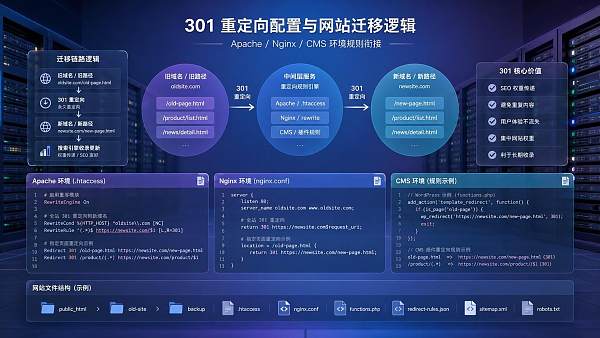
The Pre-Launch Inspection Sequence Determines Whether You Will Need to Rework It Later
The truly time-saving approach is not to write the rules first, but to create a mapping table first. Even if there are only dozens of entries, it is recommended to organize the “old URL–new URL–redirect reason.” During a site-wide migration, at minimum, sample-check core pages: the homepage, section pages, product detail pages, article pages, filter pages, download pages, and form pages.
Once this step is done thoroughly, the subsequent Apache, Nginx, or CMS configuration is essentially just a difference in the execution layer.
How to Configure an Apache Environment: The Key Is Not Syntax but Rule Order
A common approach in Apache is to write 301 rules through .htaccess or virtual host configuration. What operators most often overlook is the rule order and matching scope. For example, if you write a broad redirect first and then a single-page redirect, the later, more precise rule may never be executed.
In practice, it is recommended to arrange the rules as follows:
- First handle protocol and primary-domain standardization;
- Then handle directory-level rules, such as redirects from an old section to a new section;
- Finally add one-to-one redirects for individual pages.
If the site uses RewriteRule, remember to check whether query parameters are preserved. Many landing pages or filter pages rely on parameters to identify the source. If the parameters are lost after the redirect, marketing attribution and page logic may both be affected. Another frequent error is creating a redirect loop: one rule redirects HTTP to HTTPS, another redirects non-www to www, and the CMS adds yet another rule. When all three overlap, the browser begins reporting errors.
Nginx Configuration Is More Concise, but Do Not Make “Global Redirects” Too Broad
Nginx 301 redirects are generally placed in the server block, offering good performance and controllability. However, because the syntax is straightforward, many people immediately apply a site-wide rewrite, unintentionally redirecting APIs, static resources, and backend paths that should not be redirected. International and multilingual websites are particularly prone to this problem. For directories such as /en/, /de/, and /fr/, if the target structure has not been properly designed, uniform rewrites can directly disrupt the language versions.
A more reliable approach is to first distinguish among three types of rules: domain-level, directory-level, and page-level. Domain-level rules are suitable for site-wide migrations; directory-level rules are suitable for section restructuring; and page-level rules are used to fill in gaps. Do not put all requirements into a single regular expression. The more complex the regular expression, the more painful troubleshooting will be later, especially on websites maintained by multiple people.
Before going live, perform at least one sample access test: test once in a browser, once with a command-line request, and once from a mobile device. What you need to confirm is not only “whether it redirects,” but also “whether it reaches the destination in one step, whether the target is correct, and whether the response code is 301.”
Being Able to Configure It in the CMS Backend Does Not Mean You Can Skip Checks
Many website builders, e-commerce systems, and content management systems now provide redirect plugins or backend rule management, which is convenient for non-technical operators. However, the risk with a CMS is that you see “a new redirect has been added,” but do not see that caching, plugin conflicts, canonical tags, language plugins, and pagination rules are also affecting the result at the same time.
If you are setting up a 301 in the backend of a SaaS website builder or a marketing-oriented website, focus on these items:
- Whether the backend is configured for a 301 permanent redirect rather than a 302 temporary redirect;
- Whether the old page still appears in navigation, article recommendations, breadcrumbs, and the sitemap;
- Whether an automatically generated canonical tag still points to the old URL;
- Whether the server’s actual response code changes after the cache is refreshed.
People who manage content websites often merge old articles into a new topic page while handling redirects. In such cases, also review the content archiving logic. For pages such as A Brief Discussion of Problems and Countermeasures in Corporate Tax Planning, if the URL has been changed, do not only modify the frontend entry point. Historical indexed URLs, related internal articles, and topic aggregation pages must also be checked together. Otherwise, although the redirect has been implemented, the crawling signals will remain fragmented.
What Most Easily Undermines SEO Performance Is Not Inability to Configure It, but These Common Mistakes
The first is a redirect chain that is too long. Old A redirects to old B, and old B redirects to new C. Although it technically works, both crawling efficiency and user experience will suffer. If you can redirect directly from A to C, do not add an extra hop.
The second is redirecting large numbers of pages to the homepage. This is especially common in redesign projects. It may appear convenient, but it causes considerable damage. Search engines want to see correspondence between content, not “send everything back to the homepage anyway.”
The third is implementing only external redirects without changing the internal site structure. If internal links, XML sitemaps, canonical tags, hreflang, and multilingual switching entry points still point to old addresses, search engines will receive conflicting signals.
Another frequently overlooked issue is treating a 301 as a universal solution for all indexing problems. If the page content itself is too thin, highly duplicated, slow to load, or thematically inconsistent with the old page, a 301 cannot fix it. This is particularly evident on international and multilingual websites. A redirect only organizes the relationship between addresses; it does not improve content quality for you.
After Launch, Do Not Just Check “Whether It Is Accessible”; Monitor These Feedback Signals
The real inspection begins after the configuration is complete. You need to review logs, crawling activity, and search engine feedback instead of opening a few pages, deciding that everything looks fine, and stopping there. At the operational level, proceed in this order:
- Sample-check core old URLs, confirming that they return a 301 directly and land on the target new URLs;
- Visit the target pages and confirm that they return 200 and do not continue redirecting;
- Update the sitemap and internal links, making the new URLs the primary crawling entry points wherever possible;
- Observe over a period of time whether crawling of old URLs decreases and indexing of new URLs takes over.
If you operate a website for acquiring customers through multiple channels, add one more check: confirm that links in advertising landing pages, social media profile pages, email templates, and business systems have been replaced accordingly. A 301 can serve as a fallback, but continuously sending traffic to old addresses creates an additional redirect cost over the long term.
The Truly Efficient Approach Is to Proceed According to Priority
If you are about to start now, do not begin by “organizing every historical URL,” as that will usually hold up the project. A more practical sequence is to standardize the protocol and primary domain first, then handle core traffic pages and already indexed pages, followed by section migrations, and finally long-tail pages and scattered old links.
The difference among Apache, Nginx, and CMS systems ultimately lies only in the entry point. What truly determines the effectiveness of 301 weiterleitung einrichten is whether the mapping relationships are accurate, whether the rules conflict, and whether the internal site signals keep pace. Get these three things right and the migration will be stable. Conversely, even if all the syntax is written correctly, you may only achieve a “successful redirect” without obtaining the SEO results you need.
Related Articles
 Should you choose a personal account or a business account for Facebook paid promotion?
 No More Writing Product Copy by Hand? Yiyingbao AI Direct + 12 Major Components Deliver a Game-Changing Edge for Overseas Trade Website Building!
![]() Google Bidding Changes Dramatically on 8.17! Your Customer Acquisition Costs Are About to Rise – Part 2
Google Bidding Changes Dramatically on 8.17! Your Customer Acquisition Costs Are About to Rise – Part 2



Related Products
 Yiyingbao SaaS Intelligent Website Building and Marketing SystemYiyingbao SaaS Intelligent Website Building and Marketing System, AI-powered no-code website building, rapid creation of multilingual B2B international websites in 10 minutes, global server acceleration, AI-powered SEO optimization, helping businesses connect efficiently with global markets. The perfect integration of technology and operation makes building an international trade website remarkably simple
 AI+SEM Intelligent Advertising Marketing SystemAI+SEM drives intelligent ad creation, empowering full-funnel precision advertising marketing. The system automatically generates weekly/monthly reports, AI recommends keywords and target countries, monitors core metrics in real-time with intelligent alerts, and enables one-click high-conversion ad solutions to help quickly acquire customers and improve ROI.
 AI+SEO Dual-Engine System Optimization ServicesYiyingbao’s AI+SEO dual-engine optimization system helps foreign trade enterprises acquire high-quality organic traffic through AI-powered keyword research, content generation, and comprehensive technical optimization, significantly improving search rankings and conversion rates.
 AI+SNS Social Media Marketing SystemYingbao AI+SNS Social Media Marketing System - Precision social capture for the social media era. Supports one-click content synchronization across major platforms like Facebook and LinkedIn. AI intelligently rewrites posts for enhanced relevance. 24/7 AI customer service and user profiling analysis empower businesses to efficiently expand into global markets.
 AI+SEO营销解决方案易营宝AI+SEO营销解决方案,通过AI批量写作、智能生成TDK、精准关键词扩词等功能,全面优化网站SEO效果,提升流量与转化率。助力企业构建高效智能网站新生态。
 AI+SEM Advertising Marketing SolutionsAI+SEM Advertising Marketing Solution leverages AI technology to deeply empower SEM ad campaigns. It automatically generates weekly/monthly reports using AI, presenting account data across multiple dimensions for comprehensive insights into campaign performance and trends. The system precisely recommends keywords and target countries, intelligently generates high-conversion ad copy, and enables one-click activation of efficient campaign plans to help businesses rapidly acquire customers. Simultaneously, it monitors core metrics in real time, intelligently identifies abnormal fluctuations, and issues timely alerts to ensure stable, high-return advertising results.
 Domain Name ServicesEasyWin provides professional domain name services, including intelligent queries, one-stop registration, brand protection, and full lifecycle management, helping businesses build a digital brand image.
 EasyOperate B2C Cross-Border E-Commerce Platform & Independent WebsiteEasyStore B2C Cross-border E-commerce Independent Store is an intelligent website building and cross-border e-commerce integrated solution independently developed by EasyStore Information Technology (Beijing) Co., Ltd. The system is specially designed for small and medium-sized as well as large export enterprises, integrating 'website building, operation, marketing, advertising, and conversion' into one, helping enterprises quickly establish cross-border e-commerce independent stores to achieve brand globalization and global sales growth.
The platform supports multiple languages, multiple currencies, and multi-channel marketing, with built-in AI intelligent translation and SEO optimization systems, suitable for mainstream markets such as Southeast Asia, Europe and America, Latin America, and the Middle East, assisting Chinese manufacturing enterprises in efficiently deploying international e-commerce strategies. SSL证书易营宝提供专业SSL安全证书服务,包括单域名和泛域名证书,确保网站数据传输加密、身份验证和完整性保护,助力企业建立安全可信的在线业务环境。









