









- AliExpress Announces New Service Rules for Russia, Linked to Wildberries Product IntegrationOct 28, 2026View details
- Black Friday Preparations Enter the Final Sprint Week as Cross-Border E-Commerce Platforms Roll Out Their PlansOct 28, 2026View details
- CBP Finalizes Electronic Rail Export Manifest Rule, Effective October 26, 2026Oct 26, 2026View details
- Amazon’s 2026 peak season surcharge takes effect on October 25Oct 26, 2026View details
- AI Is Eating SaaS: Three Real-World Cases in One AfternoonOct 25, 2026View details
- Exiger CEO: The SaaS Apocalypse Is Real, but It Means Something DifferentOct 25, 2026View details
How Does a Headless CMS for Global Websites Manage Multilingual Content Relationships?
When launching a website in multiple languages, the common problems are not about whether translations exist. Instead, after an English product page is updated, no one knows what needs to be synchronized on the German page; users switch languages but are sent back to the homepage; or translations that have been taken offline still appear in the language navigation. To manage these relationships, use stable content group identifiers to link each language version, then record the language, region, publication status, and source version separately, rather than guessing which versions correspond based on titles or URLs.
When evaluating a Headless CMS for global websites solution, you need to validate the content model, translation workflow, and frontend output together. The fact that a CMS stores these relationships does not mean the website will switch languages correctly or generate hreflang tags; the delivery API must provide enough information for the frontend to identify “which language versions of the same content are publicly accessible.”
Define “the same content” before deciding how to store translations
English and German descriptions of the same product usually belong to one content group. However, promotional pages targeting different markets with different offers may not simply be translations of one another. Before modeling the content, clarify which pages share the same business identity and which are independent market-specific content. Otherwise, forced pairing may send users to a page that is not equivalent.
We recommend separating business identity from language-version identity to prevent relationships from breaking when language titles or paths change:
- contentGroupId: Identifies the same content across languages and does not change when content is translated or renamed.
- variantId and locale: Identify a specific version and its language and region, such as de-DE. Each locale should be unique within a group.
- sourceVariantId and sourceRevision: Record which version and revision the translation was based on, so you can determine whether it is out of date.
- slug, status, and publication date: Managed independently for each language version; publication results for the source language are not inherited by default.
Language codes should use the BCP 47 format. Whether to distinguish en-US from en-GB should depend on content differences, not simply on the target country. Market identifiers in business systems can be stored separately and should not be mixed with language fields.
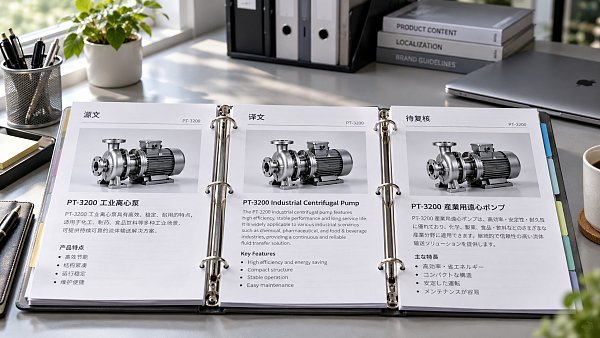
Localized fields or separate language entries: how do you choose?
Both models can establish relationships; the difference lies in the granularity of editing and publishing.
Product models and technical specifications can be shared, while titles, descriptions, and SEO copy are maintained by language. Prices, certification details, and delivery terms may need to be overridden by market. Do not translate every field indiscriminately, and do not let “shared fields” obscure genuine regional differences.
Relationships must also cover referenced content. If a German product page references an English downloadable resource, the system should make clear whether it is an approved shared asset or whether a German version is missing. Checking only the main page text is not enough.
Make translation relationships part of the publishing workflow, not just the editing interface
The existence of a translation does not mean it is still valid. When the source text changes, compare the source revision recorded for the translation with the current revision, and mark affected versions as “pending review” rather than directly overwriting approved copy. Whether to take an old translation offline should depend on the risk of the changes: wording adjustments and changes to safety parameters should not follow the same policy.
- When the source text is ready for translation, create a task containing the content group, language, field path, and source revision.
- When the translation is returned, check the source revision. If the source has changed, retain the draft and flag the conflict rather than silently overwriting it.
- During review, check terminology, referenced resources, regional restrictions, and localized SEO fields, then publish using the appropriate permissions.
- After publishing or taking content offline, use a Webhook to trigger page rebuilds, cache invalidation, and language navigation updates, and retry failed events.
Task callbacks must be idempotent to prevent retries from creating duplicate entries. Preview and public delivery APIs should also be isolated to prevent drafts from being exposed online through language relationship lists.
Fallback results from the API must be identifiable
If a request for a French page returns English content and the frontend still labels it as French, the declared language will not match the page body. The API should return the requested language, the language actually returned, and whether a fallback was triggered; returning only the body text is not enough.
We recommend configuring separate fallback rules for body content, menus, and shared assets. If a menu translation is missing, it can fall back according to product policy. If a full-page translation has not yet been published, however, the system should explicitly choose whether to hide the language option, indicate that the page is unavailable, or redirect to the source-language URL. Do not silently copy source text under a target-language URL.
Cache keys should distinguish at least the content, language, and delivery environment. Otherwise, even with correct database relationships, cache collisions may cause identical pages to be returned for requests in different languages.
SEO relationships should reference only versions that are genuinely accessible
Language switching and hreflang should use the same published relationship data. When switching languages, retain the content group rather than simply replacing the language prefix in the path. If the target version does not exist, do not generate a link that merely appears valid.
- hreflang should include the current page itself and corresponding versions that actually exist, with reciprocal references between them. Language-region codes must also use a format supported by search engines.
- Indexable standalone language pages generally use a self-referencing canonical; they should not all point to the source-language page, as this sends conflicting canonicalization signals.
- Versions that are unpublished, redirected, return errors, or are set to noindex should no longer be output as language alternatives for indexing.
For acceptance testing, use the same content group to test four scenarios: “source text updated,” “translation unpublished,” “language version taken offline,” and “slug renamed.” Check whether the API, language navigation, cache, and hreflang change in sync. If the relationship appears correct in the admin interface but invalid URLs remain live, investigate the publishing events and frontend build pipeline first, rather than rebuilding the translation relationships.
Related Articles
 How Does a Headless CMS for Global Websites Manage Multilingual Content Relationships?
 How Can Website UX Improvements Reduce Inquiry Form Abandonment?
 How to Evaluate Mobile Responsiveness for a B2C E-commerce Website


Related Products
 Yiyingbao SaaS Intelligent Website Building and Marketing SystemYiyingbao SaaS Intelligent Website Building and Marketing System, AI-powered no-code website building, rapid creation of multilingual B2B international websites in 10 minutes, global server acceleration, AI-powered SEO optimization, helping businesses connect efficiently with global markets. The perfect integration of technology and operation makes building an international trade website remarkably simple
 AI+SEM Intelligent Advertising Marketing SystemAI+SEM drives intelligent ad creation, empowering full-funnel precision advertising marketing. The system automatically generates weekly/monthly reports, AI recommends keywords and target countries, monitors core metrics in real-time with intelligent alerts, and enables one-click high-conversion ad solutions to help quickly acquire customers and improve ROI.
 AI+SEO Dual-Engine System Optimization ServicesYiyingbao’s AI+SEO dual-engine optimization system helps foreign trade enterprises acquire high-quality organic traffic through AI-powered keyword research, content generation, and comprehensive technical optimization, significantly improving search rankings and conversion rates.
 AI+SNS Social Media Marketing SystemYingbao AI+SNS Social Media Marketing System - Precision social capture for the social media era. Supports one-click content synchronization across major platforms like Facebook and LinkedIn. AI intelligently rewrites posts for enhanced relevance. 24/7 AI customer service and user profiling analysis empower businesses to efficiently expand into global markets.
 AI+SEO营销解决方案易营宝AI+SEO营销解决方案,通过AI批量写作、智能生成TDK、精准关键词扩词等功能,全面优化网站SEO效果,提升流量与转化率。助力企业构建高效智能网站新生态。
 AI+SEM Advertising Marketing SolutionsAI+SEM Advertising Marketing Solution leverages AI technology to deeply empower SEM ad campaigns. It automatically generates weekly/monthly reports using AI, presenting account data across multiple dimensions for comprehensive insights into campaign performance and trends. The system precisely recommends keywords and target countries, intelligently generates high-conversion ad copy, and enables one-click activation of efficient campaign plans to help businesses rapidly acquire customers. Simultaneously, it monitors core metrics in real time, intelligently identifies abnormal fluctuations, and issues timely alerts to ensure stable, high-return advertising results.
 Domain Name ServicesEasyWin provides professional domain name services, including intelligent queries, one-stop registration, brand protection, and full lifecycle management, helping businesses build a digital brand image.
 EasyOperate B2C Cross-Border E-Commerce Platform & Independent WebsiteEasyStore B2C Cross-border E-commerce Independent Store is an intelligent website building and cross-border e-commerce integrated solution independently developed by EasyStore Information Technology (Beijing) Co., Ltd. The system is specially designed for small and medium-sized as well as large export enterprises, integrating 'website building, operation, marketing, advertising, and conversion' into one, helping enterprises quickly establish cross-border e-commerce independent stores to achieve brand globalization and global sales growth.
The platform supports multiple languages, multiple currencies, and multi-channel marketing, with built-in AI intelligent translation and SEO optimization systems, suitable for mainstream markets such as Southeast Asia, Europe and America, Latin America, and the Middle East, assisting Chinese manufacturing enterprises in efficiently deploying international e-commerce strategies. SSL证书易营宝提供专业SSL安全证书服务,包括单域名和泛域名证书,确保网站数据传输加密、身份验证和完整性保护,助力企业建立安全可信的在线业务环境。









