









- The U.S. has ended the $800 de minimis exemption for non-postal shipments; express courier packages must be formally declared.Nov 16, 2026View details
- ASEAN Signs Digital Economy Framework Agreement, Moving Toward Harmonized Cross-Border E-Commerce RulesNov 15, 2026View details
- Shenzhen Becomes the First City in Mainland China to Exceed RMB 5 Trillion in Foreign TradeNov 15, 2026View details
- Fujian Announces the First Batch of Provincial-Level Cross-Border E-Commerce Industrial Parks and Key Brands for CultivationNov 14, 2026View details
- Amazon Global Store Announces the Launch of the 2026 Black Friday Global Shopping SeasonNov 14, 2026View details
- CCTV.com Examines APEC’s Role in China’s Foreign TradeNov 12, 2026View details
What Is 301 Redirect SEO Used For? The Impact of Redirects on Indexation, Link Equity, and Website Migration
What Is 301 Weiterleitung SEO Used For? Don’t Treat It as Just a “Redirect”
What is 301 weiterleitung SEO used for? It not only affects search engine indexing efficiency, but also relates to authority transfer, retention of traffic from old pages, and the success or failure of website migrations. Only by understanding how 301 redirects work can you avoid simultaneous declines in rankings and inquiries after a website redesign.
When many people first encounter a 301 redirect, they understand it as “automatically taking users from an old URL to a new URL.” This is not entirely wrong, but it is far from sufficient for SEO. When search engines see a 301, the message they receive is not simply “help the user switch to another page,” but rather “this address has been permanently moved, and indexing, evaluation, and crawling should gradually focus on the new address.” In other words, the essence of a 301 is the migration of URL assets, not merely a page redirection function.
This is why, when redesigning a website, adjusting sections, changing domains, upgrading from HTTP to HTTPS, or replacing discontinued product pages, technically being able to open the new page does not mean that the SEO work is complete. Without correctly implementing 301 redirects, search engines may continue crawling the old URLs, while the backlinks, historical clicks, and indexing signals accumulated by the old pages may not be transferred smoothly to the new pages. The result is often not simply “a slower recovery,” but a combination of disorganized indexing, ranking fluctuations, and breaks in organic traffic.
Its Impact on Indexing Is Not Simply Whether Pages Are Indexed, but Which Pages Are Indexed
Many website owners worry that new pages may not be indexed after 301 redirects are implemented. A more accurate question is whether search engines will gradually transfer the indexing eligibility, crawl frequency, and page-topic evaluation originally associated with the old URL to the new URL.
If the 301 configuration is clear, the old and new pages have consistent content topics, and internal links are updated at the same time, search engines will generally regard this as a normal migration. During this process, the old address may continue to appear in the index for a period of time, but the focus will gradually shift to the new address. By contrast, if a large number of old pages are all redirected to the homepage, or a page originally describing Product A is redirected to an entirely unrelated page for Product B, search engines may not accept the redirects as valid. Such redirects also provide a poor user experience and may be judged as low-quality migrations.
Therefore, when discussing the impact of 301 redirects on indexing, it is not enough to look only at whether a redirect exists. Three conditions must also be considered: whether the page topics correspond, whether the internal site structure is synchronized, and whether search engines can still efficiently understand the relationship between the old and new pages. Many migration failures are not caused by the 301 action itself, but by overly rough URL mapping logic.
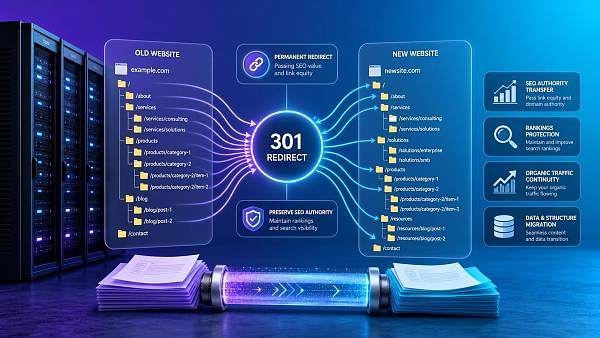
Will Authority Be Transferred? The Industry Is More Concerned About Whether Losses Can Be Controlled
The most common question about 301 redirects is “How much authority can be transferred?” This question keeps coming up because SEO is not only about whether a page can be opened, but also whether historical ranking signals, the value of external links, and user click behavior can continue. This is where the significance of a 301 lies: it is one of the standard ways for search engines to recognize a “permanent replacement relationship” and is more suitable for page migration and URL canonicalization than a temporary redirect.
However, in actual projects, “authority transfer” should not be understood as a fixed percentage. Search engines do not provide website owners with a verifiable transfer ratio, and migration results are affected by multiple factors, including content consistency, page quality, backlink relevance, internal navigation, and crawl stability. Industry experience generally suggests that the more precise the mapping, the more consistent the content, and the more unified the technical signals, the more controllable the losses. Conversely, even when 301 redirects are used, rankings for core keywords may still decline significantly.
This is especially true for large websites such as international trade websites, cross-border online stores, and multilingual corporate websites. An old URL may already have accumulated long-term exposure and inquiry entry points. In this situation, the value of a 301 is not an abstract “transfer of authority,” but the effort to connect the search signals originally dispersed across old addresses to the new structure as smoothly as possible, preventing search engines from treating the website as a group of entirely new pages that must be reevaluated after migration.
During a Website Migration, the Difference Made by Proper 301 Implementation Is Immediate
What truly tests a 301 implementation is often not a single page, but an entire website migration. Examples include changing domains, rebuilding the directory structure, switching from an old website-building system to a new platform, consolidating multilingual websites, or organizing scattered landing pages into a standardized product structure. In these situations, 301 redirects are not an auxiliary setting, but one of the core elements of the migration plan.
A relatively sound migration approach generally needs to meet several requirements: each old address should have a corresponding new address; important pages should be mapped one-to-one as a priority; all references in internal navigation, breadcrumbs, sitemaps, canonical tags, and other elements should be updated to point to the new URLs; and crawling and indexing changes should continue to be monitored after migration. The biggest mistake here is trying to save effort. Redirecting hundreds of old product pages to a single category page may be technically quick, but the SEO cost is usually high because search engines will discover that the page intent is inconsistent, while users will not find the content they originally wanted.
This issue is even more obvious in integrated website and marketing services. Many companies believe that migration is only about whether the frontend looks good, but for websites focused on customer acquisition, changes to URLs affect existing organic traffic, the quality score of advertising landing pages, and the stability of inquiry paths. Some companies also conduct overseas advertising campaigns during a redesign. In that case, frequent changes to landing page URLs can cause not only SEO fluctuations, but also undermine advertising attribution and conversion analysis. Campaigns such as Google Ads promotion, which require continuous performance tracking, keyword refinement, and adaptation to multilingual scenarios, have inherently high requirements for page stability.
Several Common Misconceptions Are More Problematic Than Not Implementing 301 Redirects
The first misconception is treating 302 redirects, JavaScript redirects, and refresh redirects as substitutes for 301 redirects. They can be used in certain business scenarios, but their communication of SEO signals for permanent migration is not equivalent. Whether search engines can identify them consistently and when they transfer the indexing focus are handled differently.
The second misconception is believing that everything is finished as long as the server returns a 301 status code. In reality, if internal links still extensively point to old addresses, search engines will continue repeatedly crawling the old URLs, naturally reducing migration efficiency. A 301 solves the question of “how to handle the old address,” while updating internal links solves the question of “whether the new address has become the default answer across the entire website.” Neither can be omitted.
The third misconception is believing that the redirect chain can be as long as necessary. For example, A redirects to B, B redirects to C, and only then reaches the official page. This slows down page loading for users and increases the cost of interpretation for crawlers. If a direct redirect is possible, do not retain multiple layers of historical redirects.
Another frequently overlooked situation is that a canonical tag is not a 301 redirect. A canonical tag tells search engines “which version is preferred,” but users and crawlers can still access the original page. A 301, on the other hand, explicitly informs them at the server level that “this address has been permanently moved.” Both relate to URL canonicalization, but they solve different problems.
When Is It Necessary, and When Should It Not Be Overused?
The situations suitable for implementing 301 redirects are quite clear: changing domains; permanently removing a page when replacement content is available; adjusting the URL structure; redirecting HTTP to HTTPS; standardizing www and non-www versions; standardizing uppercase and lowercase URLs or trailing slashes; and organizing historical paths on multilingual websites. These scenarios all have one thing in common: the old address will no longer exist as a long-term version.
There are also many situations in which 301 redirects should not be overused. Examples include temporarily switching a short-term campaign page, A/B testing pages, temporarily out-of-stock product pages, or two similar pages that still need to be retained independently. Forcing 301 redirects in all these cases may instead cause search engines to misinterpret the page relationship and may even merge indexing entry points that should have been preserved.
For corporate websites, there is another practical criterion: will the old page still need to be searched, promoted, or measured separately in the future? If the answer is yes, do not rush to create a permanent redirect. If the answer is that the page has completed its historical purpose and there is a clearly defined replacement page, then a 301 is the more prudent approach.
Understanding 301 Redirects Is Not Only About Technical Correctness, but Also Business Continuity
The key value of 301 weiterleitung SEO has never been limited to the broad concept of being “search-engine friendly.” For companies that genuinely rely on their websites to generate leads, it relates to three highly specific matters: whether old traffic can be retained, whether accumulated historical value can continue, and whether inquiries will suddenly drop off after a redesign. This is especially important for international trade companies and brands expanding overseas. Their pages often serve simultaneously as organic search entry points, advertising landing pages, product descriptions, and inquiry conversion points. Once a URL changes, an entire chain of processes is affected.
Therefore, when evaluating whether a 301 has been implemented well, do not look only at whether the browser can reach the destination page. More important questions include whether each old page has been mapped to a suitable new page, whether search engines are gradually including the new address as the primary indexed version, whether traffic to core pages remains stable, whether backlink entry points are being wasted, and whether advertising and SEO data can continue to be tracked after migration. Once these issues are clearly understood, a 301 is no longer merely a technical term, but a fundamental action that must be handled carefully during website growth.
Related Articles
 How to Add Structured Data to Product Pages with JSON-LD
 How Long Does It Take to See an Increase in Inquiries from SEO for Your Website?
 How to Promote a Website on Google in France: From French Keywords to Local Link Building



Related Products
 Yiyingbao SaaS Intelligent Website Building and Marketing SystemYiyingbao SaaS Intelligent Website Building and Marketing System, AI-powered no-code website building, rapid creation of multilingual B2B international websites in 10 minutes, global server acceleration, AI-powered SEO optimization, helping businesses connect efficiently with global markets. The perfect integration of technology and operation makes building an international trade website remarkably simple
 AI+SEM Intelligent Advertising Marketing SystemAI+SEM drives intelligent ad creation, empowering full-funnel precision advertising marketing. The system automatically generates weekly/monthly reports, AI recommends keywords and target countries, monitors core metrics in real-time with intelligent alerts, and enables one-click high-conversion ad solutions to help quickly acquire customers and improve ROI.
 AI+SEO Dual-Engine System Optimization ServicesYiyingbao’s AI+SEO dual-engine optimization system helps foreign trade enterprises acquire high-quality organic traffic through AI-powered keyword research, content generation, and comprehensive technical optimization, significantly improving search rankings and conversion rates.
 AI+SNS Social Media Marketing SystemYingbao AI+SNS Social Media Marketing System - Precision social capture for the social media era. Supports one-click content synchronization across major platforms like Facebook and LinkedIn. AI intelligently rewrites posts for enhanced relevance. 24/7 AI customer service and user profiling analysis empower businesses to efficiently expand into global markets.
 AI+SEO营销解决方案易营宝AI+SEO营销解决方案,通过AI批量写作、智能生成TDK、精准关键词扩词等功能,全面优化网站SEO效果,提升流量与转化率。助力企业构建高效智能网站新生态。
 AI+SEM Advertising Marketing SolutionsAI+SEM Advertising Marketing Solution leverages AI technology to deeply empower SEM ad campaigns. It automatically generates weekly/monthly reports using AI, presenting account data across multiple dimensions for comprehensive insights into campaign performance and trends. The system precisely recommends keywords and target countries, intelligently generates high-conversion ad copy, and enables one-click activation of efficient campaign plans to help businesses rapidly acquire customers. Simultaneously, it monitors core metrics in real time, intelligently identifies abnormal fluctuations, and issues timely alerts to ensure stable, high-return advertising results.
 Domain Name ServicesEasyWin provides professional domain name services, including intelligent queries, one-stop registration, brand protection, and full lifecycle management, helping businesses build a digital brand image.
 EasyOperate B2C Cross-Border E-Commerce Platform & Independent WebsiteEasyStore B2C Cross-border E-commerce Independent Store is an intelligent website building and cross-border e-commerce integrated solution independently developed by EasyStore Information Technology (Beijing) Co., Ltd. The system is specially designed for small and medium-sized as well as large export enterprises, integrating 'website building, operation, marketing, advertising, and conversion' into one, helping enterprises quickly establish cross-border e-commerce independent stores to achieve brand globalization and global sales growth.
The platform supports multiple languages, multiple currencies, and multi-channel marketing, with built-in AI intelligent translation and SEO optimization systems, suitable for mainstream markets such as Southeast Asia, Europe and America, Latin America, and the Middle East, assisting Chinese manufacturing enterprises in efficiently deploying international e-commerce strategies. SSL证书易营宝提供专业SSL安全证书服务,包括单域名和泛域名证书,确保网站数据传输加密、身份验证和完整性保护,助力企业建立安全可信的在线业务环境。









