









- Which customer acquisition channels will be affected by cross-border marketing trends in 2026?Sep 06, 2026View details
- Which homogenization risks should be considered in an analysis of the AI-powered website building industry?Aug 30, 2026View details
- How Will AI Marketing Trends 2026 Change Advertising Budget AllocationAug 28, 2026View details
- Is the EV SSL certificate market shrinking or upgrading? How should companies assess certificate procurement?Aug 11, 2026View details
- Why the old AMP SEO 2020 practices no longer work and what has changed in current optimization prioritiesAug 02, 2026View details
- How to Choose Topics for an Industry News Section to Attract More Organic Search TrafficJul 29, 2026View details
FDA New Regulations Take Effect: Compliance Verification for Export Enterprises’ Standalone Websites Becomes a Prerequisite
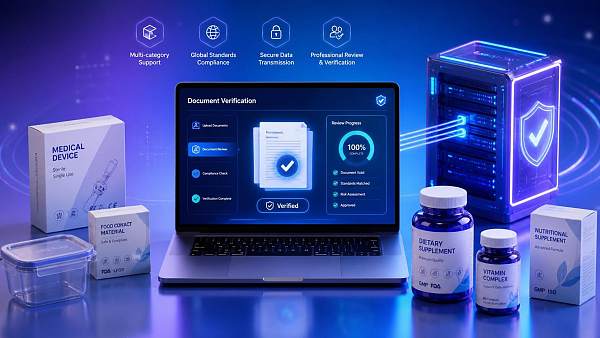
Starting August 1, 2026, the U.S. FDA will begin mandatory implementation of the “Digital Compliance Portal Access Regulation.” According to the information disclosed, Chinese suppliers exporting medical devices, food-contact materials, and dietary supplements to the U.S. market will need to integrate an FDA-approved AI document verification interface into their B2B independent websites. The interface will be used to verify product registration numbers, factory registration status, and labeling compliance in real time in English and Spanish. This change deserves industry attention, not only because it extends website functionality from product presentation to a compliance verification portal, but also because it will directly affect overseas buyers’ assessment of supplier credibility and their screening criteria during the ordering process.
What specific changes will the requirements implemented in August introduce?
The confirmed information indicates that the U.S. FDA will begin mandatory implementation of the “Digital Compliance Portal Access Regulation” on August 1, 2026. The regulation applies to Chinese suppliers exporting medical devices, food-contact materials, and dietary supplements to the United States. It requires the B2B independent websites of relevant companies to integrate an FDA-approved AI document verification interface and support real-time verification in both English and Spanish.
Based on the verification scope, three categories of information have been clearly identified: product registration numbers, factory registration status, and labeling compliance. The summary provided also indicates that this requirement will directly affect overseas buyers’ assessment of supplier credibility and their ordering decisions. Beyond the above, the input information does not provide further implementation details, technical interface requirements, or supporting explanations.
Procurement decisions are moving forward to the online compliance portal
For export suppliers, the website is no longer merely a presentation window
The analysis indicates that export companies selling directly to U.S. buyers will be affected first. This is because the new requirement does not only involve customs declaration, registration, or offline audits; it moves compliance verification forward to the B2B independent website, a key point of contact in the procurement process. For these companies, the main impacts will be reflected in customer outreach, qualification presentation, document verification, and inquiry conversion. Of particular importance is that companies will need to align their product registration information, factory registration information, and labeling-related materials with the website verification module. Otherwise, buyers may increase the level of scrutiny during the initial evaluation stage.
For buyers, supplier selection criteria will place greater emphasis on real-time verifiability
From the perspective of the business chain, overseas buyers will also be directly affected. The summary clearly states that this requirement is related to supplier credibility assessments and ordering decisions. In practice, buyers may place greater importance on whether an independent website provides a portal for real-time compliance verification when conducting preliminary supplier screening, rather than relying solely on static documents or manually sent certification materials. This means that qualification confirmation, label verification, and supplier comparison in the procurement process will increasingly depend on verifiable online results.
Services related to compliance documentation will also face pressure
For certification-related companies, testing service providers, and supply chain service companies, the main impact of this change will be reflected in document preparation and delivery coordination. The analysis indicates that when both buyers and exporters need to rely on a real-time verification module, the consistency of relevant certificates, test reports, label content, and registration status will become more sensitive. Although the input information does not provide more detailed implementation rules, it is reasonable to conclude that all service activities involved in document preparation, review, delivery, and updating will need to ensure that the information can support instant verification on the website.
What practical actions should receive closer attention now?
First, verify that the information subject to verification is complete and consistent
For relevant companies, the primary focus should be whether the product registration numbers, factory registration status, and labeling information already displayed publicly or prepared for submission to customers can be verified under a consistent set of information. The key is not to add more promotional content, but to avoid inconsistencies among website information, business documents, and actual registration status. Since the input information does not provide a specific review process, it is currently more appropriate to understand this as a need for companies to first organize internal documentation and conduct consistency checks.
The presentation of labels and documents in bilingual scenarios should be reviewed in advance
The confirmed requirements include real-time verification in both English and Spanish, which means companies cannot focus only on interface integration itself. Since labeling compliance is included in the verification scope, relevant companies need to consider whether the presentation of documents and labels in a bilingual environment facilitates verification. The input information does not provide detailed label review requirements. Therefore, the current focus should remain on “continuous verification and avoiding information mismatches,” rather than making unsupported assumptions about more detailed assessment criteria.
Procurement and delivery schedules may be affected by front-end compliance reviews
From an execution perspective, if buyers incorporate real-time independent website verification results into their ordering decisions, suppliers may be affected by the pace of front-end compliance reviews during inquiries, quotations, sample confirmation, and even order advancement. The direct implication for delivery arrangements is not that definite delays have already occurred, but that companies need to incorporate compliance document preparation into earlier business stages to reduce the possibility that problems in the verification process will affect customer decisions.
Follow up on the implementation approach rather than expanding the interpretation independently
Because the current input information does not provide technical integration details, exemptions, review feedback mechanisms, or other content, companies need to maintain clear boundaries when responding. A more prudent approach is to continue monitoring subsequent official statements, changes in customer procurement documents, and actual review requirements during implementation, rather than treating content that has not yet been clarified as established rules in advance.
This appears to be an implementation signal that has already taken effect
From an industry perspective, this information is more appropriately understood as a regulatory change that has begun to take effect, rather than as a proposal for comments or a general policy statement. The reason is clear: the input information provides a specific effective date and clearly identifies the applicable parties, website integration requirements, bilingual verification capabilities, and scope of verification.
At the same time, this remains a dynamic matter for which implementation details require continued observation. In practice, the industry will be concerned not only with “whether integration is required,” but also with how verification criteria will be unified after integration, how buyers will incorporate the requirement into supplier review procedures, and whether different product categories will be interpreted differently during implementation. At this stage, treating it as a signal that “implementation thresholds are moving online” is closer to the actual meaning of the information.
The industry implication lies not in promotion, but in the pre-transaction process
Returning to the business itself, the core significance of this change is that export compliance is no longer merely a review matter after an order has been formed. It is beginning to move forward to the stage where customers visit an independent website, verify qualifications, and decide whether to place an order. For export companies related to medical devices, food-contact materials, and dietary supplements, it is currently more appropriate to understand this information as both an effective regulatory requirement and a clear signal that procurement review methods are being adjusted.
Whether it will further affect supplier screening efficiency, delivery coordination, and the establishment of customer trust still requires continued observation in light of subsequent implementation details, changes in procurement documents, and market feedback. At this stage, companies should focus more on document consistency, website verification capabilities, and front-end compliance presentation, rather than making excessive assumptions about the scope of the impact.
Basis of this article and areas for further verification
This article was generated based on the information title, event date, and event summary provided by the user. The confirmed factual scope is limited to the information supplied. For events of this type, continued verification would normally also involve regulatory agency announcements, official releases, information from trade authorities, industry association materials, standards organization documents, and reports from authoritative media.
It should be noted that the input content does not provide a specific official source link. Therefore, this article cannot supplement the corresponding link. Further tracking and verification are still required with respect to policy details, certification implementation criteria, changes in procurement documents, industry feedback, and the actual implementation by companies.
Related Articles



Related Products
 Yiyingbao SaaS Intelligent Website Building and Marketing SystemYiyingbao SaaS Intelligent Website Building and Marketing System, AI-powered no-code website building, rapid creation of multilingual B2B international websites in 10 minutes, global server acceleration, AI-powered SEO optimization, helping businesses connect efficiently with global markets. The perfect integration of technology and operation makes building an international trade website remarkably simple
 AI+SEM Intelligent Advertising Marketing SystemAI+SEM drives intelligent ad creation, empowering full-funnel precision advertising marketing. The system automatically generates weekly/monthly reports, AI recommends keywords and target countries, monitors core metrics in real-time with intelligent alerts, and enables one-click high-conversion ad solutions to help quickly acquire customers and improve ROI.
 AI+SEO Dual-Engine System Optimization ServicesYiyingbao’s AI+SEO dual-engine optimization system helps foreign trade enterprises acquire high-quality organic traffic through AI-powered keyword research, content generation, and comprehensive technical optimization, significantly improving search rankings and conversion rates.
 AI+SNS Social Media Marketing SystemYingbao AI+SNS Social Media Marketing System - Precision social capture for the social media era. Supports one-click content synchronization across major platforms like Facebook and LinkedIn. AI intelligently rewrites posts for enhanced relevance. 24/7 AI customer service and user profiling analysis empower businesses to efficiently expand into global markets.
 AI+SEO营销解决方案易营宝AI+SEO营销解决方案,通过AI批量写作、智能生成TDK、精准关键词扩词等功能,全面优化网站SEO效果,提升流量与转化率。助力企业构建高效智能网站新生态。
 AI+SEM Advertising Marketing SolutionsAI+SEM Advertising Marketing Solution leverages AI technology to deeply empower SEM ad campaigns. It automatically generates weekly/monthly reports using AI, presenting account data across multiple dimensions for comprehensive insights into campaign performance and trends. The system precisely recommends keywords and target countries, intelligently generates high-conversion ad copy, and enables one-click activation of efficient campaign plans to help businesses rapidly acquire customers. Simultaneously, it monitors core metrics in real time, intelligently identifies abnormal fluctuations, and issues timely alerts to ensure stable, high-return advertising results.
 Domain Name ServicesEasyWin provides professional domain name services, including intelligent queries, one-stop registration, brand protection, and full lifecycle management, helping businesses build a digital brand image.
 EasyOperate B2C Cross-Border E-Commerce Platform & Independent WebsiteEasyStore B2C Cross-border E-commerce Independent Store is an intelligent website building and cross-border e-commerce integrated solution independently developed by EasyStore Information Technology (Beijing) Co., Ltd. The system is specially designed for small and medium-sized as well as large export enterprises, integrating 'website building, operation, marketing, advertising, and conversion' into one, helping enterprises quickly establish cross-border e-commerce independent stores to achieve brand globalization and global sales growth.
The platform supports multiple languages, multiple currencies, and multi-channel marketing, with built-in AI intelligent translation and SEO optimization systems, suitable for mainstream markets such as Southeast Asia, Europe and America, Latin America, and the Middle East, assisting Chinese manufacturing enterprises in efficiently deploying international e-commerce strategies. SSL证书易营宝提供专业SSL安全证书服务,包括单域名和泛域名证书,确保网站数据传输加密、身份验证和完整性保护,助力企业建立安全可信的在线业务环境。









