









- Can the average annual growth rate reflect real opportunities in overseas markets?Oct 07, 2026View details
- Which customer acquisition channels will be affected by cross-border marketing trends in 2026?Sep 06, 2026View details
- Which homogenization risks should be considered in an analysis of the AI-powered website building industry?Aug 30, 2026View details
- How Will AI Marketing Trends 2026 Change Advertising Budget AllocationAug 28, 2026View details
- Is the EV SSL certificate market shrinking or upgrading? How should companies assess certificate procurement?Aug 11, 2026View details
- Why the old AMP SEO 2020 practices no longer work and what has changed in current optimization prioritiesAug 02, 2026View details
How to Choose a Google SEO Training Course: A Competency Framework for Internal Team Training
When project leaders are planning a website launch, redesign, or overseas customer acquisition initiative, they often encounter a contradiction: the team has already purchased SEO tools, and some members can write titles and descriptions, yet organic traffic, indexing quality, and inquiry pages remain disconnected. When selecting a Google SEO training course, the key should not be “who teaches faster or provides more tools,” but whether the course can help the team build optimization capabilities that are executable, verifiable, and sustainable for collaboration.
A course suitable for internal team training should cover at least four areas: strategic judgment, technical troubleshooting, content production, and data review, while aligning with the actual workflow of the existing website. Courses that only teach keywords, backlinks, or how to use a specific plugin may suit individual beginners, but they are unlikely to solve issues such as repeated requests, page rework, and untraceable results in multi-person collaboration.
First confirm: Does the team lack knowledge or a collaboration methodology?
Choosing the wrong course is often not due to insufficient instructor capability, but because the training objectives have not been broken down. Projects at different stages require different capabilities. When a new website is preparing to launch, the team most needs information architecture, URL rules, multilingual page relationships, index control, and template fields. When a website already has some content but traffic has stalled, greater attention should be given to matching search demand, content quality, internal links, and page update mechanisms. When visits exist but inquiries are limited, the training focus should shift to landing page intent, form paths, and conversion event tracking.
Therefore, before contacting a course provider, project leaders can first organize three types of current issues: which pages have not been indexed or have been indexed incorrectly; which business pages rank but do not generate effective visits; and which handoff stage is blocking content, development, design, and advertising personnel respectively. Evaluating a course with these issues in mind makes it possible to determine whether the training content truly fits the project.
What capability framework should a course for internal training include?
Training does not need to develop everyone into the same type of SEO professional, but it should enable different roles to understand what results their actions affect. More complete courses typically break knowledge down into the following levels rather than compressing everything into keyword techniques.
Strategic level: Determine what should be optimized instead of producing content first
This section should explain how to identify search intent in target markets, distinguish the roles of product pages, category pages, solution pages, and knowledge content pages, and establish keyword-to-page mapping. Project leaders should pay particular attention to whether the course clearly explains “which page should address a given topic.” Otherwise, multiple pages may repeatedly be written around the same term, easily resulting in overlapping content and causing subsequent updates to lose priority.
Good instruction should also require teams to assess the commercial value of business terms rather than looking only at search volume. For B2B websites, content such as technical parameters, application scenarios, purchasing requirements, and delivery capabilities is often closer to the inquiry stage than broad industry terms.
Technical level: Make development work verifiable through SEO acceptance criteria
The technical module should not stop at saying that “website speed is important.” Teams need to be able to translate abstract requirements into development tasks, for example: whether pages return the correct status codes; whether navigation and important pages can be crawled properly; how duplicate pages should be canonicalized; whether filtered pages, internal search pages, and test pages are indexed by mistake; and whether multilingual versions point to the correct language and regional relationships.
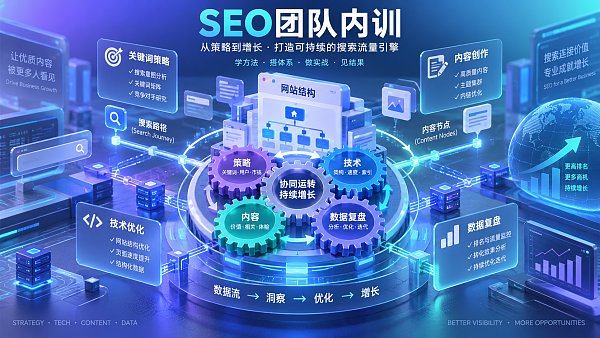
When selecting a course, you can directly ask whether it provides examples of technical audits, ways to write requirement documents, and pre-launch inspection methods. If the training only shows the interface of testing tools without explaining the business impact of issues, the order of remediation, and acceptance criteria, the development team may still face a long list of issues without knowing how to schedule them.
Content level: Turn professional materials into searchable, understandable pages
The value of content training is not in teaching people to write articles in bulk, but in establishing page production standards. The course should cover heading hierarchy, completeness of core information, the supporting role of images and tables, the context of internal links, and how product materials can be broken down into questions users will search for. Engineering, manufacturing, or cross-border business pages especially need to avoid containing only promotional language while lacking specifications, compatibility requirements, process explanations, and frequently asked questions.
It should also be confirmed whether the instructor explains the review mechanism: who verifies technical facts, who is responsible for language expression, who decides whether a page can be published, and how versions are recorded after content updates. Without these steps, internal training often leaves only fragmented writing techniques behind.
Data level: Use the same set of metrics to discuss priorities
Internal team training must include basic data interpretation capabilities. Not every member needs to conduct complex analysis, but they should at least be able to distinguish the meanings of impressions, clicks, indexing, rankings, dwell time, and conversion events, and understand that data fluctuations do not necessarily mean the work has failed. More importantly, the course should teach the team to break down issues by page type, market language, search topic, and conversion path rather than looking only at one total traffic figure.
When an enterprise is advancing adjustments to its website and marketing processes, An Analysis of the Impact of Digital Transformation on Enterprise Resilience can also serve as material for internal discussion, helping project members understand SEO training within the context of process coordination, data governance, and continuous iteration rather than regarding it as an isolated content task.
Use a trial session or course outline to determine whether it is “learnable” or “implementable”
A course outline that includes “technical SEO, content SEO, and data analysis” does not necessarily mean the content is sufficiently in-depth. Project leaders can further screen courses based on their delivery approach:
- Whether there are clearly defined deliverables: For example, a page inventory, keyword mapping sheet, technical issue priorities, content templates, or a monthly review format. Without deliverables, training can easily become knowledge sharing.
- Whether it fits existing roles: The course should explain the level of mastery required for development, content, and operations personnel respectively, rather than requiring everyone to complete the same exercises.
- Whether real pages can be used for practice: Demonstrations detached from the existing site make concepts easier to understand, but diagnosing real pages is more likely to expose problems in templates, content, and processes.
- Whether it includes a post-training execution schedule: In the two to four weeks after internal training ends, which issues should be fixed first, who is responsible for follow-up, and how changes will be verified determine whether the training outcomes can be retained.
Two seemingly convenient choices also require caution: one is content that relies excessively on a single tool, leaving the team unable to continue after changing tools; the other is a course that promises short-term rankings without explaining prerequisites such as page foundations, market competition, and content review. The former limits capability transfer, while the latter can easily shift the team’s attention from controllable work to results that cannot be guaranteed.
Arrange training according to project stages to avoid “solving every problem in one course”
Smaller teams can first complete joint training on strategy and basic technical aspects, then have content personnel move on to producing topic-based pages. Teams with longer collaboration chains are better suited to splitting training into alignment sessions and role-specific practical sessions. The former unifies terminology and goals, while the latter practices real tasks, reducing situations where “everyone understands, but no one knows what to do next.”
Include course procurement requirements in the project brief
When making the final decision, it is advisable to treat the course as a project deliverable rather than simply purchasing training hours. The project brief should specify the website scope covered by the training, participating roles, page issues to be addressed, the format of assignments after each session, the review schedule, and the internal person in charge. If the course provider cannot adjust its cases, exercises, and deliverables based on this information, it is more suitable for public courses and may not necessarily be suitable for internal team training.
The value of Google SEO training is ultimately reflected in whether the team can turn search demand into consistent page, technical, and data actions. Training that leaves behind standards, responsibility boundaries, and review methods is more likely to continue delivering value after personnel changes, website expansion, and market adjustments.
Related Articles


Related Products
 Yiyingbao SaaS Intelligent Website Building and Marketing SystemYiyingbao SaaS Intelligent Website Building and Marketing System, AI-powered no-code website building, rapid creation of multilingual B2B international websites in 10 minutes, global server acceleration, AI-powered SEO optimization, helping businesses connect efficiently with global markets. The perfect integration of technology and operation makes building an international trade website remarkably simple
 AI+SEM Intelligent Advertising Marketing SystemAI+SEM drives intelligent ad creation, empowering full-funnel precision advertising marketing. The system automatically generates weekly/monthly reports, AI recommends keywords and target countries, monitors core metrics in real-time with intelligent alerts, and enables one-click high-conversion ad solutions to help quickly acquire customers and improve ROI.
 AI+SEO Dual-Engine System Optimization ServicesYiyingbao’s AI+SEO dual-engine optimization system helps foreign trade enterprises acquire high-quality organic traffic through AI-powered keyword research, content generation, and comprehensive technical optimization, significantly improving search rankings and conversion rates.
 AI+SNS Social Media Marketing SystemYingbao AI+SNS Social Media Marketing System - Precision social capture for the social media era. Supports one-click content synchronization across major platforms like Facebook and LinkedIn. AI intelligently rewrites posts for enhanced relevance. 24/7 AI customer service and user profiling analysis empower businesses to efficiently expand into global markets.
 AI+SEO营销解决方案易营宝AI+SEO营销解决方案,通过AI批量写作、智能生成TDK、精准关键词扩词等功能,全面优化网站SEO效果,提升流量与转化率。助力企业构建高效智能网站新生态。
 AI+SEM Advertising Marketing SolutionsAI+SEM Advertising Marketing Solution leverages AI technology to deeply empower SEM ad campaigns. It automatically generates weekly/monthly reports using AI, presenting account data across multiple dimensions for comprehensive insights into campaign performance and trends. The system precisely recommends keywords and target countries, intelligently generates high-conversion ad copy, and enables one-click activation of efficient campaign plans to help businesses rapidly acquire customers. Simultaneously, it monitors core metrics in real time, intelligently identifies abnormal fluctuations, and issues timely alerts to ensure stable, high-return advertising results.
 Domain Name ServicesEasyWin provides professional domain name services, including intelligent queries, one-stop registration, brand protection, and full lifecycle management, helping businesses build a digital brand image.
 EasyOperate B2C Cross-Border E-Commerce Platform & Independent WebsiteEasyStore B2C Cross-border E-commerce Independent Store is an intelligent website building and cross-border e-commerce integrated solution independently developed by EasyStore Information Technology (Beijing) Co., Ltd. The system is specially designed for small and medium-sized as well as large export enterprises, integrating 'website building, operation, marketing, advertising, and conversion' into one, helping enterprises quickly establish cross-border e-commerce independent stores to achieve brand globalization and global sales growth.
The platform supports multiple languages, multiple currencies, and multi-channel marketing, with built-in AI intelligent translation and SEO optimization systems, suitable for mainstream markets such as Southeast Asia, Europe and America, Latin America, and the Middle East, assisting Chinese manufacturing enterprises in efficiently deploying international e-commerce strategies. SSL证书易营宝提供专业SSL安全证书服务,包括单域名和泛域名证书,确保网站数据传输加密、身份验证和完整性保护,助力企业建立安全可信的在线业务环境。









