









- Can the average annual growth rate reflect real opportunities in overseas markets?Oct 07, 2026View details
- Which customer acquisition channels will be affected by cross-border marketing trends in 2026?Sep 06, 2026View details
- Which homogenization risks should be considered in an analysis of the AI-powered website building industry?Aug 30, 2026View details
- How Will AI Marketing Trends 2026 Change Advertising Budget AllocationAug 28, 2026View details
- Is the EV SSL certificate market shrinking or upgrading? How should companies assess certificate procurement?Aug 11, 2026View details
- Why the old AMP SEO 2020 practices no longer work and what has changed in current optimization prioritiesAug 02, 2026View details
How to Upgrade Facebook Operations from Content Scheduling to a Measurable Lead Generation Mechanism
When many teams work on Facebook, the task they are most familiar with is “scheduling content”: product images on Monday, customer feedback on Wednesday, and event previews on Friday. The page appears to be continuously updated, and engagement occasionally improves, but when managers ask, “How many qualified inquiries and follow-up-ready customers did this content generate?”, operations teams can often only present likes, reach, and follower growth.
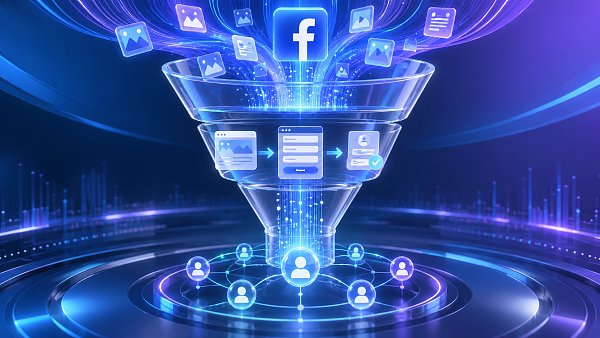
This is precisely the hurdle that Facebook operations needs to overcome. Truly mature Facebook operations should not treat the content calendar as the endpoint, but instead measure every post, every direct message, and every form submission within the same customer acquisition journey. For foreign trade companies, manufacturing factories, and cross-border brands targeting overseas markets, social media is not merely a lively display window; it is a frontline channel that helps potential customers discover the brand, build trust, and enter the sales process.
Start with a different perspective: Content is not a task; it is a touchpoint on the customer acquisition journey
Overseas buyers rarely place an order immediately after seeing a product post. Especially in B2B scenarios, they typically go through a process of “discovering the brand—confirming product capabilities—assessing fit—leaving contact information—starting communication.” If operations personnel focus only on the data from individual posts, they can easily overlook the questions that truly matter: Who does this content attract? Where do they go after viewing it? Do they ultimately become leads that sales can follow up on?
Therefore, content scheduling should extend from “What should we post this week?” to “Which audience should we move one step forward this week?” For example, for audiences encountering the brand for the first time, content can focus on application scenarios, pain points, and basic awareness; for people who have visited the website or watched a video, it is more appropriate to provide specification materials, production processes, case studies, or quotation inquiry options; visitors who have submitted a form but have not responded can be re-engaged through remarketing content.
The same factory video may be evaluated differently depending on its objective. If it serves a brand awareness purpose, video completion rate and the quality of engaged audiences deserve more attention; if it is used for remarketing, the focus should be on form start rate, inquiry rate, and cost per lead after users click through to the landing page. Discussing “viral content” without considering the business stage often brings operations back to ineffective traffic competition.
Before building a trackable journey, define what constitutes a “qualified lead”
Many Facebook pages are already connected to a website but still cannot assess the value of social media. The reason is often not a lack of tools, but unclear lead standards. Some count every Messenger direct message as an inquiry, while others pass visitors who download a catalog directly to sales. As a result, marketing and sales consistently have differing judgments about lead quality.
It is recommended that operations and sales jointly break conversions down into several clear levels:
- Top-of-funnel actions: Watching videos, liking, commenting, saving, and clicking the homepage, suitable for assessing content appeal;
- Intent actions: Visiting product pages, downloading materials, clicking WhatsApp or Messenger, and staying on key pages;
- Lead actions: Submitting forms, booking demonstrations, requesting quotations, and clearly expressing purchasing needs;
- Opportunity actions: Customers who pass initial screening based on region, needs, budget, or purchasing cycle and can enter sales follow-up.
Each level should correspond to event tracking, form fields, and attribution rules. Landing page links should include UTM parameters to distinguish organic posts, ads, community shares, and different content themes; the website should be configured with identifiable conversion events, such as form submissions, clicks on instant messaging tools, catalog downloads, or appointment buttons. This way, operations personnel no longer need to rely on intuition to determine whether content is effective, but can trace a lead back to the specific post, ad set, or landing page through which it entered.
Audience segmentation determines whether content truly “speaks to the right people”
Broadly publishing the same type of content to all countries and all interest groups is a common waste of resources in Facebook operations. A procurement manager looking for a supplier and a casual browser newly exposed to the industry care about different information; North American customers value certifications, delivery times, and after-sales response, while markets in the Middle East or Latin America may pay more attention to local fit, communication language, and barriers to cooperation.
In practice, you can first establish three basic audience types: existing customers or high-value inquiries for creating lookalike audiences; people who have visited the website, interacted with the page, or watched videos for remarketing; and cold-start audiences segmented by country or region, industry role, interests, and business needs. Segmentation does not need to be highly complex at the beginning, but each audience type must have different content paths and conversion objectives.
For example, cold-start content can use educational topics such as “how to choose a certain type of equipment” and “common application issues” to lower the barrier to understanding; remarketing content can showcase production details, delivery capabilities, FAQs, or customer application scenarios; for high-intent visitors, it is more appropriate to provide clear options such as quotation requests, sample applications, and consultation bookings. Content thus no longer merely fills the page, but gradually shortens the customer’s decision-making journey.
Do not treat the page as an isolated island: The landing page determines whether leads can be retained
The content promised in a Facebook post or advertisement must continue after the click. If users see “customized solutions” but enter a website containing only a general company introduction; if the page requires an overly long form, loads slowly, or lacks local language support, the interest built by front-end content can easily be lost.
Pages designed for overseas customer acquisition should at least enable visitors to quickly find four types of information: what problems the product or service solves, which scenarios it applies to, why the company is trustworthy, and how to get in touch next. B2B pages may include specification downloads, project consultation, WhatsApp/Messenger contact options, and concise forms; B2C cross-border pages should place greater emphasis on the purchasing process, delivery information, reviews, and payment information. Key pages should also account for the mobile experience, as a large volume of social media visits occurs on mobile phones.
Yiyingbao provides coordinated services for AI-powered website building, multilingual websites, cross-border e-commerce stores, SEO, advertising, and overseas social media for foreign trade and global brand expansion scenarios. Its value lies not only in completing website development, but also in providing social media traffic with a destination that can receive, track, and be continuously optimized. Once websites, advertising accounts, social media channels, and lead management standards are gradually unified, operations personnel can see beyond “which types of content drive visits” to the deeper question of “which types of content bring convertible customers.”
A weekly report is not enough; operations teams need to understand changes in the funnel
Measurable operations do not mean monitoring every metric every day. A more practical approach is to review signals at different levels by cycle: check for delivery anomalies and responses to comments and direct messages daily; review content reach, click-through rate, landing page visits, and lead volume weekly; and combine sales feedback monthly to assess qualified inquiry rate, opportunity rate, and customer acquisition costs across different markets, content themes, and audience groups.
When a certain type of content generates high engagement but almost no clicks, there is no need to dismiss it immediately; it may be suitable for brand exposure. When there are many clicks but few form submissions, prioritize checking landing page relevance, loading speed, and form design. When lead volume is considerable but sales considers the leads invalid, targeting criteria should be tightened, qualification fields should be added, or advertising promises should be adjusted. The value of metrics is not in “reporting attractive figures,” but in indicating what should be improved in the next round.
When establishing cross-channel data standards, operations personnel can also refer to the thinking on technology application and organizational collaboration in Practical Challenges and Countermeasures for Fintech in Promoting Enterprise Innovation and Development. Tools can provide data, but how data is defined, who processes it, and how it is fed back into business actions still require the joint participation of marketing, sales, and management.
Starting with the next content schedule, add three essential actions
There is no need to overturn the existing workflow. In the next scheduling cycle, label each key piece of content with its target audience, content stage, and expected action; before publishing, check whether link parameters, landing page continuity, and conversion events are functioning properly; after publishing, do not only save screenshots of engagement, but also record visits, leads, and subsequent sales feedback. After several consecutive cycles, the team will gradually discover which themes truly bring target customers and which only generate temporary attention.
The maturity of Facebook operations is not about posting more every day, but about placing every exposure within a verifiable growth logic. Only when content, audiences, website conversion paths, and lead follow-up form a closed loop can Facebook operations gradually evolve from a content schedule into an overseas customer acquisition mechanism that companies can review and optimize.
Related Articles



Related Products
 Yiyingbao SaaS Intelligent Website Building and Marketing SystemYiyingbao SaaS Intelligent Website Building and Marketing System, AI-powered no-code website building, rapid creation of multilingual B2B international websites in 10 minutes, global server acceleration, AI-powered SEO optimization, helping businesses connect efficiently with global markets. The perfect integration of technology and operation makes building an international trade website remarkably simple
 AI+SEM Intelligent Advertising Marketing SystemAI+SEM drives intelligent ad creation, empowering full-funnel precision advertising marketing. The system automatically generates weekly/monthly reports, AI recommends keywords and target countries, monitors core metrics in real-time with intelligent alerts, and enables one-click high-conversion ad solutions to help quickly acquire customers and improve ROI.
 AI+SEO Dual-Engine System Optimization ServicesYiyingbao’s AI+SEO dual-engine optimization system helps foreign trade enterprises acquire high-quality organic traffic through AI-powered keyword research, content generation, and comprehensive technical optimization, significantly improving search rankings and conversion rates.
 AI+SNS Social Media Marketing SystemYingbao AI+SNS Social Media Marketing System - Precision social capture for the social media era. Supports one-click content synchronization across major platforms like Facebook and LinkedIn. AI intelligently rewrites posts for enhanced relevance. 24/7 AI customer service and user profiling analysis empower businesses to efficiently expand into global markets.
 AI+SEO营销解决方案易营宝AI+SEO营销解决方案,通过AI批量写作、智能生成TDK、精准关键词扩词等功能,全面优化网站SEO效果,提升流量与转化率。助力企业构建高效智能网站新生态。
 AI+SEM Advertising Marketing SolutionsAI+SEM Advertising Marketing Solution leverages AI technology to deeply empower SEM ad campaigns. It automatically generates weekly/monthly reports using AI, presenting account data across multiple dimensions for comprehensive insights into campaign performance and trends. The system precisely recommends keywords and target countries, intelligently generates high-conversion ad copy, and enables one-click activation of efficient campaign plans to help businesses rapidly acquire customers. Simultaneously, it monitors core metrics in real time, intelligently identifies abnormal fluctuations, and issues timely alerts to ensure stable, high-return advertising results.
 Domain Name ServicesEasyWin provides professional domain name services, including intelligent queries, one-stop registration, brand protection, and full lifecycle management, helping businesses build a digital brand image.
 EasyOperate B2C Cross-Border E-Commerce Platform & Independent WebsiteEasyStore B2C Cross-border E-commerce Independent Store is an intelligent website building and cross-border e-commerce integrated solution independently developed by EasyStore Information Technology (Beijing) Co., Ltd. The system is specially designed for small and medium-sized as well as large export enterprises, integrating 'website building, operation, marketing, advertising, and conversion' into one, helping enterprises quickly establish cross-border e-commerce independent stores to achieve brand globalization and global sales growth.
The platform supports multiple languages, multiple currencies, and multi-channel marketing, with built-in AI intelligent translation and SEO optimization systems, suitable for mainstream markets such as Southeast Asia, Europe and America, Latin America, and the Middle East, assisting Chinese manufacturing enterprises in efficiently deploying international e-commerce strategies. SSL证书易营宝提供专业SSL安全证书服务,包括单域名和泛域名证书,确保网站数据传输加密、身份验证和完整性保护,助力企业建立安全可信的在线业务环境。









