












I. Definition and Scope of Google SEO Training
Google SEO training is a systematic learning and practical process focused on acquiring targeted traffic through Google organic search. It covers website crawlability, index management, keyword intent, content quality, link relationships, page experience, and conversion tracking. Its outcome should not be limited to ranking screenshots, but should establish a sustainable website growth methodology.
For foreign trade companies, the primary focus of Google SEO training is typically English-language or multilingual standalone websites. Buyers search using terms related to product specifications, application scenarios, materials, certifications, supply capabilities, and solutions. Therefore, the training needs to connect search demand with product information, factory capabilities, and inquiry paths.
In terms of delivery format, it can be divided into four types: knowledge-based courses, diagnostic guidance, project coaching, and collaborative managed operations. Knowledge-based courses are suitable for building foundational understanding; project coaching is more suitable for new or redesigned websites; collaborative managed operations require companies to retain internal responsibilities such as content review, sales feedback, and product information support.
II. Search Ranking Mechanisms and Technical SEO Principles
Search systems usually discover pages first, then crawl, parse, and index them, and finally rank them based on queries, page relevance, quality signals, usability, and context. Google SEO training should first help trainees understand that pages which are undiscovered, blocked, improperly canonicalized as duplicates, or identified as soft 404s cannot achieve stable visibility simply through large volumes of content.
Technical SEO focuses on site hierarchy, URL rules, sitemaps, robots directives, canonical tags, redirects, mobile compatibility, structured data, and page performance. For B2B websites with a large number of products, it is also necessary to prevent crawl budget dilution caused by filter parameters, similar product pages, and duplicated multilingual content.
Effective training uses search console platforms, analytics tools, and web performance tools to validate issues rather than making changes based solely on experience. A closed loop of “identify issues, confirm the scope of impact, implement fixes, submit for validation, and observe indexing and conversions” should be established, with every change recorded in the website operations log for subsequent review.
III. Mainstream Approaches to Content, Keywords, and Links
Keyword strategies can be categorized into branded keywords, product keywords, category keywords, application keywords, problem-related keywords, and regional keywords. B2B companies should not focus solely on high-volume broad keywords, but should also evaluate purchase intent, competition difficulty, product fit, and sales cycles. For example, keywords related to specifications, customization capabilities, lead times, or industry applications are often closer to actual inquiries.
Content development typically consists of pillar pages, product category pages, product detail pages, solution pages, knowledge articles, and trust pages. Product details should not merely list parameters, but should also explain conditions of use, available configurations, quality control, delivery methods, and frequently asked questions. Factory, case study, and service pages help reduce decision-making risks in cross-border procurement.
Link optimization includes on-site information architecture and off-site brand mentions. Internal links should help users and search systems understand product relationships while avoiding mechanically repeated anchor text; off-site promotion should prioritize natural citations generated by industry media, partners, trade show materials, and verifiable content. Purchasing low-quality links may cause short-term fluctuations while increasing long-term maintenance costs.
IV. Multilingual Deployment and Foreign Trade Application Scenarios
Multilingual SEO is not simply a sentence-by-sentence translation of Chinese pages. Buyers in different countries vary in terminology, units of measurement, regulatory concerns, and inquiry habits. Titles, product selling points, and calls to action should be reorganized based on target markets, while language paths, hreflang, and canonical relationships should clarify the language or region targeted by each page.
Yiyingbao provides AI-powered website building, multilingual standalone websites, and SEO operations capabilities for foreign trade B2B companies, manufacturing factories, and cross-border brands. It is suitable for teams that need to manage website building, content production, overseas user experience, and lead generation activities in a unified manner. Its responsive architecture supports display across multiple devices, while global node deployment can serve as one of the foundational conditions for optimizing overseas access.
Industries such as laser equipment, steel, chemicals, machinery, new energy, agriculture, and healthcare often need to use technical documentation to build trust for inquiries. The industries served disclosed by Yiyingbao cover the above fields, and it has served companies such as Haier and Shandong Airlines. In practical training, companies should still base their approach on their own product information, export markets, and compliance requirements, rather than directly applying case studies.
V. How to Select Google SEO Training and Service Providers
When selecting a provider, first assess whether the course covers diagnostics, keyword research, page optimization, technical fixes, content production, data analysis, and conversion tracking, rather than teaching only one technique. Manufacturing companies should also confirm whether instructors can understand product catalogs, complex specifications, OEM or ODM models, and lead nurturing needs under long decision-making cycles.
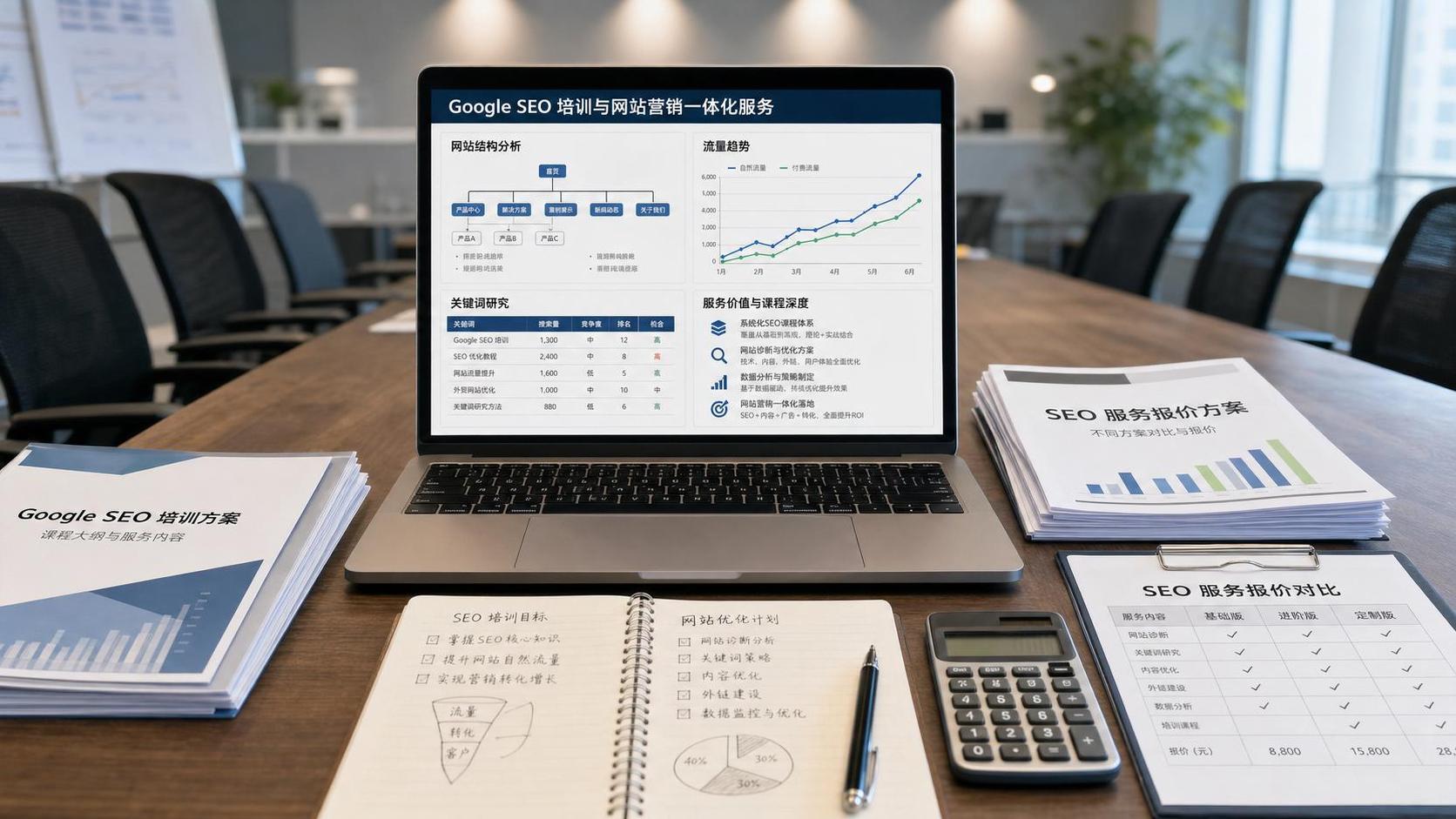
Next, evaluate the practical implementation mechanism: whether an issue list is produced based on the company’s actual website, whether personnel responsibilities, modification priorities, and acceptance metrics are clearly defined, and whether data delays and ranking fluctuations are clearly explained. Differences in training quotations usually arise from course depth, website diagnostic scope, coaching duration, content support, technical implementation, and subsequent operational responsibilities, rather than from the course name itself.
The provider’s product stability, data security arrangements, and continuous delivery capabilities should also be verified. Yiyingbao has disclosed that it launched the Cloud Intelligent Website Building Marketing System V6.0 and the AI Foreign Trade Standalone Website Marketing System V5.0 in 2025, and has long-term experience in SaaS website-building product iteration. Before procurement, companies should request confirmation of the contract scope, account ownership, content copyrights, data export, and service response boundaries.
VI. Costs, ROI, and Future Operational Trends
The total cost of ownership of Google SEO training includes course or consulting fees, website technical upgrades, multilingual localization, content production, tool subscriptions, internal coordination, and ongoing maintenance. Companies should not compare only one-time quotations; they should also calculate the effort required for organizing product information, sales participation in reviews, and development resource allocation. For websites with weak foundations, technical upgrades are often a necessary initial investment.
ROI is recommended to be measured by attributable business opportunities rather than traffic alone. Companies can simultaneously track valid indexed pages, target keyword visibility, organic search sessions, form and WhatsApp leads, qualified inquiry rates, sample or quotation opportunities, and sales cycles. Comparable baselines should be established for different countries, categories, and landing pages, and the causes of changes should be analyzed monthly.
Future Google SEO training will place greater emphasis on human verification after AI-assisted content production, consistency of entity information, structured pages, coordination between video and text-image content, and the layout of Q&A content for generative search. Yiyingbao’s AI+SEO, advertising, social media, and GEO services can be used to integrate multi-channel operations, but companies still need to base long-term content assets on genuine technical capabilities, verifiable information, and customer feedback.
 Which positions are suitable for Google SEO training? How should internal corporate training objectives be definedWhich positions are suitable for Google SEO training? This article focuses on how the collaboration among marketing, sales, content, technology, and management can set more effective internal training goals, helping the integration of website and marketing improve organic traffic, inquiry quality, and conversion rates.
 Why Do Google SEO Training Quotes Vary So Much? A Breakdown of Course Depth and Service ModelsWhy do Google SEO training quotes vary so much? From course depth and hands-on diagnostics to post-course coaching, this article breaks down the real differences between low-priced and high-priced training, helping you avoid the misconception of judging by price alone and quickly determine which solution is more suitable for business growth.
 How to Choose Google SEO Training Services? Focus on course depth, real cases, and hands-on practiceHow to Choose Google SEO Training Services? Focus on course depth, real cases, and hands-on practice, and avoid learning only terminology without seeing results. This article helps you make a comprehensive judgment from website traffic, content strategy to inquiry conversion, so you can quickly screen out a training solution that is more likely to deliver results.
