









- How to assess foreign trade website development trends?Looking at 2026 changes from multilingual,AI content to conversion pathsJul 04, 2026View details
- What are the new trends in multilingual marketing data analytics tools in 2026? Focus on attribution、automation and complianceJul 04, 2026View details
- Is Brand Globalization Marketing Consulting Worth Buying? At What Stage Should Companies Bring It InJul 01, 2026View details
- Cross-Border Marketing Trend Research: Why More and More Companies Are Starting to Deploy AI Search and GEO OptimizationJun 30, 2026View details
- Cross-Border Marketing Trend Research: How Independent Sites, AI Content, and Short-Video Customer Acquisition Are ChangingJun 30, 2026View details
- How Can a Brand Updates Page Be Made More SEO-Friendly? Analysis of Update Frequency, Content Structure, and Internal Linking StrategyJun 28, 2026View details
- What stages does the cross-border services ecosystem include? How do website building, promotion, payment, and compliance work togetherJun 22, 2026View details
- How will email marketing costs change in 2026Jun 22, 2026View details
What New Changes Are Happening in Content Marketing for International Digital Agencies
At a time when traffic dividends are peaking and AI is rapidly reshaping the communication landscape, content marketing for international digital agencies is shifting from isolated output to a data-driven, full-chain collaborative, and deeply localized approach, becoming a key engine for global business growth.
For business decision-makers, the focus is no longer just on “creating content,” but on whether content can support the coordination of four stages: customer acquisition, conversion, sales follow-up, and brand building. Especially under the trend of integrated website + marketing services, the value of content is being upgraded from communication material to growth infrastructure.
Since its establishment in 2013, E-Marketing Information Technology (Beijing) Co., Ltd. has long focused on building full-chain capabilities around intelligent website development, SEO optimization, social media marketing, and advertising placement. Driven by artificial intelligence and big data, the company has adopted a dual-engine strategy of “technological innovation + localized services,” serving more than 100,000 enterprises and maintaining growth of over 30% for consecutive years, providing more actionable digital growth solutions for companies expanding overseas.
Four Key Changes in Content Marketing for International Digital Agencies
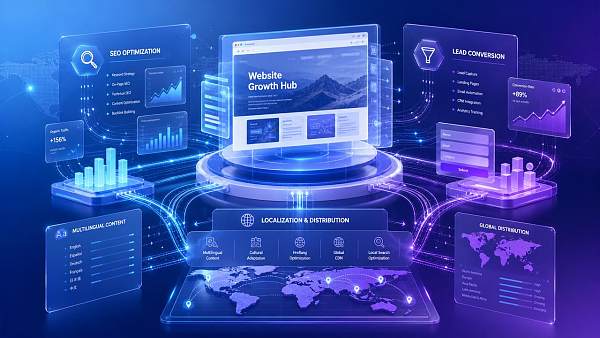
Over the past 3–5 years, the logic of content marketing for international digital agencies has changed significantly. Companies are no longer satisfied with publishing a few articles per month or posting on a single social media platform, but instead require content systems to continuously deliver search visibility, lead growth, and increased brand awareness within a 90-day to 180-day cycle.
1. From content production to content asset operations
In international markets, the life cycle of a single piece of content is shortening, but the value of topic clusters continues to rise. A mature content system usually consists of 1 core page, 5–8 topic pages, more than 20 scenario-based content pieces, and several FAQ pages, forming continuously accumulating content assets through internal links rather than one-time publishing behavior.
2. From single-language communication to localized semantic expression
Many companies mistakenly believe that “translation completed” means international communication completed. In fact, the English-speaking market, German-speaking market, and Southeast Asian market differ greatly in keyword preferences, page structure, CTA expression, and acceptance of industry terminology. Content localization should at least cover four levels: language, search habits, procurement wording, and conversion paths.
3. From traffic orientation to lead quality orientation
Business decision-makers care more about the rate of valid inquiries than superficial traffic volume. Content marketing for international digital agencies is shifting its core metrics from PV and likes to form submission rate, number of MQLs, inquiry response timeliness, and opportunity conversion cycle. Common evaluation windows are 30 days, 60 days, and 90 days.
4. From fragmented departmental execution to full-chain collaboration
Content is no longer completed solely by the marketing department. Mature projects often require synchronized advancement of website development, SEO strategy, advertising placement, social media operations, and sales collaboration. If the official website structure, landing pages, keyword layout, and sales forms are disconnected from one another, then even if content is published 2–3 times per week, it is still difficult to achieve stable conversions.
The table below can help companies quickly determine the gap between their current content system and the requirements of the new stage, making it easier for decision-makers to identify priority areas for improvement.
If a company is still operating in the model on the left, it will usually encounter the problem of frequent content updates that still fail to generate inquiries. The upgrade of content marketing for international digital agencies is essentially about turning content from a promotional tool into a quantifiable, accumulative, and optimizable growth system.
Execution Capabilities That Business Decision-Makers Should Focus On Most
From the perspective of procurement and management, when companies choose content marketing services for international digital agencies, they fear three types of problems most: plans that look good but cannot be executed, content that gets published but fails to convert, and abundant data that still cannot guide budget allocation. Therefore, when evaluating a service provider’s capabilities, companies should not only look at creative expression, but also whether the delivery mechanism is complete.
Website and content must be planned simultaneously
A website is the core foundation for content conversion. A B2B website targeting overseas markets should usually complete three synchronized designs at the early stage of website development: information architecture, keyword mapping, and conversion paths. If SEO is added only after the website is built, the subsequent redesign cost often increases by 20%–40%, and it may also affect the performance of pages that have already been indexed.
Presentation methods suitable for industrial exporters are being upgraded
Taking industrial exporters as an example, an official website needs not only product pages, but also visual ways to build B-end trust. For example, around scenarios such as heavy vehicles, logistics, companies can clearly present supply scale, business coverage, and professional consultation entry points through digital portals, overseas coverage maps, client logo walls, and product search centers.
This type of page design is especially suitable for businesses involving bulk transactions, long decision-making chains, and multi-region procurement coordination. Compared with traditional static introduction pages, interactive hotspot maps, data dashboards, and responsive motion effects are more likely to establish a professional impression within the first 30 seconds of a visit, improving the probability of form submissions and return visits.
Content topics should align closely with the procurement decision chain
High-value content does not only include brand stories. For business customers, the content that truly influences inquiries usually falls into 6 categories: industry solutions, product comparisons, application scenarios, delivery processes, frequently asked questions, and risk control. At least 12–18 topics should be planned per quarter to cover search needs at different procurement stages.
- Awareness stage: industry trends, regional market entry recommendations, interpretation of technology directions
- Evaluation stage: solution comparisons, functional structure, service processes, delivery cycles
- Decision stage: case logic, FAQ, after-sales mechanisms, consultation entry design
To help management more quickly determine whether a supplier has integrated delivery capabilities, evaluation can be carried out from the following 5 dimensions.
These 5 dimensions directly reflect whether a service provider truly understands the core of integrated website + marketing services. If content marketing for international digital agencies lacks coordination among website, data, and conversion, it will be difficult to support the continuous investment of a company’s annual budget.
How to Develop a More Effective International Content Growth Plan
Truly effective content marketing for international digital agencies does not start with writing content and then finding channels, but with first defining the market, target customers, and conversion actions, and then working backward to build the content structure. For most B2B companies, an executable plan can usually be divided into 3 stages, each lasting 4–8 weeks.
Phase One: Build the Foundation
First complete market prioritization, website diagnosis, keyword layering, and page planning. The focus of this stage is not on quantity, but on clarifying the structural relationships among the main site, topic pages, product pages, and inquiry pages. It is usually recommended to prioritize the creation of 10–20 core pages to ensure that content has stable conversion points.
Phase Two: Drive Growth
After entering the execution phase, content publishing frequency, external communication rhythm, and advertising tests need to advance simultaneously. A common practice is to launch more than 4 in-depth content pieces and 2 topic expansion pages per month, then enhance exposure through social media distribution and search optimization, and use data to determine which topics have the value to continue scaling up.
Phase Three: Improve Conversion
Once traffic begins to stabilize, optimization focus should shift to CTA design, form fields, page proof elements, and sales follow-up efficiency. For example, controlling form fields within 4–6 items is often more conducive to submissions than lengthy forms; meanwhile, adding service processes, delivery milestones, and FAQ to key pages can effectively reduce low-quality inquiries.
Common Misunderstandings and Risk Points
- Focusing only on content quantity, not page structure, leading to fragmented indexing and weak conversion.
- Treating multilingual content as a translation project while ignoring market differences and localized expression.
- Executing websites, ads, and social media separately, lacking unified themes and data standards.
- Looking only at traffic data, not valid inquiries and sales feedback, making budgets hard to optimize.
For decision-makers, the new changes in content marketing for international digital agencies are not simply that “there is more content,” but that content must be upgraded simultaneously with website development, search layout, conversion design, and market localization. Only by incorporating content into a complete growth chain can companies gradually build stable international customer acquisition capabilities within 6 to 12 months.
With more than ten years of industry accumulation, E-Marketing integrates intelligent website development, SEO optimization, social media marketing, and advertising placement into a unified solution, making it especially suitable for companies seeking to improve overseas visibility, inquiry efficiency, and brand trust. If you are evaluating an upgrade path for content marketing for international digital agencies, feel free to contact us now to obtain a customized solution, consult product details, and learn more about our solutions.
Related Articles
 How can video news production be made more efficient?Breaking down the standard process from topic selection to editing
 How to assess foreign trade website development trends?Looking at 2026 changes from multilingual,AI content to conversion paths
 What are the new trends in multilingual marketing data analytics tools in 2026? Focus on attribution、automation and compliance

Related Products
 EasyCamp SaaS Smart Website Marketing SystemE-Yingbao SaaS Smart Website Marketing System: AI-powered, zero-code website building. Rapidly launch multilingual independent e-commerce sites in just 10 minutes. Global server acceleration and AI-driven SEO optimization empower businesses to efficiently connect with global markets. The seamless integration of technology and user-friendly operation makes building e-commerce sites incredibly simple.
 AI+SEM Intelligent Advertising Marketing SystemAI+SEM drives intelligent ad creation, empowering full-funnel precision advertising marketing. The system automatically generates weekly/monthly reports, AI recommends keywords and target countries, monitors core metrics in real-time with intelligent alerts, and enables one-click high-conversion ad solutions to help quickly acquire customers and improve ROI.
 AI+SEO Dual Engine Optimization ServiceEasyWin AI+SEO Dual Engine Optimization System leverages AI-powered keyword mining, content generation, and comprehensive technical optimization to help foreign trade enterprises acquire high-quality organic traffic, significantly improving search rankings and conversion rates.
 AI+SNS Social Media Marketing SystemYingbao AI+SNS Social Media Marketing System - Precision social capture for the social media era. Supports one-click content synchronization across major platforms like Facebook and LinkedIn. AI intelligently rewrites posts for enhanced relevance. 24/7 AI customer service and user profiling analysis empower businesses to efficiently expand into global markets.
 AI+SEO营销解决方案易营宝AI+SEO营销解决方案,通过AI批量写作、智能生成TDK、精准关键词扩词等功能,全面优化网站SEO效果,提升流量与转化率。助力企业构建高效智能网站新生态。
 AI+SEM Advertising Marketing SolutionsAI+SEM Advertising Marketing Solution leverages AI technology to deeply empower SEM ad campaigns. It automatically generates weekly/monthly reports using AI, presenting account data across multiple dimensions for comprehensive insights into campaign performance and trends. The system precisely recommends keywords and target countries, intelligently generates high-conversion ad copy, and enables one-click activation of efficient campaign plans to help businesses rapidly acquire customers. Simultaneously, it monitors core metrics in real time, intelligently identifies abnormal fluctuations, and issues timely alerts to ensure stable, high-return advertising results.
 Domain Name ServicesEasyWin provides professional domain name services, including intelligent queries, one-stop registration, brand protection, and full lifecycle management, helping businesses build a digital brand image.
 EasyOperate B2C Cross-Border E-Commerce Platform & Independent WebsiteEasyStore B2C Cross-border E-commerce Independent Store is an intelligent website building and cross-border e-commerce integrated solution independently developed by EasyStore Information Technology (Beijing) Co., Ltd. The system is specially designed for small and medium-sized as well as large export enterprises, integrating 'website building, operation, marketing, advertising, and conversion' into one, helping enterprises quickly establish cross-border e-commerce independent stores to achieve brand globalization and global sales growth.
The platform supports multiple languages, multiple currencies, and multi-channel marketing, with built-in AI intelligent translation and SEO optimization systems, suitable for mainstream markets such as Southeast Asia, Europe and America, Latin America, and the Middle East, assisting Chinese manufacturing enterprises in efficiently deploying international e-commerce strategies. SSL证书易营宝提供专业SSL安全证书服务,包括单域名和泛域名证书,确保网站数据传输加密、身份验证和完整性保护,助力企业建立安全可信的在线业务环境。









