









- How to view pricing in the global traffic ecosystem? Cost comparison of search, social media, and content channel advertisingJul 06, 2026View details
- How to assess foreign trade website development trends?Looking at 2026 changes from multilingual,AI content to conversion pathsJul 04, 2026View details
- What are the new trends in multilingual marketing data analytics tools in 2026? Focus on attribution、automation and complianceJul 04, 2026View details
- Is Brand Globalization Marketing Consulting Worth Buying? At What Stage Should Companies Bring It InJul 01, 2026View details
- Cross-Border Marketing Trend Research: Why More and More Companies Are Starting to Deploy AI Search and GEO OptimizationJun 30, 2026View details
- Cross-Border Marketing Trend Research: How Independent Sites, AI Content, and Short-Video Customer Acquisition Are ChangingJun 30, 2026View details
- How Can a Brand Updates Page Be Made More SEO-Friendly? Analysis of Update Frequency, Content Structure, and Internal Linking StrategyJun 28, 2026View details
- What stages does the cross-border services ecosystem include? How do website building, promotion, payment, and compliance work togetherJun 22, 2026View details
How to avoid data distortion in website traffic analysis? The GA4 and heatmap joint verification method
Why do the GA4 data and the actual conversions not match?
This is a common dilemma faced by frontline personnel in foreign trade website building and SEO optimization: ad clicks are genuine, but GA4 shows a bounce rate as high as 92%; landing page dwell time is only 8 seconds, but heatmaps show users repeatedly scrolling to the form area. The problem often lies not in the tool itself, but in the inherent blind spots of a single data source—GA4 relies on event tracking and session logic, making it unable to perceive the true interactive intent within the page; heatmaps lack contextual paths, making it difficult to determine behavioral motivations.
In serving over 100,000 enterprises, YiYingBao discovered that approximately 67% of data distortion stemmed from cross-domain redirects without cookie sharing, single-page application (SPA) route changes not triggering page_view, or third-party pop-ups intercepting gtag initialization. These are not simply "inaccurate data," but rather "incomplete data."
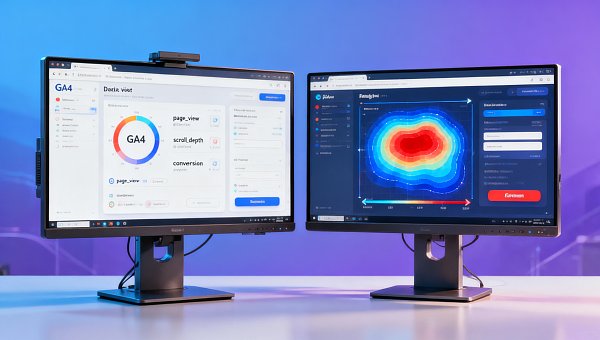
What exactly does GA4's linkage verification with heatmaps check?
The linkage is not simply a comparison of two numbers, but rather the construction of three layers of cross-validation:
- Page-level validation: GA4's page_view count vs. heatmap first-screen load completion rate (excluding "fake visits" caused by JS blocking);
- Behavioral-level validation: GA4's scroll_depth event trigger ratio vs. heatmap scrolling hotspot coverage area;
- Conversion-level validation: GA4 form submission event count vs. heatmap click density + mouse hover duration in the submit button area.
For example, when performing GEO optimization for a B2B auto parts website, we found that GA4 recorded 327 "inquiry form submissions", but the heatmap showed that the click density of the button area was only 0.3 times per thousand views. Further investigation confirmed that the error event was not reported after the form's JS validation failed, causing GA4 to misjudge the submission as successful.
In which scenarios is it necessary to initiate linked verification?
Not all pages require frequent verification. The following four types of high-value nodes are recommended to undergo closed-loop verification once a month:
How to quickly establish a verification SOP?
YiYingBao's self-developed AI+SEO/GEO optimization system has modularized the linkage verification process. Operators only need three steps:
- Enable the "Dual Source Verification Switch" in the cloud-based intelligent website building backend to automatically synchronize the GA4 configuration ID and heatmap acquisition code;
- Set a verification threshold (e.g., trigger an alarm if page_view deviation > 12% or button click density < 0.5 times/thousand times).
- View the "Deviation Attribution Report" generated by the system, which includes the location of tracking errors, JS conflict prompts, and repair suggestions.
This mechanism helped clients reduce the average data diagnostic cycle from 7.2 days to 1.4 days in 2023. It's worth noting that upgrading team capabilities is equally crucial— innovative strategies for enterprise talent resource development and management in the knowledge economy era emphasize that frontline operators need to possess "data semantic understanding," rather than simply being able to read reports.
After verification, what's the next step?
Verification is just the beginning. When a systematic deviation is found between GA4 and the heatmap, the following three types of root causes should be investigated first:
- Technical layer: Check whether "Scroll Depth" and "Video Viewing" are enabled in GA4 Enhanced Measurement, and confirm whether the Heatmap SDK is compatible with Chrome 120+ new privacy policy;
- Content layer: Compare the reading completion rate of AI-generated copy and human-written copy on heatmaps for pages with high bounce rates;
- Strategy layer: If the multilingual page heatmap shows that users frequently switch languages but GA4 does not record language events, the hreflang tag deployment logic needs to be reviewed.
Finally, a reminder: avoid "validation for validation's sake." The real goal is to let website traffic analysis return to the essence of the business—identifying which page truly carries the intent to initiate an inquiry, which copy actually drives the decision, and which channels bring in customer assets that can be retained. This is precisely the underlying logic of YiYingBao's ten-year commitment to "technological innovation + localized service": tools serve people, rather than people adapting to tools.
Related Articles



Related Products
 EasyCamp SaaS Smart Website Marketing SystemE-Yingbao SaaS Smart Website Marketing System: AI-powered, zero-code website building. Rapidly launch multilingual independent e-commerce sites in just 10 minutes. Global server acceleration and AI-driven SEO optimization empower businesses to efficiently connect with global markets. The seamless integration of technology and user-friendly operation makes building e-commerce sites incredibly simple.
 AI+SEM Intelligent Advertising Marketing SystemAI+SEM drives intelligent ad creation, empowering full-funnel precision advertising marketing. The system automatically generates weekly/monthly reports, AI recommends keywords and target countries, monitors core metrics in real-time with intelligent alerts, and enables one-click high-conversion ad solutions to help quickly acquire customers and improve ROI.
 AI+SEO Dual Engine Optimization ServiceEasyWin AI+SEO Dual Engine Optimization System leverages AI-powered keyword mining, content generation, and comprehensive technical optimization to help foreign trade enterprises acquire high-quality organic traffic, significantly improving search rankings and conversion rates.
 AI+SNS Social Media Marketing SystemYingbao AI+SNS Social Media Marketing System - Precision social capture for the social media era. Supports one-click content synchronization across major platforms like Facebook and LinkedIn. AI intelligently rewrites posts for enhanced relevance. 24/7 AI customer service and user profiling analysis empower businesses to efficiently expand into global markets.
 AI+SEO营销解决方案易营宝AI+SEO营销解决方案,通过AI批量写作、智能生成TDK、精准关键词扩词等功能,全面优化网站SEO效果,提升流量与转化率。助力企业构建高效智能网站新生态。
 AI+SEM Advertising Marketing SolutionsAI+SEM Advertising Marketing Solution leverages AI technology to deeply empower SEM ad campaigns. It automatically generates weekly/monthly reports using AI, presenting account data across multiple dimensions for comprehensive insights into campaign performance and trends. The system precisely recommends keywords and target countries, intelligently generates high-conversion ad copy, and enables one-click activation of efficient campaign plans to help businesses rapidly acquire customers. Simultaneously, it monitors core metrics in real time, intelligently identifies abnormal fluctuations, and issues timely alerts to ensure stable, high-return advertising results.
 Domain Name ServicesEasyWin provides professional domain name services, including intelligent queries, one-stop registration, brand protection, and full lifecycle management, helping businesses build a digital brand image.
 EasyOperate B2C Cross-Border E-Commerce Platform & Independent WebsiteEasyStore B2C Cross-border E-commerce Independent Store is an intelligent website building and cross-border e-commerce integrated solution independently developed by EasyStore Information Technology (Beijing) Co., Ltd. The system is specially designed for small and medium-sized as well as large export enterprises, integrating 'website building, operation, marketing, advertising, and conversion' into one, helping enterprises quickly establish cross-border e-commerce independent stores to achieve brand globalization and global sales growth.
The platform supports multiple languages, multiple currencies, and multi-channel marketing, with built-in AI intelligent translation and SEO optimization systems, suitable for mainstream markets such as Southeast Asia, Europe and America, Latin America, and the Middle East, assisting Chinese manufacturing enterprises in efficiently deploying international e-commerce strategies. SSL证书易营宝提供专业SSL安全证书服务,包括单域名和泛域名证书,确保网站数据传输加密、身份验证和完整性保护,助力企业建立安全可信的在线业务环境。









