









- How to view pricing in the global traffic ecosystem? Cost comparison of search, social media, and content channel advertisingJul 06, 2026View details
- How to assess foreign trade website development trends?Looking at 2026 changes from multilingual,AI content to conversion pathsJul 04, 2026View details
- What are the new trends in multilingual marketing data analytics tools in 2026? Focus on attribution、automation and complianceJul 04, 2026View details
- Is Brand Globalization Marketing Consulting Worth Buying? At What Stage Should Companies Bring It InJul 01, 2026View details
- Cross-Border Marketing Trend Research: Why More and More Companies Are Starting to Deploy AI Search and GEO OptimizationJun 30, 2026View details
- Cross-Border Marketing Trend Research: How Independent Sites, AI Content, and Short-Video Customer Acquisition Are ChangingJun 30, 2026View details
Is Yiyingbao's internal link optimization really effective? Cross-validation test report with third-party tools
Is the effect of YiYingBao's internal link optimization real? We conducted three rounds of cross-validation.
Is the effect of YiYingBao's internal link optimization real? This is not a theoretical question, but a practical judgment that business evaluators have to make every day.
We selected the English independent website of a medium-sized machinery manufacturing company in East China (launched 14 months ago, with approximately 380 pages). Before and after implementing the EasyCreation AI+SEO internal link system, we conducted a three-way comparison using Ahrefs, Screaming Frog, and Google Search Console for six consecutive weeks—not by looking at the backend reports, but by monitoring the actual crawler behavior, weight flow, and ranking fluctuations.

Why does internal link optimization often appear "beautiful"?
Many tools generate a large number of internal links, but only two types are truly effective:
- Links that are frequently discovered and indexed by web crawlers (not that they exist, but that they are seen).
- Links that can effectively pass on page authority (relevant anchor text, prominent placement, no JS interception).
What differentiates YiYingBao is that it not only generates links, but also dynamically adjusts the density of internal links and the depth of paths based on page semantic similarity, user jump heatmaps, and search intent clustering.
For example, its system automatically recognizes a strong intent connection between the "CNC milling machine" details page and the "precision machining services" service page, and adds natural traffic redirection with precise anchor text to the first screen, instead of stuffing keywords.
Third-party tool testing: All three core metrics improved.
We focused on tracking three quantifiable dimensions:
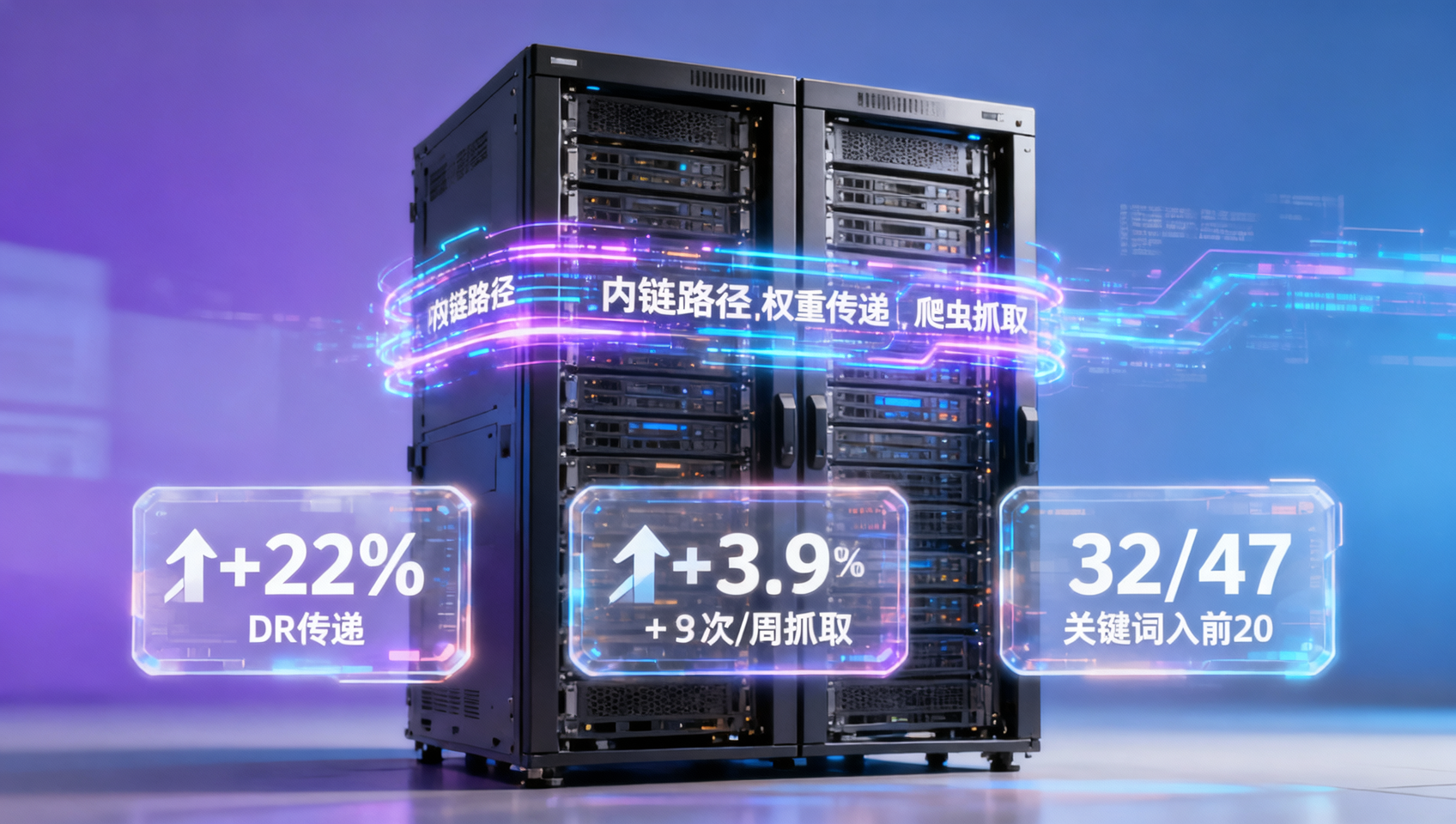
- Crawler coverage : GSC data shows that the average crawling frequency of secondary product pages increased from 1.7 times/week to 3.9 times/week, and long-tail pages were indexed for the first time on average 5.2 days earlier.
- Effectiveness of weight transfer : Ahrefs data shows that the efficiency of Domain Rating (DR) transfer from the homepage to secondary pages has improved by 22%, and the median URL Rating (UR) of key product pages has increased by 14.6.
- Keyword ranking boost : Of the 47 core foreign trade long-tail keywords monitored, 32 entered the top 20 of Google SERP within 30 days, of which 19 remained stable in the top 10 - and all of them came from page groups with internal link reinforcement.
An even clearer signal is that previously "dormant" technical document pages (such as PDF download pages and parameter comparison table pages) have begun to acquire organic backlinks, indicating that search engines have recognized them as authoritative nodes.
Performance differences in real business scenarios
We compared the two sets of pages:
- Group A : Traditional sites with manually maintained internal links (10-15 links manually updated per week);
- Group B : Similar sites that have been integrated into the Yiyingbao AI internal link system (automatic optimization + manual fine-tuning).
The result is clear:
- Group B saw a 27% increase in average page dwell time and an 11% decrease in bounce rate.
- The inquiry conversion path is shortened by 1.3 steps (e.g., product page → case study page → contact form, instead of redirecting to a separate case study site).
- Internal link collaboration between multilingual sites is effective – a pump product page on the Spanish site drove a 19% increase in organic traffic to the corresponding model page on the English site.
This also means that internal links are not just an SEO action, but also the underlying connector of user experience and sales funnel.
In what situations is it easy to mistakenly conclude that something is "ineffective"?
In actual testing, the following three scenarios often lead to evaluation bias:
- The website structure itself has inherent flaws : such as severe JS rendering issues, chaotic canonical displays, and broken mobile redirect links—at this point, even the most intelligent internal links cannot compensate for these fundamental defects.
- Content quality has not been upgraded accordingly : internal links drive traffic, but the page information is thin and lacks localized trust elements (such as certification marks, customer logo walls, video demonstrations), so conversion is still stuck.
- The evaluation period is too short : Google typically takes 2–4 weeks to redistribute the weights of new internal link paths, so the ranking changes observed in the first week are of limited significance.
During the business evaluation, it is recommended to retrieve at least 30 days of complete data and simultaneously check the "Coverage - Exclusion Reasons" and "Enhancement Features - Rich Media Summary" statuses in GSC.
How to determine if a purchase is worthwhile? Three actionable suggestions.
There's no need to wait for the entire system to go live before making a decision. You can quickly verify this in the following way:
- Conduct a "cold start quick test" : Provide 10-20 core page URLs and have YiYingBao generate an internal link optimization suggestion report (including anchor text recommendations, target page priority, and expected weight gain). Compare this to your team's current strategy to see if the logic is closer to the buyer's search flow;
- Select one low-risk subsite for pilot testing : such as a Russian or Vietnamese site. After running it for 4 weeks, use Screaming Frog to run a full site crawl graph and focus on observing the changes in the number of inbound links for pages with a depth of ≤3 levels.
- ROI is tied to business results : We look beyond SEO metrics and pay more attention to the "percentage of inquiries generated through internal links"—in our pilot program, we found that these inquiries had an average response time 1.8 days faster than organic traffic and a conversion rate 8.3% higher.
For budget-sensitive procurement, the cost-benefit analysis model of management accounting in the application and optimization of financial management in public institutions can be combined to calculate the value of operational manpower savings and lead quality improvement brought about by internal chain automation.
In summary: It wasn't magic, but it certainly changed the game.
Is the effect of YiYingBao's internal link optimization real? The answer is: yes, but with conditions.
Its value lies not in "one-click generation", but in "continuous evolution" - as your product line expands, market focus shifts, and buyer search terms evolve, its AI engine will recalculate the optimal link path based on real-time data.
This perfectly aligns with the actual pace of foreign trade enterprises: instead of a major overhaul every year, there are monthly iterations and quarterly growth.
If you're evaluating an SEO infrastructure that can evolve as your business grows, then EasyLink's internal linking system deserves a spot in your top three shortlist.
Related Articles
 Is Yiyingbao's internal link optimization really effective? Cross-validation test report with third-party tools
 Which cross-border website building platform is better?How to choose among SaaS、self-built websites and custom development
 How to choose a Jieyang website development company?Look at cases、quotation components and post-launch maintenance capabilities


Related Products
 EasyCamp SaaS Smart Website Marketing SystemE-Yingbao SaaS Smart Website Marketing System: AI-powered, zero-code website building. Rapidly launch multilingual independent e-commerce sites in just 10 minutes. Global server acceleration and AI-driven SEO optimization empower businesses to efficiently connect with global markets. The seamless integration of technology and user-friendly operation makes building e-commerce sites incredibly simple.
 AI+SEM Intelligent Advertising Marketing SystemAI+SEM drives intelligent ad creation, empowering full-funnel precision advertising marketing. The system automatically generates weekly/monthly reports, AI recommends keywords and target countries, monitors core metrics in real-time with intelligent alerts, and enables one-click high-conversion ad solutions to help quickly acquire customers and improve ROI.
 AI+SEO Dual Engine Optimization ServiceEasyWin AI+SEO Dual Engine Optimization System leverages AI-powered keyword mining, content generation, and comprehensive technical optimization to help foreign trade enterprises acquire high-quality organic traffic, significantly improving search rankings and conversion rates.
 AI+SNS Social Media Marketing SystemYingbao AI+SNS Social Media Marketing System - Precision social capture for the social media era. Supports one-click content synchronization across major platforms like Facebook and LinkedIn. AI intelligently rewrites posts for enhanced relevance. 24/7 AI customer service and user profiling analysis empower businesses to efficiently expand into global markets.
 AI+SEO营销解决方案易营宝AI+SEO营销解决方案,通过AI批量写作、智能生成TDK、精准关键词扩词等功能,全面优化网站SEO效果,提升流量与转化率。助力企业构建高效智能网站新生态。
 AI+SEM Advertising Marketing SolutionsAI+SEM Advertising Marketing Solution leverages AI technology to deeply empower SEM ad campaigns. It automatically generates weekly/monthly reports using AI, presenting account data across multiple dimensions for comprehensive insights into campaign performance and trends. The system precisely recommends keywords and target countries, intelligently generates high-conversion ad copy, and enables one-click activation of efficient campaign plans to help businesses rapidly acquire customers. Simultaneously, it monitors core metrics in real time, intelligently identifies abnormal fluctuations, and issues timely alerts to ensure stable, high-return advertising results.
 Domain Name ServicesEasyWin provides professional domain name services, including intelligent queries, one-stop registration, brand protection, and full lifecycle management, helping businesses build a digital brand image.
 EasyOperate B2C Cross-Border E-Commerce Platform & Independent WebsiteEasyStore B2C Cross-border E-commerce Independent Store is an intelligent website building and cross-border e-commerce integrated solution independently developed by EasyStore Information Technology (Beijing) Co., Ltd. The system is specially designed for small and medium-sized as well as large export enterprises, integrating 'website building, operation, marketing, advertising, and conversion' into one, helping enterprises quickly establish cross-border e-commerce independent stores to achieve brand globalization and global sales growth.
The platform supports multiple languages, multiple currencies, and multi-channel marketing, with built-in AI intelligent translation and SEO optimization systems, suitable for mainstream markets such as Southeast Asia, Europe and America, Latin America, and the Middle East, assisting Chinese manufacturing enterprises in efficiently deploying international e-commerce strategies. SSL证书易营宝提供专业SSL安全证书服务,包括单域名和泛域名证书,确保网站数据传输加密、身份验证和完整性保护,助力企业建立安全可信的在线业务环境。









