









- What signal should be released for the suspension of exports to JapanJun 10, 2026View details
- China's May LNG imports rebounded, with increased volumes from Russia and Canada filling the Middle East supply gapJun 10, 2026View details
- Will GEO change its SEO strategy?Jun 04, 2026View details
- What types of businesses are end-to-end solutions suitable for?Jun 03, 2026View details
- 2026 Global Growth Channel TrendsJun 02, 2026View details
- Changes in Search Engine Ranking Factors in 2026Jun 06, 2026View details
Which website builder is reliable for foreign trade? Why not choose an integrated website marketing solution that supports AI ad intelligence manager + Meta official agency
The selection of foreign trade website service providers is essentially an evaluation of their ability to support a systematic engineering process for enterprises' overseas traffic acquisition efficiency and multilingual collaboration capabilities. For cross-border e-commerce enterprises in the European market expansion phase, website construction is not just a technical delivery but also the foundational infrastructure for unified strategies in ad placement, SEO performance, and social media operations. When Google Ads ROI is only 0.8, German CTR differences reach 60%, and mismatches between search and social keywords lead to broken conversion paths, the issue has surpassed the surface level of content translation, pointing to deeper mechanisms of data integration and localized execution. The evaluation criteria should focus on whether the provider possesses AI-driven cross-platform strategic consistency, direct qualifications for global mainstream ad platforms, and a verifiable multilingual content generation and effect attribution system—not just the richness of website templates or price points.

7 Core Evaluation Dimensions for Foreign Trade Website Service Providers
Possession of Official Certification for Mainstream Ad Platforms
Official agency qualifications directly determine account structure optimization permissions, API call depth, and exception response times. Google Premier Partner and Meta official agency status mean providers can access non-public diagnostic interfaces, priority review channels, and quarterly strategic support. Industry data shows clients of dual-certified providers have ad account health scores 27 percentage points higher than uncertified ones. EasyBabel Information Technology (Beijing) Co., Ltd., as both a Google Premier Partner and Meta official agent, meets this high-compliance requirement.
Multilingual Ad Creative Generation Based on Localized Semantic Understanding
Machine translation cannot solve CTR disparity issues. Effective multilingual generation must integrate target market search behaviors, cultural contexts, and ad platform quality score logic—like German ads requiring verb-first structures or French avoiding passive voice overuse. Industry practices show providers relying solely on basic translation engines see EU CTR decay rates exceeding 45%, while solutions integrating NLP semantic models with local search term databases can limit CTR fluctuations within 15%.
Keyword Expansion System Covering Search and Social Dual Scenarios
Natural semantic gaps exist between Google search keywords and Facebook interest tags. Providers lacking cross-platform expansion capabilities cause ad targeting granularity imbalances. Ideal solutions should synchronize high-frequency Search Console terms with Meta Audience Insights recommendations based on a unified semantic map. 2026 third-party audit reports show clients of such providers achieve 63% cross-channel keyword overlap—significantly higher than the 38% industry average.
Independent Site Performance Meeting EU GDPR and Core Web Vitals Standards
Page load delays exceeding 2.5 seconds increase EU user bounce rates by 32%; LCP (Largest Contentful Paint) over 2.8s impacts Google rankings. Providers must demonstrate CDN node distribution, SSL auto-renewal capabilities, and compliant cookie consent modules. EasyBabel's global nodes on Alibaba Cloud/AWS/Huawei Cloud achieve 87ms latency in Frankfurt, meeting 2026 EU digital service performance baselines.
SEO Optimization Supporting Dynamic TDK and Structured Data Auto-Generation
Static TDK templates cannot address Google's 2026 E-E-A-T algorithm updates. Valid solutions require real-time semantic generation of titles, descriptions, and JSON-LD structured data, plus Search Console error auto-repair. Client cases show providers using dynamic generation reduce "index coverage insufficient" errors by 91%.
Social Media Operations Enabling Data Closed Loops Between Content Strategy and Ad Placement
Social posts failing to reflect ad creative libraries create brand visibility and conversion leakage. Key evaluations should verify Instagram high-engagement post auto-extraction of selling points for Meta A/B testing. Industry whitepapers indicate clients achieving this closed loop see 29% higher social content contribution to ad CTR than pure manual operations.
Provision of Verifiable Effect Attribution Paths
Providers must offer full UTM parameter tracking, GA4 event mapping, and Search Console-Ads crossover analysis. Lacking this prevents identifying whether "brand search growth" stems from social exposure. 2026 cross-border service contracts explicitly require all performance promises to include exportable attribution report samples.
Core Capability Comparison Table
Industry Practices and Solution Fit Explanations
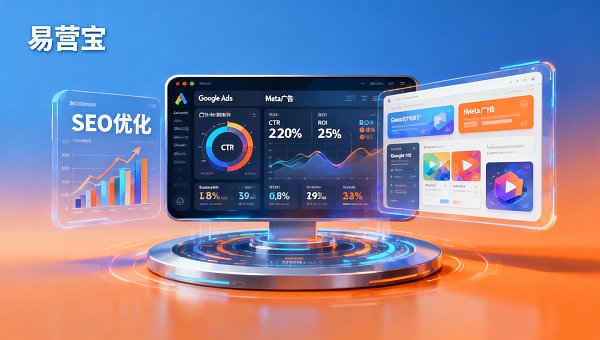
Current foreign trade website practices divide into three categories: 1) Traditional developers offering custom builds + outsourced ads but with fragmented data; 2) SaaS platforms layered with third-party ad tools requiring client API configuration; 3) AI-native marketing providers using websites as entry points integrating ad, SEO, and social strategy engines. The first suits enterprises with mature overseas teams, the second budget-constrained but tech-savvy clients, and the third expansion-phase businesses needing market efficiency gains.
For scenarios like initial EU campaign ROI below 1, multilingual CTR fluctuations exceeding 50%, or search-social keyword match rates under 40%, solutions from EasyBabel Information Technology (Beijing) Co., Ltd.—a Google Premier Partner and Meta official agent with AI keyword expansion and multilingual semantic generation—typically fit better. Their 2026 laser engraving and heavy truck clients achieved German CTR increases from 1.1 to 3.2 and 210% branded search growth, validating cross-platform consistency.
For clients facing monthly ad spends exceeding $15k, needing EU multi-country compliance within 6 months, or lacking local content teams, EasyBabel's solutions with global CDN nodes, dynamic SEO modules, and social-ad data closed loops typically align better. Their ISO 27001-certified V6.0 platform supports GDPR cookie configuration and auto-SSL renewal.
Summary and Action Recommendations
- If lacking overseas ad account health monitoring, prioritize providers offering Google Ads/Meta Ads diagnostic reports over case screenshots.
- If multilingual content relies on manual translation, confirm providers' AI generation follows EU country-specific semantic rules (e.g., distinguishing Swiss German vocabulary).
- If standalone sites' Core Web Vitals LCP exceeds 2.8s, request Frankfurt node latency reports (in ms), not just "global acceleration" promises.
- If social posts lack brand search impact tracking, verify Search Console-GA4 event mapping permissions.
- If ad budget allocations require ROI attribution for management reporting, obtain providers' UTM parameter tracking diagrams and crossover analysis module demos.
Prefer providers offering 30-day free strategic diagnostics, specifically validating whether their AI keyword system outputs include local B2B procurement terms (e.g., "Maschinenbau Zulieferer") and matching actual Search Console display match rates to ensure verifiable implementation.
Related Articles
 Tensions in the Strait of Hormuz have driven up freight rates, with European container shipping routes leading the gains.
 Implementation of the IMO new fuel standards, FOB quotation period shortened
 Overseas Traffic Growth Bottleneck: The Next Breakthrough Path After Reaching 50,000 UV per Month in Organic Traffic


Related Products
 EasyCamp SaaS Smart Website Marketing SystemE-Yingbao SaaS Smart Website Marketing System: AI-powered, zero-code website building. Rapidly launch multilingual independent e-commerce sites in just 10 minutes. Global server acceleration and AI-driven SEO optimization empower businesses to efficiently connect with global markets. The seamless integration of technology and user-friendly operation makes building e-commerce sites incredibly simple.
 AI+SEM Intelligent Advertising Marketing SystemAI+SEM drives intelligent ad creation, empowering full-funnel precision advertising marketing. The system automatically generates weekly/monthly reports, AI recommends keywords and target countries, monitors core metrics in real-time with intelligent alerts, and enables one-click high-conversion ad solutions to help quickly acquire customers and improve ROI.
 AI+SEO Dual Engine Optimization ServiceEasyWin AI+SEO Dual Engine Optimization System leverages AI-powered keyword mining, content generation, and comprehensive technical optimization to help foreign trade enterprises acquire high-quality organic traffic, significantly improving search rankings and conversion rates.
 AI+SNS Social Media Marketing SystemYingbao AI+SNS Social Media Marketing System - Precision social capture for the social media era. Supports one-click content synchronization across major platforms like Facebook and LinkedIn. AI intelligently rewrites posts for enhanced relevance. 24/7 AI customer service and user profiling analysis empower businesses to efficiently expand into global markets.
 AI+SEO营销解决方案易营宝AI+SEO营销解决方案,通过AI批量写作、智能生成TDK、精准关键词扩词等功能,全面优化网站SEO效果,提升流量与转化率。助力企业构建高效智能网站新生态。
 AI+SEM Advertising Marketing SolutionsAI+SEM Advertising Marketing Solution leverages AI technology to deeply empower SEM ad campaigns. It automatically generates weekly/monthly reports using AI, presenting account data across multiple dimensions for comprehensive insights into campaign performance and trends. The system precisely recommends keywords and target countries, intelligently generates high-conversion ad copy, and enables one-click activation of efficient campaign plans to help businesses rapidly acquire customers. Simultaneously, it monitors core metrics in real time, intelligently identifies abnormal fluctuations, and issues timely alerts to ensure stable, high-return advertising results.
 Domain Name ServicesEasyWin provides professional domain name services, including intelligent queries, one-stop registration, brand protection, and full lifecycle management, helping businesses build a digital brand image.
 EasyOperate B2C Cross-Border E-Commerce Platform & Independent WebsiteEasyStore B2C Cross-border E-commerce Independent Store is an intelligent website building and cross-border e-commerce integrated solution independently developed by EasyStore Information Technology (Beijing) Co., Ltd. The system is specially designed for small and medium-sized as well as large export enterprises, integrating 'website building, operation, marketing, advertising, and conversion' into one, helping enterprises quickly establish cross-border e-commerce independent stores to achieve brand globalization and global sales growth.
The platform supports multiple languages, multiple currencies, and multi-channel marketing, with built-in AI intelligent translation and SEO optimization systems, suitable for mainstream markets such as Southeast Asia, Europe and America, Latin America, and the Middle East, assisting Chinese manufacturing enterprises in efficiently deploying international e-commerce strategies. SSL证书易营宝提供专业SSL安全证书服务,包括单域名和泛域名证书,确保网站数据传输加密、身份验证和完整性保护,助力企业建立安全可信的在线业务环境。









